
Chef Juliette
John Dory (St. Pierre)
John Dory has the delicacy of sole and the firmness of turbot. A light flouring, a quick butter sauté, and nut-brown beurre noisette show exactly why looks never mattered.
A cooking platform built around craft, culture, and the stories behind what we eat.
Created by Chef Juliette
Based on No. 1788, Suprêmes de Pigeonneaux à la Marigny, from Le Guide Culinaire (1907) by Auguste Escoffier
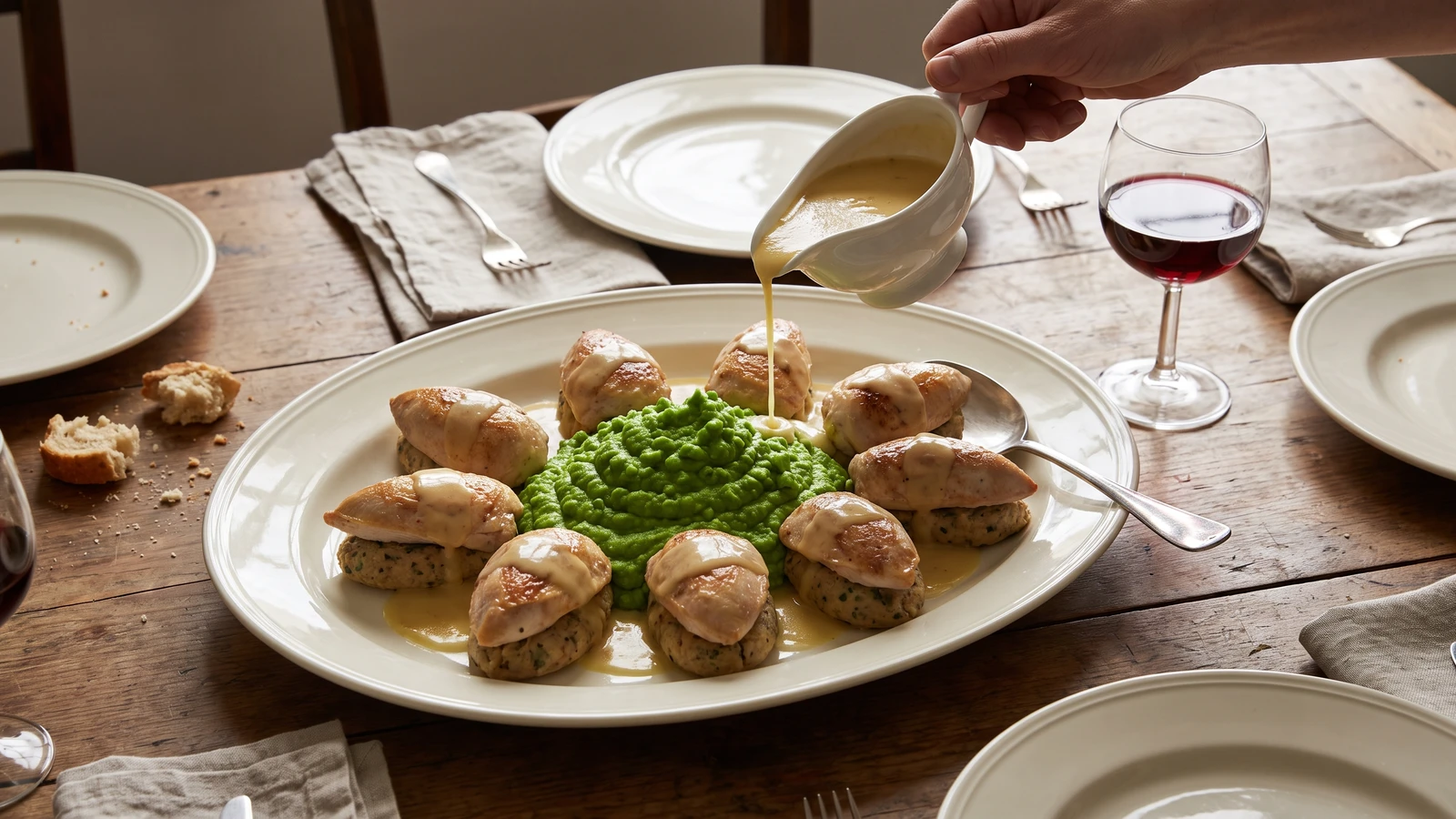
Just-cooked squab suprêmes sit on tender ovals of their own leg forcemeat around green pea purée, all bound by bacon-scented cooking juices and an essence-enriched velouté.
Suprêmes de Pigeonneaux à la Marigny (squab breast fillets on leg-meat forcemeat with pea purée and velouté) teaches control across two cookings. The breasts are poêlé under bacon only until shy of done, because their brief oven finish is not reheating, it is the second half of the cook. Know that before touching the pan and the dish falls into place.
The original assumed a saucier on staff, stock never off the fire, a salamander ready for the final pass, and enough hands to bone legs while another cook watched the sauce. This home version keeps Poëlings (No. 250) and Gratins (No. 268) as the finished cross-referenced preparations the book intended, then replaces the brigade traffic with one small casserole, one saucepan, a food processor, and a hot oven. Good unsalted poultry stock stands in for the perpetual stockpot, and a paper template replaces the oval cutter if you don't own one. Separate cooks and holding pans are scaffolding, so they go. Leg meat made into mousseline forcemeat, bacon protecting the breasts, pea purée at the centre, and pigeon essence folded into velouté are the dish, so they stay.
One cook, one stove, one evening. Keep the mousseline cold, but guard the breast temperature above all: stop the poëling at 145 to 150°F (63 to 66°C), then let the assembled oven finish carry the meat safely to 165°F (74°C). Cook the breasts fully the first time and no sauce can return their tenderness.
Suprêmes de Pigeonneaux à la Marigny belongs to the Parisian classical table, where à la Marigny identifies a fixed composition rather than a province: squab, pea purée, forcemeat supports, and velouté deepened with pigeon essence. Pigeon traveled easily between bourgeois home tables and formal kitchens because one bird made a neat individual portion, while disciplined cooks turned its legs and carcass into structure and sauce instead of waste. Marigny is therefore not a regional pigeon recipe dressed in borrowed local color; its identity lies in the composed garnish and in using the whole bird.
Quantity
4 birds (about 1 to 1¼ lb / 450 to 550 g each)
legs removed and boned for forcemeat; breasts left on the carcasses
Quantity
2 teaspoons (10 ml / 12 g)
divided
Quantity
¾ teaspoon (3.75 ml / 1.5 g)
divided
Quantity
1
Quantity
⅔ cup (160 ml / 160 g)
very cold
Quantity
½ cup (120 ml / 113 g)
divided
Quantity
1 home-scale preparation Poëlings (No. 250)
scaled for 4 squab bodies; all cooking liquor reserved
Quantity
8 slices (about 4 oz / 115 g)
Quantity
2 tablespoons (30 ml / 30 g) from Gratins (No. 268)
Quantity
4 cups (950 ml / 600 g)
Quantity
4 cups (950 ml / 950 g)
divided
Quantity
¼ cup (60 ml / 30 g)
| Ingredient | Quantity |
|---|---|
| whole young squablegs removed and boned for forcemeat; breasts left on the carcasses | 4 birds (about 1 to 1¼ lb / 450 to 550 g each) |
| fine sea saltdivided | 2 teaspoons (10 ml / 12 g) |
| finely ground white pepperdivided | ¾ teaspoon (3.75 ml / 1.5 g) |
| large egg white | 1 |
| heavy creamvery cold | ⅔ cup (160 ml / 160 g) |
| unsalted butterdivided | ½ cup (120 ml / 113 g) |
| prepared poëling setup for the squabscaled for 4 squab bodies; all cooking liquor reserved | 1 home-scale preparation Poëlings (No. 250) |
| very thin unsmoked bacon | 8 slices (about 4 oz / 115 g) |
| prepared gratin forcemeat for bonding | 2 tablespoons (30 ml / 30 g) from Gratins (No. 268) |
| freshly shelled or frozen peas | 4 cups (950 ml / 600 g) |
| unsalted poultry or light veal stockdivided | 4 cups (950 ml / 950 g) |
| all-purpose flour | ¼ cup (60 ml / 30 g) |
Cut the legs from the squab, leaving the breast meat attached to each carcass. Bone the legs carefully, remove every hard tendon, and dice the meat; you should have about 7 oz (200 g). Spread it on a plate and chill it with the food-processor bowl and blade for 15 minutes. Keep the breast-bearing carcasses cold. Mousseline forcemeat depends on cold meat binding cold cream, and warmth is its first enemy.
Process the cold leg meat with 1 teaspoon of the salt and ¼ teaspoon of the white pepper until it becomes smooth and tacky. Add the egg white and process only until absorbed. With the machine pulsing, add the cold cream gradually, holding back 2 tablespoons, and stop as soon as the paste is smooth, glossy, and firm enough to hold a spoon mark. Press it through a fine sieve, then poach a teaspoon in barely simmering water and taste for seasoning. If the paste turns loose or greasy, stop processing and set the bowl over ice; work in the reserved cold cream a teaspoon at a time until it gathers again. Ça se rattrape. Chill the finished mousseline while the oven heats.
Heat the oven to 300°F (150°C). Butter an 8-inch (20 cm) square metal pan with 1 tablespoon of the measured butter, spread the mousseline about ⅜ inch (1 cm) thick, and cover its surface with buttered parchment. Set the pan in a larger roasting pan and add hot water to come halfway up its sides. Bake until the forcemeat is just set and reaches 165°F (74°C), about 12 to 16 minutes. Cool for 5 minutes, then cut 8 ovals the size of the breasts. An oval cutter is convenient, not sacred; trace one breast on parchment and use that template with a small knife if needed.
Cook the peas in well-salted boiling water until tender and brilliantly green, 3 to 5 minutes depending on whether they are frozen or fresh. Drain thoroughly, then blend with 3 tablespoons of the butter and up to ¼ cup (60 ml) of the stock. Pass the purée through a fine sieve, season with salt and white pepper, and keep it covered over barely warm water. It should stand in a soft pyramid without looking stiff. If it slumps, cook it gently for a minute to shed moisture; if it becomes dense, loosen it with stock one spoonful at a time.
Make a roux blanc (white roux): melt 2 tablespoons of the butter in a saucepan, stir in the flour, and cook gently for 2 minutes without letting it color. Whisk in 2½ cups (590 ml) of the stock a little at a time, scraping into every corner so no flour hides there. Hold the velouté at a bare simmer for 20 minutes, skimming as needed, until it coats the back of a spoon in a thin, even layer. If it is lumpy, strain it. If it tightens before the pigeon essence is ready, loosen it with a little stock and keep it warm.
Heat the oven to 375°F (190°C). Season the squab lightly, then drape 2 bacon slices over the breast of each bird. Using the prepared Poëlings (No. 250), poêle the 4 bodies in the smallest suitable covered casserole, basting as directed and adding no liquid during the cooking. Begin checking after 10 minutes and remove the birds when the thickest part of each breast reaches 145 to 150°F (63 to 66°C), usually after 12 to 16 minutes. They are not ready to serve yet. If a breast reaches 160°F (71°C), remove it immediately and keep it out of the warm casserole; use the shortest possible final oven pass later.
Remove and discard the bacon. Quickly raise the 8 suprêmes from the carcasses and peel away their skin, then cover them loosely. Chop the warm carcasses with poultry shears and return them to the poëling vessel with all the cooking liquor produced by Poëlings (No. 250). Add 1 cup (240 ml) of the stock and simmer gently for 10 minutes before removing the fat, because the stock needs that contact with the butter and browned remains to recover their flavor. Strain, skim carefully, and reduce the essence to about ½ cup (120 ml). Whisk it into the velouté, simmer until the sauce naps the spoon, then remove it from the heat and whisk in the remaining 2 tablespoons butter. If the sauce separates into greasy beads, whisk a tablespoon of warm stock in a clean saucepan and add the broken sauce gradually. Ça se rattrape.
Raise the oven to 425°F (220°C). Arrange the 8 mousseline ovals on a lightly buttered baking dish and spread each with a thin layer of the prepared gratin forcemeat from Gratins (No. 268). Set one suprême on each oval and press just firmly enough to bond them. Bake for 4 to 7 minutes, until the bonding forcemeat is poached and the centre of each breast reaches 165°F (74°C). If a breast slides, lift it, add another thin dab of gratin forcemeat, and return it to the oven for a minute or two.
Spoon the hot pea purée into a broad pyramid at the centre of a warmed oval platter. Arrange the 8 mounted suprêmes around it, breast sides uppermost, and coat them generously with the pigeon-enriched velouté, letting a little sauce pool around the forcemeat ovals. Serve the remaining sauce alongside. This is formal food, but it should still arrive generously and be eaten while the sauce gleams. À table!
1 serving (about 500g)
Culinary guides, cultural storytelling, and the editorial depth that makes cooking meaningful.
Discover Culinary ExplorerChef Juliette
John Dory has the delicacy of sole and the firmness of turbot. A light flouring, a quick butter sauté, and nut-brown beurre noisette show exactly why looks never mattered.

Chef Juliette
Fresh haddock proves its delicacy in the meunière pan: a fine flour crust, moist pearly flakes, and beurre noisette sharpened with lemon and parsley, ready from one skillet in half an hour.

Chef Juliette
Éperlans à l’Anglaise turns small fish into a lesson in disciplined coating: boned smelts under a close, crisp crumb, pan-fried in clarified butter and finished with bright, half-melted maître d’hôtel butter.

Chef Juliette
Tiny smelts, shallot, mushrooms, white wine, gratin sauce, and fine bread raspings meet a fierce oven, where the fish must turn tender in the same breath the buttered crust bronzes.