
Chef Juliette
John Dory (St. Pierre)
John Dory has the delicacy of sole and the firmness of turbot. A light flouring, a quick butter sauté, and nut-brown beurre noisette show exactly why looks never mattered.
A cooking platform built around craft, culture, and the stories behind what we eat.
Created by Chef Juliette
Based on No. 1787, Suprêmes de Pigeonneaux à la Saint-Clair, from Le Guide Culinaire (1907) by Auguste Escoffier
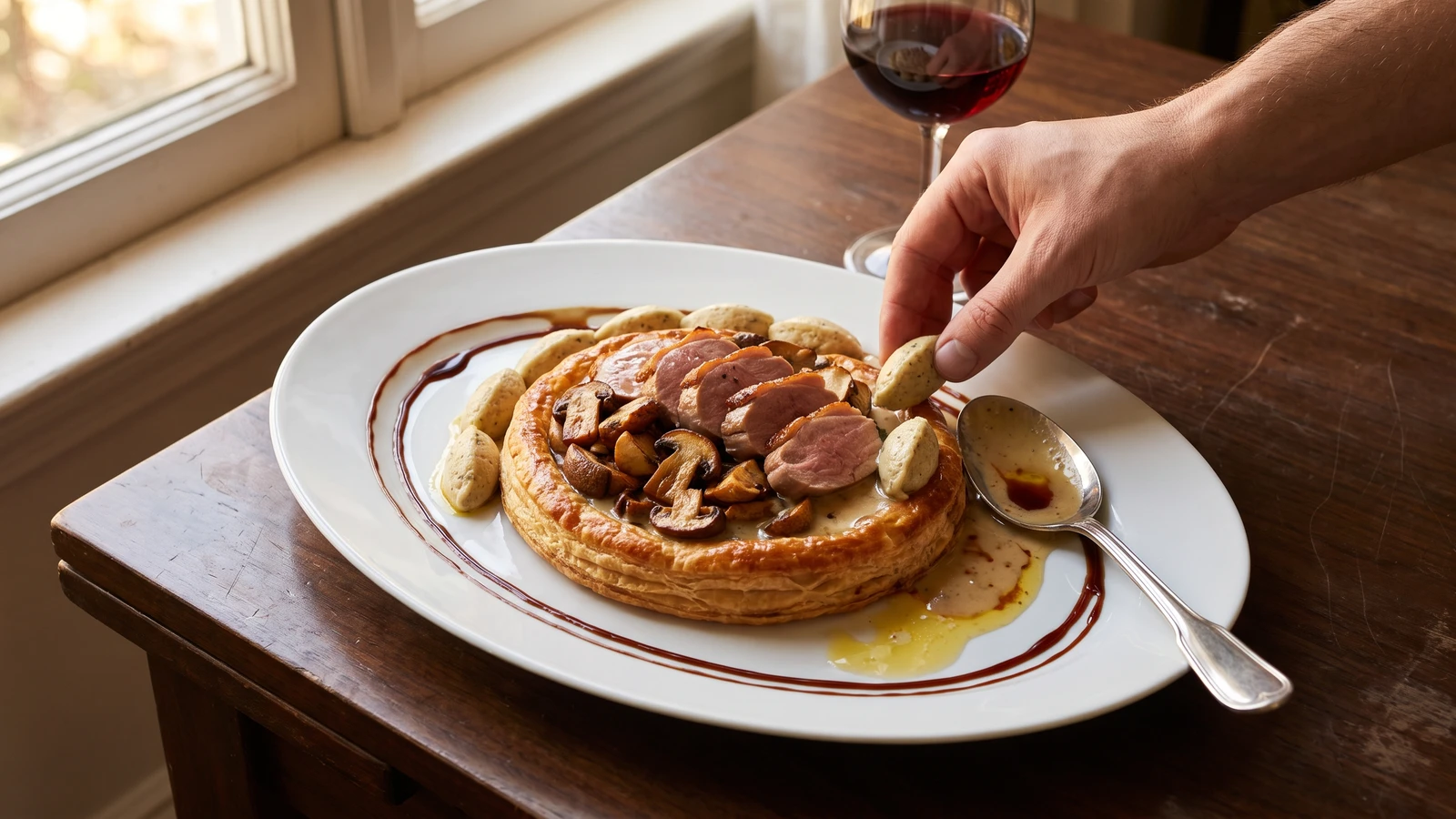
Rose squab breasts over buttered cèpes, ringed with olive-size mousseline quenelles and onion velouté in a crisp croustade, a precise lesson in pale poêling, sauce work, and timing.
Suprêmes de Pigeonneaux à la Saint-Clair (Saint-Clair squab breasts) teaches the discipline of pale cooking. The pigeon must remain rose, the onions must soften without taking colour, and the finished sauce must taste of the bird and its butter rather than a browned pan. This is poêler, to cook gently in butter under cover. The one true thing to know before touching the pan is simple: browning, usually our ally, changes the character of this dish completely.
The original kitchen assumed a saucier on staff, stock never off the fire, a tammy for sieving, a drying box for Croûtes et Croustades (No. 2393), and a salamander ready for neighboring dishes, though Saint-Clair itself asks for no gratin finish. At home, one saucepan builds the velouté, good unsalted poultry stock replaces the perpetual stockpot, a processor and fine sieve replace the tammy, and a low oven refreshes the finished croustade. Poëlings (No. 250) becomes a covered, butter-rich oven cooking in a pan just large enough for four breast crowns. One cook, one stove, one evening.
The brigade's extra holding pans and spare hands were scaffolding, so they can go. The separate leg mousseline, its olive-size quenelles, the pale onion bed, the pyramid of buttered cèpes, and the thread of glace de viande must stay, because they are the dish. Watch the onions and the breast temperature above everything else: pale and underdone is the narrow gate through which Saint-Clair passes.
Suprêmes de Pigeonneaux à la Saint-Clair belongs to the French grand-kitchen register of named garnitures, the codified service carried through Parisian dining rooms and hotel brigades. Saint-Clair identifies this exact composition rather than a broad regional pigeon style: pale poêled breasts, leg-meat quenelles, cèpes, onion velouté, meat glaze, and a shallow croustade. Pigeon was familiar dovecote food across France, but pastry, sieved sauce, and the ordered ring of quenelles moved it from the roast platter into composed dining-room service.
Quantity
4, about 1 lb each (1.8 kg total), for Poëlings (No. 250)
legs removed and breasts left on the crowns
Quantity
6 packed cups (1.4 L / 600 g)
thinly sliced
Quantity
9 tablespoons (135 ml / 128 g)
divided
Quantity
1
Quantity
1/2 cup (120 ml / 120 g)
very cold and divided
Quantity
3 cups (720 ml / 720 g)
divided
Quantity
3 tablespoons (45 ml / 24 g)
Quantity
6 cups sliced (1.4 L / 500 g)
brushed clean and thoroughly dried
Quantity
1 shallow shell, about 9 in (23 cm) across
baked and thoroughly dried
Quantity
3 tablespoons (45 ml / 55 g)
warmed
Quantity
2 teaspoons (10 ml / 12 g)
divided
Quantity
1 teaspoon (5 ml / 2 g)
divided
| Ingredient | Quantity |
|---|---|
| young pigeons or farmed squablegs removed and breasts left on the crowns | 4, about 1 lb each (1.8 kg total), for Poëlings (No. 250) |
| yellow onionsthinly sliced | 6 packed cups (1.4 L / 600 g) |
| unsalted butterdivided | 9 tablespoons (135 ml / 128 g) |
| large egg white | 1 |
| heavy creamvery cold and divided | 1/2 cup (120 ml / 120 g) |
| unsalted poultry stockdivided | 3 cups (720 ml / 720 g) |
| all-purpose flour | 3 tablespoons (45 ml / 24 g) |
| fresh or thawed frozen cèpes (porcini)brushed clean and thoroughly dried | 6 cups sliced (1.4 L / 500 g) |
| Croûtes et Croustades (No. 2393)baked and thoroughly dried | 1 shallow shell, about 9 in (23 cm) across |
| glace de viande (meat glaze)warmed | 3 tablespoons (45 ml / 55 g) |
| fine saltdivided | 2 teaspoons (10 ml / 12 g) |
| ground white pepperdivided | 1 teaspoon (5 ml / 2 g) |
Separate the legs without cutting into the breast crowns. Skin and bone the legs, trim away every visible tendon, and cut the meat into small pieces. Keep this meat, the processor bowl, and its blade thoroughly cold. Trim the crowns neatly, remove any pinfeathers, and return them to the cold while the mousseline is made. Reserve the bones and giblets for another stock.
Process the cold leg meat with 1/2 teaspoon of the salt and a pinch of white pepper until it becomes smooth and tacky. Add the egg white and process only until absorbed. With the machine running, pour in 6 tablespoons (90 ml / 90 g) of the cold cream in a thin stream, reserving the rest for adjustment. Press the mousseline, a cream-lightened forcemeat, through a fine sieve and keep it over ice. If it develops a greasy sheen or looks grainy, it has warmed. Stop, chill it over ice for ten minutes, then pulse briefly until it binds again. Ça se rattrape.
Bring 2 cups (480 ml / 480 g) of the poultry stock to a bare tremble, about 180°F to 185°F (82°C to 85°C). Shape one test quenelle, a small dumpling, between two wet teaspoons to the size of a small olive. Poach it gently until firm and cooked through, about 4 minutes, then taste. If it spreads, chill the mousseline for fifteen minutes before trying again. If it is springy rather than tender, beat in the reserved cream one teaspoon at a time. Shape and poach about 24 quenelles in batches, never allowing the stock to boil, until their centers reach 165°F (74°C). Lift them into a shallow dish with enough strained poaching stock to cover and keep them moist.
Melt 2 tablespoons (30 ml / 28 g) of the butter in a small saucepan. Stir in the flour and cook gently for 2 minutes without allowing the roux to colour. Gradually whisk in 1 1/4 cups (300 ml / 300 g) of the hot strained poaching stock, then simmer very softly for 15 minutes, stirring along the bottom. This poultry velouté is the pale roux-thickened stock sauce that will carry the onions. If it lumps, do not attack it with more flour. Whisk in a spoonful of hot stock and pass it through the fine sieve. Keep it warm.
Heat the oven to 340°F (170°C). Spread the sliced onions in a thick, even bed inside a heavy lidded pan just large enough to hold the four crowns. Dot them with 4 tablespoons (60 ml / 57 g) of the butter. Season the crowns with 1 teaspoon of the salt and 1/2 teaspoon of white pepper, settle them breast-side up on the onions, and spoon melted butter over them. Apply Poëlings (No. 250): cover tightly, cook without added liquid, and baste with the butter every 4 minutes. Remove the crowns after 14 to 18 minutes, when the breasts register 129°F to 133°F (54°C to 56°C); they must remain underdone for carving and the brief final warming. If onion edges begin to tan, lower the heat and remove those slices immediately. Do not add stock, which would turn the poêling into a braise.
Transfer the crowns to a warm plate and cover loosely. Leave the cooking butter with the onions, add 1 cup (240 ml / 240 g) of the velouté, and simmer gently for 10 minutes so the stock absorbs the flavor held in the butter. Skim away only the excess fat after this simmer. Blend briefly, then press the onions and sauce firmly through a fine sieve into a clean saucepan. The sauce should be ivory, glossy, and thick enough to nap a spoon. If it is heavy, loosen it with strained poaching stock; if thin, reduce it before adding the quenelles. If butter beads on the surface, warm the sauce gently and whisk in a spoonful of velouté. Ça se rattrape. Add the quenelles and hold them at the barest heat.
Melt the remaining 3 tablespoons (45 ml / 43 g) of butter in a wide pan over medium-high heat. Add the cèpes in one uncrowded layer, working in batches if necessary, and toss until tender with bronze edges and a butter-bright sheen. Season with the remaining salt and white pepper. If the mushrooms release a puddle, lift them out, reduce that liquid until only butter remains, then return them for the final toss. The pyramid needs cèpes that hold themselves, not mushrooms swimming in their own water.
Warm the shallow Croûtes et Croustades (No. 2393) for 5 minutes in the low oven. Cut each breast fillet cleanly from its crown, following the breastbone with a small sharp knife, then remove the pale skin. Check the center. If a fillet is rarer than intended, lay it in the warm onion sauce for 30 to 60 seconds, only until the final temperature reaches roughly 140°F to 145°F (60°C to 63°C). Do not simmer it. The sauce can finish an underdone breast, but nothing can make an overcooked one tender again.
Set the warm croustade on a heated serving platter. Build the buttered cèpes into a low pyramid at its center and arrange the eight skinned breast fillets over them, leaning upward without crushing the pastry. Lift the quenelles from the sauce. Coat the pigeon lightly with the onion velouté, arrange the quenelles in an even ring around it, and finish with a narrow thread of warm glace de viande around the sauce. Carry it to the table immediately, while the croustade remains crisp and the sauce still gleams. À table!
1 serving (about 575g)
Culinary guides, cultural storytelling, and the editorial depth that makes cooking meaningful.
Discover Culinary ExplorerChef Juliette
John Dory has the delicacy of sole and the firmness of turbot. A light flouring, a quick butter sauté, and nut-brown beurre noisette show exactly why looks never mattered.

Chef Juliette
Fresh haddock proves its delicacy in the meunière pan: a fine flour crust, moist pearly flakes, and beurre noisette sharpened with lemon and parsley, ready from one skillet in half an hour.

Chef Juliette
Éperlans à l’Anglaise turns small fish into a lesson in disciplined coating: boned smelts under a close, crisp crumb, pan-fried in clarified butter and finished with bright, half-melted maître d’hôtel butter.

Chef Juliette
Tiny smelts, shallot, mushrooms, white wine, gratin sauce, and fine bread raspings meet a fierce oven, where the fish must turn tender in the same breath the buttered crust bronzes.