Culinary Explorer

A cooking platform built around craft, culture, and the stories behind what we eat.
Discover Culinary Explorer
Vol au Vent de Pigeonneaux

Vol au Vent de Pigeonneaux

Created by Chef Juliette

Based on No. 1782, Vol au Vent de Pigeonneaux, from Le Guide Culinaire (1907) by Auguste Escoffier

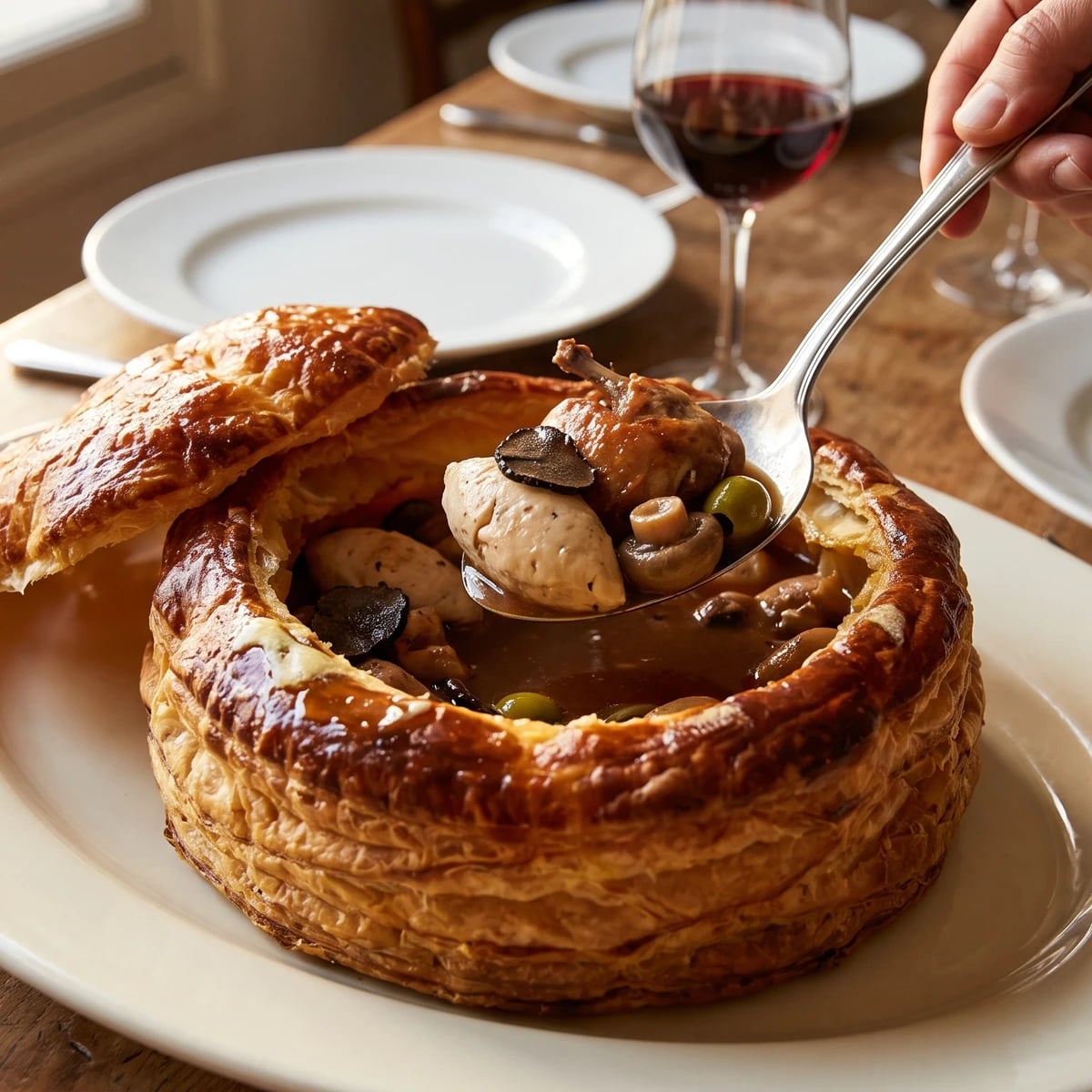
A burnished vol-au-vent filled at the last minute with squab poêlé only just done, truffle-rich Financière garnish, and glossy poëling liquor: a lesson in timing pastry against sauce.

Main Dishes
French
Dinner Party
Special Occasion
Celebration
50 min
Active Time
1 hr 30 min cook2 hr 40 min total
Yield4 servings

Vol-au-Vent de Pigeonneaux (puff-pastry case filled with young pigeon) teaches one uncompromising principle: a crisp shell and a sauced filling may meet only at the last minute. The squabs are poêlés (cooked gently with butter under cover) until barely done, quartered, and folded into a rich Financière garnish sharpened by their own cooking liquor. Fill too early and the pastry drinks the sauce. Nothing restores that lost crispness.

The grand kitchen divided this work among a pâtissier, a saucier with stock never off the fire, and a cook attending the birds, with a salamander waiting to refresh the crust before service. One cook has a good all-butter puff pastry, the two finished preparations preserved by their cross-references, and an ordinary oven for the final crisping. The pastry station and folded napkin beneath the platter are brigade scaffolding, so they go. Four small squabs, one generous shell, one stove, one evening.

What remains is the dish and must stay: real butter in the linked preparations, squab cooked only just through, the poëling liquor worked back into the garnish, and assembly while everyone is taking their seats. Have the filling glossy, the shell hot, and the platter waiting before those two ever meet.

The vol-au-vent belongs to the formal Parisian table, where pastry cooks turned laminated dough into tall communal cases whose name, a flight in the wind, boasts of their lightness. It was never one fixed filling; poultry, sweetbreads, seafood, quenelles, truffles, and rich garnitures moved through the shell according to the menu. Unlike the smaller individual bouchée à la reine, the vol-au-vent traditionally arrives as a centerpiece to be opened and served at the table.

The technique, the tradition, and the story behind every dish.

Discover Culinary Explorer

Ingredients

all-butter puff pastry

Quantity

1¾ pounds (800 g)

chilled and divided into 3 equal pieces

all-purpose flour

Quantity

2 tablespoons (30 ml / 16 g)

for rolling

large egg

Quantity

1

beaten

cold water

Quantity

1 tablespoon (15 ml / 15 g)

oven-ready young squabs

Quantity

4, about 12 to 14 ounces (340 to 400 g) each, for Poëlings (No. 250)

feet and wing tips removed

fine sea salt

Quantity

½ teaspoon (2.5 ml / 3 g)

freshly ground black pepper

Quantity

¼ teaspoon (1.25 ml / 0.6 g)

prepared garnish from Poularde à la Financière

Quantity

2½ cups (600 ml / 650 g), Poularde à la Financière (No. 1474)

kept hot

strained poëling liquor

Quantity

¾ cup (180 ml / 180 g), from Poëlings (No. 250)

hot and carefully skimmed

Equipment Needed

  • Heavy rimmed baking sheet
  • Parchment paper
  • Rolling pin
  • 12-inch (30 cm) round template or cake ring
  • 8½-inch (22 cm) plate or cutter
  • Poultry shears or a narrow boning knife
  • Instant-read thermometer
  • Wide 3-quart (2.8-liter) saucepan
  • Warm 14-inch (35 cm) serving platter

Instructions

  1. 1

    Build the pastry case

    Line a heavy baking sheet with parchment. On a lightly floured surface, roll each piece of pastry into a 12-inch (30 cm) round about ⅛ inch (3 mm) thick. Leave one round whole for the base and dock its exposed center with a fork. Cut an 8½-inch (22 cm) opening from each of the other rounds, reserving one neat center disc as the lid. Dampen the rim of the base lightly with the cold water, stack the two rings on top, and press only enough to join them. Brush the upper surface and lid with beaten egg, keeping egg away from the cut edges where it would seal the layers. Chill for 20 minutes. If the pastry softens and drags under the knife, stop and chill it for 10 minutes before recutting cleanly. Ça se rattrape.

  2. 2

    Bake and dry

    Heat the oven to 425°F (220°C). Bake the case and lid for 15 minutes without opening the door, then lower the heat to 375°F (190°C) and continue for 20 to 25 minutes, until the walls stand tall and the pastry is deeply butter-gold. Lift away any soft pastry from inside the case without cutting into the base, lower the oven to 350°F (175°C), and dry the case and lid for another 8 to 10 minutes. Let them cool uncovered. A pale shell will soften quickly under sauce, so give it full color now.

    If one wall begins to lean, brace it gently from inside with a loose cuff of foil during the drying bake. Remove the foil while the shell is still warm.
  3. 3

    Poêle the squabs

    Season the squabs with the salt and pepper, then prepare them according to Poëlings (No. 250). Begin checking the thickest part of the breast after about 18 minutes and stop cooking at 160°F (71°C); rest the birds covered for 5 to 8 minutes so carryover heat brings them to 165°F (74°C). Complete, strain, and carefully skim the poëling liquor as directed, reserving ¾ cup (180 ml). The breast must remain moist because it receives one final warming in the sauce.

  4. 4

    Quarter and stage

    Raise the oven to 375°F (190°C) and return the empty pastry case and lid for 6 to 8 minutes. Meanwhile, remove each squab leg neatly at the hip, then split the remaining crown lengthwise to make two breast portions, giving four pieces from each bird as the original service requires. Set the pieces aside under a loose cover. Warm the prepared garnish from Poularde à la Financière (No. 1474) over the gentlest heat, stirring carefully so the quenelles and mushroom heads remain intact. It must be hot but never boiling.

  5. 5

    Bind the filling

    Stir ½ cup (120 ml) of the hot poëling liquor from Poëlings (No. 250) into the garnish from Poularde à la Financière (No. 1474), then add more liquor a spoonful at a time until the sauce coats the garnish and pools slowly rather than running like broth. If it is too loose, lift out the solid garnish and reduce the liquid alone for 2 to 4 minutes before returning everything to the pan. Do not reach for flour. Ça se rattrape. Fold in the squab quarters and warm them for 1 to 2 minutes without simmering, checking that each piece reaches 165°F (74°C).

  6. 6

    Fill at service

    Set the hot pastry case on a warm serving platter. Spoon in the squab and Financière garnish, distributing the quarters through the shell and pouring the glossy sauce over them. Set the pastry lid slightly askew so the filling remains visible. Carry it directly to the table. Filling the shell at the last minute is not ceremony, it is the dish. À table!

Chef Tips

  • Buy farmed young squab from a butcher or game supplier, not wild pigeon. The birds should be plump across the breast and close in size so all four finish together; frozen squab is perfectly sound if thawed slowly in the refrigerator.
  • Use all-butter puff pastry and keep it cold. Vegetable shortening gives height without the flavor this crust requires, and margarine has no place here. We don't apologize for butter.
  • The linked preparations are modular by design. Prepare the garnish from Poularde à la Financière (No. 1474) before beginning this assembly, then make the squabs and their liquor through Poëlings (No. 250) while the baked shell waits.
  • Serve a structured red Burgundy or a mature, restrained Bordeaux. The wine needs enough freshness for the butter and demi-glace, but not so much weight that it buries the squab and truffle.
  • Once filled, the vol-au-vent does not keep. If there are leftovers, lift the filling from the shell and refrigerate the two separately; reheat the filling gently and crisp the pastry in the oven before reassembling.

Advance Preparation

  • The pastry case can be baked up to 6 hours ahead. Cool it completely and leave it uncovered at room temperature, then crisp it at 375°F (190°C) for 6 to 8 minutes immediately before filling.
  • The garnish from Poularde à la Financière (No. 1474) can be completed a day ahead, chilled promptly, and reheated over gentle heat. Keep the quenelles and other garnish pieces whole.
  • Trim the squabs earlier in the day, dry them well, and keep them covered in the refrigerator. Cook them through Poëlings (No. 250) close to service so the breasts remain moist.

Frequently Asked Questions

Nutrition Information

1 serving (about 550g)

Calories
1640 calories
Total Fat
117 g
Saturated Fat
56 g
Trans Fat
3 g
Unsaturated Fat
58 g
Cholesterol
285 mg
Sodium
1900 mg
Total Carbohydrates
82 g
Dietary Fiber
5 g
Sugars
3 g
Protein
64 g

Note: Chef personas and recipes are created with AI assistance. Cook with care: follow safe food-handling practices, check doneness with a thermometer when needed, and adapt for allergies and your kitchen.

Where cooking meets culture.

Culinary guides, cultural storytelling, and the editorial depth that makes cooking meaningful.

Discover Culinary Explorer

More from Poultry (Volaille) - Ducks and Ducklings (Canards et Canetons)

Browse the full collection