
Chef Juliette
John Dory (St. Pierre)
John Dory has the delicacy of sole and the firmness of turbot. A light flouring, a quick butter sauté, and nut-brown beurre noisette show exactly why looks never mattered.
A cooking platform built around craft, culture, and the stories behind what we eat.
Created by Chef Juliette
Based on No. 1474, Poularde à la Financière, from Le Guide Culinaire (1907) by Auguste Escoffier
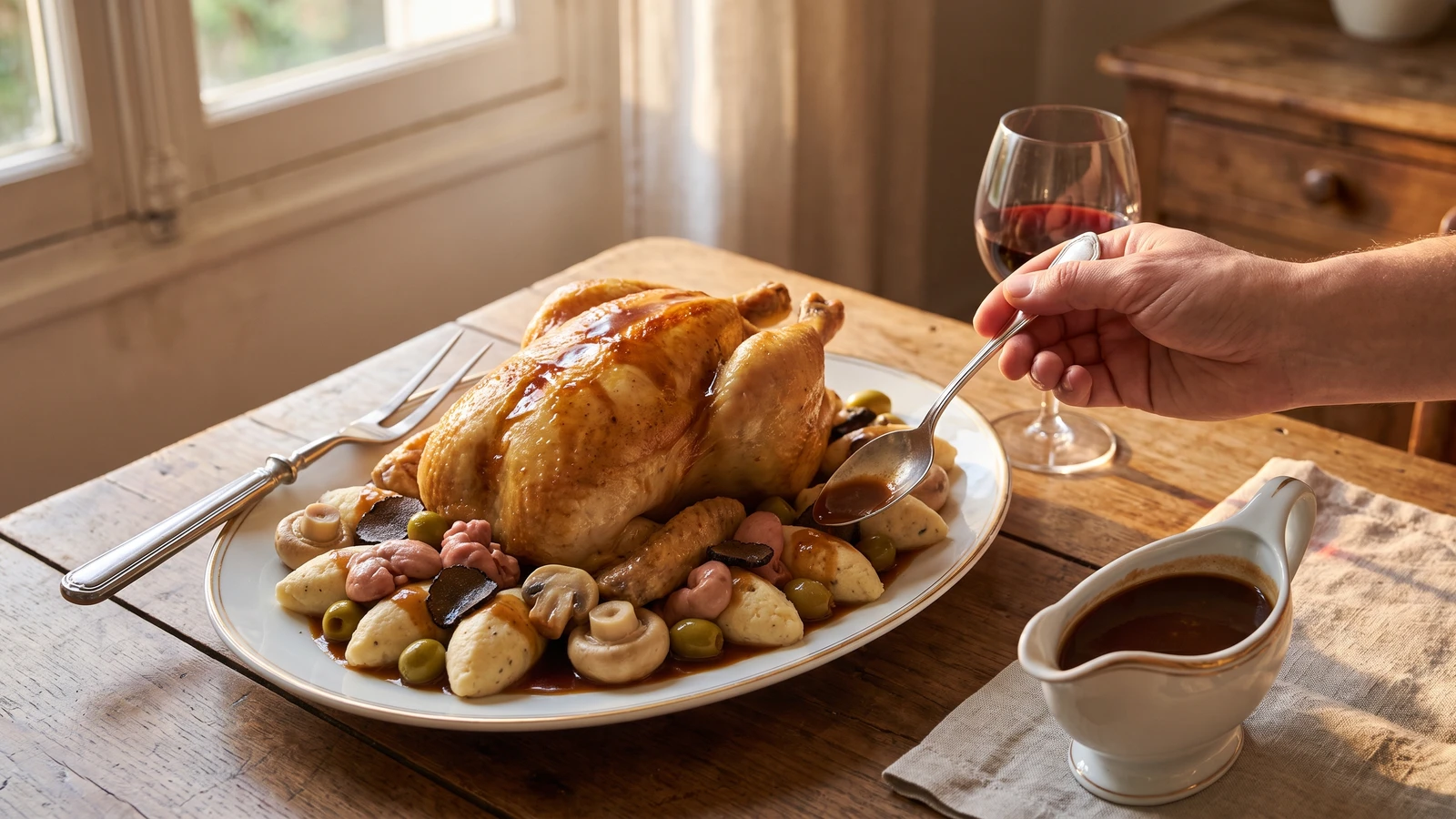
A whole poularde, gently braised and ringed with quenelles, grooved mushrooms, delicate cocks’ combs and kidneys, truffle, and olives, all held together by glossy demi-glace enriched with the bird’s own liquor.
Poularde à la Financière (braised pullet with financière garnish) teaches the architecture of a grand garnish: every morsel is cooked on its own terms, then brought under one sauce so the platter tastes composed rather than crowded. The quenelles, small poached dumplings of chicken mousseline, must stay tender; the mushrooms stay distinct; the truffle remains fragrant; and the demi-glace, the half-glaze sauce, joins them without drowning the bird.
The source assumes a saucier at hand, stock never off the fire, chicken mousseline waiting on ice, and another pair of hands tending the garnishes. At home, reach for genuine prepared demi-glace and prepared chicken mousseline from your freezer or a good butcher, then make both belong to this bird with its reduced braising liquor. A cocotte replaces the braising pan, kitchen string replaces the trussing needle, and a salamander has no work here because financière is glossed with sauce, not scorched from above. The separate kitchen stations are scaffolding. The braise, the complete financière garnish, and the truffle-scented sauce are the dish and must stay. One cook, one stove, one evening.
Know this before touching the pan: the braising liquor must gain body before the garnish enters it. Strain and reduce it until concentrated, then marry it to the demi-glace; pour thin liquor straight into the sauce and those splendid garnishes merely float in soup. Get the reduction right and the whole platter gleams.
Poularde à la Financière belongs to Parisian grande cuisine, where a braised pullet was surrounded by the full garniture financière: quenelles, mushroom heads, cocks’ combs and kidneys, truffle, and olives, all joined by demi-glace. The usual story connects the name to financiers able to pay for such costly morsels, but the canon fixes something more useful than the anecdote: financière denotes a specific abundant garnish, not merely a rich brown sauce. As the dish traveled from staffed dining rooms to bourgeois celebration tables, it kept that identity through the arrangement of its garnishes around the whole bird.
Quantity
1, weighing 4 to 4½ lb (1.8 to 2 kg)
giblets removed
Quantity
2 teaspoons (10 ml / 12 g)
Quantity
1 teaspoon (5 ml / 2 g)
Quantity
5 tablespoons (75 ml / 70 g)
divided
Quantity
1 medium (about 5 oz / 150 g)
cut into large dice
Quantity
1 medium (about 3½ oz / 100 g)
cut into large dice
Quantity
1 stalk (about 2 oz / 55 g)
cut into large dice
Quantity
2½ cups (600 ml / 600 g)
divided
Quantity
1
Quantity
1 cup (240 ml / 225 g)
thoroughly cold
Quantity
12, about 1½ cups (360 ml / 225 g)
grooved
Quantity
4, about 3 oz (85 g), fresh ones cleaned using Blanchings (No. 273), or cooked and drained from brine
Quantity
4, about 2 oz (55 g)
rinsed and trimmed
Quantity
16, about ¾ cup (180 ml / 110 g)
pitted
Quantity
1 small, about 1 oz (30 g)
thinly sliced
Quantity
1 cup (240 ml / 250 g)
Quantity
1 tablespoon (15 ml / 15 g)
| Ingredient | Quantity |
|---|---|
| whole poularde or plump air-chilled chickengiblets removed | 1, weighing 4 to 4½ lb (1.8 to 2 kg) |
| fine sea salt | 2 teaspoons (10 ml / 12 g) |
| finely ground white pepper | 1 teaspoon (5 ml / 2 g) |
| unsalted butterdivided | 5 tablespoons (75 ml / 70 g) |
| onioncut into large dice | 1 medium (about 5 oz / 150 g) |
| carrotcut into large dice | 1 medium (about 3½ oz / 100 g) |
| celerycut into large dice | 1 stalk (about 2 oz / 55 g) |
| unsalted brown chicken or veal stockdivided | 2½ cups (600 ml / 600 g) |
| bouquet garni of parsley stems, thyme, and bay | 1 |
| prepared chicken mousseline forcemeatthoroughly cold | 1 cup (240 ml / 225 g) |
| small button mushroom capsgrooved | 12, about 1½ cups (360 ml / 225 g) |
| prepared cocks’ combs | 4, about 3 oz (85 g), fresh ones cleaned using Blanchings (No. 273), or cooked and drained from brine |
| cocks’ kidneys, sold as rognons de coqrinsed and trimmed | 4, about 2 oz (55 g) |
| green olivespitted | 16, about ¾ cup (180 ml / 110 g) |
| black truffle, fresh or preservedthinly sliced | 1 small, about 1 oz (30 g) |
| prepared unsalted demi-glace | 1 cup (240 ml / 250 g) |
| truffle essence or juice from preserved truffles | 1 tablespoon (15 ml / 15 g) |
Heat the oven to 325°F (165°C). Dry the poularde thoroughly, then season it inside and out with the salt and white pepper. Fold the wing tips beneath the bird and tie the legs together with kitchen string, keeping the breast broad rather than hauling the string tight. Trussing is practical here: it gives the bird an even shape, protects the breast, and lets it sit handsomely on the final platter.
Melt 3 tablespoons of the butter in a heavy cocotte over medium heat. When the foam subsides, brown the poularde patiently on the breast, back, and both sides until the skin is an even hazelnut gold, 12 to 15 minutes in all. Lift it out. Add 1 tablespoon butter with the onion, carrot, and celery, and cook until lightly colored. Pour in 2 cups of the stock, scraping every browned trace from the pot, then add the bouquet garni. Return the bird breast-side up; the liquid should reach roughly one-third of the way up its sides. Cover and braise in the oven for 75 to 95 minutes, basting once, until the thickest part of the thigh reaches 165°F (74°C) without touching bone. If the butter or fond darkens toward bitter black during browning, lower the heat and loosen it immediately with a spoonful of stock before continuing.
While the poularde braises, bring a wide saucepan of water to the barest tremble, about 180°F (82°C). Using two teaspoons dipped in cold water, shape the cold chicken mousseline into 12 small oval quenelles. Poach one as a test, then cook the rest without crowding for 6 to 8 minutes, turning once, until softly firm and springy. Lift them into a shallow dish with a spoonful of poaching liquid. If the test quenelle frays, stop. Ça se rattrape. Lower the water below a simmer and chill the mousseline for 10 minutes before shaping again; boiling water and warm forcemeat are the usual culprits.
Fresh cocks’ combs must arrive cleaned and peeled through Blanchings (No. 273); that separate preparation is not repeated here. Simmer prepared fresh combs gently in the remaining ½ cup stock with enough water to cover for 25 to 35 minutes, until a knife enters without resistance. Cooked combs from brine need only 5 minutes of warming. Add the cocks’ kidneys for the final 4 to 5 minutes, just until firm, then lift both out. Blanch the olives in fresh boiling water for 2 minutes and drain. Melt the remaining tablespoon of butter in the emptied saucepan, add the grooved mushroom caps with 2 tablespoons of the comb cooking liquor, cover, and cook gently for 5 to 7 minutes until tender and glossy. Keep the quenelles, mushrooms, combs, kidneys, and olives separate so each retains its shape.
Transfer the cooked poularde to a warm platter, cover it loosely, and rest it for 15 minutes. Strain the braising liquor into a wide saucepan, discard the vegetables and bouquet garni, and skim away the surface fat. Boil the liquor steadily until reduced to about 1 cup and distinctly concentrated. Add the prepared demi-glace and reduce again until about 1½ cups remain and the sauce naps the back of a spoon in a glossy, even coat. A thin sauce needs further reduction; one that tightens too far takes a spoonful of unsalted stock. If it looks greasy, skim it rather than whisking the fat back in.
Lower the sauce to the gentlest heat and stir in the truffle essence. Reserve about ¾ cup in a warmed sauceboat. Add the quenelles, mushroom caps, cocks’ combs, kidneys, and olives to the remaining sauce and warm them for 2 to 3 minutes without boiling. Slip in the truffle slices for the final 30 seconds. High heat toughens the quenelles and spends the truffle’s perfume before the platter reaches the table, so this last warming must remain calm.
Remove the string and set the poularde in the center of a warmed oval platter. Arrange the garnish in small alternating groups around it, giving every serving a quenelle, mushroom, cocks’ comb or kidney, olives, and truffle. Spoon only the sauce clinging to the garnish around the bird, enough to make everything gleam without hiding its shape. Send the reserved truffle-scented sauce beside it in the sauceboat and carve at the table. À table!
1 serving (about 525g)
Culinary guides, cultural storytelling, and the editorial depth that makes cooking meaningful.
Discover Culinary ExplorerChef Juliette
John Dory has the delicacy of sole and the firmness of turbot. A light flouring, a quick butter sauté, and nut-brown beurre noisette show exactly why looks never mattered.

Chef Juliette
Fresh haddock proves its delicacy in the meunière pan: a fine flour crust, moist pearly flakes, and beurre noisette sharpened with lemon and parsley, ready from one skillet in half an hour.

Chef Juliette
Éperlans à l’Anglaise turns small fish into a lesson in disciplined coating: boned smelts under a close, crisp crumb, pan-fried in clarified butter and finished with bright, half-melted maître d’hôtel butter.

Chef Juliette
Tiny smelts, shallot, mushrooms, white wine, gratin sauce, and fine bread raspings meet a fierce oven, where the fish must turn tender in the same breath the buttered crust bronzes.