
Chef Juliette
Smelt (Éperlans)
Tiny éperlans, lightly floured and fried until their tails stand crisp, arrive in a generous heap on a napkin with fried parsley and grooved lemon, a weeknight lesson in heat and restraint.
A cooking platform built around craft, culture, and the stories behind what we eat.
Created by Chef Juliette
Based on No. 1772, Terrine de Caneton Rouennais à la Gelée, from Le Guide Culinaire (1907) by Auguste Escoffier
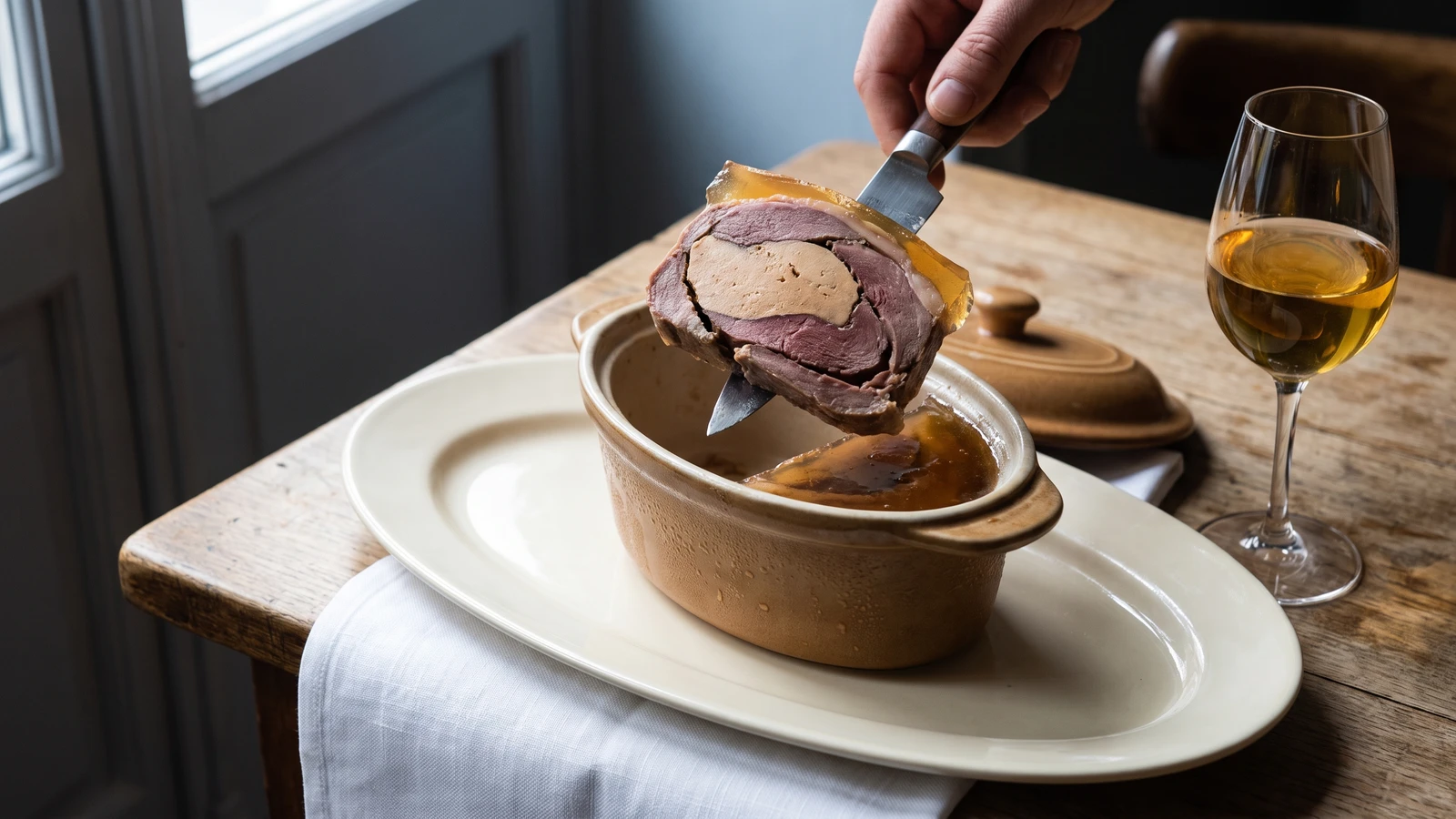
Terrine de Caneton Rouennais à la Gelée turns one duckling into both rich liver filling and clear carcass aspic, a cold Normandy centerpiece built by cool forcemeat, gentle heat, and patience.
Terrine de Caneton Rouennais à la Gelée (Rouen duckling terrine in aspic) teaches the disciplined economy of the classical kitchen: the flesh becomes the terrine, the livers become its forcemeat, and the carcass returns as the gelée that seals everything beneath a clear amber cover. The one true thing to know before touching a pan is simple. The forcemeat must be completely cold before it enters the duck, or its butter escapes during cooking and leaves the filling greasy instead of close and smooth.
The original kitchen assumed a poultry cook to bone the bird, a saucier on staff, strong veal stock never off the fire, and a purpose-made terrine just large enough to embrace the duckling. At home, you do the same work in sequence: partial boning with a small sharp knife, carcass stock simmering on one burner, and a 1.5-liter covered terrine or snug loaf pan set inside a roasting pan. A little plain gelatin is permitted only when your veal stock fails the cold-saucer test. It replaces the natural strength of the perpetual stockpot, not the flavor of the carcass. The separate hands and separate stockpot were brigade scaffolding and can go. The partial boning, sieving, bain-marie (hot-water bath), and carcass aspic are the dish, so they stay.
When it is right, the duck cuts into generous cold slices with a fine liver filling at its center, while the gelée holds a quiet amber gleam around it and tastes unmistakably of the bird. The active work belongs to one cook, one stove, one evening; the cold rest finishes what heat began. Cool the forcemeat thoroughly. That is the step that decides everything afterward.
Terrine de Caneton Rouennais à la Gelée belongs to Rouen and the Seine valley of Normandy, where the Rouen duckling became prized for its dark, full-flavored flesh and generous liver. Grand kitchens carried the bird into elaborate pressed and sauced preparations, while this terrine applied the same whole-bird economy to cold service, using the carcass itself to strengthen the aspic. Rouennais here identifies the duckling and its Norman character; the dish is not canard à la presse, but a distinct preparation of sieved liver forcemeat, gentle cooking, and gelée.
Quantity
1 duckling, about 4 lb (1.8 kg)
neck and giblets removed, liver reserved
Quantity
6 livers, about 12 oz (340 g)
trimmed, including the reserved duckling liver
Quantity
½ cup (3 oz / 85 g)
rind removed and cut into small dice
Quantity
6 tablespoons (90 ml / 85 g)
Quantity
½ onion, about ¼ cup (60 ml / 55 g)
finely chopped
Quantity
1 teaspoon (5 ml / 6 g), plus more as needed
divided between the forcemeat and aspic
Quantity
½ teaspoon (2.5 ml / 1 g)
Quantity
1 pinch, about 1/16 teaspoon (0.3 ml / 0.1 g)
Quantity
1 pinch, about 1/16 teaspoon (0.3 ml / 0.1 g)
Quantity
Scant ½ cup (100 ml / 95 g)
Quantity
1 broad thin slice, about 2 oz (55 g)
for covering the duckling
Quantity
2½ cups (600 ml / 600 g)
Quantity
2 teaspoons (10 ml / 7 g)
use only if the reduced aspic fails the cold-saucer test
Quantity
About 8 cups (2 L / 2 kg)
for the bain-marie and final degreasing
| Ingredient | Quantity |
|---|---|
| Rouen ducklingneck and giblets removed, liver reserved | 1 duckling, about 4 lb (1.8 kg) |
| duck liverstrimmed, including the reserved duckling liver | 6 livers, about 12 oz (340 g) |
| unsmoked fat baconrind removed and cut into small dice | ½ cup (3 oz / 85 g) |
| unsalted butter | 6 tablespoons (90 ml / 85 g) |
| small onionfinely chopped | ½ onion, about ¼ cup (60 ml / 55 g) |
| fine sea saltdivided between the forcemeat and aspic | 1 teaspoon (5 ml / 6 g), plus more as needed |
| freshly ground black pepper | ½ teaspoon (2.5 ml / 1 g) |
| ground thyme | 1 pinch, about 1/16 teaspoon (0.3 ml / 0.1 g) |
| ground bay leaf | 1 pinch, about 1/16 teaspoon (0.3 ml / 0.1 g) |
| French brandy | Scant ½ cup (100 ml / 95 g) |
| unsmoked fat baconfor covering the duckling | 1 broad thin slice, about 2 oz (55 g) |
| strong unsalted veal stock | 2½ cups (600 ml / 600 g) |
| unflavored powdered gelatin (optional)use only if the reduced aspic fails the cold-saucer test | 2 teaspoons (10 ml / 7 g) |
| boiling waterfor the bain-marie and final degreasing | About 8 cups (2 L / 2 kg) |
Set the duckling breast-side down and cut through the skin along one side of the backbone from neck to tail. Keeping the knife against bone, scrape the flesh away from the ribs and back, turning the bird as you work so the blade never points blindly into the skin. Disjoint the shoulders and hips, free the rib cage, breastbone, and backbone as one carcass, and stop where the leg bones begin; the legs remain bone-in. Cut away and discard the tail. Reserve the carcass, neck, and all bony trimmings for the aspic. If the skin is nicked, lay a small flap of loose neck skin beneath the opening before trussing. Ça se rattrape, and the patch will disappear inside the compact bird.
Chop the carcass and neck into pieces that fit a medium saucepan. Add the strong veal stock and bring it slowly to a bare simmer, skimming away the grey foam as it rises. Partially cover and let it tremble gently for 60 to 75 minutes while you prepare and cook the duckling. A hard boil drives fat into the stock and clouds the gelée; if it begins rolling, lower the heat at once and add a spoonful of cool stock.
Heat the diced fat bacon and butter in a wide frying pan until the bacon turns translucent and the butter foams. Season the duck livers with the salt and pepper, then sprinkle them with the ground thyme, ground bay leaf, and chopped onion. Raise the heat, add everything to the pan, and toss over fierce heat for 60 to 90 seconds, just long enough to warm the livers and color their surfaces lightly. Their centers must remain soft and nearly raw because they cook again inside the duck. Scrape the livers, bacon, onion, butter, and every drop of fat onto a shallow tray.
Let the liver mixture lose its surface heat, then rub the entire preparation through a sturdy fine-mesh sieve with a flexible scraper. Discard the sinew left behind. Spread the smooth forcemeat in a shallow bowl and refrigerate until completely cold and firm, about 30 minutes. Fry a teaspoonful to check the seasoning, then adjust the cold mixture if needed. If the forcemeat grows loose or beads with melted butter while you work, stop and chill it for 15 minutes before continuing. Ça se rattrape. Do not stuff it warm.
Heat the oven to 350°F (175°C). Lay the partially boned duckling skin-side down and spoon the cold forcemeat into the space left by the carcass, keeping it in an even mound between the breast meat and legs. Fold the sides over the filling and turn the bird breast-side up. Tie it compactly with four or five separate loops of kitchen twine, the home equivalent of formal entrée trussing, so the filling cannot escape. Place it in a lidded 1.5-liter terrine or snug loaf pan, choosing one with as little empty space as possible. Sprinkle the brandy over the duckling, lay the broad slice of bacon across its breast, and cover tightly.
Set the covered terrine inside a deep roasting pan and pour in enough boiling water to reach halfway up its sides. Bake for 40 minutes, then test the center of the forcemeat with an instant-read thermometer without touching bone. The book's forty minutes is the first check, not permission to guess: the center must reach 165°F (74°C). If it has not, cover again and continue in 5-minute intervals. Keep the bain-marie at a quiet tremble. If it boils hard, replace a cup of hot water with cool water before the forcemeat tightens and turns grainy.
Strain the carcass stock through a fine strainer lined with damp cheesecloth, without pressing on the bones. Return it to a clean saucepan and reduce gently to 1⅔ cups (400 ml / 400 g). Taste and correct the salt. Spoon a tablespoon onto a cold saucer and chill it for 5 minutes; it should set to a soft gel that quivers when touched. If it remains liquid, sprinkle the gelatin over 3 tablespoons of cold reduced stock and let it swell for 5 minutes, then whisk it into the remaining warm stock off the heat. Do not boil after adding gelatin. This is the honest home replacement for a stockpot rich enough to set by itself.
When the duckling comes from the oven, leave it covered for 10 minutes while the aspic cools until warm but still fluid. Pour the aspic slowly into the terrine, letting it run around the bird and rise over the bacon-covered breast. A snug vessel matters here because the measured gelée should cover the duckling rather than disappear into empty corners. Let the terrine cool for no longer than 1 hour, then cover and refrigerate for at least 8 hours, until the aspic is thoroughly set.
Scrape the opaque layer of set fat from the gelée with a teaspoon. Dip a clean spoon into boiling water, dry its underside, and sweep it lightly over the remaining fatty film, repeating as needed; this preserves the book's boiling-water finish without flooding or melting the aspic. Blot the rim dry, remove the twine as the bird is carved, and set the terrine on a folded napkin laid over a long serving dish. Cut generous slices through the boned breast and forcemeat, spooning some clear gelée beside each serving. Never apologize at your own table. À table!
1 serving (about 190g)
Culinary guides, cultural storytelling, and the editorial depth that makes cooking meaningful.
Discover Culinary ExplorerChef Juliette
Tiny éperlans, lightly floured and fried until their tails stand crisp, arrive in a generous heap on a napkin with fried parsley and grooved lemon, a weeknight lesson in heat and restraint.

Chef Juliette
Brandade de Morue turns salt cod, warm olive oil, and milk into a pale, silky emulsion: keep everything warm and add the oil slowly, then crown the generous dome with butter-fried bread.

Chef Juliette
Salt cod worked warm with cream, one patient spoonful at a time, until the rough flakes become a glossy Nîmes paste, domed generously and ringed with butter-fried croutons for the table.

Chef Juliette
Wine-poached char packed in its earthenware crock beneath butter gold: a make-ahead first course that turns careful cooling, thorough boning, and one unbroken seal into quiet abundance.