
Chef Juliette
John Dory (St. Pierre)
John Dory has the delicacy of sole and the firmness of turbot. A light flouring, a quick butter sauté, and nut-brown beurre noisette show exactly why looks never mattered.
A cooking platform built around craft, culture, and the stories behind what we eat.
Created by Chef Juliette
Based on No. 1753, Ballotines de Caneton, from Le Guide Culinaire (1907) by Auguste Escoffier
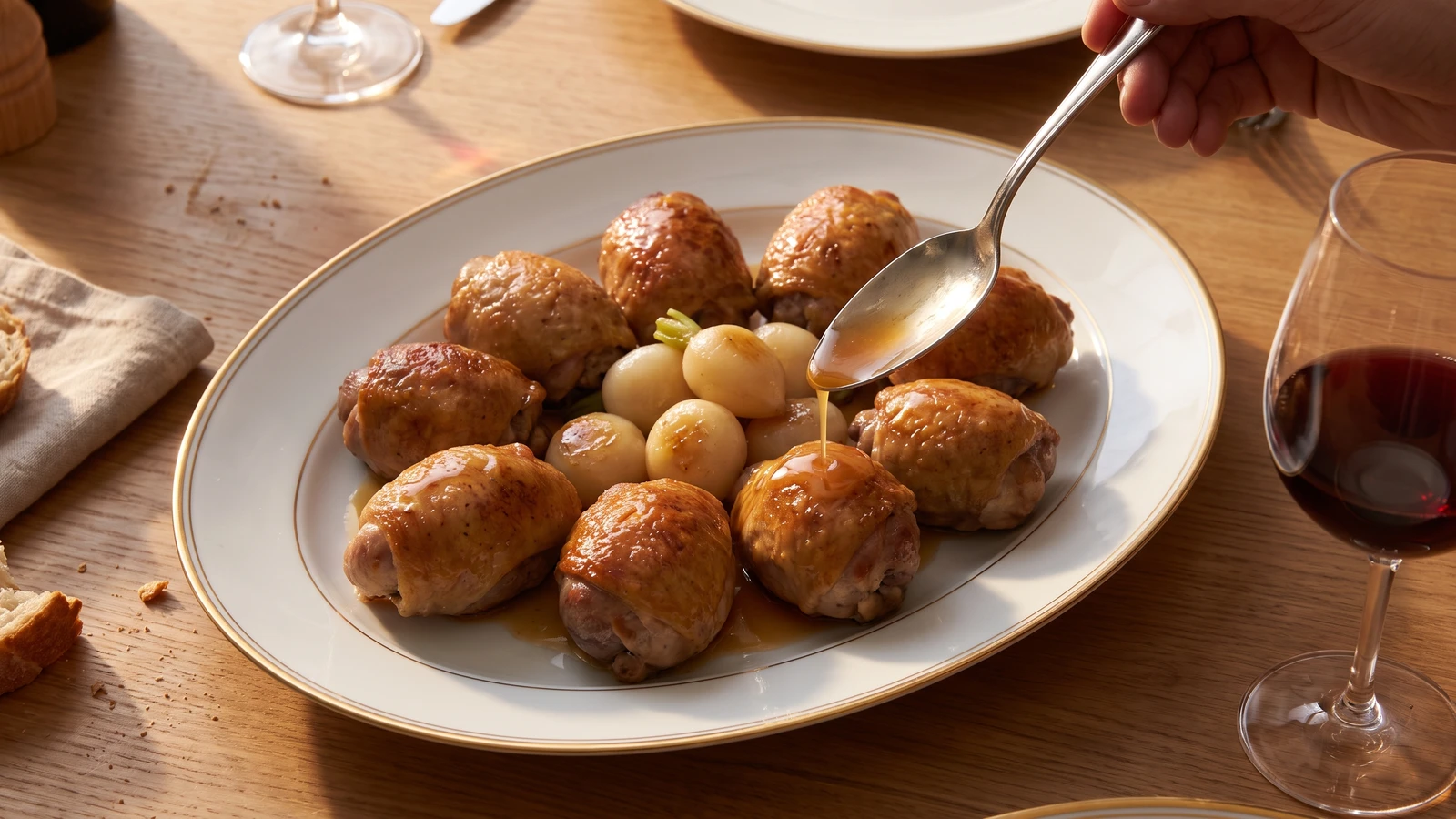
Ballotines de Caneton turn a boned duckling into eight neat parcels, their silky forcemeat held in its own skin, barely poached in duck stock, then glazed until each one gleams.
Ballotines de Caneton (stuffed duckling parcels) teach temperature control twice: the farce fine, the silky forcemeat, must stay cold while you work it, and the poaching stock must barely tremble once the parcels enter. The one true thing to know before touching a pan is this: a rolling pot will split the skin. Gentle heat keeps each ballotine plump, smooth, and full of its own juices.
The source cleared every bone and used all the duck meat because brigade service could absorb a large batch. This version keeps its defining ratio exactly, duck with half its weight of veal, half its weight of fresh pork fat, and one-third its weight of panada, while reducing the fixed yolk, salt, foie gras, and mushroom additions to one quarter. That gives eight original two-ounce portions for four people. A market duck supplies more meat than eight skin wrappers require, so the excess is reserved rather than turning dinner into banquet production.
The original kitchen assumed a saucier beside a stockpot never off the fire, several hands to pound and sieve the forcemeat, and a salamander waiting to set the glaze. Here, a food processor replaces the pounding, the stripped carcass makes one compact stock, that same stock reduces into the glaze, and the broiler supplies the final flash. Those are brigade scaffolding. The cold binder, fine sieve, duck-skin wrapper, muslin, and quiet poach are the dish itself, and they stay. One cook, one stove, one evening. Keep the stock at a tremble, never a roll; that is the step that decides the dish.
Ballotines belong to the repertory of Parisian grande cuisine, where poultry was boned, filled, shaped, and poached or braised for formal service, with caneton prized for its rich meat and supple skin. The name carries the idea of a small bundle, and the form traveled from whole stuffed birds toward individual portions such as these two-ounce parcels. It is often confused with a galantine, but in this preparation the ballotine is served hot and freshly glazed, not as a large chilled presentation.
Quantity
1 whole (4½ to 5 lb / 2 to 2.3 kg)
skin removed in one piece, carcass chopped, and 1 cup (240 ml / 170 g) meat reserved for the forcemeat
Quantity
8 cups (1.9 L / 1.9 kg)
Quantity
1
peeled and quartered
Quantity
1
peeled and cut into chunks
Quantity
1 stalk
cut into chunks
Quantity
1
Quantity
½ cup loosely packed (120 ml / 85 g)
diced and thoroughly chilled
Quantity
½ cup loosely packed (120 ml / 85 g)
diced and thoroughly chilled
Quantity
1
chilled
Quantity
1¼ teaspoons (6.25 ml / 8 g), divided, including ½ teaspoon (2.5 ml / 3.5 g) for the forcemeat
Quantity
¼ teaspoon (1.25 ml / 0.6 g)
Quantity
⅛ teaspoon (0.6 ml / 0.25 g)
Quantity
1 tablespoon plus 1 teaspoon (20 ml / 21 g) from Gratins (No. 268)
chilled
Quantity
¼ cup (60 ml / 21 g)
very finely chopped
Quantity
3 tablespoons (45 ml / 42 g)
divided
Quantity
12 (about 1 lb / 450 g)
peeled and neatly quartered
Quantity
1 teaspoon (5 ml / 4 g)
| Ingredient | Quantity |
|---|---|
| whole ducklingskin removed in one piece, carcass chopped, and 1 cup (240 ml / 170 g) meat reserved for the forcemeat | 1 whole (4½ to 5 lb / 2 to 2.3 kg) |
| cold water | 8 cups (1.9 L / 1.9 kg) |
| small onionpeeled and quartered | 1 |
| carrotpeeled and cut into chunks | 1 |
| celerycut into chunks | 1 stalk |
| bouquet garni | 1 |
| lean vealdiced and thoroughly chilled | ½ cup loosely packed (120 ml / 85 g) |
| fresh pork back fatdiced and thoroughly chilled | ½ cup loosely packed (120 ml / 85 g) |
| A. Bread Panadachilled | ¼ cup (60 ml / 57 g) A. Bread Panada (No. 190) |
| large egg yolkchilled | 1 |
| fine sea salt | 1¼ teaspoons (6.25 ml / 8 g), divided, including ½ teaspoon (2.5 ml / 3.5 g) for the forcemeat |
| ground white pepper | ¼ teaspoon (1.25 ml / 0.6 g) |
| freshly grated nutmeg | ⅛ teaspoon (0.6 ml / 0.25 g) |
| gratin foie-gras forcemeatchilled | 1 tablespoon plus 1 teaspoon (20 ml / 21 g) from Gratins (No. 268) |
| button mushroomsvery finely chopped | ¼ cup (60 ml / 21 g) |
| unsalted butterdivided | 3 tablespoons (45 ml / 42 g) |
| small turnipspeeled and neatly quartered | 12 (about 1 lb / 450 g) |
| granulated sugar | 1 teaspoon (5 ml / 4 g) |
Ask the butcher to remove the duckling's skin in one piece and return the chopped carcass, wings, and neck. Strip every scrap of meat from the bones, weigh out 1 cup (240 ml / 170 g) for the forcemeat, and reserve the remainder for another meal. Put the carcass and cold water in a narrow stockpot, bring them up slowly, and skim before the liquid reaches a simmer. Add the onion, carrot, celery, and bouquet garni, then cook at the barest tremble for 75 minutes. Strain without pressing the solids. You should have about 6 cups (1.4 L / 1.4 kg) of clean, lightly concentrated duck stock; keep it unsalted because part of it will be reduced.
Melt 1 tablespoon (15 ml / 14 g) of the butter in a small pan. Sauté the mushrooms over lively heat until their water has evaporated and they smell deeply mushroomy, but stop before their edges become hard. Spread them on a cold plate and refrigerate until completely chilled. Warm mushrooms would soften the pork fat and weaken the forcemeat before it ever reaches the pot.
Chill the food-processor bowl and blade, then add the duck meat, veal, pork fat, ½ teaspoon (2.5 ml / 3.5 g) salt, white pepper, and nutmeg. Process in short pulses until finely chopped. Add the chilled A. Bread Panada (No. 190) and egg yolk, then process only until the farce fine, the silky forcemeat, becomes cohesive and slightly springy. Force it through a fine-mesh sieve with a flexible scraper, then fold in the chilled gratin foie-gras forcemeat from Gratins (No. 268) and the mushrooms. If the mixture begins to smear or shine with loose fat, stop immediately and set the bowl over ice for 15 minutes before continuing. Ça se rattrape while everything is still cold.
Poach a teaspoonful of farce in gently simmering water until cooked through. Cut it open: it should be smooth, moist, and free of visible beads of fat. Taste for pepper and nutmeg, remembering that the reduced glaze will bring additional salt. Weigh the remaining farce into eight equal portions of about 2 oz (57 g) each, shape them into short, neat ovals, and chill for 30 minutes.
Scrape excess fat from the inner surface of the duck skin without thinning it, then cut eight pieces large enough to enclose the portions, about 5 by 6 inches (13 by 15 cm). Place each piece outer-side down, set a portion of farce across the center, and roll so the skin overlaps underneath. Patch any small tear from the inner side with a skin trimming; the muslin will hold it in place. Wrap each ballotine snugly in butter muslin and tie both ends with kitchen string. Keep the parcels chilled while the stock heats.
Heat enough duck stock to cover the ballotines in a wide saucepan, holding it between 176 and 185°F (80 and 85°C). Lower in the wrapped parcels and keep them submerged with a small heatproof plate if necessary. Poach for 25 to 30 minutes, turning once, until the center of each reaches 160°F (71°C). The liquid must never roll. If it boils and the skin begins to swell, pull the pan from the heat, add a ladleful of cold stock, and lower the burner before continuing. If a parcel splits, lift it out, wrap it in fresh muslin, and return it gently. Ça se rattrape.
While the ballotines poach, put the turnips in a sauté pan with 1 tablespoon (15 ml / 14 g) butter, the sugar, a pinch of the remaining salt, and enough reserved duck stock to come halfway up their sides. Cover with a round of parchment and simmer gently until tender, 15 to 20 minutes. Remove the parchment and roll the turnips through the reducing liquid until they are glossy and evenly coated. If the glaze catches before the turnips are tender, add another spoonful of stock and continue.
Lift the cooked ballotines onto a tray and rest them for 5 minutes. Strain 2 cups (475 ml / 475 g) of the poaching stock into a wide pan, bring it to a full boil, and reduce it to about ⅓ cup (80 ml / 85 g), skimming away excess fat, until it coats a spoon in a glossy film. Take it off the heat and whisk in the final 1 tablespoon (15 ml / 14 g) butter. Remove the muslin, set the ballotines on a rack, and brush them generously with the reduction. Pass them beneath a fully heated broiler, the home salamander, for 45 to 90 seconds, just until the glaze sets to a lacquer. Watch without wandering; its work happens quickly.
Arrange the eight glazed ballotines in a circle on a warm platter and spoon the glazed turnips into the center, exactly as the dish intends. Brush over a final thin coat of duck glaze and serve the remaining reduction in a small warm sauceboat. Two ballotines make a generous serving. À table!
1 serving (about 420g)
Culinary guides, cultural storytelling, and the editorial depth that makes cooking meaningful.
Discover Culinary ExplorerChef Juliette
John Dory has the delicacy of sole and the firmness of turbot. A light flouring, a quick butter sauté, and nut-brown beurre noisette show exactly why looks never mattered.

Chef Juliette
Fresh haddock proves its delicacy in the meunière pan: a fine flour crust, moist pearly flakes, and beurre noisette sharpened with lemon and parsley, ready from one skillet in half an hour.

Chef Juliette
Éperlans à l’Anglaise turns small fish into a lesson in disciplined coating: boned smelts under a close, crisp crumb, pan-fried in clarified butter and finished with bright, half-melted maître d’hôtel butter.

Chef Juliette
Tiny smelts, shallot, mushrooms, white wine, gratin sauce, and fine bread raspings meet a fierce oven, where the fish must turn tender in the same breath the buttered crust bronzes.