Chef Juliette
Ordinary or White Consommé
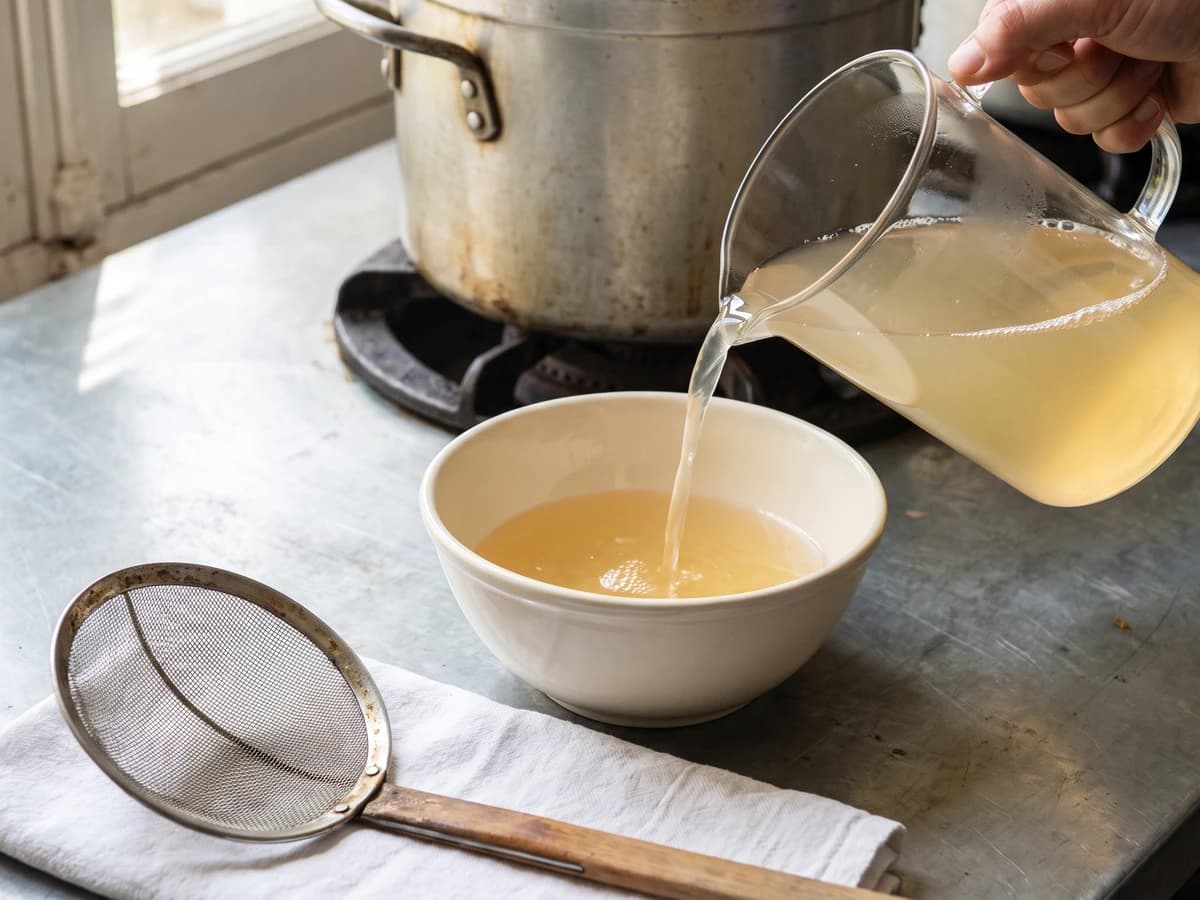
Beef shin, lean beef, and fowl begin in cold water and rise slowly toward a tremble. Skim before the boil, and you learn the quiet discipline that gives every clear French broth its backbone.
A cooking platform built around craft, culture, and the stories behind what we eat.
Created by Chef Juliette
Based on No. 174b, Seasoning and Condiments, from Le Guide Culinaire (1907) by Auguste Escoffier
Salt, acid, heat, sweetness, pungency, and fat kept in their proper places: a home seasoning station that teaches exact measurement, deliberate blending, and the calm rescue of an overseasoned pot.
Assaisonnements et Condiments (seasoning and condiment system) teach the most portable rule in the classical kitchen: season by role, not by the handful. Salt gives definition, acid wakes the palate, pepper and spice bring heat, sugar or honey rounds an edge, pungents supply force, and fat carries aroma. Exactness matters because these effects accumulate, especially when a liquid reduces.
The original entry assumed a saucier on staff and a service shelf holding every acid, pepper, bottled condiment, wine, and fat at arm's reach. It required neither a salamander nor a stock never off the fire; its hidden luxury was an enormous mise en place maintained by many hands. At home, make the three preparations the entry names, sel épicé, mignonette, and vinaigre à l'estragon, then keep the remaining classes separate and clearly labeled. The source supplies classifications rather than fixed proportions, so the blend below is a measured working batch for the home pantry, not an invented universal marinade.
Decanting dozens of ingredients into service cruets was brigade scaffolding and can go. Weighing accurately, crushing pepper to the proper texture, and tasting after reduction are the work that must stay. The deciding step is simple: keep the classes separate until the food tells you what is missing, then record every addition.
This classification belongs to the working pantry of Parisian grande cuisine, where the saucier organized seasonings by function so a reduction, braise, soup, or cold sauce could be corrected with precision. It traveled naturally into cuisine bourgeoise because the household cook needed the same distinctions, only in smaller jars and with fewer hands. Its surprising breadth, placing verjuice and Seville orange beside curry, Worcestershire, and ketchup, shows that the classical French pantry judged a condiment by its usefulness rather than its pedigree.
Quantity
1 cup (240 ml / 290 g)
divided between plain salt and sel épicé
Quantity
2 tablespoons (30 ml / 12 g)
Quantity
1 tablespoon (15 ml / 7 g)
Quantity
1/4 teaspoon (1.25 ml / 0.5 g)
Quantity
1/4 cup (60 ml / 25 g)
to be concassed
Quantity
2 tablespoons (30 ml / 14 g)
Quantity
2 tablespoons (30 ml / 14 g)
Quantity
3 cups (720 ml / 720 g)
divided
Quantity
1 loosely packed cup (240 ml / 20 g)
washed and dried thoroughly
Quantity
1 cup (240 ml / 240 g)
Quantity
1/2 cup (120 ml / 120 g)
Quantity
1/2 cup (120 ml / 120 g)
chosen according to the dish
Quantity
1/2 cup (120 ml / 100 g)
Quantity
1/2 cup (120 ml / 170 g)
Quantity
1 (about 8 oz / 225 g)
Quantity
4 (about 6 oz / 170 g)
Quantity
1 head (about 2 oz / 55 g)
Quantity
1 bunch (about 1 oz / 30 g)
Quantity
1 small root (about 4 oz / 115 g)
Quantity
1 cup (240 ml / 240 g)
Quantity
1 cup (240 ml / 150 g)
drained
Quantity
1/2 cup (120 ml / 75 g)
drained
Quantity
1/2 cup (120 ml / 120 g)
Quantity
1 cup (240 ml / 245 g)
Quantity
1 bottle (3 1/8 cups / 750 ml / about 750 g)
Quantity
2 cups (480 ml / 454 g)
Quantity
1 cup (240 ml / 205 g)
Quantity
2 cups (480 ml / 440 g)
Quantity
2 cups (480 ml / 430 g)
| Ingredient | Quantity |
|---|---|
| fine sea saltdivided between plain salt and sel épicé | 1 cup (240 ml / 290 g) |
| whole black peppercorns for sel épicé | 2 tablespoons (30 ml / 12 g) |
| sweet paprika | 1 tablespoon (15 ml / 7 g) |
| cayenne | 1/4 teaspoon (1.25 ml / 0.5 g) |
| whole black peppercorns for mignonetteto be concassed | 1/4 cup (60 ml / 25 g) |
| curry powder | 2 tablespoons (30 ml / 14 g) |
| quatre-épices | 2 tablespoons (30 ml / 14 g) |
| white wine vinegardivided | 3 cups (720 ml / 720 g) |
| fresh tarragon leaveswashed and dried thoroughly | 1 loosely packed cup (240 ml / 20 g) |
| verjuice | 1 cup (240 ml / 240 g) |
| fresh lemon juice | 1/2 cup (120 ml / 120 g) |
| common-orange or Seville-orange juicechosen according to the dish | 1/2 cup (120 ml / 120 g) |
| granulated sugar | 1/2 cup (120 ml / 100 g) |
| honey | 1/2 cup (120 ml / 170 g) |
| medium onion | 1 (about 8 oz / 225 g) |
| shallots | 4 (about 6 oz / 170 g) |
| garlic | 1 head (about 2 oz / 55 g) |
| chives | 1 bunch (about 1 oz / 30 g) |
| horseradish root | 1 small root (about 4 oz / 115 g) |
| Dijon mustard | 1 cup (240 ml / 240 g) |
| cornichonsdrained | 1 cup (240 ml / 150 g) |
| capersdrained | 1/2 cup (120 ml / 75 g) |
| Worcestershire sauce | 1/2 cup (120 ml / 120 g) |
| plain tomato ketchup | 1 cup (240 ml / 245 g) |
| dry wine suitable for reductions and braises | 1 bottle (3 1/8 cups / 750 ml / about 750 g) |
| unsalted butter | 2 cups (480 ml / 454 g) |
| rendered poultry or duck fat | 1 cup (240 ml / 205 g) |
| neutral edible oil | 2 cups (480 ml / 440 g) |
| extra-virgin olive oil | 2 cups (480 ml / 430 g) |
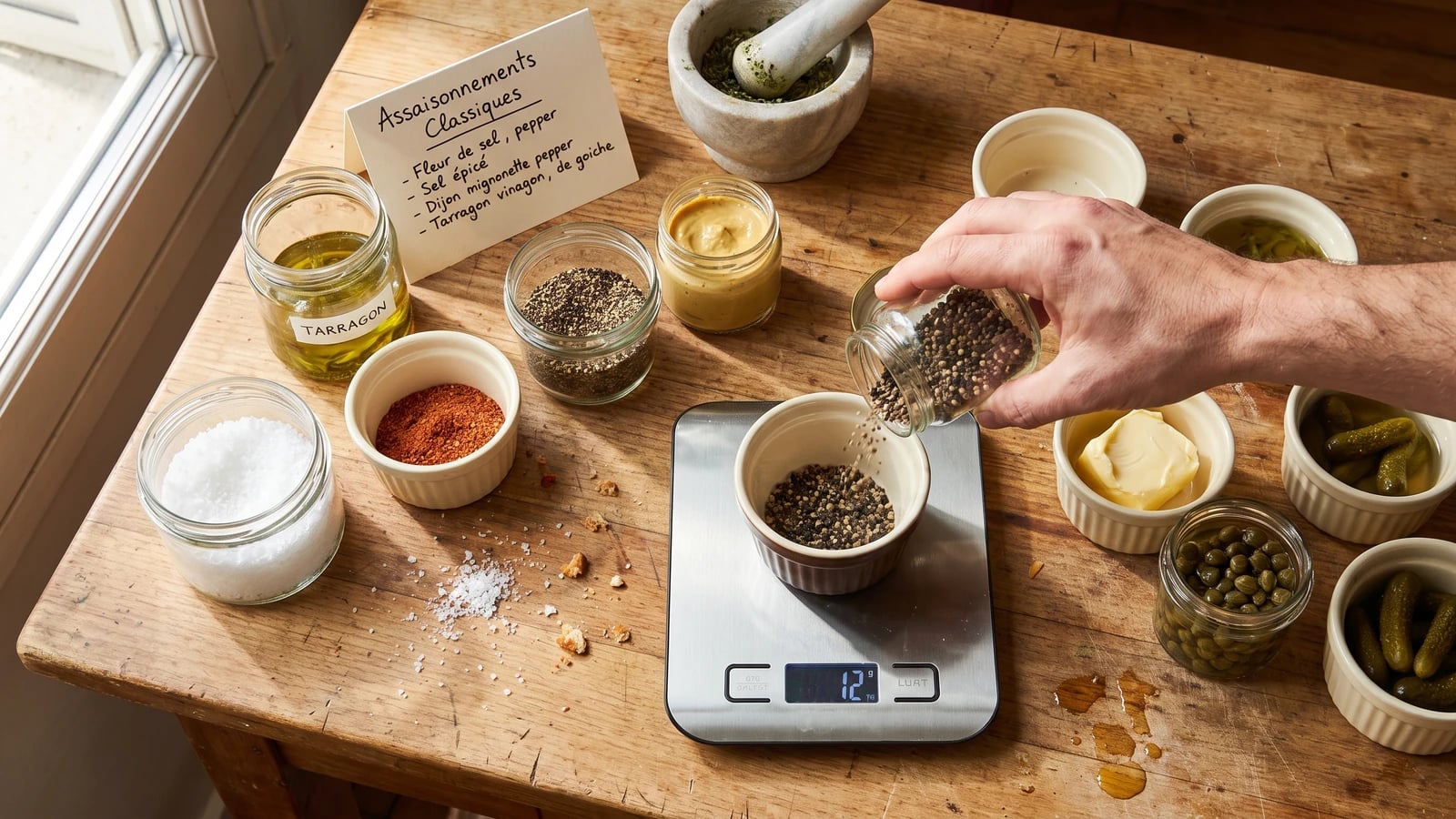
Set out seven labeled groups. The four seasoning classes are saline, acid, hot, and saccharine. The three condiment classes are pungents, strong prepared condiments, and fats. Keep every component separate; this is a working palette, not a jar into which the entire pantry is emptied. Reserve 145 g of the fine salt as plain salt and weigh the remaining 145 g for the sel épicé.
Grind the 12 g of peppercorns finely, then combine them with the measured 145 g salt, paprika, and cayenne. Whisk for a full minute, scrape the bowl, and whisk again until the brick-red spice is distributed without streaks. Transfer the sel épicé (spiced salt) to an airtight jar. If the scale jumps past a quantity before mixing, lift out the excess and weigh again; once everything is blended, subtraction becomes guesswork.
Concass the remaining 25 g peppercorns, meaning crush them roughly, in a mortar or beneath a heavy pan. Stop when most peppercorns have split into coarse, angular fragments. Mignonette needs texture because it should release heat gradually in a marinade or reduction; powder makes the first mouthful fierce and the last one muddy. If part of the batch turns dusty, sift it. Keep the coarse pieces as mignonette and reserve the dust for the next sel épicé. Ça se rattrape.
Reserve 1 cup (240 ml / 240 g) of the vinegar as the plain acid seasoning. Put the remaining 2 cups (480 ml / 480 g) in a small nonreactive saucepan and warm it gently to about 150°F (65°C), without boiling. Pack the completely dry tarragon into a clean heatproof jar, pour over the warm vinegar, close, cool, and refrigerate for 48 hours. Strain and bottle the vinaigre à l'estragon (tarragon vinegar). Taste after the first day; if the leaves begin to give bitterness, strain early, then dilute with reserved plain vinegar in measured 2-tablespoon (30 ml / 30 g) additions.
Place the plain vinegar, vinaigre à l'estragon, verjuice, lemon juice, and the chosen orange juice together as acids. Keep curry, quatre-épices, sel épicé, and mignonette in separate jars among the hot seasonings. Set sugar and honey apart as saccharine seasonings. Separation is the method: curry belongs where a formula calls for curry, and sweetness corrects a particular edge rather than every sauce by habit.
Store the onion, shallots, garlic, chives, and horseradish whole until a dish calls for them. Chop only the quantity needed, because a cut shallot sweetens and softens while grated horseradish loses its force quickly. Mustard, cornichons, capers, Worcestershire, ketchup, and wine form the prepared condiment group. Remember that these bring salt or acid of their own, so count them before reaching for the salt jar.
Weigh the food before seasoning and write down each addition. For 1 pound (450 g) of unseasoned meat or vegetables, begin with 4 g sel épicé, about 0.9 percent of the food's weight. For 1 quart (1 litre) of an unsalted liquid that will reduce, begin with 5 g sel épicé and reserve the final adjustment until reduction is complete. Add acid in 1-teaspoon (5 ml / 5 g) measures, sugar in 1/2-teaspoon (2.5 ml / 2 g) measures, honey in 1/2-teaspoon (2.5 ml / 3.5 g) measures, and ground spice in weighed 0.25 g additions. These are starting doses, not universal final formulas; exactness means knowing what entered the pot.
If the food is too salty, stop reducing and enlarge it with an unsalted portion of its own foundation; a potato does not selectively remove salt. If a finished sauce is badly oversalted, move half to a clean pan, rebuild an equal quantity without seasoning, then combine the two gradually. Too much acid needs more unsalted foundation or butter when the sauce properly takes butter, not a blind fistful of sugar. Excess pepper or cayenne needs dilution and, where the dish allows it, fat. Ça se rattrape, but only if you stop adding and correct the offending class rather than chasing it around the pot.
Keep sel épicé and mignonette airtight, dry, and away from light; make fresh batches after two months, when their perfume begins to flatten. Refrigerate the strained vinaigre à l'estragon and use it within six weeks. Keep butter and rendered fat cold, oils tightly closed in a dark cupboard, and commercial condiments according to their labels. Never hold fresh garlic or herbs under oil at room temperature. Tape a small card inside the cupboard and record the successful seasoning totals for each dish. That card becomes your real home repertoire. À table!
1 serving (about 556g)
Culinary guides, cultural storytelling, and the editorial depth that makes cooking meaningful.
Discover Culinary ExplorerChef Juliette
Beef shin, lean beef, and fowl begin in cold water and rise slowly toward a tremble. Skim before the boil, and you learn the quiet discipline that gives every clear French broth its backbone.
Chef Juliette
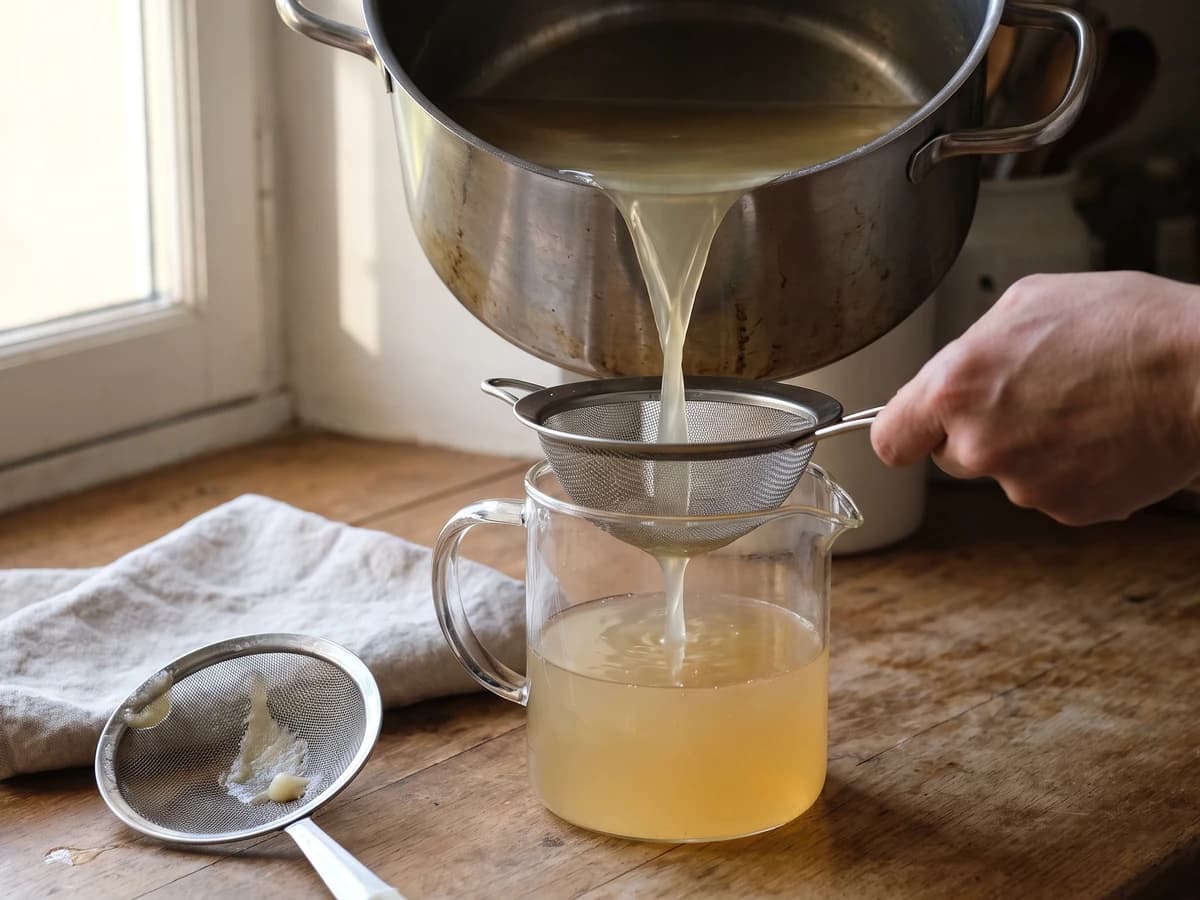
Break the veal bones small, then give them eight hours at a bare tremble. This pale, gelatinous fond becomes the quiet foundation beneath velouté, blanquette, and every sauce that must stay light.
Chef Juliette
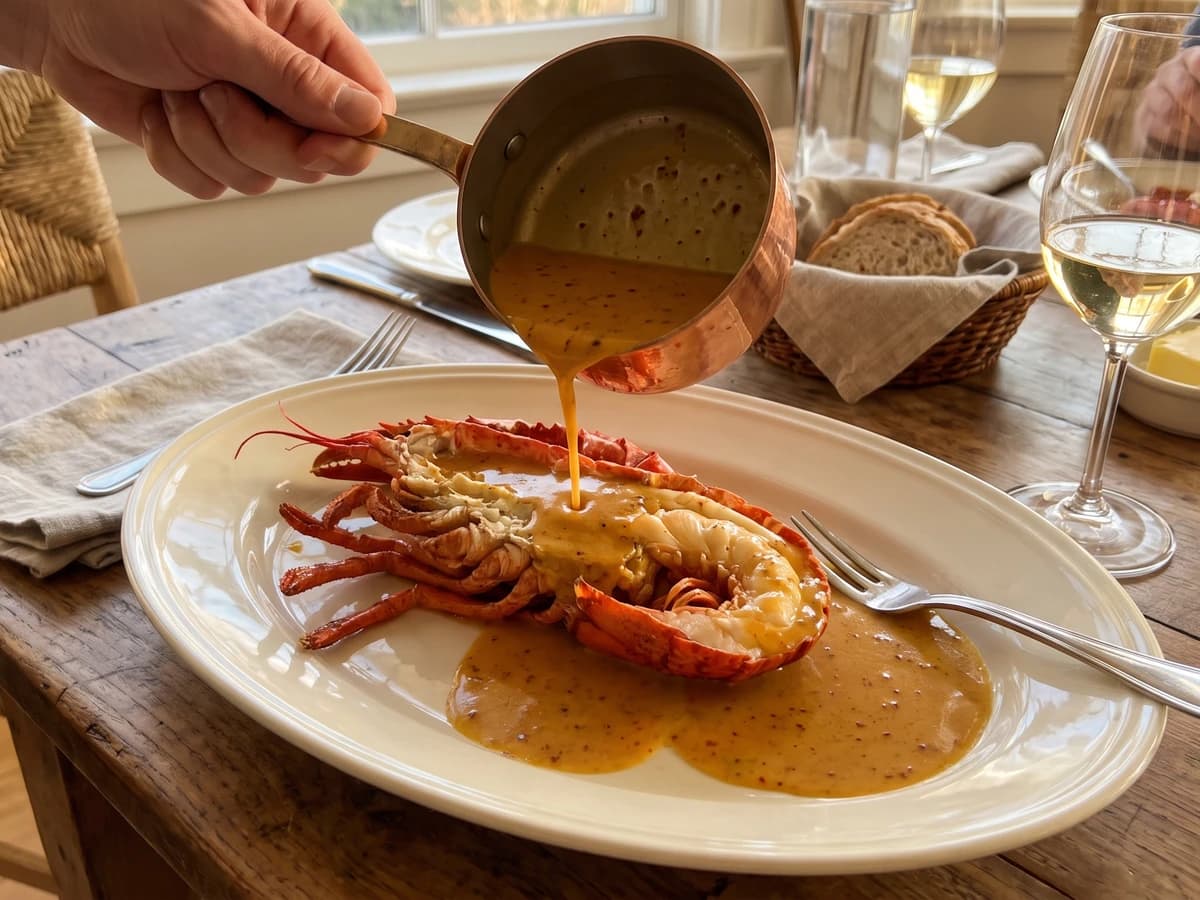
Sauce Orientale concentrates lobster-rich American Sauce with curry, then folds in cream away from the fire: a glossy, gently spiced derivative made for lobster, crayfish, and firm fish.
Chef Juliette
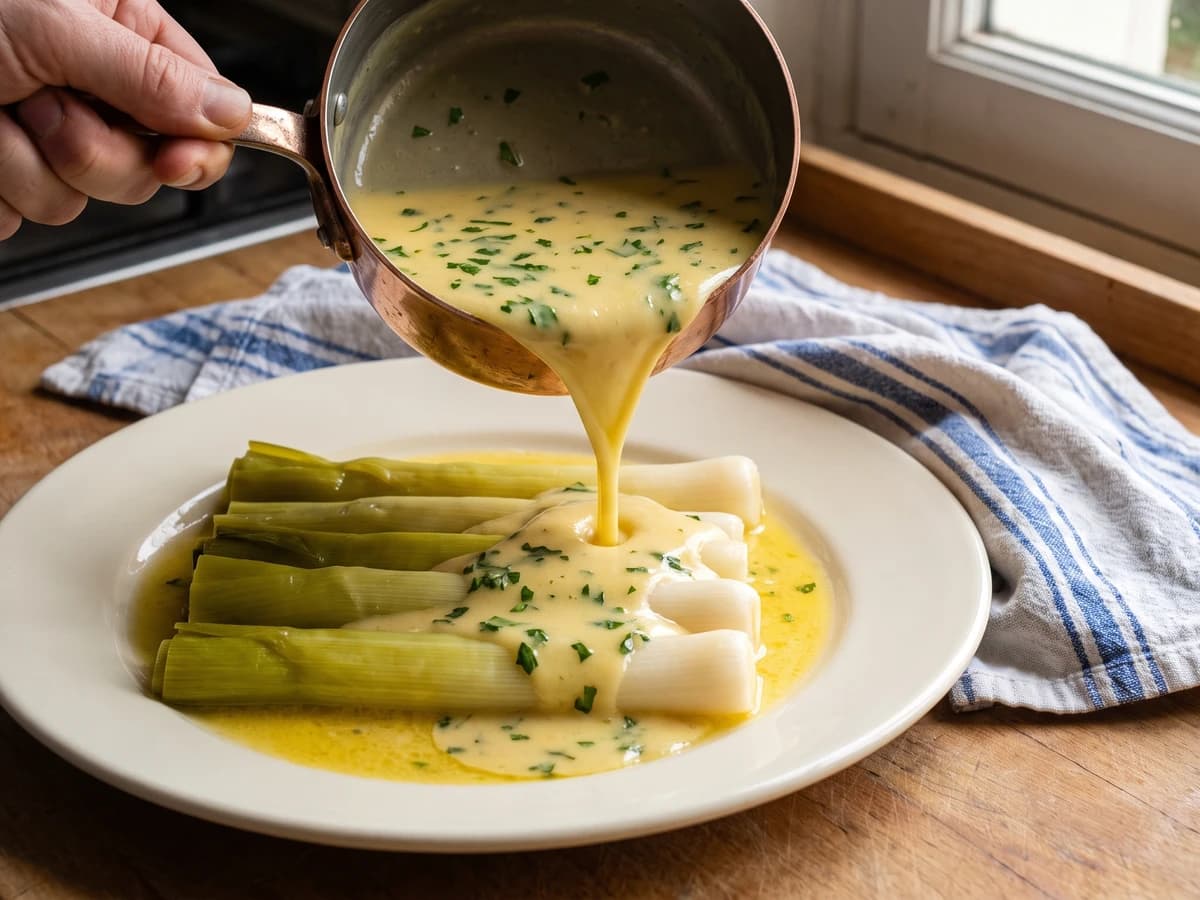
An old lesson in sauce families: Sauce Allemande takes mushroom liquor, then butter, lemon, and parsley, becoming a glossy Poulette for sheep's trotters, leeks, cauliflower, and anything needing gentle richness with a bright edge.