
Chef Juliette
John Dory (St. Pierre)
John Dory has the delicacy of sole and the firmness of turbot. A light flouring, a quick butter sauté, and nut-brown beurre noisette show exactly why looks never mattered.
A cooking platform built around craft, culture, and the stories behind what we eat.
Created by Chef Juliette
Based on No. 1666, Foies de Volaille et Rognons Sautés au Vin Rouge, from Le Guide Culinaire (1907) by Auguste Escoffier
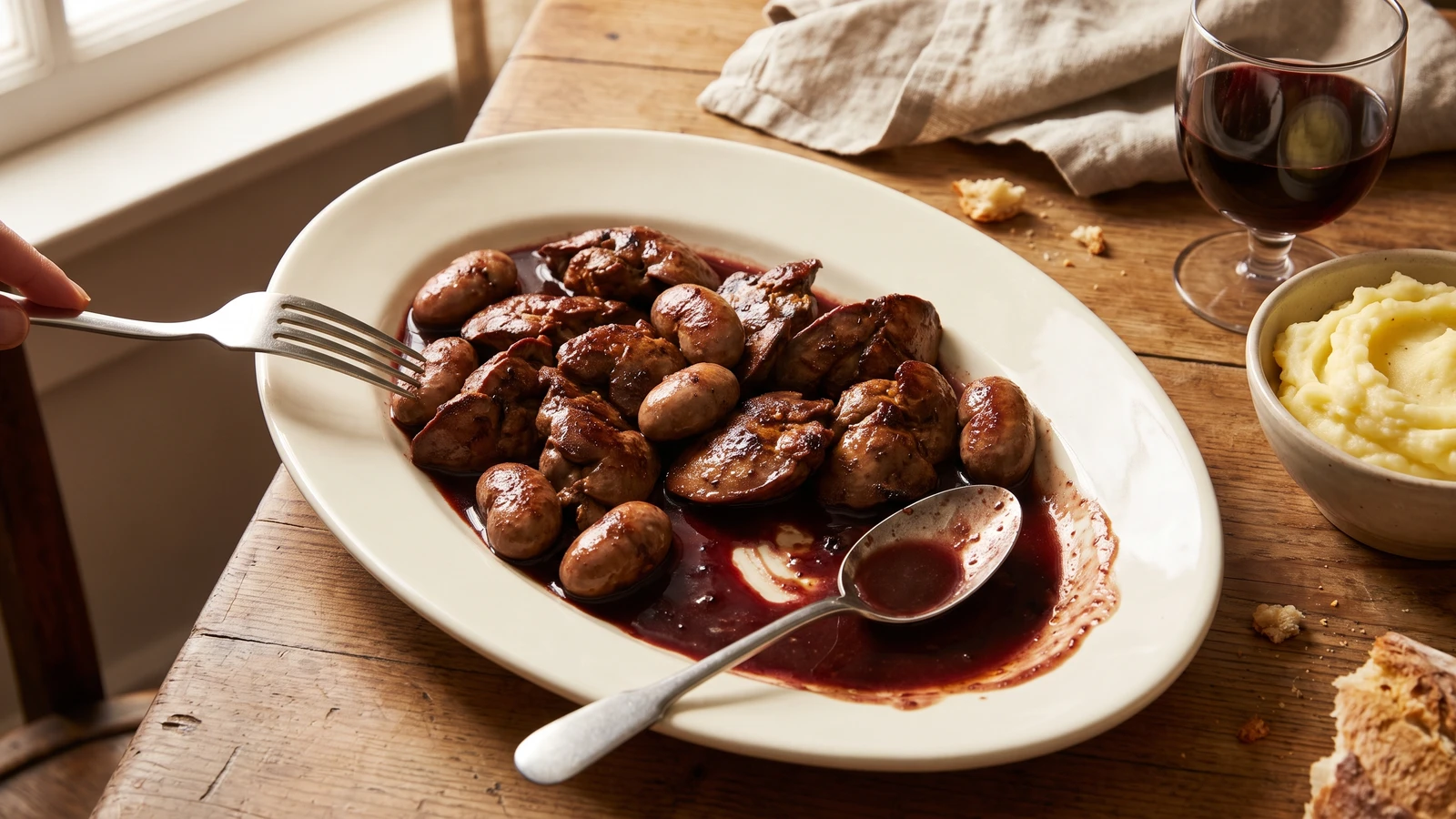
Foies de Volaille et Rognons Sautés au Vin Rouge teaches the essential sauté: color the offal quickly, reduce the wine almost dry, then finish the meat glaze with cold butter away from the flame.
Foies de Volaille et Rognons Sautés au Vin Rouge (chicken livers and cocks' kidneys quickly fried with red wine) teaches one uncompromising principle: the wine must reduce almost dry before the meat glaze enters. Stop early and the sauce tastes raw and watery. Go far enough and the wine leaves a concentrated garnet glaze clinging to the pan, ready to take the richness of meat glaze and butter.
The grand-kitchen entry assumed a saucier on staff and meat glaze waiting beside a stockpot that never went cold. A salamander has no work here. At home, you need a wide stainless-steel skillet, two tablespoons of concentrated meat glaze, and portions small enough to brown without crowding. The timbale and the brigade choreography are scaffolding, so they can go. The hard sauté, the near-dry reduction, and the final monter au beurre, whisking cold butter into the sauce away from the heat, are the dish and must stay. One cook, one stove, one evening.
Everything happens quickly once the offal meets the butter, so trim, measure, and warm the serving dish first. The step that decides the result is simple: reduce the red wine until only a syrupy film remains before adding the meat glaze.
This preparation belongs to the Parisian classical sauté repertory and the wider cuisine bourgeoise, where delicate poultry offal was cooked to order and prepared meat glaze turned the pan fond into sauce within minutes. Despite their English name, rognons de coq are not renal kidneys but the rooster's small testes, once available wherever poultry was raised and now the province of specialist butchers and farmers. The red-wine version follows the same grammar as other wine-finished kidney dishes: quick browning, an almost-dry reduction, meat glaze, and butter.
Quantity
about 2 cups (475 ml / 300 g)
trimmed and sliced ½ inch thick
Quantity
about 2 cups (475 ml / 300 g)
membranes and connective tissue trimmed, larger pieces halved
Quantity
¾ teaspoon (3.75 ml / 4.5 g)
divided
Quantity
½ teaspoon (2.5 ml / 1 g)
Quantity
6 tablespoons (90 ml / 85 g)
divided, with 2 tablespoons kept cold for finishing
Quantity
1¼ cups (300 ml / 300 g)
choose a bright wine without heavy oak
Quantity
2 tablespoons (30 ml / 35 g)
prepared from ½ cup gelatin-rich unsalted veal or beef stock or obtained from a good butcher
Quantity
2 tablespoons (30 ml / 30 g)
use only if needed to loosen or rescue the sauce
Quantity
1 Rognons Sautés au Champagne (No. 1333)
apply its sauté, wine-reduction, meat-glaze, and butter-finish sequence with red wine replacing Champagne
Quantity
1 Gratins (No. 268)
retain as the source cross-reference only; do not gratin this sauté
| Ingredient | Quantity |
|---|---|
| chicken liverstrimmed and sliced ½ inch thick | about 2 cups (475 ml / 300 g) |
| cocks' kidneysmembranes and connective tissue trimmed, larger pieces halved | about 2 cups (475 ml / 300 g) |
| fine sea saltdivided | ¾ teaspoon (3.75 ml / 4.5 g) |
| freshly ground black pepper | ½ teaspoon (2.5 ml / 1 g) |
| unsalted butterdivided, with 2 tablespoons kept cold for finishing | 6 tablespoons (90 ml / 85 g) |
| excellent dry red winechoose a bright wine without heavy oak | 1¼ cups (300 ml / 300 g) |
| melted meat glazeprepared from ½ cup gelatin-rich unsalted veal or beef stock or obtained from a good butcher | 2 tablespoons (30 ml / 35 g) |
| cold water (optional)use only if needed to loosen or rescue the sauce | 2 tablespoons (30 ml / 30 g) |
| finished procedural templateapply its sauté, wine-reduction, meat-glaze, and butter-finish sequence with red wine replacing Champagne | 1 Rognons Sautés au Champagne (No. 1333) |
| related source preparationretain as the source cross-reference only; do not gratin this sauté | 1 Gratins (No. 268) |
Use Rognons Sautés au Champagne (No. 1333) as the governing procedural template, replacing its Champagne with the measured red wine while preserving the quick sauté, near-dry reduction, meat glaze, and butter finish. Gratins (No. 268) remains the source entry's related preparation, but it is not applied here. This dish is a sauté, not a gratin.
If the meat glaze is already concentrated, warm it just until fluid and measure 2 tablespoons (30 ml / 35 g). If beginning with gelatin-rich unsalted stock, boil ½ cup until only 2 tablespoons remain and the liquid coats a cold spoon with a sticky gloss. This is the honest home equivalent of the stockpot that never went cold. Avoid salty, flour-thickened gravy concentrates, which become harsh when reduced.
Remove any green-stained patches, tough veins, and loose connective tissue from the chicken livers, then slice them evenly. Trim the fine outer membrane and attached tissue from the cocks' kidneys, halving any large ones so the two kinds of offal cook at the same pace. Pat everything very dry and keep it cold until the skillet is ready. Wet offal releases liquid, and liquid prevents the hard, bronzed sauté this dish requires.
Warm a serving dish. Heat 2 tablespoons of the butter in a wide stainless-steel skillet over medium-high heat until the foam subsides and the butter turns hazelnut-gold. Season half the offal immediately before it enters the pan, then lay it in one uncrowded layer. Sauté without disturbing until the first side is deeply bronzed, turn, and cook the second side until the thickest pieces reach 165°F (74°C). Transfer them to the warm dish and repeat with the remaining offal and 2 more tablespoons butter. If the butter blackens, stop and wipe out the bitter solids before continuing with fresh butter. Ça se rattrape. Do not scrape away a brown, unburnt fond, because that is the sauce's foundation.
Pour off any excess fat while leaving the brown fond in the skillet. Add the red wine and déglacer, dissolving every caramelized trace with a wooden spoon. Boil briskly until the wine is reduced almost entirely and only about 2 tablespoons of dark, syrupy liquid glaze the pan. The sharp alcoholic smell should be gone. If the reduction remains thin, keep boiling. If it goes dry but has not scorched, add 1 tablespoon cold water and dissolve it again. Ça se rattrape.
Lower the heat and stir in the melted meat glaze. Simmer for 30 to 60 seconds, just until the sauce looks wine-dark, concentrated, and able to coat the back of a spoon. Taste before adding more salt, because meat glaze concentrates seasoning fiercely. If the sauce becomes too tight, loosen it with cold water a teaspoon at a time. It should cling, not sit like paste.
Remove the skillet completely from the heat. Cut the remaining 2 tablespoons cold butter into small pieces and whisk them in one at a time until the sauce becomes smooth and glossy. This is monter au beurre, and the pan must stay away from the flame or the emulsion will split. If beads of butter appear, whisk 1 teaspoon cold water in a clean bowl, then add the broken sauce gradually. Ça se rattrape.
Return the sautéed livers and cocks' kidneys to the skillet off the heat and turn them through the sauce only until evenly coated. Do not simmer them again, or the liver becomes chalky and the kidneys firm. Transfer everything to the warmed dish, spoon over every streak of sauce, and serve at once with mashed potatoes or bread ready to catch it. À table!
1 serving (about 165g)
Culinary guides, cultural storytelling, and the editorial depth that makes cooking meaningful.
Discover Culinary ExplorerChef Juliette
John Dory has the delicacy of sole and the firmness of turbot. A light flouring, a quick butter sauté, and nut-brown beurre noisette show exactly why looks never mattered.

Chef Juliette
Fresh haddock proves its delicacy in the meunière pan: a fine flour crust, moist pearly flakes, and beurre noisette sharpened with lemon and parsley, ready from one skillet in half an hour.

Chef Juliette
Éperlans à l’Anglaise turns small fish into a lesson in disciplined coating: boned smelts under a close, crisp crumb, pan-fried in clarified butter and finished with bright, half-melted maître d’hôtel butter.

Chef Juliette
Tiny smelts, shallot, mushrooms, white wine, gratin sauce, and fine bread raspings meet a fierce oven, where the fish must turn tender in the same breath the buttered crust bronzes.