Culinary Explorer

A cooking platform built around craft, culture, and the stories behind what we eat.
Discover Culinary Explorer
Rognons Sautés au Champagne

Rognons Sautés au Champagne

Created by Chef Juliette

Based on No. 1333, Rognons Sautés au Champagne, from Le Guide Culinaire (1907) by Auguste Escoffier

Rognons sautés au Champagne teach the essential wine-pan sauce: brown the kidneys fast, reduce Champagne almost dry, then add meat glaze and mount with butter until every piece wears a bright, savory gloss.

Main Dishes
French
Dinner Party
Special Occasion
Date Night
20 min
Active Time
15 min cook35 min total
Yield4 servings

Rognons Sautés au Champagne (mutton kidneys sautéed with Champagne) teaches the wine-pan sauce at its clearest. One true thing: the kidneys wait for the sauce, never the sauce for the kidneys. Brown them quickly, lift them out, and don't return them until the reduction is finished. Let them simmer in Champagne and tenderness is gone.

The original entry assumed a saucier on staff, meat glaze held beside a stockpot never off the fire, a fierce range that could take six kidneys without cooling, and a timbale waiting warm for service. A salamander has no work here, because the entire sauce is made in the pan. At home, an unsalted refrigerated meat-glaze concentrate replaces the perpetual stockpot, two small batches replace the fierce range, and a warmed deep serving bowl replaces the timbale. We scale six kidneys to four while keeping the precise wine-to-glaze ratio. The ready glaze and service vessel are brigade scaffolding; the near-dry reduction and final butter are the dish itself. One cook, one stove, one evening.

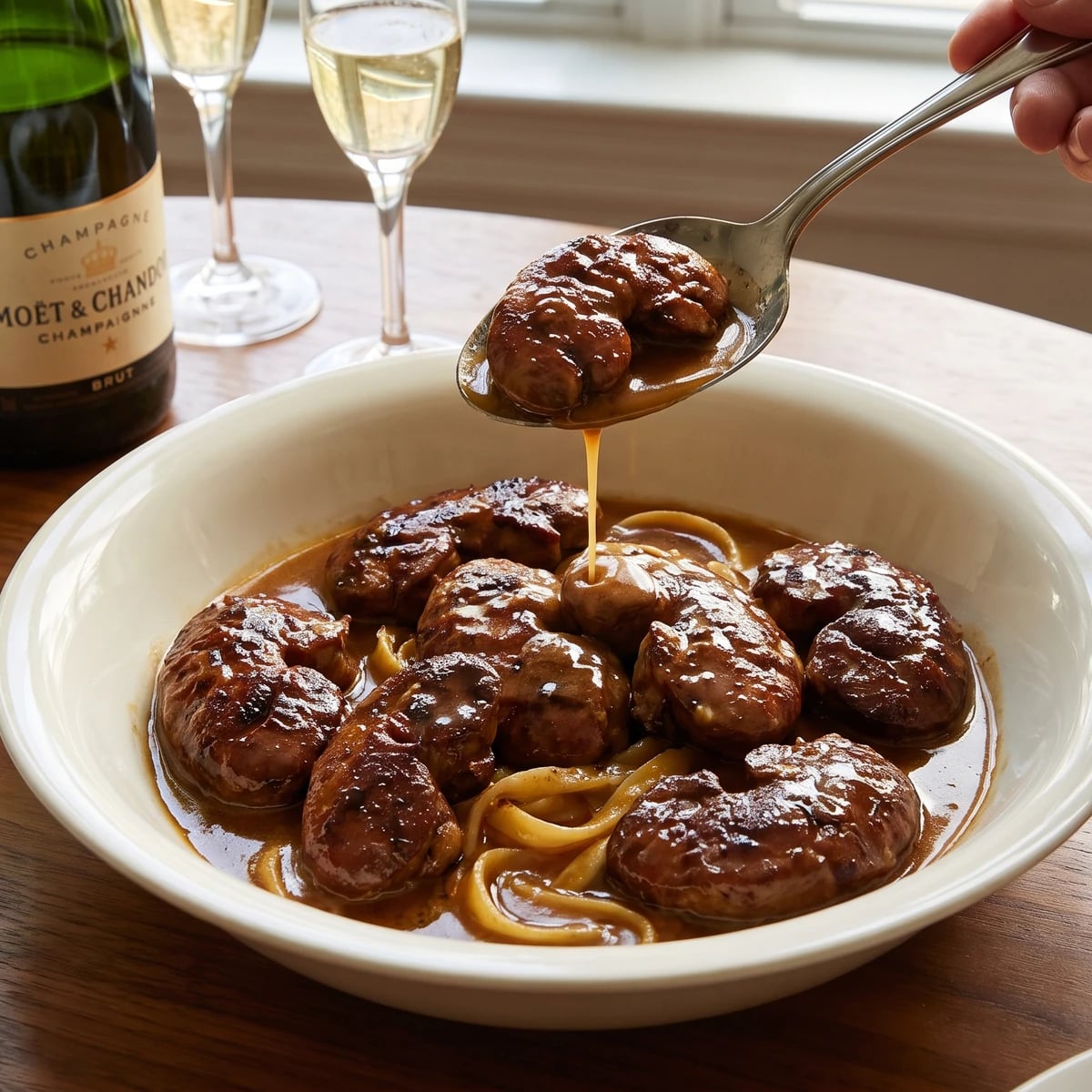
The finished kidneys are deeply bronzed, tender within, and wrapped in a thin, lustrous sauce that tastes savory first and Champagne second. Before the pan heats, dry the kidneys completely. Moisture turns a sauté into a simmer, and that is the one mistake this sauce cannot conceal.

Rognons sautés belong to Parisian bistro and bourgeois cookery, where kidneys were prized as quick-cooking cuts and the browned pan became the foundation of supper. The Champagne version comes from the grand-kitchen branch of that practice: the same sauté-and-deglaze grammar used with Madeira or port, made more festive with Champagne and reinforced by meat glaze. It is not a provincial dish from Champagne; the wine names the sauce, while the method belongs to the national classical canon.

The technique, the tradition, and the story behind every dish.

Discover Culinary Explorer

Ingredients

mutton kidneys

Quantity

4 (about 1 lb / 450 g total)

outer skins removed and halved lengthwise

unsalted butter for sautéing

Quantity

2 tablespoons (30 ml / 28 g)

divided

fine sea salt

Quantity

½ teaspoon (2.5 ml / 3 g)

freshly ground black pepper

Quantity

¼ teaspoon (1.25 ml / 0.5 g)

brut Champagne

Quantity

¾ cup plus 1 tablespoon (190 ml / 190 g)

melted unsalted meat glaze

Quantity

4 teaspoons (20 ml / 23 g)

cold unsalted butter for finishing

Quantity

1 tablespoon (15 ml / 14 g)

cut into 3 pieces

Equipment Needed

  • 30 cm / 12-inch heavy stainless-steel sauté pan
  • Small sharp knife
  • Flexible metal spatula or tongs
  • Instant-read thermometer
  • 1.5-liter warmed deep serving bowl

Instructions

  1. 1

    Prepare the kidneys

    Peel away any remaining translucent outer skin and split each kidney lengthwise. If the butcher has left a dense white core in the center, trim it narrowly with a small sharp knife while keeping each half intact. Pat every surface thoroughly dry, then leave the kidneys uncovered in the cold while you measure the Champagne and meat glaze. Warm a deep serving bowl with hot water, dry it, and set it beside the stove.

    Don't soak the kidneys in milk or water. Fresh mutton kidneys need no disguise, and a waterlogged surface will simmer instead of brown.
  2. 2

    Sauté in batches

    Season the kidneys with the salt and pepper just before cooking. Heat a wide stainless-steel sauté pan over medium-high heat, then add half the sautéing butter. When the foam rises and begins to subside, lay in four kidney halves, cut sides down. Sauté for 1½ to 2 minutes without disturbing them, turn, and cook the rounded sides for another 1 to 2 minutes. Transfer them to the warmed bowl while still slightly underdone, about 150 to 155°F (66 to 68°C) at the thickest point. Repeat with the remaining butter and kidneys.

    If the pan fills with grey liquid, it cooled or became crowded. Lift the kidneys out, boil the liquid away, add a little of the remaining sautéing butter, and resume with fewer pieces. Ça se rattrape.
  3. 3

    Swill with Champagne

    With all the kidneys out of the pan, immediately pour in the Champagne. Swill the pan, scraping every browned morsel from its floor and sides into the wine. Boil briskly until the Champagne has reduced almost entirely, about 5 to 7 minutes. As the liquid narrows, lower the heat and watch closely. It is ready when only about 1 tablespoon remains and the pan wears a syrupy, wine-scented glaze rather than a puddle.

    If the pan goes dry before the meat glaze is ready to enter, pull it from the heat and stir in 1 tablespoon (15 ml / 15 g) cold water to release the fond. Ça se rattrape. If the residue smells scorched rather than toasted, move to a clean pan; burnt butter cannot be persuaded into a good sauce.
  4. 4

    Add the meat glaze

    Lower the heat and stir in the melted meat glaze. Let it bubble gently for 20 to 30 seconds, just until the reduction and glaze become one glossy base. Taste before adding any further seasoning, because even an unsalted concentrate becomes powerful when reduced. If it tastes too forceful, loosen it with 1 teaspoon (5 ml / 5 g) water and bring it back to one brief simmer.

  5. 5

    Monter au beurre

    Take the pan completely off the heat. Monter au beurre, finish the sauce with cold butter, by whisking in two pieces one at a time until the sauce gleams and lightly coats a spoon. If the butter floats in greasy beads, whisk in 1 teaspoon (5 ml / 5 g) cold water off the heat, then continue. Ça se rattrape. Return the kidneys and their resting juices to the pan, toss them gently over the lowest heat for 30 to 45 seconds, and confirm that the thickest pieces reach 160°F (71°C). If their juices thin the sauce, lift the kidneys out, reduce the sauce briefly, remove it from the heat, and whisk in the reserved final piece of butter before coating them again. Transfer everything to the warmed bowl and serve immediately. À table!

Chef Tips

  • Order mutton kidneys from a butcher and ask for them whole, not sliced. They should look moist and deep red-brown and smell cleanly mineral, never sharp or ammoniacal. If only small lamb kidneys are available, use enough to reach the same 1 lb (450 g) weight and shorten the first sauté slightly; the flavor will be milder, and that difference is real.
  • Use brut Champagne. The sauce reduces the wine until every quality is concentrated, so a sweet bottle becomes cloying and a harsh one becomes harsher. The recipe takes only part of the bottle, which settles the question of what to pour with dinner.
  • The original's melted meat glaze was not gravy. Look for an unsalted refrigerated or frozen concentrate made by reducing beef or veal stock until gelatinous, with no sugar and no starch thickener. Four teaspoons are enough because the Champagne reduction does the rest.
  • Serve the rognons the moment the sauce is mounted. Pommes purée or plain buttered noodles will catch every drop without arguing with the Champagne. Kidneys become firm when reheated, so this is a dish to finish while everyone is already moving toward the table.

Advance Preparation

  • The kidneys may be skinned, halved, trimmed, and dried up to 4 hours ahead. Keep them uncovered in the cold between clean paper towels, then season only when the pan is ready.
  • Measure the Champagne and meat glaze earlier in the day, and keep the finishing butter cut and cold. Once the kidneys enter the pan, the dish moves quickly.
  • The sauce cannot be made ahead because it is built from the fresh fond left by the kidneys. Cooked rognons also toughen when reheated, so plan to serve them directly from the pan.

Frequently Asked Questions

Nutrition Information

1 serving (about 105g)

Calories
205 calories
Total Fat
12 g
Saturated Fat
7 g
Trans Fat
0.4 g
Unsaturated Fat
4 g
Cholesterol
405 mg
Sodium
500 mg
Total Carbohydrates
1 g
Dietary Fiber
0 g
Sugars
1 g
Protein
19 g

Note: Chef personas and recipes are created with AI assistance. Cook with care: follow safe food-handling practices, check doneness with a thermometer when needed, and adapt for allergies and your kitchen.

Where cooking meets culture.

Culinary guides, cultural storytelling, and the editorial depth that makes cooking meaningful.

Discover Culinary Explorer

More from Relevés and Entrées - MUTTON, GRASS LAMB AND HOUSE LAMB

Browse the full collection