
Chef Juliette
Abatis aux Navets
Glazed turnips, pearl onions, and tender poultry giblets settle into a pale, glossy sauce, with crisp-edged salt pork lending depth: a thrifty braise whose whole success rests on cooking the flour first.
A cooking platform built around craft, culture, and the stories behind what we eat.
Created by Chef Juliette
Based on No. 1662, Crêtes et Rognons de Coq à la Grecque, from Le Guide Culinaire (1907) by Auguste Escoffier
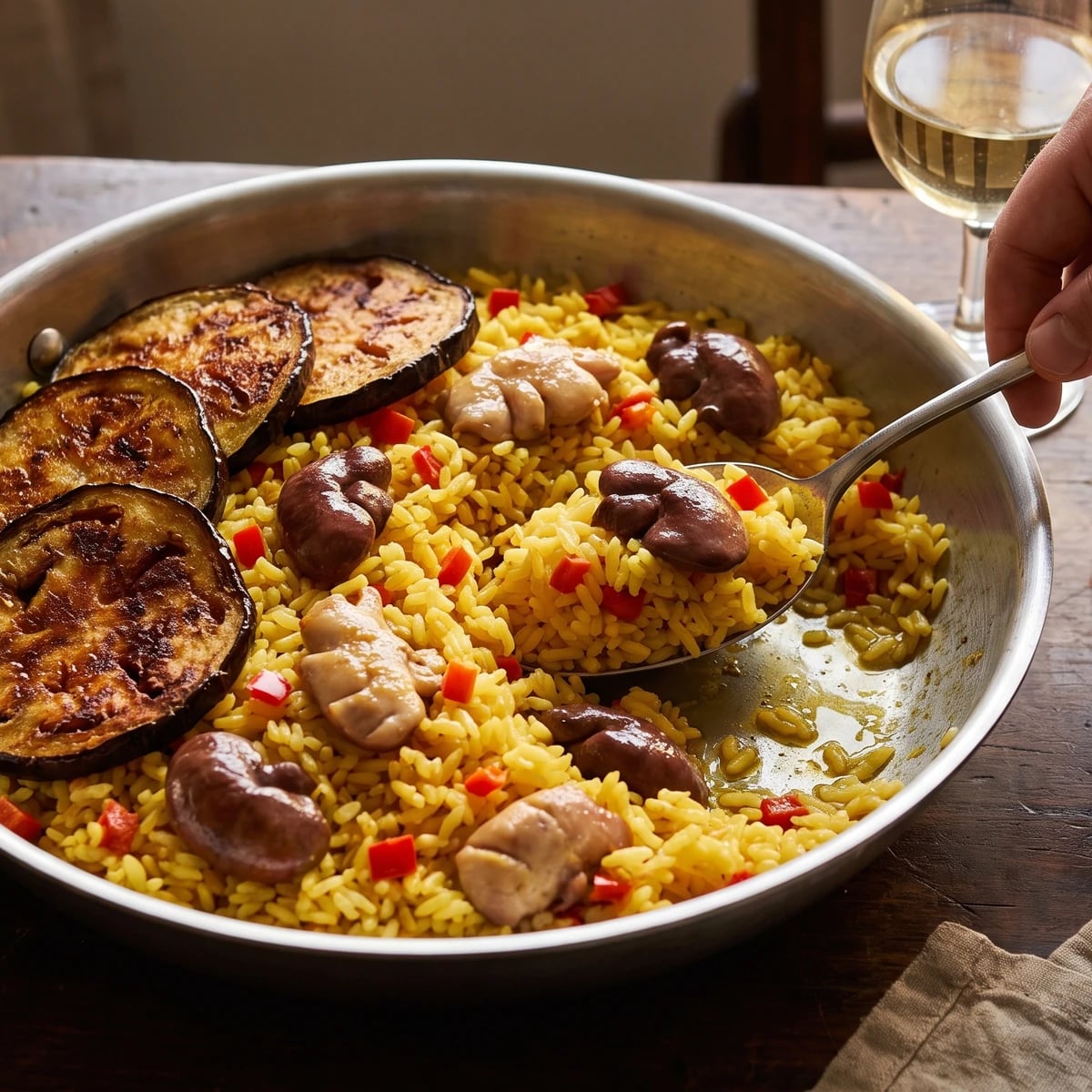
Crêtes et Rognons de Coq à la Grecque makes timing the technique: saffron pilaff, tender poultry offal, and crisp aubergine must meet in one warm pan and reach the table without waiting.
Crêtes et Rognons de Coq à la Grecque (cocks' combs and kidneys with saffron pilaff) teaches service à la minute, the discipline of making every element land together. The rice must remain separate, the kidneys tender, the combs buttery, and the aubergine crisp at the edges. The one true thing is this: the dish cannot wait for the cook.
The original assumed a brigade with prepared combs at hand, one cook minding the pilaff, another ready to fry, and a silver saucepan already warm for service. At home, the linked comb preparations are completed first, the work is arranged around the rice's clock, and a warmed shallow serving pan replaces the silver. I have reduced the ten-cover quantities to four, rounding the indivisible offal to ten kidneys and five combs so their two-to-one proportion remains intact. One cook, one stove, one evening.
The separate stations and silver vessel were brigade scaffolding and may go. Correctly prepared combs, kidneys frizzled in real butter, aubergine fried at the last moment, and immediate service are the dish itself. The rice is your clock: once its lid lifts, finish the offal, fold gently, and go straight to the table.
This dish belongs to the Parisian grand-kitchen repertory rather than to a regional Greek home table. Its à la grecque title names a classical garnish in which saffron pilaff, capsicum, and aubergine frame prized poultry abatis, the edible trimmings that whole-bird kitchens kept and grand kitchens refined. It should not be confused with the separate French vegetable preparation also called à la grecque, in which vegetables are cooked with oil, wine, and aromatics.
Quantity
Scant 1 cup (225 ml / 190 g)
rinsed until the water runs clear and drained thoroughly
Quantity
1⅔ cups (400 ml / 400 g)
heated, with ¼ cup reserved
Quantity
1½ tablespoons (22 ml / 21 g)
Quantity
2 tablespoons (30 ml / 25 g)
finely chopped
Quantity
⅕ large, about 3 tablespoons (45 ml / 30 g)
cut into 5 mm dice
Quantity
Scant 1/16 teaspoon (0.3 ml / 0.05 g)
Quantity
10
ready-cleaned, membrane-trimmed, and dried thoroughly
Quantity
2 tablespoons (30 ml / 28 g)
divided
Quantity
1, about 200 g
cut crosswise into 4 center roundels 1 cm thick
Quantity
2 tablespoons (30 ml / 16 g)
for dredging
Quantity
½ cup (120 ml / 110 g)
Quantity
1¼ teaspoons (6 ml / 7.5 g)
divided
Quantity
¼ teaspoon (1 ml / 0.5 g)
| Ingredient | Quantity |
|---|---|
| long-grain white ricerinsed until the water runs clear and drained thoroughly | Scant 1 cup (225 ml / 190 g) |
| light chicken stockheated, with ¼ cup reserved | 1⅔ cups (400 ml / 400 g) |
| unsalted butter for the pilaff | 1½ tablespoons (22 ml / 21 g) |
| yellow onionfinely chopped | 2 tablespoons (30 ml / 25 g) |
| red capsicumcut into 5 mm dice | ⅕ large, about 3 tablespoons (45 ml / 30 g) |
| saffron threads | Scant 1/16 teaspoon (0.3 ml / 0.05 g) |
| very fresh cocks' kidneysready-cleaned, membrane-trimmed, and dried thoroughly | 10 |
| unsalted butter for frizzling the kidneysdivided | 2 tablespoons (30 ml / 28 g) |
| fine cocks' combs | 5, completed through Blanchings (No. 273) and Poëlings (No. 250) |
| small auberginecut crosswise into 4 center roundels 1 cm thick | 1, about 200 g |
| plain flourfor dredging | 2 tablespoons (30 ml / 16 g) |
| neutral frying oil | ½ cup (120 ml / 110 g) |
| fine sea saltdivided | 1¼ teaspoons (6 ml / 7.5 g) |
| freshly ground black pepper | ¼ teaspoon (1 ml / 0.5 g) |
Before the 25-minute service run begins, have the five fine cocks' combs fully completed through Blanchings (No. 273) and Poëlings (No. 250), following those linked preparations as written. Keep the finished combs covered with their cooking butter at the gentlest warmth for no more than 20 minutes. These operations remain whole because each is its own preparation in the canon; this recipe reaches for them ready.
Heat the oven to 350°F (180°C). Pour 2 tablespoons of the hot stock over the saffron and leave it for 5 minutes. Set out the drained rice, diced capsicum, onion, kidneys, aubergine, flour, and two pans before cooking begins. Once the rice starts, every remaining action has its place; this mise en place is what replaces the spare hands of a brigade.
Melt the pilaff butter in a heavy ovenproof saucepan over medium-low heat. Add the onion and cook for 2 minutes without coloring, then add the capsicum for 1 minute. Stir in the rice and nacrez it, coating every grain in butter until it looks pearly but not browned. Add 1½ cups of the hot stock, the saffron with its soaking stock, and ¾ teaspoon of the salt. Bring just to a simmer, cover tightly, and bake for 17 minutes. Rest it covered for 5 minutes, then test a grain. If the center remains chalky and the pan is dry, add 2 tablespoons of reserved hot stock, cover, and bake for 4 minutes more. Ça se rattrape. If liquid remains, return the pan uncovered for 2 minutes.
During the final 10 minutes of the rice's cooking, season the aubergine roundels lightly on both sides and dredge them in the flour, shaking off every loose trace. Heat the oil to 350°F (175°C) and fry the roundels without crowding until deep gold, about 2 minutes per side. Drain them on a rack and keep them uncovered. If the oil cools and the surface turns soft, raise it to temperature and return the roundels for 20 seconds; the edges will recover, though oil already absorbed cannot be taken back.
Five minutes before the pilaff is ready, melt 1½ tablespoons of the kidney butter in a wide frying pan over medium-high heat. When the bubbling subsides and the butter smells nutty, add the thoroughly dry kidneys in one layer. Season with the remaining salt and the pepper, then frizzle them briskly for 2 to 3 minutes, tossing often, until lightly bronzed, just firm, and opaque throughout; the largest should reach 165°F (74°C). If they shed liquid and begin to gray, lift them out, pour away the liquid, wipe the pan, and return them briefly with the reserved butter. Ça se rattrape. Do not keep cooking once they are done, or tenderness is lost.
Fluff the pilaff gently with a fork, separating the grains without crushing them. Fold in the frizzled kidneys with their browned butter, then add the combs completed through Blanchings (No. 273) and Poëlings (No. 250), turning them through only enough to distribute them without tearing their delicate points. Taste once for salt. From this moment, do not hold the dish.
Warm a shallow metal serving pan with hot water, empty it, and dry it completely. Spoon in the saffron pilaff, leaving several combs and kidneys visible across the top, then arrange the four fried aubergine roundels around the rim in an overlapping circle. Carry it directly to the table while the rice still gleams and the aubergine edges remain crisp. À table!
1 serving (about 250g)
Culinary guides, cultural storytelling, and the editorial depth that makes cooking meaningful.
Discover Culinary Explorer
Chef Juliette
Glazed turnips, pearl onions, and tender poultry giblets settle into a pale, glossy sauce, with crisp-edged salt pork lending depth: a thrifty braise whose whole success rests on cooking the flour first.

Chef Juliette
Pâté d’abatis turns modest poultry giblets into a generous supper: browned in butter, bound with a light consommé sauce, cooled completely, then sealed beneath puff pastry that rises crisp and gilded.

Chef Juliette
Four boned chicken legs become compact ballotines, packed with good sausage meat, sewn into their own skin, browned deeply, and braised until the filling stays juicy and the pan sauce gleams.

Chef Juliette
Boudins de Volaille à la Richelieu turn a cold chicken mousseline around truffled salpicon, then poach, crumb, and bronze it in clarified butter, with glossy Périgueux sauce served separately.