
Chef Juliette
John Dory (St. Pierre)
John Dory has the delicacy of sole and the firmness of turbot. A light flouring, a quick butter sauté, and nut-brown beurre noisette show exactly why looks never mattered.
A cooking platform built around craft, culture, and the stories behind what we eat.
Created by Chef Juliette
Based on No. 1618, Suprêmes de Volaille Talleyrand, from Le Guide Culinaire (1907) by Auguste Escoffier
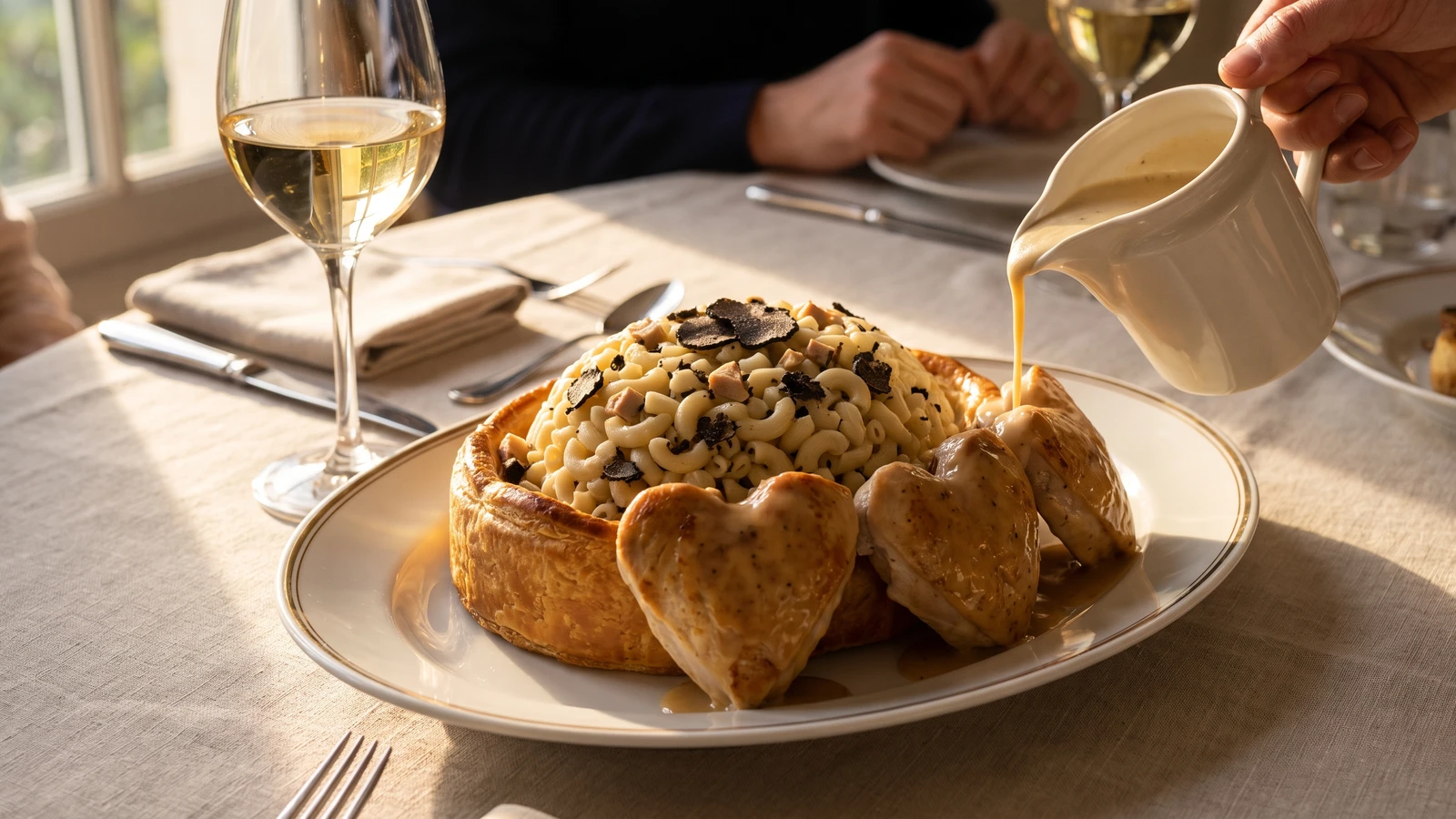
Four foie-gras-stuffed chicken suprêmes, gently dry-poached and glazed with Allemande, lean around a crisp croustade of creamy macaroni, diced truffle, and foie gras, with velouté passed generously.
Suprêmes de Volaille Talleyrand (Talleyrand chicken breast fillets with truffled macaroni, foie gras, and Allemande) teaches orchestration. The one true thing to know before touching a pan is that every component must arrive hot while the stuffed chicken remains tender. The croustade must stay crisp, the godiveau cold until it cooks, and the sauces fluid enough to coat rather than bury. This is not complication for its own sake. Each texture has a job.
The book's kitchen assumed a saucier on staff, stock never off the fire, a drying-box for pastry, and a salamander ready for the last heat. At home, one saucepan makes the velouté and Allemande in sequence, while a low domestic oven dries and warms the croustade. What changed is scale and labor, not composition: four suprêmes replace the banquet rank, half the book's macaroni basis gives 4 ounces of macaroni with 1½ ounces each of foie gras and truffle, and the stuffing still takes foie gras purée equal to half the bulk of godiveau. One cook, one stove, one evening.
The brigade's separate batches and extra hands were scaffolding, so they can go. The crisp croustade, exact garnish ratios, cold forcemeat, pochage à sec, Allemande coating, crown arrangement, and separate sauceboat of velouté are the dish, so they stay. The decisive step is the pochage à sec, dry-poaching without added liquid: keep the suprêmes covered and cook them gently until the filling is safely done. Rush that heat and the chicken pays for it.
Suprêmes de Volaille Talleyrand belongs to the Parisian grand kitchen and takes its name from the diplomat Talleyrand, whose table made hospitality part of statecraft. Its croustade, crown of chicken breast, foie gras, and black truffle speak the language of ceremonial service rather than any regional farmhouse or Lyonnais bouchon. The macaroni is no foreign flourish: Parisian cooks had long treated pasta as a formal garniture, enriching it with cream and arranging it architecturally beside poultry.
Quantity
1 baked 8-inch (20 cm) croustade from Croûtes et Croustades (No. 2393)
Quantity
4 (about 1½ lb / 680 g total)
Quantity
½ cup (120 ml / 110 g) Veal Forcemeat with Fat or Godiveau (No. 198)
thoroughly chilled
Quantity
¼ cup (60 ml / 55 g)
pressed through a fine sieve into a purée and chilled
Quantity
2 tablespoons (30 ml / 28 g)
softened
Quantity
1 cup (240 ml / 113 g)
Quantity
½ cup (120 ml / 120 g)
Quantity
1 tablespoon (15 ml / 14 g)
Quantity
3 tablespoons (45 ml / 43 g)
chilled and cut into small dice
Quantity
⅓ cup (80 ml / 43 g)
drained if preserved and cut into small dice
Quantity
3 tablespoons (45 ml / 42 g)
Quantity
⅓ cup (80 ml / 40 g)
Quantity
2½ cups (600 ml / 600 g)
kept hot
Quantity
⅓ cup (80 ml / 80 g)
divided
Quantity
1
Quantity
2 teaspoons (10 ml / 10 g)
Quantity
2 teaspoons (10 ml / 12 g), plus more for the macaroni water
divided
Quantity
½ teaspoon (2.5 ml / 1 g)
divided
| Ingredient | Quantity |
|---|---|
| baked croustade | 1 baked 8-inch (20 cm) croustade from Croûtes et Croustades (No. 2393) |
| boneless, skinless chicken breast halves | 4 (about 1½ lb / 680 g total) |
| cream godiveauthoroughly chilled | ½ cup (120 ml / 110 g) Veal Forcemeat with Fat or Godiveau (No. 198) |
| cooked foie gras for stuffingpressed through a fine sieve into a purée and chilled | ¼ cup (60 ml / 55 g) |
| unsalted butter for the baking dishsoftened | 2 tablespoons (30 ml / 28 g) |
| dried small tubular macaroni | 1 cup (240 ml / 113 g) |
| heavy cream for the macaroni | ½ cup (120 ml / 120 g) |
| unsalted butter for the macaroni | 1 tablespoon (15 ml / 14 g) |
| cooked foie gras for the macaronichilled and cut into small dice | 3 tablespoons (45 ml / 43 g) |
| fresh or preserved whole black truffledrained if preserved and cut into small dice | ⅓ cup (80 ml / 43 g) |
| unsalted butter for the velouté | 3 tablespoons (45 ml / 42 g) |
| all-purpose flour | ⅓ cup (80 ml / 40 g) |
| unsalted chicken stockkept hot | 2½ cups (600 ml / 600 g) |
| heavy cream for the Allemandedivided | ⅓ cup (80 ml / 80 g) |
| large egg yolk | 1 |
| fresh lemon juice | 2 teaspoons (10 ml / 10 g) |
| fine sea saltdivided | 2 teaspoons (10 ml / 12 g), plus more for the macaroni water |
| finely ground white pepperdivided | ½ teaspoon (2.5 ml / 1 g) |
Have the baked croustade from Croûtes et Croustades (No. 2393) ready on a wire rack. Keep the Veal Forcemeat with Fat or Godiveau (No. 198) and both portions of foie gras cold until needed. Heat the oven to 325°F (165°C), butter a shallow baking dish, and butter one side of a sheet of parchment cut to cover the chicken directly. Warm the chicken stock in a small pan without boiling it.
Melt the 3 tablespoons of butter in a heavy saucepan over medium-low heat. Stir in the flour and cook this roux blanc, a white roux, for 2 minutes without letting it color. Add the hot stock a ladleful at a time, whisking each addition smooth before the next, then hold the sauce at a bare simmer for 20 minutes, stirring often and skimming any froth. It should lightly nap the back of a spoon. If lumps form, lift the pan from the heat and whisk hard; ça se rattrape. Strain the sauce if needed. Reserve 1¼ cups (300 ml) as the velouté to pass at the table and keep about 1 cup (240 ml) in the saucepan for the Allemande.
Fold the chilled foie gras purée into the cold Veal Forcemeat with Fat or Godiveau (No. 198) until completely even, keeping the bowl over ice if the kitchen is warm. Poach a teaspoonful in barely simmering water and cut it open to check that it sets softly. If the mixture slumps or smears, chill it for 15 minutes before proceeding. Trim each chicken breast into a rounded heart shape by cutting a shallow notch at the broad end and tucking the thin tip underneath. Cut a deep pocket through the thick side without piercing the outer faces, season inside and out with salt and white pepper, and divide the stuffing among the pockets. Press each opening closed and set the suprêmes seam-side down.
Arrange the stuffed suprêmes in the buttered dish with space between them. Lay the parchment buttered-side down directly over the chicken, then cover the dish tightly with foil. Bake for 22 to 30 minutes without added liquid, until an instant-read thermometer inserted into the center of the godiveau registers 165°F (74°C). Check each breast separately. If a smaller one finishes early, remove it and keep it covered rather than drying it while the others catch up. Rest the suprêmes under the parchment for 5 minutes, then stir their clear cooking juices into the reserved table velouté.
While the chicken cooks, boil the macaroni in well-salted water until barely tender, then drain it thoroughly. Bring the ½ cup of cream to a gentle simmer in a wide pan and reduce it by about one-third. Whisk in the tablespoon of butter, add the macaroni, and turn it over low heat until every piece wears a close ivory coating. Remove the pan from the heat and fold in the 43 grams each of diced foie gras and truffle, preserving the book's proportion exactly. If the cream tightens or shows an oily edge, fold in a spoonful of warm velouté off the heat until it comes together. Never let the foie gras boil into the sauce.
Whisk the egg yolk with ¼ cup (60 ml) of the Allemande cream. Slowly whisk in several spoonfuls of the hot velouté from its saucepan, then return this liaison, a yolk-and-cream thickening, to the remaining sauce. Stir over the lowest heat until the Allemande thickens enough to coat the suprêmes, but never let it boil. Season with lemon juice, salt, and white pepper. At the first sign of graininess, take it off the heat and whisk in the remaining cold cream over a bowl of cold water, then strain it. Ça se rattrape. Keep the Allemande warm over barely warm water.
Set the baked croustade from Croûtes et Croustades (No. 2393) in the oven for 5 to 7 minutes, just until dry, crisp, and warm. This short visit to the domestic oven replaces the drying-box and salamander. If the rim is already deeply golden, cover it loosely with foil so it stays crisp without darkening further.
Set the warm croustade on a heated serving platter and spoon in the creamy macaroni, shaping it into a generous dome above the rim. Coat each suprême completely with Allemande, then lean the four pieces around the dome in a crown, their narrow ends pointing inward and upward. Spoon over enough remaining Allemande to restore the gloss without flooding the pastry. Reheat the reserved velouté just to a gentle simmer, pour it into a warm sauceboat, and pass it separately at the table. Serve at once. À table!
1 serving (about 550g)
Culinary guides, cultural storytelling, and the editorial depth that makes cooking meaningful.
Discover Culinary ExplorerChef Juliette
John Dory has the delicacy of sole and the firmness of turbot. A light flouring, a quick butter sauté, and nut-brown beurre noisette show exactly why looks never mattered.

Chef Juliette
Fresh haddock proves its delicacy in the meunière pan: a fine flour crust, moist pearly flakes, and beurre noisette sharpened with lemon and parsley, ready from one skillet in half an hour.

Chef Juliette
Éperlans à l’Anglaise turns small fish into a lesson in disciplined coating: boned smelts under a close, crisp crumb, pan-fried in clarified butter and finished with bright, half-melted maître d’hôtel butter.

Chef Juliette
Tiny smelts, shallot, mushrooms, white wine, gratin sauce, and fine bread raspings meet a fierce oven, where the fish must turn tender in the same breath the buttered crust bronzes.