
Chef Juliette
John Dory (St. Pierre)
John Dory has the delicacy of sole and the firmness of turbot. A light flouring, a quick butter sauté, and nut-brown beurre noisette show exactly why looks never mattered.
A cooking platform built around craft, culture, and the stories behind what we eat.
Created by Chef Juliette
Based on No. 1379, Ris d’Agneau, from Le Guide Culinaire (1907) by Auguste Escoffier
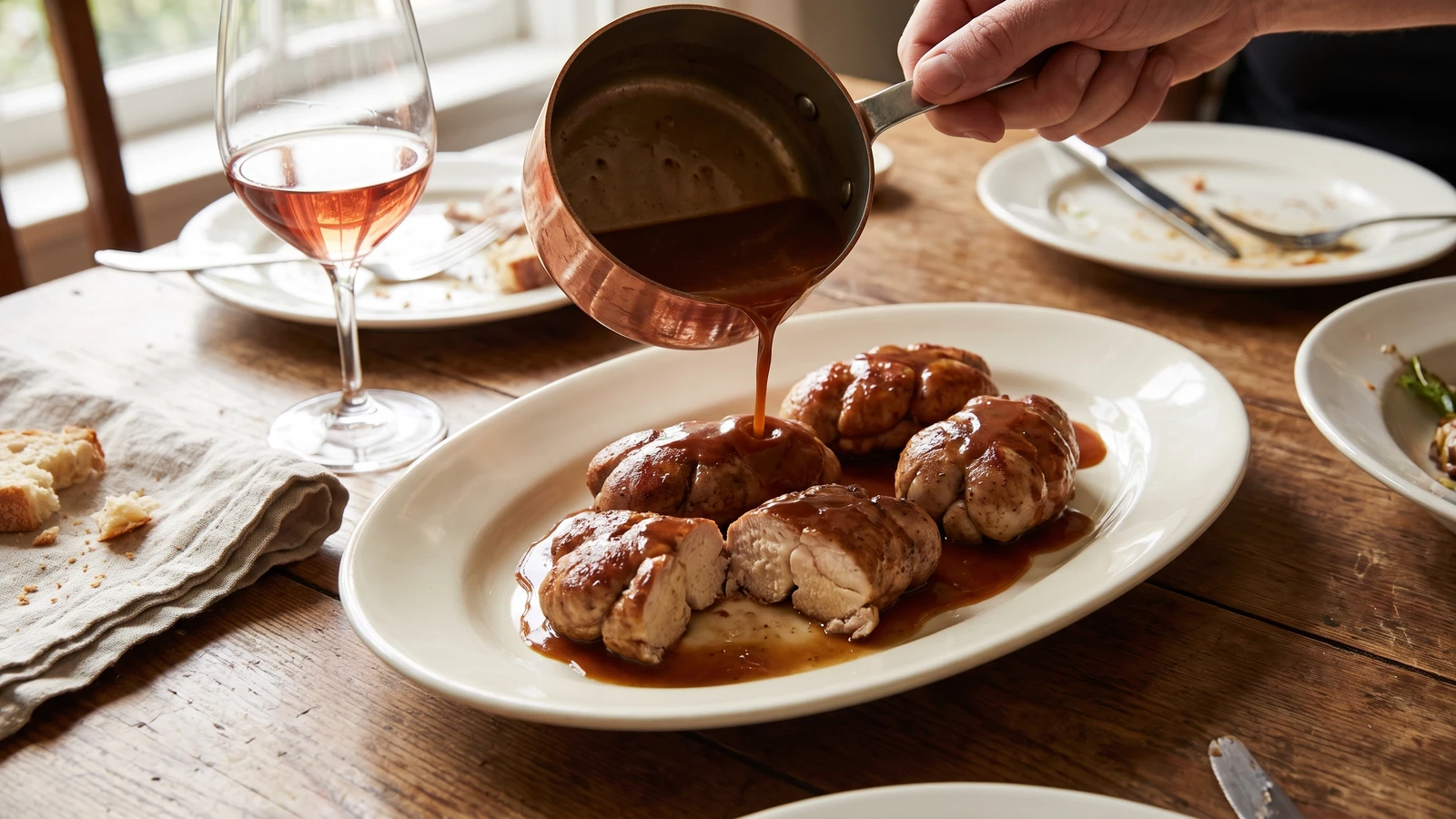
Ris d’agneau turn delicate offal into a burnished main: clear the blood, blanch only to the boil, press for shape, then braise gently and reduce the juices to a glossy glaze.
Ris d’Agneau Braisés et Glacés (braised and glazed lamb sweetbreads) teach one precise lesson: blanching sets the flesh, it does not cook it. Lamb sweetbreads are smaller and less forgiving than veal sweetbreads, so they leave the water the moment the boil arrives. Miss that moment and tenderness begins slipping away.
The original preparation assumed cold running water, brigade quantities, brown stock never off the fire, and a saucier free to reduce and baste until every lobe shone. Your home equivalent is a chilled bowl with frequent water changes, strong gelatin-rich stock, and one wide sauté pan that braises and reduces in turn. The brown-braised treatment becomes a main dish for four here; the white-braised treatment remains a separate service beside poached poultry, because those are two intentions, not interchangeable shortcuts. Constant running water and a separate sauce station are brigade scaffolding. Soaking, the instant blanch, pressing, and gentle braising are the dish itself.
Done properly, the ris d’agneau arrive deep bronze beneath a mahogany glaze, tender inside and resilient enough to hold their shape. One cook, one stove, one evening. Before you touch the sauté pan, get the soaking water nearly clear and be ready to drain at the first true boil.
Ris d’agneau belong less to one province than to the Parisian classical table, where the smaller lamb gland was handled like veal sweetbread and served either as the center of a preparation or as a delicate garnish bound with brown sauce. The name sweetbread hides the ingredient: these are the thymus and pancreas of young animals, prized because blanching, pressing, and braising turn their loose lobes into fine, tender morsels. The canon preserves both brown-braised, glazed service and white-braised service beside poached poultry, with the treatment chosen according to the sauce and the company on the plate.
Quantity
2 lb (900 g)
Quantity
About 3 gal (11.5 L / 11.5 kg)
divided for soaking, blanching, and cooling
Quantity
4 cups (950 ml / 550 g)
Quantity
2 tsp (10 ml / 12 g)
divided
Quantity
1 tsp (5 ml / 2 g)
Quantity
3 tbsp (45 ml / 42 g)
Quantity
1 cup (240 ml / 150 g)
cut into 1/4-inch dice
Quantity
3/4 cup (180 ml / 90 g)
cut into 1/4-inch dice
Quantity
1/2 cup (120 ml / 60 g)
cut into 1/4-inch dice
Quantity
1 tbsp (15 ml / 16 g)
Quantity
3 cups (710 ml / 740 g)
Quantity
1
Quantity
3 tbsp (45 ml / 42 g)
cubed
Quantity
1 application Blanchings (No. 273)
Quantity
1 prepared batch Attereaux de Ris de Veau à la Villeroy (No. 1219)
Quantity
4 prepared Croûtes et Croustades (No. 2393)
| Ingredient | Quantity |
|---|---|
| fresh lamb sweetbreads | 2 lb (900 g) |
| very cold waterdivided for soaking, blanching, and cooling | About 3 gal (11.5 L / 11.5 kg) |
| ice | 4 cups (950 ml / 550 g) |
| fine saltdivided | 2 tsp (10 ml / 12 g) |
| freshly ground black pepper | 1 tsp (5 ml / 2 g) |
| clarified butter | 3 tbsp (45 ml / 42 g) |
| onioncut into 1/4-inch dice | 1 cup (240 ml / 150 g) |
| carrotcut into 1/4-inch dice | 3/4 cup (180 ml / 90 g) |
| celerycut into 1/4-inch dice | 1/2 cup (120 ml / 60 g) |
| tomato paste | 1 tbsp (15 ml / 16 g) |
| strong, low-sodium lamb or veal stock | 3 cups (710 ml / 740 g) |
| bouquet garni | 1 |
| cold unsalted buttercubed | 3 tbsp (45 ml / 42 g) |
| canonical clearing and setting procedure | 1 application Blanchings (No. 273) |
| optional separate canonical attereaux branch (optional) | 1 prepared batch Attereaux de Ris de Veau à la Villeroy (No. 1219) |
| optional separate canonical croustade branch (optional) | 4 prepared Croûtes et Croustades (No. 2393) |
Begin Blanchings (No. 273) by setting the sweetbreads in a large nonreactive bowl and covering them by 2 inches with very cold water. Refrigerate for 2 hours, changing the water every 30 minutes, until the final water is nearly clear rather than red. This replaces the old running tap without changing the purpose of the soak. If the water remains strongly rosy, give it another change; do not try to make up for an incomplete soak by boiling longer.
Transfer the sweetbreads to a saucepan, cover generously with fresh cold water, and bring the temperature up gradually over medium heat. Watch closely. The instant a true boil breaks across the surface, drain them and lower them into the ice water for 10 minutes. This completes Blanchings (No. 273): the brief heat firms the outer tissue so it can be trimmed, while the cold stops the cooking. If the water rolled for less than a minute, drain and chill at once. Ça se rattrape: shorten the later braise by about 5 minutes and begin checking early.
Drain and pat the sweetbreads dry. With a small sharp knife, pull away the tough outer membrane, blood vessels, loose fat, and any ragged tissue while keeping the plump lobes intact. Set them between two clean towel-lined trays, place a 1 to 2 lb weight on top, and refrigerate for 45 to 60 minutes. Pressing gives the soft lobes an even thickness, so they brown and braise at the same pace; crush them flat and you lose the generous texture.
Heat the oven to 325°F (165°C). Pat the pressed sweetbreads completely dry and season them with half the salt and the pepper. Heat the clarified butter in a wide ovenproof sauté pan over medium-high heat, then brown the sweetbreads in two batches, about 2 minutes per broad face, until deeply golden. If they shed liquid and begin to stew, lift them out, let the liquid boil away, add a little more clarified butter if needed, and continue in smaller batches. Pale sweetbreads give nothing to the sauce; the browned fond on the pan floor is its foundation.
Lower the heat to medium and add the onion, carrot, and celery. This mirepoix, the diced aromatic vegetables, should cook for 7 to 9 minutes until softened and well colored, not scorched. Stir in the tomato paste and cook for 2 minutes, until it darkens to brick red. Pour in 1 cup of the stock and scrape every browned speck from the pan floor. Let it simmer for 2 minutes so the fond dissolves completely into the braising liquor.
Nestle the browned sweetbreads over the mirepoix, add the bouquet garni, and pour in enough remaining stock to come halfway up their sides. Bring the liquid just to a bare simmer, cover the pan, and transfer it to the oven. Braise for 20 to 25 minutes, turning the lobes once, until they feel tender with a slight resilience and reach 160°F (71°C) at the center. A hard boil tightens them, so if the liquid is bubbling aggressively, lower the oven by 25°F (15°C).
Lift the sweetbreads onto a warm plate and discard the bouquet garni. Strain the braising liquor through a fine sieve into a clean skillet, pressing the mirepoix only gently, then boil until reduced to about 3/4 cup and glossy enough to coat the back of a spoon. Taste before adding the remaining salt, because reduction concentrates everything. Remove the skillet from the heat and whisk in the cold butter a few cubes at a time, then return the sweetbreads and baste until lacquered. If the glaze looks oily, stop adding butter and whisk in 1 tbsp of cold stock off the heat. Ça se rattrape. Return it to the gentlest heat only after it comes smooth.
For the brown-braised main, arrange the ris d’agneau on a warmed platter and spoon the glaze over and around them. The source keeps its other applications separate: for the skewer branch, reach for the finished Attereaux de Ris de Veau à la Villeroy (No. 1219); for pastry-shell service, reach for the finished Croûtes et Croustades (No. 2393). Their methods live in their own preparations and are not rebuilt here. Choose one branch rather than piling all three onto a plate. Tonight, the burnished sweetbreads and their glaze are enough. À table!
1 serving (about 220g)
Culinary guides, cultural storytelling, and the editorial depth that makes cooking meaningful.
Discover Culinary ExplorerChef Juliette
John Dory has the delicacy of sole and the firmness of turbot. A light flouring, a quick butter sauté, and nut-brown beurre noisette show exactly why looks never mattered.

Chef Juliette
Fresh haddock proves its delicacy in the meunière pan: a fine flour crust, moist pearly flakes, and beurre noisette sharpened with lemon and parsley, ready from one skillet in half an hour.

Chef Juliette
Éperlans à l’Anglaise turns small fish into a lesson in disciplined coating: boned smelts under a close, crisp crumb, pan-fried in clarified butter and finished with bright, half-melted maître d’hôtel butter.

Chef Juliette
Tiny smelts, shallot, mushrooms, white wine, gratin sauce, and fine bread raspings meet a fierce oven, where the fish must turn tender in the same breath the buttered crust bronzes.