
Chef Juliette
John Dory (St. Pierre)
John Dory has the delicacy of sole and the firmness of turbot. A light flouring, a quick butter sauté, and nut-brown beurre noisette show exactly why looks never mattered.
A cooking platform built around craft, culture, and the stories behind what we eat.
Created by Chef Juliette
Based on No. 1360, Selle d’Agneau de Lait Édouard Vii, from Le Guide Culinaire (1907) by Auguste Escoffier
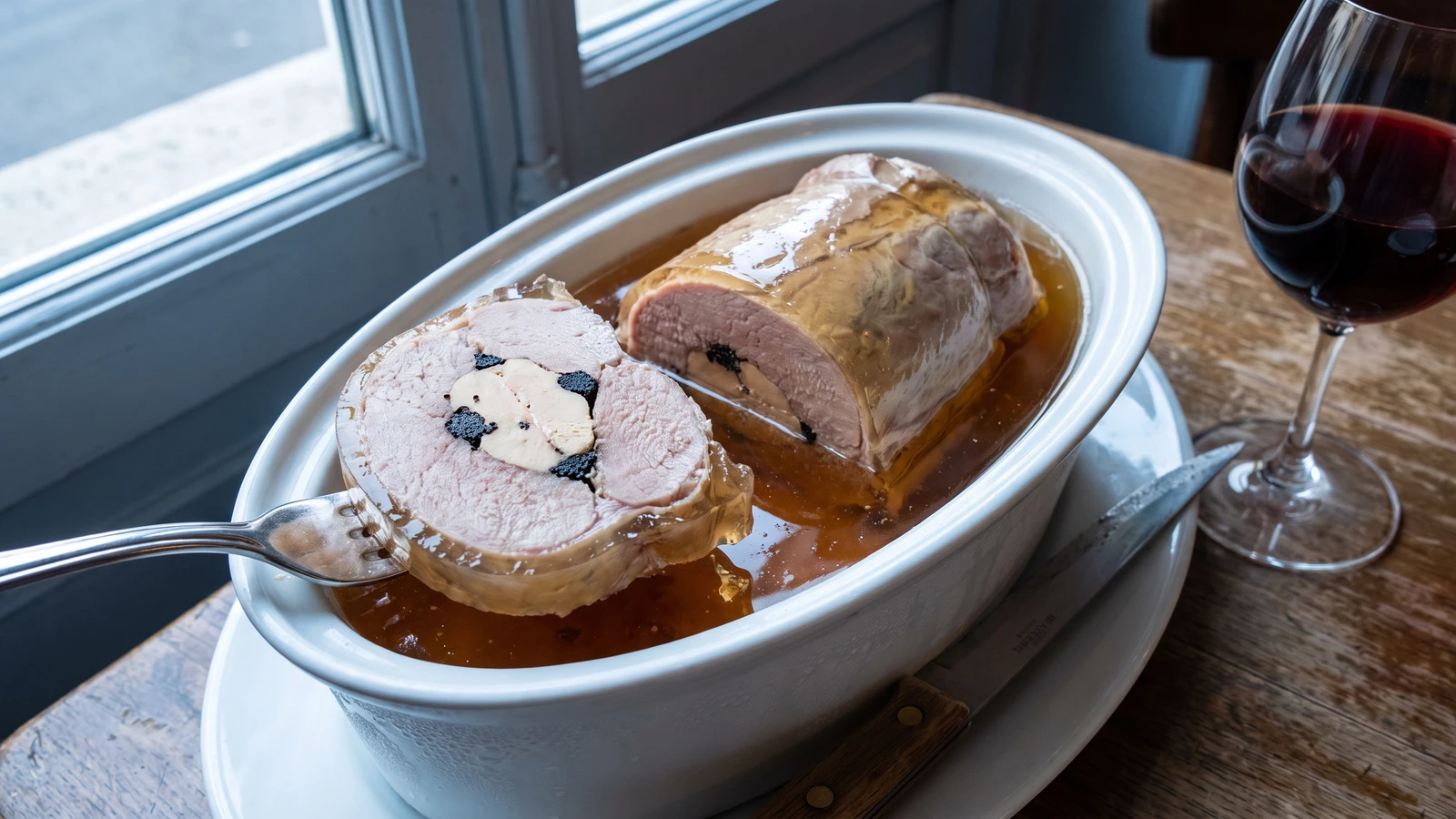
A whole milk-lamb saddle rebuilt around foie gras, black truffle, and Marsala, gently poached on bacon rind and chilled in amber jelly: the cold centerpiece that teaches patience, fit, and temperature.
Selle d’agneau de lait Édouard VII (milk-lamb saddle filled with truffled foie gras and served cold in its terrine) teaches one uncompromising lesson: the foie gras at the center, not the lamb around it, decides when the poaching ends. If that core is undercooked, the magnificent outside cannot save the slice.
The original kitchen assumed a butcher to bone the saddle from underneath, a saucier on staff, a stock never off the fire, and a fitted Terrine à Pâté. A salamander, for once, has nothing to do. At home, the butcher still does the delicate boning, rich unsalted veal stock reinforced with gelatin replaces the standing braising liquor, and a snug oval casserole and ceramic terrine replace the batterie of specialized pans.
The brigade-sized centerpiece becomes one small saddle for four. Vast pots of stock and a separate hand for degreasing were scaffolding; the intact outer cover, truffle-studded foie gras, Marsala, bacon-rind bed, close muslin wrap, and very cold service are the dish and must stay. Begin checking the center after forty-five minutes and trust the thermometer. If it needs longer, give it longer. Ça se rattrape, but only before the saddle leaves its liquor.
Selle d’agneau de lait Édouard VII belongs to the ceremonial tables of Parisian grand kitchens, where whole saddles were reconstructed around luxurious garnishes and presented cold from fitted terrines. The royal name does not make the dish English; foie gras, black truffle, fortified wine, and a gelatin-rich poaching liquor speak the language of the French cold buffet. Its real extravagance is structural rather than decorative: the intact lamb conceals the foie until the first slice reveals it.
Quantity
1 saddle, about 4½ lb / 2 kg bone-in or 2¼ lb / 1 kg after boning
boned from underneath with the outer fat cover intact
Quantity
1 cup (240 ml / 240 g) Cooked Marinade for Venison (No. 168)
prepared separately and fully chilled
Quantity
1 lobe, about 12 oz / 340 g
cold and carefully deveined
Quantity
1 small truffle, about 1 oz / 28 g
cut into narrow batons
Quantity
¾ cup (180 ml / 180 g)
Quantity
1 tablespoon (15 ml / 18 g)
divided
Quantity
1 teaspoon (5 ml / 2 g)
divided
Quantity
4 loosely packed cups (950 ml / 450 g) bacon rind prepared through Blanchings (No. 273)
cleared of fat
Quantity
6 cups (1.4 L / 1.4 kg)
Quantity
1 tablespoon plus 2 teaspoons (25 ml / 18 g)
divided, with 1 teaspoon reserved for rescue
Quantity
Up to 2 cups (475 ml / 475 g)
only if needed to cover the saddle
| Ingredient | Quantity |
|---|---|
| small milk-fed lamb saddleboned from underneath with the outer fat cover intact | 1 saddle, about 4½ lb / 2 kg bone-in or 2¼ lb / 1 kg after boning |
| Cooked Marinade for Venisonprepared separately and fully chilled | 1 cup (240 ml / 240 g) Cooked Marinade for Venison (No. 168) |
| fresh foie gras lobecold and carefully deveined | 1 lobe, about 12 oz / 340 g |
| black trufflecut into narrow batons | 1 small truffle, about 1 oz / 28 g |
| dry Marsala | ¾ cup (180 ml / 180 g) |
| fine saltdivided | 1 tablespoon (15 ml / 18 g) |
| freshly ground white pepperdivided | 1 teaspoon (5 ml / 2 g) |
| bacon rindcleared of fat | 4 loosely packed cups (950 ml / 450 g) bacon rind prepared through Blanchings (No. 273) |
| rich unsalted veal stock | 6 cups (1.4 L / 1.4 kg) |
| unflavored powdered gelatin (optional)divided, with 1 teaspoon reserved for rescue | 1 tablespoon plus 2 teaspoons (25 ml / 18 g) |
| hot water (optional)only if needed to cover the saddle | Up to 2 cups (475 ml / 475 g) |
Lay the boned saddle meat-side down in the fully chilled Cooked Marinade for Venison (No. 168) for twenty minutes, keeping the intact outer fat cover above the liquid. Lift it out, drain it well, and dry every surface. Milk-fed lamb needs the marinade’s perfume, not a long acidic treatment intended for game. Open the saddle outer-side down and season its inner surface with 2 teaspoons of the salt and half the white pepper.
Make narrow incisions along the cold foie gras and insert the truffle batons, distributing them so every finished slice catches some black truffle. Season with the remaining salt and white pepper, place the foie in a close-fitting dish, and pour over the Marsala. Cover and chill for two hours, turning twice. Lift out the foie, blot its surface gently, and reserve every drop of Marsala for the poaching liquor.
Set the foie lengthwise down the middle of the opened saddle. Bring the lamb flaps closely around it, restoring the saddle’s original rounded shape without crushing the foie. Sew the underside with a trussing needle and kitchen twine, then tie crosswise at 1-inch intervals. If the meat tears, cover the opening with a thin lamb trimming and bind it under the next loop of twine. Ça se rattrape. What matters is a closed parcel with no route for the softening foie to escape.
Roll the reconstructed saddle tightly in a double thickness of clean muslin, folding the ends inward before tying them securely. The muslin replaces the restraining hands of the brigade: it keeps the saddle’s shape, holds the seam shut, and prevents the outer meat from loosening in the liquor. The wrap should be close and firm, never tight enough to squeeze the foie out.
Arrange the bacon rind prepared through Blanchings (No. 273) across the bottom of a snug oval casserole, making a complete protective bed. Bloom 1 tablespoon plus 1 teaspoon of the gelatin in ½ cup of the cold veal stock, then combine it with the remaining stock and warm gently until dissolved. Reserve the final teaspoon of gelatin. Add the Marsala from the foie marinade and bring the liquor to 82 to 85°C, or 180 to 185°F. Do not remove any surface fat.
Lower the wrapped saddle onto the bacon rind and add hot water only if the liquor does not cover it by about ½ inch. Lay a parchment cartouche over the surface and use a small heatproof plate to keep the saddle submerged. Hold the liquor between 82 and 85°C, or 180 and 185°F, with only an occasional movement at the surface. Begin checking after forty-five minutes by passing a thin thermometer through the underside seam into the center of the foie gras. Continue until the center reaches 70°C, or 158°F, and remains there for two minutes, usually fifty to sixty-five minutes in all. If the liquor boils, lift the casserole off the heat and add a ladle of cool stock or water before continuing gently. Ça se rattrape. Boiling, not extra time, is what renders away the foie and toughens the lamb.
Lift the saddle carefully and rest it for five minutes, then remove the muslin while it is still warm. Place the saddle seam-side down in an oval Terrine à Pâté just large enough to hold it. Strain the hot cooking liquor over the saddle without degreasing it; the natural fat must remain because it seals the surface while the gelatin-rich liquor sets. If the saddle tries to float, hold it down with parchment and a small saucer until the liquor begins to thicken.
Set the terrine in a larger vessel of ice water and cool it promptly, changing the ice as it melts. Move it to the refrigerator within an hour, cover loosely, and chill for at least twelve hours, until the liquor forms a tender amber jelly and the saddle is cold to its center. If the liquor remains loose after six hours, lift out the saddle, warm 2 cups of the liquor, dissolve the reserved teaspoon of gelatin in it, and strain it back over the meat before chilling again. Ça se rattrape.
When the saddle is completely cold, remove the saucer and parchment and lift away the firm fat with a spoon. Dip the spoon in boiling water, dry it, and pass its warm bowl lightly over any remaining film. This gives the clean surface once achieved with a boiling-water rinse, without washing flavor from the jelly. Wipe the rim, leave the saddle in its terrine, and serve it very cold. Cut generous crosswise slices so the lamb, foie gras, and black truffle show together. À table!
1 serving (about 305g)
Culinary guides, cultural storytelling, and the editorial depth that makes cooking meaningful.
Discover Culinary ExplorerChef Juliette
John Dory has the delicacy of sole and the firmness of turbot. A light flouring, a quick butter sauté, and nut-brown beurre noisette show exactly why looks never mattered.

Chef Juliette
Fresh haddock proves its delicacy in the meunière pan: a fine flour crust, moist pearly flakes, and beurre noisette sharpened with lemon and parsley, ready from one skillet in half an hour.

Chef Juliette
Éperlans à l’Anglaise turns small fish into a lesson in disciplined coating: boned smelts under a close, crisp crumb, pan-fried in clarified butter and finished with bright, half-melted maître d’hôtel butter.

Chef Juliette
Tiny smelts, shallot, mushrooms, white wine, gratin sauce, and fine bread raspings meet a fierce oven, where the fish must turn tender in the same breath the buttered crust bronzes.