
Chef Juliette
Baron (or Pair of Hind-quarters) of Lamb
A whole saddle and its two hind legs, butter-poêlé under a close cover, carved rosy beside new vegetables and clear pan gravy: grand anatomy brought within reach of one home oven.
A cooking platform built around craft, culture, and the stories behind what we eat.
Created by Chef Juliette
Based on No. 1359, Saddle and Neck of Lamb, from Le Guide Culinaire (1907) by Auguste Escoffier
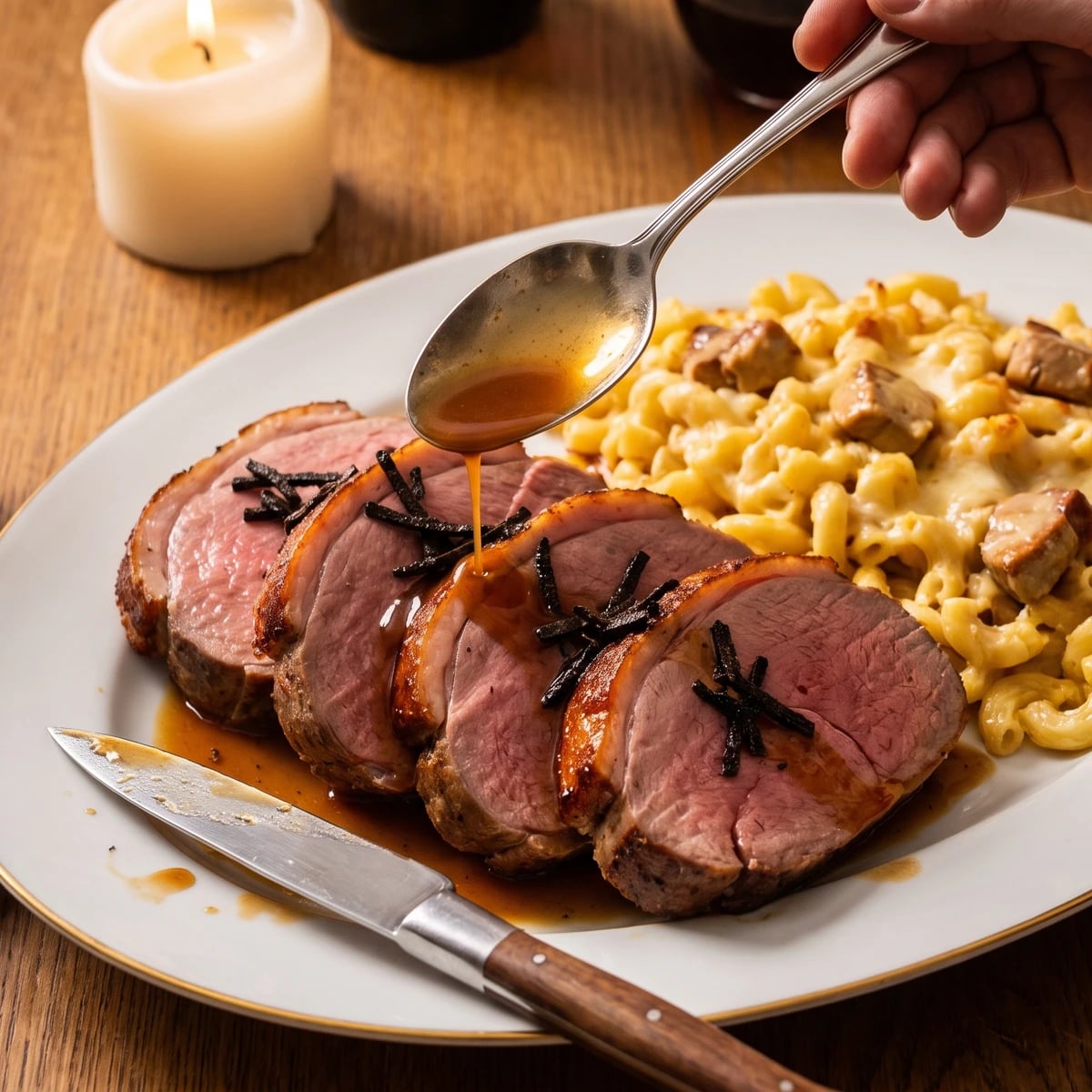
Selle et collet d’agneau turns two opposite cuts into one generous centerpiece: the saddle stays rosy beneath a truffled glaze, while the neck gives its depth to a clear, glossy jus.
Selle et collet d’agneau (saddle and neck of lamb) teaches one true thing before you touch a pan: tender saddle and muscular neck cannot take the same heat. The neck must simmer long enough to surrender its strength to the stock, while the selle stays rosy and succulent. Poêler (to roast gently under cover in butter) gives the prime joint protection without turning it into a braise.
The original recipe assumed a saucier on staff, brown stock never off the fire, a salamander waiting to glaze the joint, and a saddle large enough for a banquet. Your home equivalents are a quick stock strengthened with lamb neck, one close-fitting covered braiser, and the oven broiler watched without blinking. The thick matignon jacket and brigade portions were scaffolding, so they become a modest aromatic bed and a garnish for four. The butter-rich covered roasting, the absence of liquid during cooking, the ten-minute extraction of the pan vegetables, and the final glaze are the dish, so they stay. One cook, one stove, one evening.
The finished selle is burnished outside, rosy within, and scented by black truffle beneath its bacon veil. Its clear jus tastes more deeply of lamb than the joint alone could manage, while the butter-bound macaroni carries foie gras, cheese, and truffle without cream. Keep the roasting pan dry until the saddle comes out. That is the step that decides everything.
The selle belongs to the formal French service canon shaped in Paris rather than to one provincial larder; as a relevé, a substantial joint presented after the lighter opening courses, it displayed both the butcher’s precision and the saucier’s command of the pan liquor. Lamb saddle inherited the treatments of veal saddle, including truffle-studded presentations, while the less tender neck remained valuable for braises and the concentrated stock served beside the prime cut. Poêling is often mistaken for skillet frying, but in classical practice it is a covered, butter-rich oven roast over aromatics, finished uncovered for colour.
Quantity
1 saddle, 3½ pounds (1.6 kg), for Selle de Veau (Relevé) (No. 1181)
chine bone removed, kidneys retained if available, flank left long enough to cover the under-fillets
Quantity
1½ pounds (680 g)
Quantity
2 teaspoons (10 ml / 12 g)
Quantity
1 teaspoon (5 ml / 2 g)
Quantity
1 tablespoon (15 ml / 14 g)
Quantity
3 cups (720 ml / 720 g)
Quantity
1
Quantity
1 medium, about 5 ounces (150 g)
finely sliced
Quantity
2 medium, about 5 ounces (150 g)
finely sliced
Quantity
2 ribs, about 3½ ounces (100 g)
finely sliced
Quantity
½ cup (120 ml / 55 g)
finely diced
Quantity
6 tablespoons (90 ml / 85 g) for Poëlings (No. 250)
melted
Quantity
8 slices, about 5 ounces (140 g)
Quantity
2½ ounces (70 g) for Selle de Veau à la Talleyrand (No. 1191)
about 1 ounce cut into studs and 1½ ounces cut into fine julienne
Quantity
2 cups (480 ml / 225 g)
Quantity
1 tablespoon (15 ml / 18 g)
Quantity
1½ tablespoons (22 ml / 21 g)
Quantity
¼ cup (60 ml / 22 g)
finely grated
Quantity
¼ cup (60 ml / 22 g)
finely grated
Quantity
1½ ounces (42 g)
cut into large dice
Quantity
Up to ¼ cup (60 ml / 60 g)
| Ingredient | Quantity |
|---|---|
| bone-in lamb saddlechine bone removed, kidneys retained if available, flank left long enough to cover the under-fillets | 1 saddle, 3½ pounds (1.6 kg), for Selle de Veau (Relevé) (No. 1181) |
| meaty lamb neck pieces | 1½ pounds (680 g) |
| fine sea salt | 2 teaspoons (10 ml / 12 g) |
| freshly ground black pepper | 1 teaspoon (5 ml / 2 g) |
| unsalted butter, for browning the neck | 1 tablespoon (15 ml / 14 g) |
| unsalted veal stock, or unsalted chicken stock | 3 cups (720 ml / 720 g) |
| bouquet garni of parsley stems, thyme, and bay | 1 |
| yellow onionfinely sliced | 1 medium, about 5 ounces (150 g) |
| carrotsfinely sliced | 2 medium, about 5 ounces (150 g) |
| celeryfinely sliced | 2 ribs, about 3½ ounces (100 g) |
| lean unsmoked hamfinely diced | ½ cup (120 ml / 55 g) |
| unsalted butter, for the covered roastmelted | 6 tablespoons (90 ml / 85 g) for Poëlings (No. 250) |
| thinly sliced streaky bacon | 8 slices, about 5 ounces (140 g) |
| fresh black truffle or good whole preserved black truffleabout 1 ounce cut into studs and 1½ ounces cut into fine julienne | 2½ ounces (70 g) for Selle de Veau à la Talleyrand (No. 1191) |
| dried short straight macaroni | 2 cups (480 ml / 225 g) |
| coarse salt, for the macaroni water | 1 tablespoon (15 ml / 18 g) |
| unsalted butter, for the macaroni | 1½ tablespoons (22 ml / 21 g) |
| Gruyèrefinely grated | ¼ cup (60 ml / 22 g) |
| Parmesanfinely grated | ¼ cup (60 ml / 22 g) |
| firm foie grascut into large dice | 1½ ounces (42 g) |
| reserved macaroni water (optional) | Up to ¼ cup (60 ml / 60 g) |
Take the lamb from the cold 45 minutes before cooking and dry it thoroughly. Use Selle de Veau (Relevé) (No. 1181) as the trimming pattern: season the inside, draw the flank over the under-fillets and kidneys, then cover the upper surface with the bacon and secure everything with five or six evenly spaced loops of twine. Cut twelve narrow incisions across the meaty loins and insert the truffle studs upright, following the treatment of Selle de Veau à la Talleyrand (No. 1191). Its twenty large studs belonged to a much larger joint; twelve smaller studs preserve the distribution on a saddle for four. Season the outside with half the fine salt and pepper.
Melt the tablespoon of butter in a stockpot over medium-high heat. Season the neck pieces lightly with some of the remaining salt, then brown every broad surface to a deep bronze; crowding gives you grey meat and a timid stock, so work in two batches if necessary. Return all the neck to the pot, add the stock and bouquet garni, and scrape the bottom clean. Hold at the barest simmer, uncovered, for 60 minutes, skimming only the grey froth. Strain through a fine sieve and reserve 2 cups of the neck-enriched stock, keeping the rest nearby for loosening the jus. Prepare the saddle and matignon while this simmers.
Heat the oven to 325°F (165°C). Mix the onion, carrots, celery, and ham into a raw matignon and spread it across the bottom of a heavy covered braiser just large enough to hold the saddle. Set the lamb on top, pour over the melted butter, and cover tightly. Cook according to the intent of Poëlings (No. 250), basting with the butter every 15 minutes but adding no stock or water. Begin checking after 40 minutes. When the centre reaches 125°F (52°C), uncover and continue until it reaches 130°F (54°C) and the exterior has begun to colour, about 8 to 12 minutes more. If the vegetables threaten to burn, lower the oven and transfer the lamb with the unburned matignon to a clean pan, adding another spoonful of butter rather than liquid. Ça se rattrape. Rest the saddle, loosely covered, for 20 minutes.
While the saddle rests, set the braiser over medium heat with all its butter and matignon still inside. Pour in 2 cups of the neck stock, scrape up the browned fond, and simmer gently for a full 10 minutes before removing any fat. That contact returns the flavour held by the butter to the stock. Strain through a fine sieve without pressing the vegetables, then skim carefully or pass the liquid through a fat separator. Boil the clear liquor until about 1 cup remains and it lightly coats a spoon. If it looks greasy, skim again rather than thickening it; if it reduces too far, whisk in reserved neck stock a tablespoon at a time. Taste only now for salt and pepper.
Boil the macaroni in well-salted water until tender but still resilient, then reserve a little cooking water and drain thoroughly. For the home-scaled garnish of Selle de Veau à la Talleyrand (No. 1191), return the macaroni to the warm pan off the heat and bind it with 1½ tablespoons of butter, the Gruyère, and the Parmesan. Fold in the foie gras dice and truffle julienne last so they warm without disappearing into the pasta. These quantities preserve the source ratio for half a pound of macaroni. If the cheese seizes into threads, add hot macaroni water one spoonful at a time and stir gently. No cream is needed.
Heat the broiler and place a rack about 8 inches beneath it. Remove the bacon and twine from the rested saddle, brush the meat generously with reduced jus, and pass it under the broiler for 30 to 60 seconds, just until the glaze shines and the surface deepens to mahogany. Never walk away. Confirm that the centre has reached about 140°F (60°C); after a final five-minute rest it should reach 145°F (63°C). If the glaze catches, pull the joint out immediately and brush away the bitter patch with fresh jus. Cut both loins from the backbone, slice them thickly across the grain, and include the kidneys if present. Arrange the slices beside the truffled macaroni, spoon over enough jus to make everything gleam, and send the rest in a warm sauceboat. À table!
1 serving (about 575g)
Culinary guides, cultural storytelling, and the editorial depth that makes cooking meaningful.
Discover Culinary Explorer
Chef Juliette
A whole saddle and its two hind legs, butter-poêlé under a close cover, carved rosy beside new vegetables and clear pan gravy: grand anatomy brought within reach of one home oven.

Chef Juliette
Two lamb legs become one burnished joint under a covered butter roast, then their own drippings become a clear, peppery gravy. Gentle heat and faithful basting teach the discipline of poêler.

Chef Juliette
Quartier d’Agneau Poêlé teaches the discipline of basting: a young hindquarter slowly enclosed with butter, then uncovered to bronze, with clear lamb jus and spring vegetables carried proudly to the Sunday table.

Chef Juliette
Butter-basted lamb fillet, rosy within and bronzed outside, with new spring vegetables and a clear pan gravy. Filet d’agneau poêlé teaches the quiet heat and steady spooning that protect a tender cut.