
Chef Juliette
John Dory (St. Pierre)
John Dory has the delicacy of sole and the firmness of turbot. A light flouring, a quick butter sauté, and nut-brown beurre noisette show exactly why looks never mattered.
A cooking platform built around craft, culture, and the stories behind what we eat.
Created by Chef Juliette
Based on No. 1181, Selle de Veau (Relevé), from Le Guide Culinaire (1907) by Auguste Escoffier
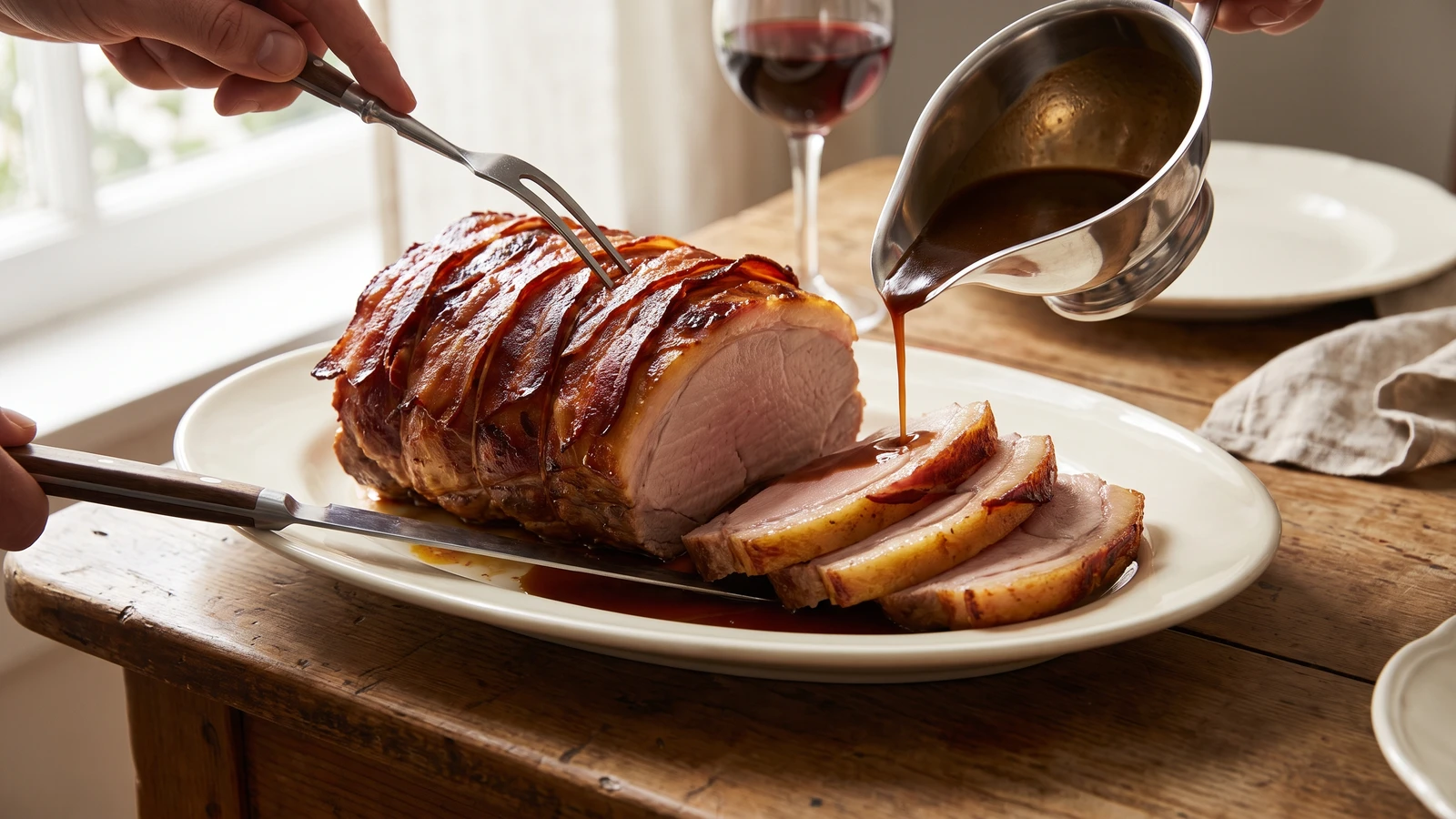
A half saddle of veal, bacon-barded and braised by short moistening, emerges bronze and succulent, with the concentrated veal glaze that makes this grand relevé worthy of the home table.
Selle de Veau (braised saddle of veal) teaches the discipline of short moistening. Stock is added in stages, not poured around the joint all at once: the first additions reduce to a gelatinous glaze, the final one supplies just enough moisture for the braise, and frequent basting keeps the exposed loin succulent. Give it a bath of stock and the lower half poaches while the upper half dries. That is the one true thing to know before touching the pan.
The original kitchen assumed a whole saddle sized for a formal relevé, a saucier on staff, brown veal stock never off the fire, and a salamander waiting to set the final glaze. For four, the source itself permits a half saddle, one loin with its protected under-fillet. Your butcher does the sawing, a snug cocotte replaces the great braising pan, prepared veal stock gains the missing gelatin when necessary, and a household broiler supplies the final fierce heat. We remove the brigade scaffolding of scale and extra hands; the barding, staged reductions, basting, and exact doneness remain because they are the dish. One cook, one stove, one evening.
Properly handled, the saddle reaches the table bronze and lacquered, its bacon gleaming over pale, juicy slices and its concentrated jus pooling around them. Watch the first two short reductions closely. They decide whether the veal is protected by glaze or merely sitting in broth.
Selle de veau belongs to the formal French table rather than to a single province: as a relevé, a substantial joint was carried in whole and carved after the lighter courses. Veal seldom bore that role because its loin dries quickly, but the saddle, protected by flank and bacon and fed with gelatinous veal stock, was the grand exception. Its white-meat braise is often mistaken for a long pot-roast; in classical practice it is closer to a covered roast with staged stock, stopped at sliceable succulence rather than cooked until it collapses.
Quantity
4½ to 5 pounds (2 to 2.3 kg)
split lengthwise to retain one loin and under-fillet, kidney removed and flank retained
Quantity
2 teaspoons (10 ml / 12 g)
Quantity
1 teaspoon (5 ml / 2 g)
Quantity
10 to 12 thin slices (8 ounces / 225 g)
Quantity
4 tablespoons (60 ml / 57 g)
Quantity
1, about 1½ cups (355 ml / 225 g)
sliced
Quantity
2, about 1½ cups (355 ml / 200 g)
sliced
Quantity
1
made with 4 parsley stems, 2 thyme sprigs, and 1 bay leaf
Quantity
4 cups (950 ml / 950 g), for Braising of White Meats (No. 248)
Quantity
2 teaspoons (10 ml / 6 g)
bloomed in a little cold stock if needed
| Ingredient | Quantity |
|---|---|
| bone-in half saddle of vealsplit lengthwise to retain one loin and under-fillet, kidney removed and flank retained | 4½ to 5 pounds (2 to 2.3 kg) |
| fine sea salt | 2 teaspoons (10 ml / 12 g) |
| freshly ground black pepper | 1 teaspoon (5 ml / 2 g) |
| unsmoked fatty bacon | 10 to 12 thin slices (8 ounces / 225 g) |
| unsalted butter | 4 tablespoons (60 ml / 57 g) |
| large onionsliced | 1, about 1½ cups (355 ml / 225 g) |
| medium carrotssliced | 2, about 1½ cups (355 ml / 200 g) |
| bouquet garnimade with 4 parsley stems, 2 thyme sprigs, and 1 bay leaf | 1 |
| unsalted gelatin-rich brown veal stock | 4 cups (950 ml / 950 g), for Braising of White Meats (No. 248) |
| unflavored powdered gelatin (optional)bloomed in a little cold stock if needed | 2 teaspoons (10 ml / 6 g) |
Heat the oven to 325°F (165°C). Chill a spoonful of the veal stock briefly: it should become softly jellied rather than remain watery. If it does not, sprinkle the powdered gelatin over ¼ cup (60 ml) of cold stock, leave it for 5 minutes, then whisk it into the remaining stock as it warms. The gelatin is not there to make gravy; it forms the protective glaze the original kitchen drew from its permanent stockpot.
Inspect the saddle before seasoning. The pelvis end should be trimmed flush, the front end should finish at the first rib, and the kidney should be removed while a thick layer of fat remains over the under-fillet. Pare the loose flank only enough that it can fold underneath and just cover that tender fillet. Season the inside with half the salt and pepper, draw the flank over the fillet, and lay the bacon across the top in overlapping slices. Tie the joint crosswise with five or six firm loops of butcher's twine so neither flank nor bacon can shift.
Melt the butter over medium heat in a cocotte just large enough to hold the saddle. Season the outside, then turn the joint carefully in the butter until every accessible side is lightly golden, 10 to 12 minutes. This is a raidissement, a gentle stiffening and coloring, not a hard sear; the surface should firm without building a thick crust. If the butter begins to darken before the veal colors, lower the heat and add a spoonful of warm stock. Lift the joint out, soften the onion and carrots in the same butter for 5 minutes, then settle the bouquet garni among them.
Return the saddle to the cocotte, bacon side up. Follow the short-moistening sequence of Braising of White Meats (No. 248): pour in ½ cup (120 ml) of hot veal stock, cover, and let it bubble moderately for 5 minutes. Uncover and reduce until the stock becomes syrupy, coats the vegetables, and clings to the joint when spooned over it. Add a second ½ cup (120 ml) and repeat. Do not walk away during either reduction. If the glaze catches on the pot floor, lower the heat and loosen it immediately with 2 tablespoons (30 ml) of stock, scraping gently until smooth. Ça se rattrape.
Add the remaining hot stock, using only enough to reach halfway up the saddle, and bring it to a bare simmer. Cover the cocotte and place it in the oven. Baste the exposed surface every 12 to 15 minutes, closing the oven promptly each time, until the thickest part of the loin reaches 140 to 142°F (60 to 61°C), about 75 to 100 minutes. If the bacon or exposed meat loses its shine between bastings, spoon over the braising liquor at once; if the liquid falls below one-third of the joint, add hot stock ¼ cup (60 ml) at a time. Short moistening, not drowning. Resting and glazing must carry the centre to at least 145°F (63°C) before carving; if it falls short, return it covered to the oven for 5 minutes at a time.
Transfer the saddle to a warm, broiler-safe platter and tent it loosely. Strain the braising liquor into a wide saucepan without pressing the vegetables, then skim away the excess fat. Boil steadily until the jus is glossy, concentrated, and coats the back of a spoon, about 10 to 15 minutes. Stir in any juices collected beneath the resting meat. If the jus turns syrupy or too salty, loosen it with unsalted stock one spoonful at a time; if it remains thin, keep reducing. Taste before adding any further salt.
Heat the broiler and place its rack about 8 inches (20 cm) from the heat. Brush the saddle generously with reduced jus, broil for 30 to 60 seconds until the coating gleams, then repeat once or twice, watching without interruption. This brief glazing replaces the salamander and should bronze the bacon edges without continuing to cook the loin. If the glaze slides straight off, it is too thin; return it to the saucepan and reduce before trying again. Verify that the centre has reached at least 145°F (63°C), then rest the glazed saddle for 5 minutes.
Remove all five or six loops of twine. Carry the saddle whole to the table if you wish, then follow the backbone and ribs with a sharp knife to release the loin in one piece. Slice it across the grain about ½ inch (1.25 cm) thick, free the smaller under-fillet from beneath the flank, and slice that separately. Arrange both cuts on the warm platter, spoon a little jus around them, and serve the rest alongside. Never apologize at your own table. À table!
1 serving (about 350g)
Culinary guides, cultural storytelling, and the editorial depth that makes cooking meaningful.
Discover Culinary ExplorerChef Juliette
John Dory has the delicacy of sole and the firmness of turbot. A light flouring, a quick butter sauté, and nut-brown beurre noisette show exactly why looks never mattered.

Chef Juliette
Fresh haddock proves its delicacy in the meunière pan: a fine flour crust, moist pearly flakes, and beurre noisette sharpened with lemon and parsley, ready from one skillet in half an hour.

Chef Juliette
Éperlans à l’Anglaise turns small fish into a lesson in disciplined coating: boned smelts under a close, crisp crumb, pan-fried in clarified butter and finished with bright, half-melted maître d’hôtel butter.

Chef Juliette
Tiny smelts, shallot, mushrooms, white wine, gratin sauce, and fine bread raspings meet a fierce oven, where the fish must turn tender in the same breath the buttered crust bronzes.