
Chef Juliette
Selle de Veau (Relevé)
A half saddle of veal, bacon-barded and braised by short moistening, emerges bronze and succulent, with the concentrated veal glaze that makes this grand relevé worthy of the home table.
A cooking platform built around craft, culture, and the stories behind what we eat.
Created by Chef Juliette
Based on No. 1289, The Cooking of Brains, from Le Guide Culinaire (1907) by Auguste Escoffier
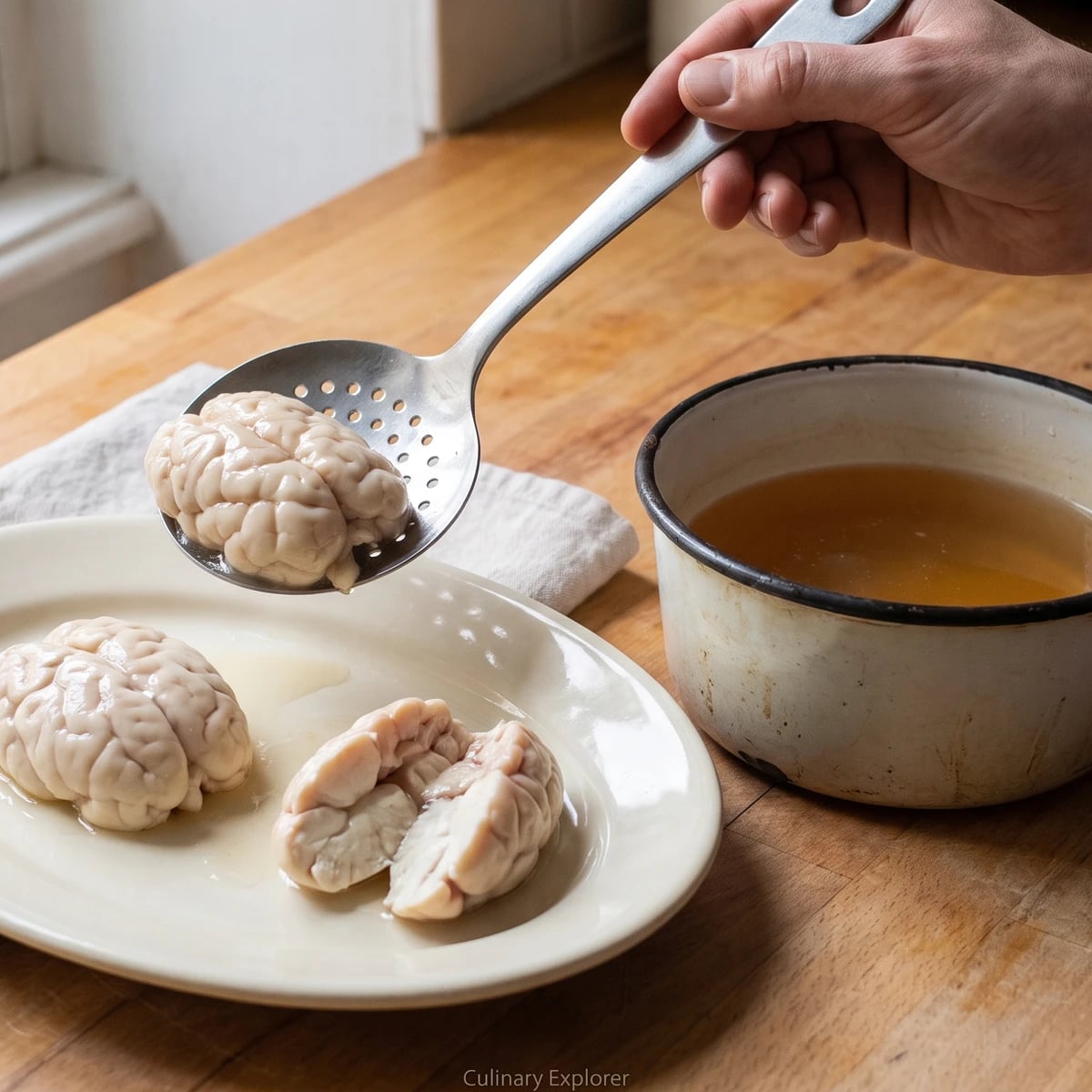
Cuisson des cervelles begins before the flame: membrane lifted cleanly, lobes soaked pale, then poached at a gentle tremble in vinegar court-bouillon until delicate, firm, and ready for the French table.
Cuisson des Cervelles (the cooking of brains) teaches one peculiar truth: the cleaning matters more than the clock. Once the fine membrane is gone and the lobes have soaked white, a gentle poach sets them. Extra time makes them firmer, but it does not ruin them. Rough handling and a rolling boil are the real enemies.
The original assumed a prep hand to clean enough brains for service and a five-quart pot of Court-bouillon with Vinegar (No. 163) waiting beside stockpots that never went cold. At home, two calf brains, six cups of that finished court-bouillon, and a three-quart saucepan feed four. The five-quart batch and tammy are brigade scaffolding, so make the referenced component separately and use a fine-mesh sieve; no saucier’s reduction or salamander finish belongs here. Only the batch size changed, not the method. One cook, one stove, one evening.
Correctly cooked cervelles are pale ivory, cohesive enough to lift whole, and delicately tender beneath their firm surface. Before the pan, work patiently and lift the membrane in small sections. That quiet bit of knife work decides the dish.
Cuisson des cervelles belongs to the Parisian bourgeois and classical table, where an acidulated court-bouillon gave delicate offal a pale, firm first cooking before another formula supplied its finish. The method traveled through bistros and home kitchens because it turned a highly perishable butcher’s cut into a manageable preparation without assigning it to any single French region. Amourettes, paired with brains in the book’s reference, are the spinal marrow of calf or ox rather than another kind of brain, and the same family of preparations was applied to both.
Quantity
2 from Calf’s Brains and Amourettes (No. 1288), about 1¾ pounds (800 g) total
Quantity
8 cups (1.9 litres / 1.9 kg), plus more for changes
Quantity
6 cups (1.4 litres / about 1.4 kg) Court-bouillon with Vinegar (No. 163)
prepared and strained
| Ingredient | Quantity |
|---|---|
| calf brains | 2 from Calf’s Brains and Amourettes (No. 1288), about 1¾ pounds (800 g) total |
| cold water | 8 cups (1.9 litres / 1.9 kg), plus more for changes |
| Court-bouillon with Vinegarprepared and strained | 6 cups (1.4 litres / about 1.4 kg) Court-bouillon with Vinegar (No. 163) |
Keep the calf brains from Calf’s Brains and Amourettes (No. 1288) cold while you work. Set them in a shallow dish with enough cold water to keep their surfaces wet, then use your fingertips and the tip of a small knife to lift the translucent outer membrane and the larger dark blood vessels. Pull in short sections without digging into the lobes. If a lobe begins to tear, stop pulling and snip the taut membrane instead; the divided piece will cook perfectly well. Ça se rattrape.
Cover the cleaned brains with the remaining cold water and refrigerate them for about two hours, changing the water every thirty minutes, until the lobes are pale and the water remains nearly clear. This whitening soak draws away blood without seasoning the flesh. Do not add lemon or extra vinegar; the proper acidity comes later from the court-bouillon.
Pour the finished Court-bouillon with Vinegar (No. 163) into a three-quart nonreactive saucepan and bring it to a full boil. Use a pan deep and narrow enough for the liquid to cover the brains completely; if it falls short, choose a smaller pan rather than diluting the court-bouillon and weakening its carefully set proportion.
Drain the brains and lower them carefully into the boiling court-bouillon with a slotted spoon. Let the liquid return just to the boil, skim away the pale foam, then immediately reduce the heat until the surface barely trembles, about 185 to 195°F (85 to 90°C). Poach gently for thirty minutes, turning the brains once with the spoon, until they are opaque throughout and the thickest part reaches at least 160°F (71°C). If the liquid boils hard, lower the heat at once; if a lobe splits, finish the pieces together and lift them separately. Time is forgiving here. Prolonged gentle cooking only makes cervelles firmer, so a delayed dinner will not ruin them.
Lift the cervelles with a broad slotted spoon and let them drain for two minutes without pressing. Move them whole into the brain preparation that follows, or divide them along their natural seams and serve them warm with a spoonful of strained cooking liquid to keep the surface moist. This entry finishes at the poach; any sauce, crumb, or butter finish belongs to its own formula. Cooking well is not cooking fancy. À table!
1 serving (about 170g)
Culinary guides, cultural storytelling, and the editorial depth that makes cooking meaningful.
Discover Culinary Explorer
Chef Juliette
A half saddle of veal, bacon-barded and braised by short moistening, emerges bronze and succulent, with the concentrated veal glaze that makes this grand relevé worthy of the home table.

Chef Juliette
A bronzed saddle of veal between two patterned vegetable domes, with clear, glossy braising jus passed at the table: classical structure translated for four, patient enough for a celebration and possible on one stove.

Chef Juliette
A veal saddle braised until tender, its fillets cut into collops and rebuilt with paprika Béchamel and truffle, then flashed beneath fierce heat until the ivory sauce glazes.

Chef Juliette
A veal saddle becomes edible architecture: Soubise and ham tucked into the carved loin, truffled Parmesan soufflé rising above it, and reduced braising liquor served alongside.