
Chef Juliette
Selle de Veau (Relevé)
A half saddle of veal, bacon-barded and braised by short moistening, emerges bronze and succulent, with the concentrated veal glaze that makes this grand relevé worthy of the home table.
A cooking platform built around craft, culture, and the stories behind what we eat.
Created by Chef Juliette
Based on No. 1288, Calf’s Brains and Amourettes, from Le Guide Culinaire (1907) by Auguste Escoffier
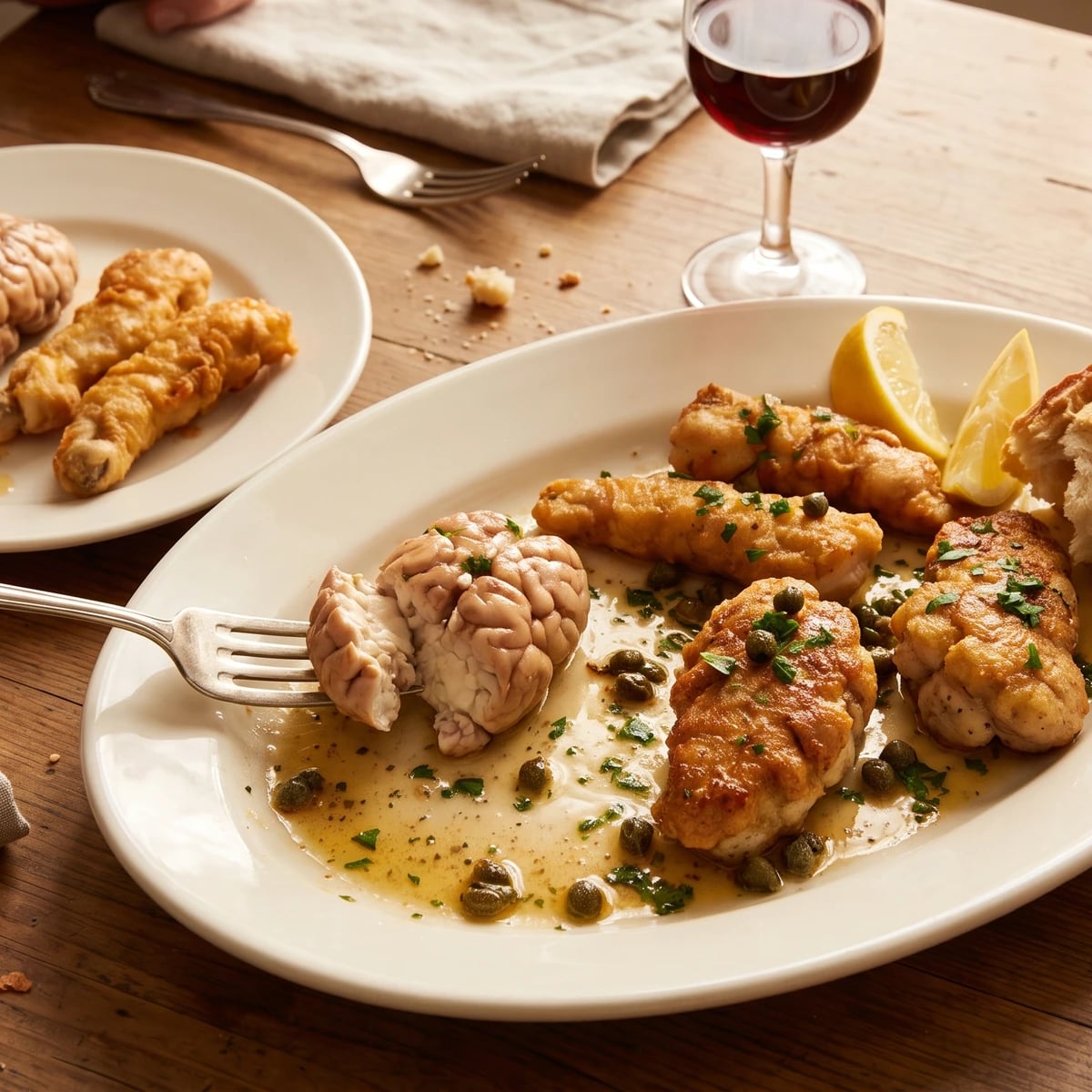
Cervelle de veau and amourettes prove delicacy is a discipline: clean patiently, poach barely, then fry meunière until the crust turns butter-gold and the centres stay tender.
Cervelle de veau et amourettes (calf's brains and spinal marrow) teaches the gentlest rule in offal cookery: the skillet is the finish, not the place where tenderness is made. These pieces must first be soaked until clean, freed of their membranes, and poached at a bare tremble. Only then can meunière, floured and butter-fried with lemon and parsley, give them a thin golden shell without toughening their creamy centres.
The source entry gives one governing instruction rather than a separate formula: amourettes take the same preparations as brains. So both receive meunière here. The grand kitchen behind that instruction could rely on a tripier to deliver immaculate offal and on spare hands and pans for cleaning, poaching, and finishing. It did not require a stockpot, a salamander, or a saucier for this treatment, and neither do you. A bowl, one saucepan, and one skillet replace that scaffolding, scaled for four. The acidulated soak, gentle poach, and last-minute butter finish remain because they are the dish. One cook, one stove, one evening.
Done properly, the crust is butter-gold, the amourettes hold their neat shape, and the brains yield under the fork like soft custard while lemon and capers keep the richness awake. The step that decides everything is the poach: keep the court-bouillon at a bare tremble, because a hard boil breaks the brains before the pan ever sees them.
Cervelle de veau belongs to Parisian cuisine bourgeoise and to triperie tables across France, where careful cleaning and gentle cooking turned highly perishable offal into a prized course. Amourettes are not marrow taken from inside a bone but the spinal cord of calf or ox, and classical cooks paired them with brains because their tenderness and handling are alike. For generations, household manuals also praised brains as restorative fare for overworked minds; that belief belongs to the table's culture, while the enduring culinary lesson is the same preparation shared by both kinds of offal.
Quantity
2 (about 570 g / 1¼ lb total)
well chilled
Quantity
340 g / 12 oz
well chilled
Quantity
as needed
for soaking and rinsing
Quantity
¼ cup (60 ml / 60 g)
for soaking
Quantity
8 cups (1.9 L / 1.9 kg)
for the court-bouillon
Quantity
½ cup (120 ml / 120 g)
for the court-bouillon
Quantity
1 medium (about 150 g / 5.3 oz)
sliced
Quantity
1 medium (about 100 g / 3.5 oz)
sliced
Quantity
1
Quantity
1 teaspoon (5 ml / 3 g)
Quantity
2 teaspoons (10 ml / 12 g)
for the court-bouillon
Quantity
¾ cup (180 ml / 90 g)
Quantity
1 teaspoon (5 ml / 6 g)
for the flour
Quantity
½ teaspoon (2.5 ml / 1 g)
Quantity
12 tablespoons (180 ml / 170 g)
divided, with 2 tablespoons held in reserve
Quantity
3 tablespoons (45 ml / 27 g)
drained and dried
Quantity
2 tablespoons (30 ml / 30 g)
Quantity
¼ cup (60 ml / 15 g)
finely chopped
Quantity
1
cut into wedges
| Ingredient | Quantity |
|---|---|
| inspected calf brainswell chilled | 2 (about 570 g / 1¼ lb total) |
| inspected calf spinal cord (amourettes)well chilled | 340 g / 12 oz |
| cold waterfor soaking and rinsing | as needed |
| white wine vinegarfor soaking | ¼ cup (60 ml / 60 g) |
| cold waterfor the court-bouillon | 8 cups (1.9 L / 1.9 kg) |
| white wine vinegarfor the court-bouillon | ½ cup (120 ml / 120 g) |
| yellow onionsliced | 1 medium (about 150 g / 5.3 oz) |
| carrotsliced | 1 medium (about 100 g / 3.5 oz) |
| bouquet garni of parsley stems, thyme, and bay | 1 |
| black peppercorns | 1 teaspoon (5 ml / 3 g) |
| fine sea saltfor the court-bouillon | 2 teaspoons (10 ml / 12 g) |
| plain flour | ¾ cup (180 ml / 90 g) |
| fine sea saltfor the flour | 1 teaspoon (5 ml / 6 g) |
| ground white pepper | ½ teaspoon (2.5 ml / 1 g) |
| unsalted butterdivided, with 2 tablespoons held in reserve | 12 tablespoons (180 ml / 170 g) |
| capersdrained and dried | 3 tablespoons (45 ml / 27 g) |
| fresh lemon juice | 2 tablespoons (30 ml / 30 g) |
| flat-leaf parsleyfinely chopped | ¼ cup (60 ml / 15 g) |
| lemoncut into wedges | 1 |
Set the chilled brains and amourettes in a large nonreactive bowl and cover them generously with cold water. Stir in the ¼ cup vinegar and refrigerate for 45 minutes. Drain, refill with fresh cold water, and refrigerate for another 30 to 45 minutes, changing the water once more if it remains strongly pink. The finished water needn't be perfectly clear, but it should no longer carry dark streaks of blood. Keep everything cold throughout.
Working with the pieces submerged in fresh cold water, use your fingertips and the tip of a small knife to lift away the translucent membrane, visible veins, and any dark clots from the brains. Slit the membrane surrounding each amourette lengthwise and peel it away without crushing the cord. If a brain begins to crumble, stop pulling. Ça se rattrape: leave the stubborn patch attached, poach the brain intact, and remove the loosened membrane after it cools.
Combine the 8 cups water, ½ cup vinegar, onion, carrot, bouquet garni, peppercorns, and 2 teaspoons salt in a 4-quart saucepan. Bring to a boil, then simmer for 15 minutes so the aromatics season the liquid. Lower the heat until the surface barely trembles, about 185°F / 85°C. This acidic court-bouillon firms the delicate proteins and keeps their flavour clean.
Lower the whole brains into the court-bouillon. After 8 minutes, add the amourettes and continue poaching both for 10 to 12 minutes, keeping the liquid below a boil. They are ready when opaque, gently firm, and at least 160°F / 71°C at the thickest point. If the liquid boils and a brain begins to fissure, pull the pan from the heat and add a splash of cold water; let the temperature settle, then finish gently. Irregular pieces still fry beautifully.
Lift the offal carefully with a spider or broad slotted spoon and let it cool on a tray for 15 minutes. Separate each brain along its natural centre into two plump lobes, giving four portions, and cut the amourettes into 3-inch lengths. Remove any membrane that loosened during poaching, then chill the pieces for 15 minutes to firm them. Pat every surface thoroughly dry. Warm pieces tear, and wet flour makes a heavy crust.
Mix the flour with 1 teaspoon salt and the white pepper in a shallow dish. Dredge each brain lobe and piece of amourette lightly, turning it without pressing, then shake away every loose clump. Flour only what will enter the pan immediately; flour left to stand absorbs moisture and becomes paste.
Melt 3 tablespoons butter in a 12-inch skillet over medium heat until its foam subsides. Add half the pieces without crowding and fry for 3 to 4 minutes on each side, turning once with a broad spatula, until the coating is evenly butter-gold and crisp at the edges. Transfer to a warm platter and repeat with another 3 tablespoons butter. If the coating clings when you try to turn it, leave it alone for another minute; once the crust is properly set, it releases.
Wipe burnt flour crumbs from the skillet and add 4 tablespoons butter. Cook over medium heat until the foam falls, the milk solids turn chestnut, and the aroma becomes nutty. This is beurre noisette (hazelnut-browned butter). If it turns black or smells sharp, pour it away and restart with the reserved 2 tablespoons. Ça se rattrape. Add the dry capers for 20 seconds, take the pan from the heat, then whisk in the lemon juice and parsley. The butter and lemon will gather into a loose, glossy emulsion.
Arrange one brain lobe and several pieces of amourette for each serving. Spoon the beurre noisette, capers, and parsley over everything while the crust is still crisp, then add the lemon wedges. Serve at once, with plain boiled potatoes or bread to catch the butter. Never apologize at your own table. À table!
1 serving (about 250g)
Culinary guides, cultural storytelling, and the editorial depth that makes cooking meaningful.
Discover Culinary Explorer
Chef Juliette
A half saddle of veal, bacon-barded and braised by short moistening, emerges bronze and succulent, with the concentrated veal glaze that makes this grand relevé worthy of the home table.

Chef Juliette
A bronzed saddle of veal between two patterned vegetable domes, with clear, glossy braising jus passed at the table: classical structure translated for four, patient enough for a celebration and possible on one stove.

Chef Juliette
A veal saddle braised until tender, its fillets cut into collops and rebuilt with paprika Béchamel and truffle, then flashed beneath fierce heat until the ivory sauce glazes.

Chef Juliette
A veal saddle becomes edible architecture: Soubise and ham tucked into the carved loin, truffled Parmesan soufflé rising above it, and reduced braising liquor served alongside.