
Chef Juliette
John Dory (St. Pierre)
John Dory has the delicacy of sole and the firmness of turbot. A light flouring, a quick butter sauté, and nut-brown beurre noisette show exactly why looks never mattered.
A cooking platform built around craft, culture, and the stories behind what we eat.
Created by Chef Juliette
Based on No. 1266, Rognon de Veau en Cocotte, from Le Guide Culinaire (1907) by Auguste Escoffier
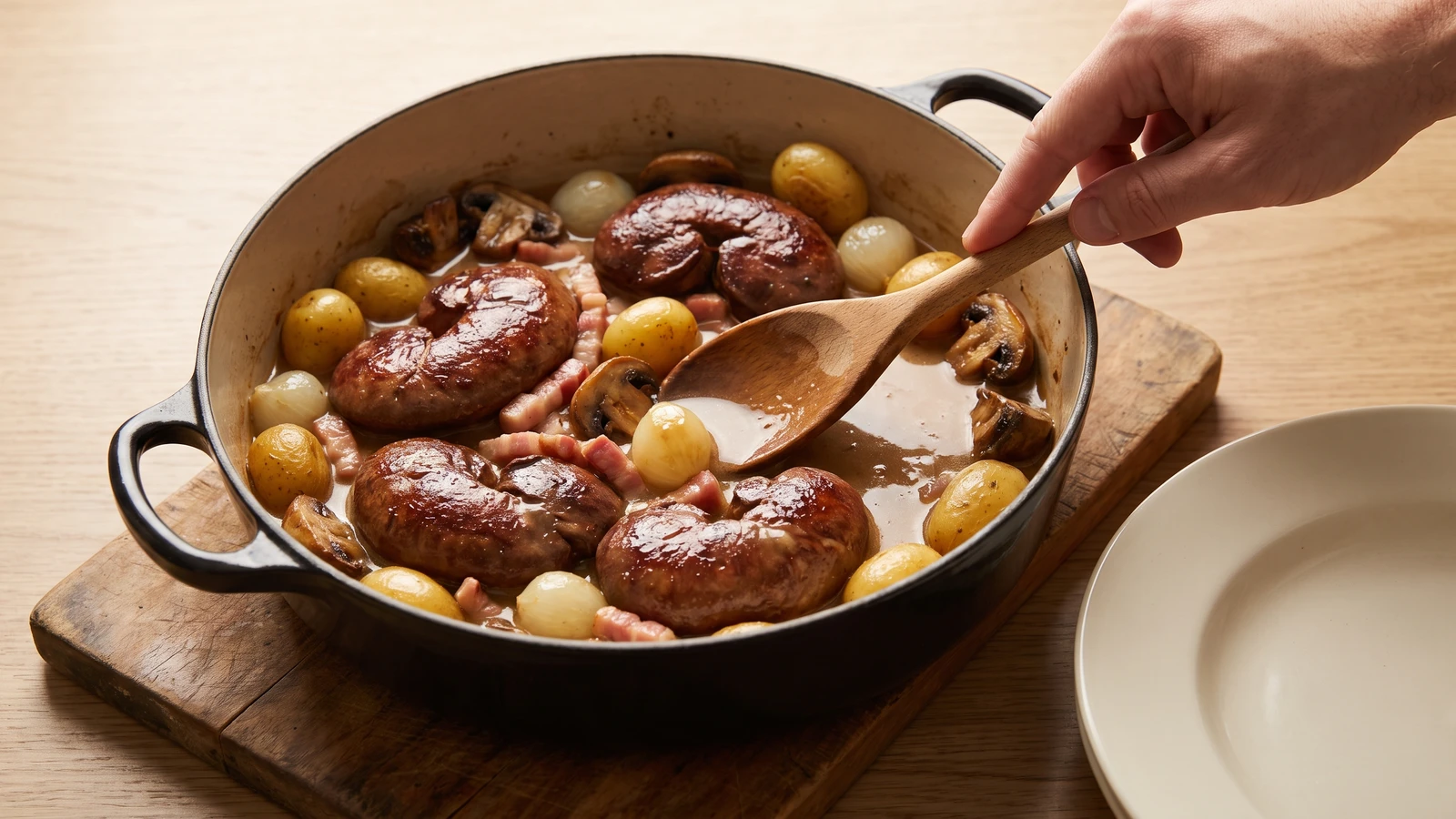
Whole veal kidneys, burnished in butter and finished gently with bacon, mushrooms, small potatoes, glazed onions, and veal gravy: a complete cocotte supper built on control, not complication.
Rognon de Veau en Cocotte (veal kidney cooked and served in its covered pot) teaches a narrow and useful lesson in offal cookery: colour comes from decisive heat, tenderness from knowing when to lower it. The kidney must meet the butter dry, brown without crowding, then finish gently. Boil it and it tightens.
The original expected an earthenware cocotte for service, a saucier with good veal gravy ready, and several hands to half-cook four garnishes in separate pans. Here the book's single-kidney proportions are multiplied fourfold, preserving the equal weights of bacon, mushroom, potato, and onion, while every garnish takes its turn in one heavy lidded cocotte. Those extra pans are brigade scaffolding and go; butter-only poëling, equal garnish weights, and last-minute gravy are the dish and stay. One cook, one stove, one evening.
Done properly, the kidneys arrive burnished and just firm, surrounded by golden potatoes, satiny onions, bacon, and mushrooms, with enough glossy veal gravy to catch every browned morsel from the pot. The step that decides it comes before the heat: remove every hard white duct, then dry the kidney until no moisture shines on its surface.
Rognon de veau en cocotte belongs to the Parisian bourgeois table and the wider French classical dining room, where a tender veal kidney could be served whole in the earthenware vessel that cooked it. En cocotte is often mistaken for a stew, but the classical method is a poêlé preparation: the meat cooks chiefly in butter, receives its separately prepared garniture, and meets only a little veal gravy at the end. Grand kitchens refined the symmetry of bacon, mushroom, potato, and onion; the home table keeps that balance while letting one substantial cocotte feed everyone.
Quantity
4 (about 2 lb / 900 g total), Poëlings (No. 250)
membranes and central white cores removed
Quantity
1½ teaspoons (7.5 ml / 9 g)
divided
Quantity
¾ teaspoon (3.75 ml / 1.5 g)
Quantity
8 tablespoons (½ cup / 120 ml / 113 g)
divided
Quantity
¾ cup (180 ml / 170 g), Blanchings (No. 273)
cut into short batons and thoroughly drained
Quantity
2 cups (480 ml / 170 g)
quartered
Quantity
1¼ cups (300 ml / 170 g), Blanchings (No. 273)
peeled and cut to the size and shape of garlic cloves
Quantity
About 18 (1 cup / 240 ml / 170 g)
peeled
Quantity
⅓ cup (80 ml / 80 g)
divided
Quantity
¼ cup (60 ml / 60 g)
warmed
| Ingredient | Quantity |
|---|---|
| small whole veal kidneysmembranes and central white cores removed | 4 (about 2 lb / 900 g total), Poëlings (No. 250) |
| fine sea saltdivided | 1½ teaspoons (7.5 ml / 9 g) |
| freshly ground black pepper | ¾ teaspoon (3.75 ml / 1.5 g) |
| unsalted butterdivided | 8 tablespoons (½ cup / 120 ml / 113 g) |
| thick-cut unsmoked bacon lardonscut into short batons and thoroughly drained | ¾ cup (180 ml / 170 g), Blanchings (No. 273) |
| small button mushroomsquartered | 2 cups (480 ml / 170 g) |
| small waxy potatoespeeled and cut to the size and shape of garlic cloves | 1¼ cups (300 ml / 170 g), Blanchings (No. 273) |
| pearl onionspeeled | About 18 (1 cup / 240 ml / 170 g) |
| waterdivided | ⅓ cup (80 ml / 80 g) |
| good veal gravywarmed | ¼ cup (60 ml / 60 g) |
Strip away the thin outer membranes. Following the natural seams between the lobes, cut out the hard central fat, vessels, and every white duct while keeping the lobes connected as one kidney. This prepares the meat for Poëlings (No. 250). Pat it exceptionally dry, leave it uncovered in the cold for ten minutes if the surface still looks damp, then season just before cooking with most of the salt and all the pepper.
Melt 1 tablespoon of the butter in the cocotte over medium-low heat. Add the pearl onions, all but 1 teaspoon of the water, and a pinch of salt. Cover and cook for 8 to 10 minutes, shaking the pot occasionally, until nearly tender. Uncover and roll the onions through the reducing butter and water until the liquid disappears and their surfaces turn satiny with touches of gold. Lift them out with a slotted spoon.
Begin with the bacon and potatoes already completed through their separate Blanchings (No. 273); dry both well before they meet the butter. Add 1 tablespoon butter to the cocotte and toss the bacon until lightly golden, then remove it. Add 1½ tablespoons butter and sauté the raw mushrooms briskly until their cut faces brown. Remove them, add another 1½ tablespoons butter, and roll the potatoes through it until pale gold and almost tender. Season the mushrooms and potatoes lightly with the remaining salt, then keep all four garnishes nearby. If the mushrooms release a puddle, remove half and let the liquid cook away before returning them. Colour comes after the water is gone.
Add the remaining 3 tablespoons butter and raise the heat to medium-high. When the foam subsides, brown the kidneys two at a time, giving each broad surface about 2 minutes and rolling the lobed edges through the butter until burnished. This is the application of Poëlings (No. 250): butter carries the heat and the savour, with no moistening during the browning. If a kidney sheds liquid, lift it out, let that moisture boil away, and resume only when the butter sputters again. Ça se rattrape. Keeping it in the puddle would boil it tough.
Return all four kidneys to the cocotte and arrange the bacon, mushrooms, potatoes, and glazed onions around them. Cover tightly, lower the heat, and cook gently for 10 to 15 minutes, turning the kidneys once. The potatoes should yield to a knife and the thickest kidney lobe should reach 160°F / 71°C. Stop there. If the kidneys finish first, lift them to a warm plate under a loose cover while the potatoes take another few minutes; if the potatoes finish first, remove them instead. One ingredient needn't suffer for another's clock.
Spoon away any deep pool of butter, leaving the glossy film and browned fond in the cocotte. Pour the warm veal gravy around the kidneys at the last minute and scrape the pot floor gently, holding everything at the faintest simmer for no more than 1 minute. If the gravy is thin, lift out the food and reduce it briefly; if it tightens too far, loosen it with the reserved teaspoon of water. Return everything only long enough to coat, then carry the cocotte straight to the table as it stands. À table!
1 serving (about 325g)
Culinary guides, cultural storytelling, and the editorial depth that makes cooking meaningful.
Discover Culinary ExplorerChef Juliette
John Dory has the delicacy of sole and the firmness of turbot. A light flouring, a quick butter sauté, and nut-brown beurre noisette show exactly why looks never mattered.

Chef Juliette
Fresh haddock proves its delicacy in the meunière pan: a fine flour crust, moist pearly flakes, and beurre noisette sharpened with lemon and parsley, ready from one skillet in half an hour.

Chef Juliette
Éperlans à l’Anglaise turns small fish into a lesson in disciplined coating: boned smelts under a close, crisp crumb, pan-fried in clarified butter and finished with bright, half-melted maître d’hôtel butter.

Chef Juliette
Tiny smelts, shallot, mushrooms, white wine, gratin sauce, and fine bread raspings meet a fierce oven, where the fish must turn tender in the same breath the buttered crust bronzes.