
Chef Juliette
John Dory (St. Pierre)
John Dory has the delicacy of sole and the firmness of turbot. A light flouring, a quick butter sauté, and nut-brown beurre noisette show exactly why looks never mattered.
A cooking platform built around craft, culture, and the stories behind what we eat.
Created by Chef Juliette
Based on No. 1215, Escalopes de Veau, from Le Guide Culinaire (1907) by Auguste Escoffier
Escalopes de Veau teach the speed of the sauté pan: veal beaten thin, sealed in a crisp à l’anglaise coat, and cooked in clarified butter before tenderness has time to turn firm.
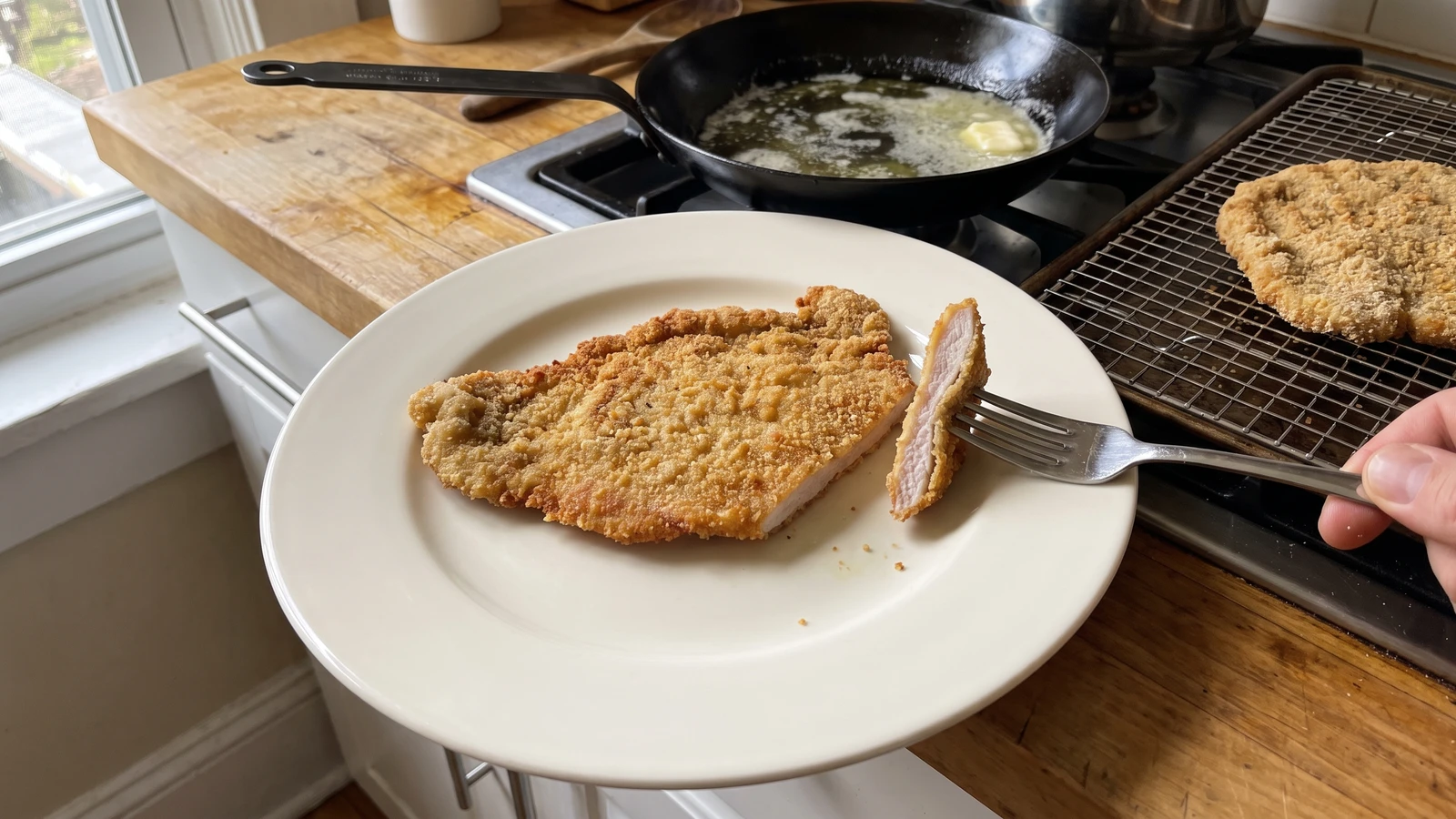
Escalopes de Veau à l’Anglaise (thin veal collops in an egg-and-breadcrumb coat) teach the speed of the sauté pan. The one true thing is this: veal beaten thin must meet very hot clarified butter and leave almost immediately. Let it linger and the meat hardens, however handsome the crust.
The grand kitchen around the original kept a saucier on staff, stock never off the fire, and a salamander ready, but this entry calls on none of them. Its own assumptions were a cushion already cleared of sinew, a moistened beater, a breading station waiting, clarified butter ready, and pans moving through service. At home, ask the butcher for four collops, replace the beater with a smooth mallet and lightly dampened parchment, then cook two at a time in one wide skillet. The stream of individual pans becomes two quick batches because crowding would cool the butter and soften the coating. One cook, one stove, one evening.
The exact oval or curve-based triangle is brigade neatness, useful but not sacred. Clearing every thread of connective tissue, beating the veal evenly thin, keeping flour, Anglaise (for Egg-and-bread-crumbing) (No. 174), and fine crumbs in that order, then cooking quickly in clarified butter are the dish and must stay. Any sauce stays separate because a crisp coat cannot survive a bath. Get the butter properly hot before the first escalope enters. That is the step that decides dinner.
Escalopes de veau belong less to one French province than to cuisine bourgeoise, especially the Parisian dining room, where trimmed boneless slices made veal quick to cook and tidy to serve. The preparation traveled easily between the home pan and classical service because its discipline is portable: remove every sinew, flatten according to the intended finish, and cook without lingering. In classical French vocabulary, à l’anglaise does not name an English sauce; it means the flour, seasoned egg preparation, and breadcrumb coat, which is why any accompanying sauce must remain beside the escalope rather than soften it.
Quantity
4 collops, 4 oz (115 g) each
cleared of all connective tissue
Quantity
½ cup (120 ml / 60 g)
for dredging
Quantity
½ cup (120 ml / 120 g) Anglaise (for Egg-and-bread-crumbing) (No. 174)
Quantity
1½ cups (360 ml / 150 g)
Quantity
½ cup (120 ml / 110 g)
divided
| Ingredient | Quantity |
|---|---|
| veal collops from the cushioncleared of all connective tissue | 4 collops, 4 oz (115 g) each |
| all-purpose flourfor dredging | ½ cup (120 ml / 60 g) |
| prepared Anglaise (for Egg-and-bread-crumbing) | ½ cup (120 ml / 120 g) Anglaise (for Egg-and-bread-crumbing) (No. 174) |
| very fine dry breadcrumbs or fine raspings | 1½ cups (360 ml / 150 g) |
| clarified butterdivided | ½ cup (120 ml / 110 g) |
Inspect each collop before you begin. Slice away every strip of silver skin, membrane, and connective tissue without gouging the meat; a thread left behind contracts in the pan and twists an otherwise even escalope. Shape the pieces into broad ovals or softly curved triangles, trimming only what is necessary. Exact geometry is brigade scaffolding. Even thickness is the useful part.
Lay one collop between two sheets of parchment and lightly dampen the upper sheet, the home equivalent of the moistened beater. Using the smooth face of a meat mallet or a rolling pin, strike from the center outward until the veal is an even scant ⅛ inch (3 mm) thick. Do not hammer holes through it. If an edge tears, overlap the torn section and tap it once to join it, then continue. Pat both surfaces completely dry after pounding because moisture would loosen the coating.
Arrange three wide shallow dishes in order: the flour, the prepared Anglaise (for Egg-and-bread-crumbing) (No. 174), and the fine breadcrumbs. This is the panure à l’anglaise, the three-part coating sequence. The flour is not filler; it gives the egg preparation a dry surface to grip. Set a wire rack beside the station so the finished pieces remain dry underneath.
Pass each escalope lightly through the flour and shake off every loose patch. Dip it into the Anglaise (for Egg-and-bread-crumbing) (No. 174), coating both faces and the edges, then let the excess drain back into the dish. Lay it in the breadcrumbs, turn it once, and press gently with a flat palm so the crumbs adhere without becoming a heavy shell. Transfer it to the rack and let the coating settle for 5 minutes.
Heat ¼ cup (60 ml / 55 g) of the clarified butter in a 12-inch (30 cm) heavy skillet over medium-high heat. It is ready when the surface shimmers and a dropped breadcrumb begins bubbling immediately, but the fat must not smoke. Lay in two escalopes without overlapping and cook for 60 to 90 seconds, until the underside is an even deep gold. Turn once with a wide spatula and cook the second side for another 45 to 75 seconds. If the crust colors too quickly, lift the skillet from the heat for several seconds and lower the flame. If the coating tries to slip, stop moving the escalope and let the first side set before turning. Ça se rattrape. Remove loose crumbs from the skillet, replenish the clarified butter, restore the heat, and cook the remaining pair.
Lift the escalopes to the wire rack and leave them unstacked. The crust should be crisp and butter-gold, while the veal beneath remains tender and may retain a faint blush. If checking with a thermometer, the thickest point should reach 145°F (63°C); rest the meat for 3 minutes. Transfer to warm plates immediately. If you offer a garnish or sauce, bring it in a separate warmed vessel and let each person add it beside the meat, never over the coating. À table!
1 serving (about 190g)
Culinary guides, cultural storytelling, and the editorial depth that makes cooking meaningful.
Discover Culinary ExplorerChef Juliette
John Dory has the delicacy of sole and the firmness of turbot. A light flouring, a quick butter sauté, and nut-brown beurre noisette show exactly why looks never mattered.

Chef Juliette
Fresh haddock proves its delicacy in the meunière pan: a fine flour crust, moist pearly flakes, and beurre noisette sharpened with lemon and parsley, ready from one skillet in half an hour.

Chef Juliette
Éperlans à l’Anglaise turns small fish into a lesson in disciplined coating: boned smelts under a close, crisp crumb, pan-fried in clarified butter and finished with bright, half-melted maître d’hôtel butter.

Chef Juliette
Tiny smelts, shallot, mushrooms, white wine, gratin sauce, and fine bread raspings meet a fierce oven, where the fish must turn tender in the same breath the buttered crust bronzes.