
Chef Juliette
John Dory (St. Pierre)
John Dory has the delicacy of sole and the firmness of turbot. A light flouring, a quick butter sauté, and nut-brown beurre noisette show exactly why looks never mattered.
A cooking platform built around craft, culture, and the stories behind what we eat.
Created by Chef Juliette
Based on No. 1151, Pièce de Bœuf à la Noailles, from Le Guide Culinaire (1907) by Auguste Escoffier
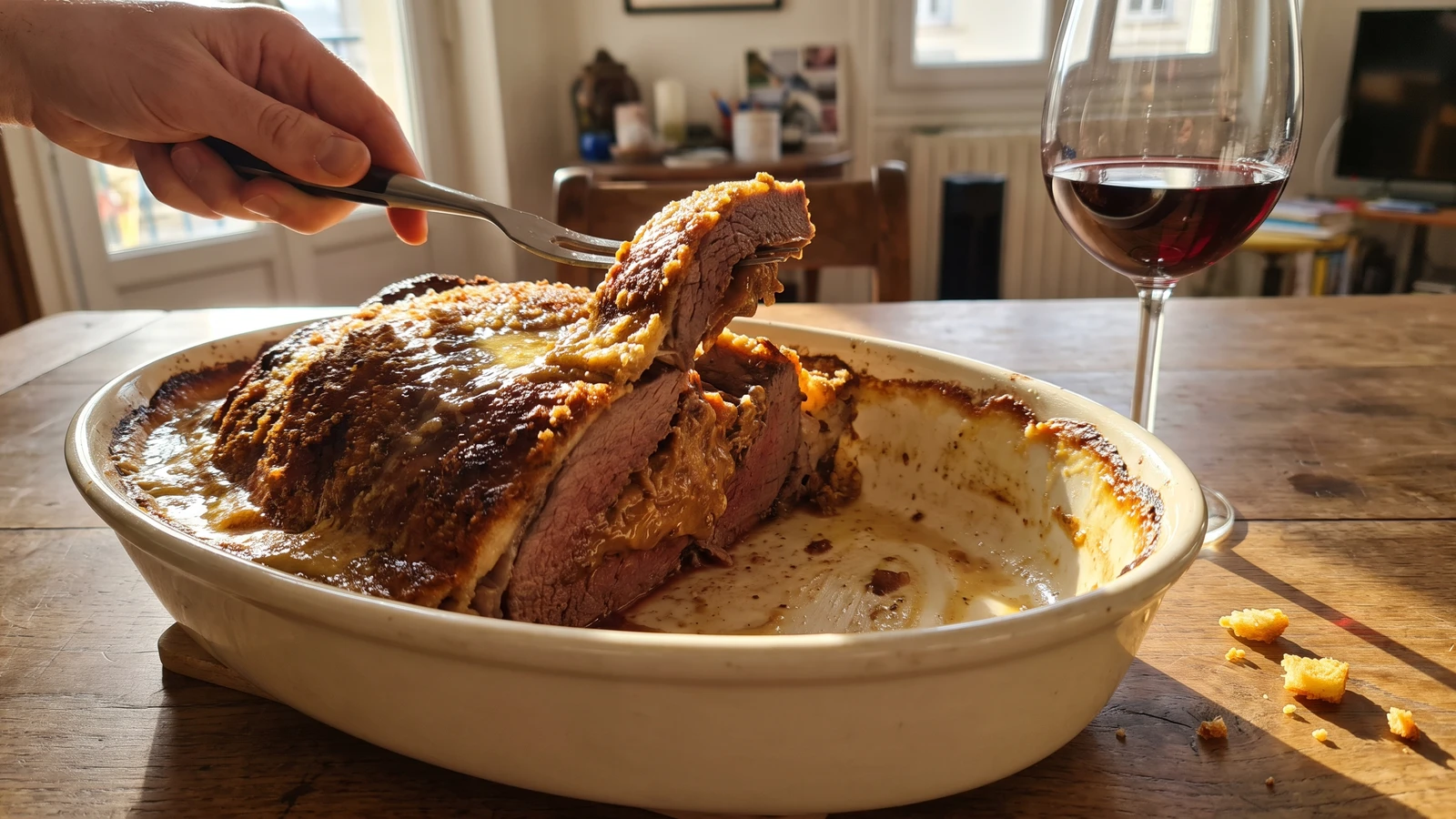
Pièce de Bœuf à la Noailles turns a patient wine braise into a burnished centerpiece, with larded beef, fond-darkened Soubise between every slice, and a rapid buttered gratin over the whole generous piece.
Pièce de Bœuf à la Noailles (larded beef braised in wine, layered with onion-and-rice purée, and quickly gratinéed) teaches one true thing: the browned fond must carry the whole dish. The beef gives the pan its bronze glaze, then the wine, onions, and rice gather that flavour into Soubise. Pale browning leaves nowhere for this grand construction to hide.
The original assumed a larding needle, a saucier on staff, veal gravy drawn from stock never off the fire, a tammy for passing the purée, and a salamander waiting to form the gratin. At home, a chilled baton of fatback follows a metal skewer through the beef, gelatin-rich veal stock supplies the body, a fine sieve replaces the tammy, and the broiler does the salamander's work. The brigade portion becomes one compact roast for four. Separate hands, extra pans, and ceremonial trimming are scaffolding and can go; larding, the two-stage braise, the passed Soubise, and the rapid gratin are the dish and must stay. One cook, one stove, one evening.
Dry the marinated beef thoroughly, then brown it until every face is deep bronze without letting the butter or fond turn black. That is the step that matters most. Once the fond is right, the gentle braise and the onions do nearly all the remaining work.
Pièce de Bœuf à la Noailles belongs to the named-preparation culture of Parisian grand cuisine rather than to a single provincial larder; Noailles was an aristocratic name attached to dishes shaped for formal service. Its defining companion, Soubise, is the onion-and-rice purée associated with another noble house, so the plate joins two menu names through technique rather than geography. What looks like presentation theater has a practical purpose: purée between the slices seasons every portion, while the rapid gratin binds the reconstructed piece beneath a buttered crust.
Quantity
1 compact roast, 2½ lb (1.15 kg)
Quantity
6 long batons, 3 oz (85 g)
well chilled
Quantity
½ cup (120 ml / 120 g) Cooked Marinade for Venison (No. 168)
prepared separately and cooled
Quantity
1 cup (240 ml / 240 g)
Quantity
¼ cup (60 ml / 57 g)
Quantity
1¾ cups (420 ml / 420 g)
Quantity
7 tablespoons (105 ml / 99 g)
divided
Quantity
4 cups (960 ml / 640 g)
finely minced
Quantity
⅓ cup (80 ml / 60 g)
Quantity
2 tablespoons (30 ml / 15 g)
Quantity
1 application of Gratins (No. 268), using the Rapid Gratin method
Quantity
2 teaspoons (10 ml / 12 g), plus more as needed
divided
Quantity
1 teaspoon (5 ml / 2 g)
Quantity
Up to ½ cup (120 ml / 120 g)
| Ingredient | Quantity |
|---|---|
| boneless beef chuck-eye roast | 1 compact roast, 2½ lb (1.15 kg) |
| unsmoked pork fatbackwell chilled | 6 long batons, 3 oz (85 g) |
| Cooked Marinade for Venisonprepared separately and cooled | ½ cup (120 ml / 120 g) Cooked Marinade for Venison (No. 168) |
| dry red wine | 1 cup (240 ml / 240 g) |
| brandy | ¼ cup (60 ml / 57 g) |
| unsalted gelatin-rich veal stock or diluted veal demi-glace | 1¾ cups (420 ml / 420 g) |
| unsalted butterdivided | 7 tablespoons (105 ml / 99 g) |
| yellow onionsfinely minced | 4 cups (960 ml / 640 g) |
| uncooked medium-grain white rice | ⅓ cup (80 ml / 60 g) |
| fine dry bread crumbs | 2 tablespoons (30 ml / 15 g) |
| Gratins | 1 application of Gratins (No. 268), using the Rapid Gratin method |
| fine saltdivided | 2 teaspoons (10 ml / 12 g), plus more as needed |
| freshly ground black pepper | 1 teaspoon (5 ml / 2 g) |
| additional hot unsalted veal stock (optional) | Up to ½ cup (120 ml / 120 g) |
Set the beef lengthwise on the board. Push a clean 6 mm metal skewer through the roast from one end to the other, working parallel to the grain, then widen the tunnel gently with the handle of a narrow wooden spoon. Feed in a chilled baton of fatback and withdraw the skewer, leaving the fat inside. Repeat at even intervals until six batons run through the meat, then tie the roast compactly with kitchen twine. If a strip buckles or breaks, chill it again and reopen the tunnel from the opposite end. Ça se rattrape.
Combine the Cooked Marinade for Venison (No. 168), red wine, and brandy in a snug nonreactive dish. Turn the beef through the liquid, cover, and refrigerate for 1 hour, turning once; for advance preparation, it may remain there for up to 12 hours. Remove the beef and reserve every drop of marinade for the braise. Pat the meat thoroughly dry, then season it with 1½ teaspoons of the salt and all the pepper. A wet roast will simmer against the pot instead of browning.
Heat the oven to 300°F (150°C). Melt 2 tablespoons (30 ml / 28 g) of the butter in a heavy cocotte over medium-high heat. When its foam subsides, add the beef and brown every surface slowly and evenly, including the ends, for 10 to 12 minutes. Aim for deep bronze, not black. If the butter scorches before the beef is ready, lift out the meat, wipe away the blackened fat without scouring off the sound brown glaze, and continue with a spoonful of fresh butter. Return the beef, pour in the reserved red-wine, brandy, and Cooked Marinade for Venison (No. 168) mixture, then add the equal quantity of veal stock. Scrape the pot floor until the fond dissolves into the liquid.
Bring the liquid just to a simmer, cover the cocotte, and place it in the oven. Braise for 1 hour and 15 minutes, turning the beef after 40 minutes. The liquid should barely tremble. If it boils hard, lower the oven to 275°F (135°C); a quiet braise keeps the meat succulent and sliceable.
While the beef completes its first stage, melt 3 tablespoons (45 ml / 42 g) of the butter in a wide pan over medium-low heat. Add the minced onions and the remaining ½ teaspoon salt. Toss them in the butter for 20 to 25 minutes, stirring frequently, until they collapse into a soft, glossy mass without browning. If their edges colour, lower the heat and add a spoonful of the braising liquid. Soubise wants sweetness from patient cooking, not caramel.
Remove the cocotte from the oven and arrange the buttered onions around the half-cooked beef. Sprinkle the uncooked rice evenly through the onions, pressing it beneath the liquid without piling it over the meat. Cover and return the cocotte to the oven for 1 hour and 15 minutes to 1 hour and 40 minutes. Turn the beef once and stir only the onions around it. The meat is ready when a thin skewer enters with little resistance but the piece still holds firmly enough to slice; the rice should be completely tender and beginning to dissolve. If the pot dries before that point, add hot veal stock ¼ cup (60 ml / 60 g) at a time.
Lift the beef onto a board, cover it loosely, and rest it for 20 minutes. Pour the onions, rice, and all the braising liquid through the fine disk of a food mill, or press them patiently through a sturdy fine-mesh sieve. Return this Soubise to the cocotte and reduce it over medium heat for 5 to 10 minutes, stirring across the bottom, until it falls from the spoon in a thick ribbon. If it becomes pasty, whisk in hot veal stock one spoonful at a time; if it remains thin, keep reducing. If coarse onion fibres remain, pass it once more. Cooking well is not cooking fancy, but the smoothness matters here.
Remove the twine and trim away only loose exterior fat or ragged edges. Cut the beef across the grain into even slices about ⅜ inch (1 cm) thick. Spread a shallow bed of Soubise in a broiler-safe oval gratin dish, then reconstruct the roast in order, spooning about 1 tablespoon (15 ml / 18 g) of Soubise between each slice. Cover the top and sides with the remaining purée. Keep the slices touching so the finished piece reads as a roast brought whole to the table, not separate portions.
Melt 1 tablespoon (15 ml / 14 g) of the butter in a small pan, add the bread crumbs, and toss until they are butter-gold and crisp at the edges. Sprinkle them evenly over the Soubise, then melt the final tablespoon of butter and spoon it across the surface. Apply Gratins (No. 268) as a Rapid Gratin: place the dish about 6 inches (15 cm) beneath a fully heated broiler for 3 to 5 minutes, rotating once, until the crust is deep gold and the sauce bubbles at the rim. If the crumbs darken too quickly, lower the dish one rack and let the centre catch up. Rest for 5 minutes, then serve directly from the gratin dish. À table!
1 serving (about 440g)
Culinary guides, cultural storytelling, and the editorial depth that makes cooking meaningful.
Discover Culinary ExplorerChef Juliette
John Dory has the delicacy of sole and the firmness of turbot. A light flouring, a quick butter sauté, and nut-brown beurre noisette show exactly why looks never mattered.

Chef Juliette
Fresh haddock proves its delicacy in the meunière pan: a fine flour crust, moist pearly flakes, and beurre noisette sharpened with lemon and parsley, ready from one skillet in half an hour.

Chef Juliette
Éperlans à l’Anglaise turns small fish into a lesson in disciplined coating: boned smelts under a close, crisp crumb, pan-fried in clarified butter and finished with bright, half-melted maître d’hôtel butter.

Chef Juliette
Tiny smelts, shallot, mushrooms, white wine, gratin sauce, and fine bread raspings meet a fierce oven, where the fish must turn tender in the same breath the buttered crust bronzes.