
Chef Juliette
John Dory (St. Pierre)
John Dory has the delicacy of sole and the firmness of turbot. A light flouring, a quick butter sauté, and nut-brown beurre noisette show exactly why looks never mattered.
A cooking platform built around craft, culture, and the stories behind what we eat.
Created by Chef Juliette
Based on No. 1149, Pièce de Bœuf à la Mode Chaude, from Le Guide Culinaire (1907) by Auguste Escoffier
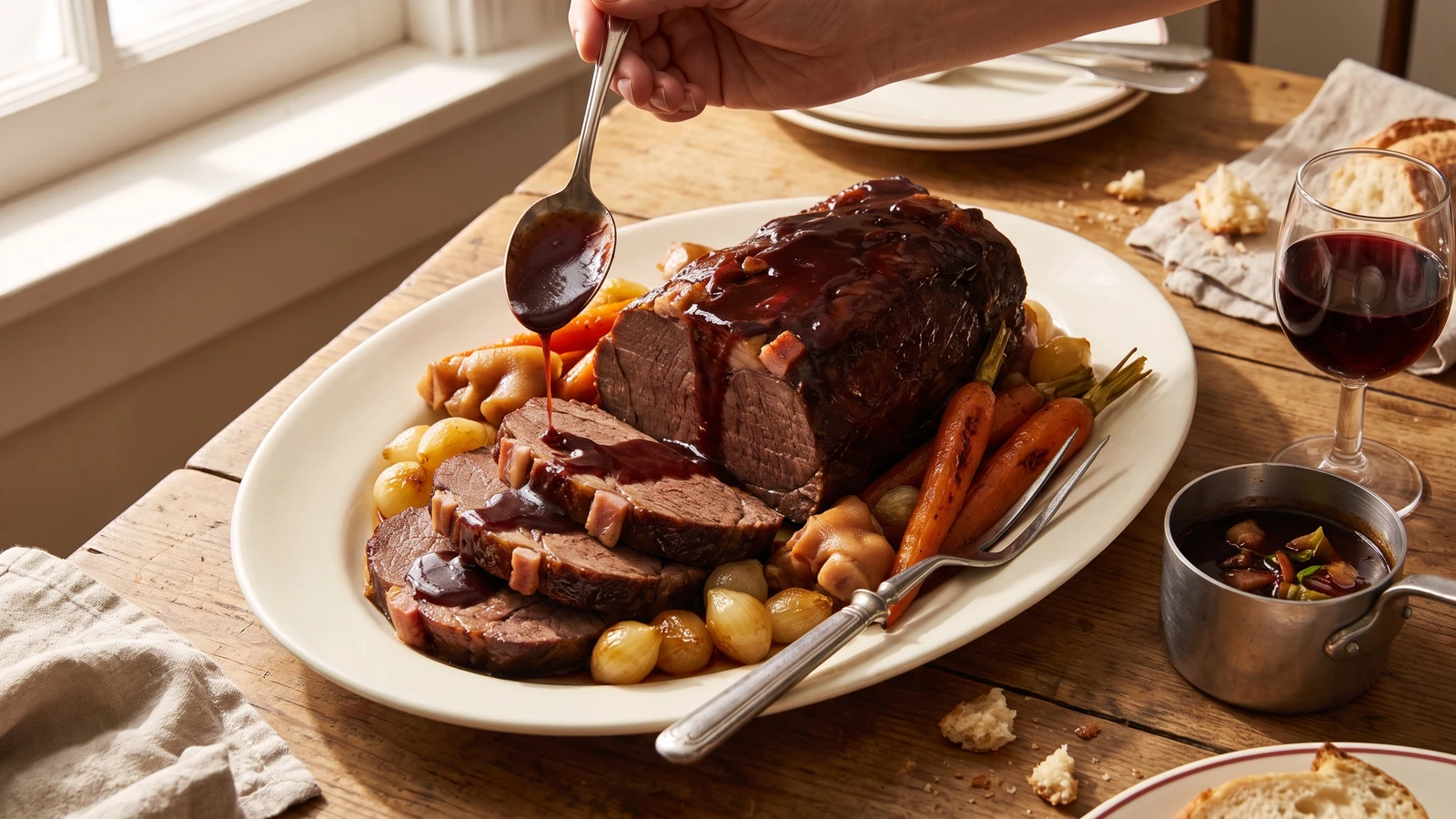
A proper bœuf à la mode makes collagen do the work: larded beef, red wine, brandy, calf's feet, carrots, and onions braised slowly until the meat yields and the sauce coats a spoon.
Pièce de Bœuf à la Mode Chaude (hot wine-braised beef with calf's feet) teaches the governing law of braising: the liquor must be short and substantial, and that begins with the pot. Before touching a pan, choose the smallest heavy cocotte that will hold the beef and calf's feet closely. A wide vessel demands more stock, and more stock dilutes the very sauce you're trying to build.
The professional entry assumed a special larding needle, a stockpot never off the fire, a saucier available to strain and reduce, a second clean pan for the final braise, and a salamander waiting to glaze the meat. At home, a narrow boning knife and skewer insert the fat, good gelatin-rich stock moistens the braise, the same wiped cocotte replaces the second pan, and the broiler supplies the final gloss. The beef has been scaled from a four-to-five-pound service piece to two and a half pounds for four people. The tournéed carrots have become even tapered lozenges because their exact shape was brigade scaffolding; the larding, wine-and-brandy marinade, calf's feet, and two-stage braise remain because they are the dish.
When the bœuf à la mode is right, the slices hold together but yield under the fork, the fatback has kept the lean meat succulent, and the sauce falls from the spoon in a wine-dark ribbon with no flour to prop it up. The calf's feet provide that body and return as part of the garnish, which is precisely why powdered gelatin is no honest replacement here. Before you begin, fit the pot to the beef; that single choice decides whether you finish with a glaze or a diluted broth.
Pièce de bœuf à la mode chaude belongs to the cuisine bourgeoise of Paris, where a larded round or rump was braised with wine, carrots, and onions, then served either hot or allowed to set in its own gelatin. Chaude distinguishes this hot service from the cold presentation, and the calf's feet supplied both the natural jelly and pieces for the garnish. Grand kitchens refined the household pot with turned vegetables, repeated glazing, and a separate timbale of sauce, but its foundation remained domestic: lean beef, a close-fitting vessel, and patient heat.
Quantity
2½ lb (1.1 kg)
tied into an even piece
Quantity
7½ oz (210 g)
cut into ¼-inch (6 mm) square batons as long as the beef
Quantity
1½ tablespoons (22 ml / 21 g)
Quantity
2 tablespoons (30 ml / 8 g)
finely chopped
Quantity
2 teaspoons (10 ml / 12 g), plus more to correct the sauce
Quantity
1 teaspoon (5 ml / 2 g)
Quantity
¼ teaspoon (1 ml / 0.5 g)
Quantity
1 dish-specific batch (about 2 cups / 480 ml / 480 g) Cooked Marinade for Venison (No. 168)
completed from the red wine and brandy specified by this entry
Quantity
1¾ cups (420 ml / 420 g)
Quantity
¼ cup (60 ml / 57 g)
Quantity
1 home-scale batch from Ordinary Braisings (No. 247), prepared for a 2½ lb (1.1 kg) piece of beef
Quantity
2 tablespoons (30 ml / 28 g)
Quantity
2 cups (480 ml / 480 g), plus more if needed
Quantity
2 feet (about 2 lb / 900 g total) through Blanchings (No. 273)
boned, blanched, cooled, and tied
Quantity
½ cup (120 ml / 65 g)
cut into 1½-inch (4 cm) tapered lozenges
Quantity
16 (about 10 oz / 280 g)
peeled
Quantity
¾ cup (180 ml / 170 g)
| Ingredient | Quantity |
|---|---|
| boneless beef rump or top roundtied into an even piece | 2½ lb (1.1 kg) |
| unsmoked pork fatbackcut into ¼-inch (6 mm) square batons as long as the beef | 7½ oz (210 g) |
| brandy for the fatback | 1½ tablespoons (22 ml / 21 g) |
| flat-leaf parsleyfinely chopped | 2 tablespoons (30 ml / 8 g) |
| fine sea salt | 2 teaspoons (10 ml / 12 g), plus more to correct the sauce |
| freshly ground black pepper | 1 teaspoon (5 ml / 2 g) |
| freshly grated nutmeg | ¼ teaspoon (1 ml / 0.5 g) |
| Cooked Marinade for Venisoncompleted from the red wine and brandy specified by this entry | 1 dish-specific batch (about 2 cups / 480 ml / 480 g) Cooked Marinade for Venison (No. 168) |
| dry red wine | 1¾ cups (420 ml / 420 g) |
| brandy for the beef marinade | ¼ cup (60 ml / 57 g) |
| browned-aromatic braising base | 1 home-scale batch from Ordinary Braisings (No. 247), prepared for a 2½ lb (1.1 kg) piece of beef |
| clarified butter | 2 tablespoons (30 ml / 28 g) |
| unsalted gelatin-rich brown beef or veal stock | 2 cups (480 ml / 480 g), plus more if needed |
| calf's feetboned, blanched, cooled, and tied | 2 feet (about 2 lb / 900 g total) through Blanchings (No. 273) |
| carrotscut into 1½-inch (4 cm) tapered lozenges | ½ cup (120 ml / 65 g) |
| small pearl onionspeeled | 16 (about 10 oz / 280 g) |
| unsalted butter for the onions | ¾ cup (180 ml / 170 g) |
Twenty minutes before larding, toss the fatback batons with the 1½ tablespoons of brandy. Drain them, roll them in the chopped parsley, and chill briefly until firm. Insert the batons lengthwise through the beef with a larding needle, or open narrow channels with a slim boning knife and guide the fat through with a sturdy skewer. Space them evenly and keep them parallel to the grain. The amount looks generous because the classical proportion is roughly three ounces of fat for every pound of lean beef; the larding is not decoration, it protects the meat through its long braise. If one channel tears, press the meat back around the fat and retie it. Ça se rattrape.
Rub the larded beef all over with the salt, pepper, and nutmeg. Place it in a nonreactive vessel that holds it snugly, then pour over the red wine and ¼ cup of brandy, completing the dish-specific Cooked Marinade for Venison (No. 168) named by the entry. Cover and refrigerate for four to five hours, turning the beef three or four times. The direct instruction for this dish governs the liquids: red wine and brandy, without vinegar or added sweetness. Set the marinade before lunch, and the cooking itself becomes one cook, one stove, one evening.
Heat the oven to 300°F (150°C). Lift the beef from its marinade, reserve every drop of liquid, and let the meat drain for thirty minutes before drying it thoroughly. Wet beef cannot brown. Have the browned-aromatic base from Ordinary Braisings (No. 247) ready, along with the calf's feet prepared through Blanchings (No. 273). Choose the smallest heavy cocotte that holds the beef and feet without crowding. A broad pot demands too much stock, and too much stock gives broth where you need sauce.
Heat the clarified butter in the cocotte until it is hot and quiet, then brown the beef deeply on every side, including both ends. Give each surface time to form a dark bronze crust before moving it. Lift the beef out. The brown film left on the pot floor is the fond, the foundation of the finished sauce. If any patch turns black, stop and transfer the beef to a clean pot, leaving the burned fat behind; bitterness cannot be reduced away, but the meat itself is unharmed.
Set the browned-aromatic base from Ordinary Braisings (No. 247) in the cocotte and place the beef over it. Pour in the reserved marinade, scraping up the fond, and boil briskly until the liquid becomes syrupy around the aromatics. This reduction is the one true foundation of the braise: concentrate the wine before adding stock, or the sauce will remain thin and raw-tasting. Add enough stock to come nearly to the top of the beef, then arrange the tied calf's feet from Blanchings (No. 273) around it. Cover, bring the liquid just to a tremble, and braise in the oven for about two hours, turning and basting every forty minutes. If the liquid boils hard, lower the oven to 275°F (135°C); if it falls below halfway up the meat, add a little hot stock.
While the first braise continues, simmer the tapered carrot lozenges in a small ladleful of braising liquor until about two-thirds tender, roughly eight minutes, then lift them out. The professional garnish used carottes tournées, carrots trimmed into elongated olives. Cutting even tapered lozenges saves waste while preserving their size and cooking rate; the exact turning was brigade presentation, not the soul of the dish. Melt the butter in a shallow saucepan and roll the pearl onions through it over medium-low heat until golden on several sides and nearly tender. Lift them out with a slotted spoon. Most of that butter stays behind, but the generous butter bath colours the onions evenly. We don't apologize for butter.
When a thin knife enters the beef deeply but still meets resistance, lift out the meat and calf's feet. Strain the braising liquor through a fine sieve, pressing lightly on the aromatics, then discard the spent base. Wipe the cocotte clean instead of reaching for a second saucepan; that second pan served a brigade's organization, while a clean reused cocotte gives the same clear sauce at home. Remove the strings from the calf's feet and cut them into small square or rectangular pieces. Return the beef to the cocotte, surround it with the carrots, onions, and calf's-foot pieces, and pour the strained liquor over everything. Cover and braise gently for another forty-five to seventy-five minutes, until a knife passes into the beef without resistance.
Lift the beef and garnish to a warm dish. Skim the fat from the braising liquor, then reduce it over lively heat until it gleams and coats the back of a spoon in a light, even film. No roux is needed. The calf's feet have supplied the gelatin that gives the sauce its body. If the sauce is watery, keep reducing; if it becomes sticky or sets on the spoon like glue, loosen it with hot stock a tablespoon at a time. Ça se rattrape. Return the garnish to the sauce, warm it gently, and correct the salt.
For the optional glaze, place the whole beef beneath a hot broiler, the home equivalent of the salamander, and brush it with a thin coat of sauce. Let the coat set for thirty to sixty seconds, brush again, and repeat two or three times until the surface shines like dark mahogany. Watch without wandering. If you plan to slice the beef before it reaches the table, skip the glazing; it is handsome, not essential. Rest the meat for ten minutes, slice it thickly across the grain, and coat it lightly with sauce. Serve the remaining sauce, carrots, onions, and pieces of calf's foot in a warmed bowl or timbale beside it. À table!
1 serving (about 520g)
Culinary guides, cultural storytelling, and the editorial depth that makes cooking meaningful.
Discover Culinary ExplorerChef Juliette
John Dory has the delicacy of sole and the firmness of turbot. A light flouring, a quick butter sauté, and nut-brown beurre noisette show exactly why looks never mattered.

Chef Juliette
Fresh haddock proves its delicacy in the meunière pan: a fine flour crust, moist pearly flakes, and beurre noisette sharpened with lemon and parsley, ready from one skillet in half an hour.

Chef Juliette
Éperlans à l’Anglaise turns small fish into a lesson in disciplined coating: boned smelts under a close, crisp crumb, pan-fried in clarified butter and finished with bright, half-melted maître d’hôtel butter.

Chef Juliette
Tiny smelts, shallot, mushrooms, white wine, gratin sauce, and fine bread raspings meet a fierce oven, where the fish must turn tender in the same breath the buttered crust bronzes.