
Chef Juliette
John Dory (St. Pierre)
John Dory has the delicacy of sole and the firmness of turbot. A light flouring, a quick butter sauté, and nut-brown beurre noisette show exactly why looks never mattered.
A cooking platform built around craft, culture, and the stories behind what we eat.
Created by Chef Juliette
Based on No. 1129, Tournedos à la Sarde, from Le Guide Culinaire (1907) by Auguste Escoffier
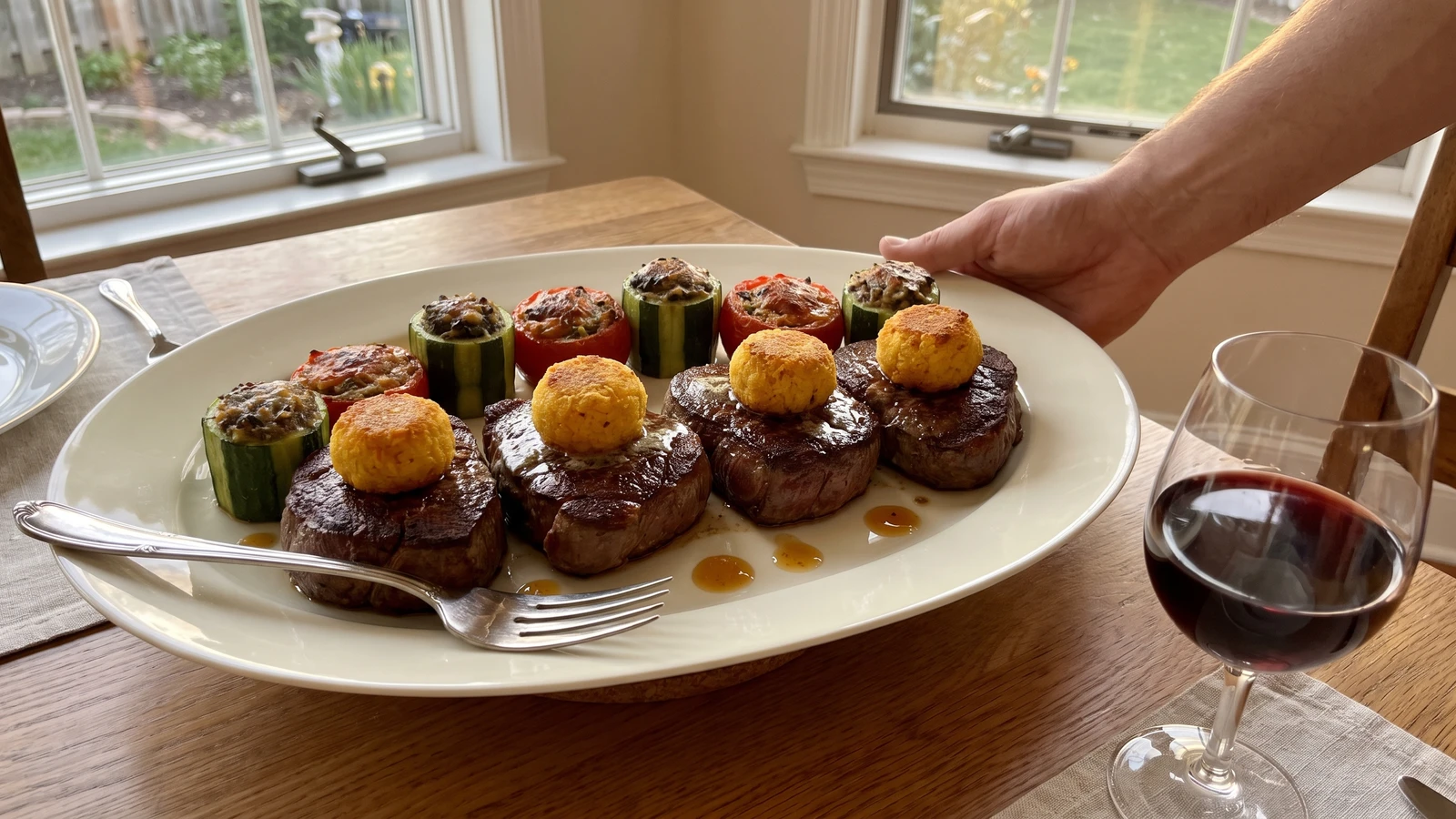
Lean tournedos seared fast in butter, each crowned with a crisp saffron-rice croquette and ringed by duxelles-filled cucumber and tomato: a grand garnish brought within reach of one cook.
Tournedos à la Sarde (butter-seared beef with saffron rice and stuffed vegetables) teaches a hard, useful rule: tenderloin must be the final thing cooked. The cucumber cases, stuffed tomatoes, and croquettes can wait briefly, but lean beef cannot. Sear it hot, rest it shortly, and serve without delay.
The original assumed a saucier keeping the duxelles dry, stock never off the fire, a salamander browning the gratin, and several hands preparing three garnishes at once. Here, one measured pan of stock replaces the stockpot, the broiler replaces the salamander, and four tournedos replace the brigade portion. The work is arranged in sequence so one cook can manage it without altering the dish's intent. One cook, one stove, one evening.
Holding separate garnishes under service lamps was brigade scaffolding, and it can go. The dry duxelles, the saffron rice thickened with yolks, the croquettes treated à l'anglaise, the butter sear, and the alternating crown are the dish itself, so they stay. Have every garnish finished and the platter warm before the tournedos touch the butter. That is the step that decides everything, because delay dries this lean cut.
Tournedos à la Sarde belongs to the codified Parisian grand-kitchen table, where à la Sarde named a composed garnish rather than recording a Sardinian household dish. Saffron rice and tomatoes supplied the Sardinian cue, while cucumber cases, duxelles, gratin work, and crown service spoke the grammar of the French brigade. As such combinations passed into bourgeois dining rooms, the garnish remained a display of coordinated technique, not a regional claim.
Quantity
4 tournedos, 5½ ounces (155 g) each
cut about 1¼ inches (3 cm) thick and tied
Quantity
½ cup (120 ml / 113 g)
divided, with half clarified for searing
Quantity
3½ cups before chopping (830 ml / 250 g)
very finely chopped
Quantity
⅓ cup (80 ml / 50 g)
finely chopped
Quantity
2 tablespoons (30 ml / 8 g)
finely chopped
Quantity
1 cucumber, about 16 ounces (450 g)
peeled and cut into four 1½-inch (4-cm) cylinders
Quantity
4 tomatoes, about 10 ounces (280 g) total
Quantity
1¼ cups (300 ml / 300 g)
divided
Quantity
⅓ cup (80 ml / 65 g)
Quantity
¼ teaspoon (1.25 ml / about 0.1 g)
Quantity
2
Quantity
1 prepared batch Gratins (No. 268), scaled to finish 8 stuffed vegetable cases
Quantity
1 prepared batch Anglaise (for Egg-and-bread-crumbing) (No. 174), scaled to coat 4 rice croquettes
Quantity
4 cups (950 ml / about 870 g)
Quantity
2 teaspoons (10 ml / 12 g)
divided
Quantity
¾ teaspoon (3.75 ml / 1.5 g)
divided
| Ingredient | Quantity |
|---|---|
| center-cut beef tenderloin tournedoscut about 1¼ inches (3 cm) thick and tied | 4 tournedos, 5½ ounces (155 g) each |
| unsalted butterdivided, with half clarified for searing | ½ cup (120 ml / 113 g) |
| button or cremini mushroomsvery finely chopped | 3½ cups before chopping (830 ml / 250 g) |
| shallotsfinely chopped | ⅓ cup (80 ml / 50 g) |
| flat-leaf parsleyfinely chopped | 2 tablespoons (30 ml / 8 g) |
| large hothouse cucumberpeeled and cut into four 1½-inch (4-cm) cylinders | 1 cucumber, about 16 ounces (450 g) |
| small firm plum tomatoes | 4 tomatoes, about 10 ounces (280 g) total |
| unsalted beef stockdivided | 1¼ cups (300 ml / 300 g) |
| short-grain white rice | ⅓ cup (80 ml / 65 g) |
| saffron threads | ¼ teaspoon (1.25 ml / about 0.1 g) |
| large egg yolks | 2 |
| Gratins | 1 prepared batch Gratins (No. 268), scaled to finish 8 stuffed vegetable cases |
| Anglaise (for Egg-and-bread-crumbing) | 1 prepared batch Anglaise (for Egg-and-bread-crumbing) (No. 174), scaled to coat 4 rice croquettes |
| neutral frying oil | 4 cups (950 ml / about 870 g) |
| fine sea saltdivided | 2 teaspoons (10 ml / 12 g) |
| freshly ground black pepperdivided | ¾ teaspoon (3.75 ml / 1.5 g) |
Warm ¾ cup (180 ml) of the stock with the saffron until the liquid turns a clear golden yellow. Stir in the rice and ¼ teaspoon of the salt, cover, and cook over the lowest heat until the grains are tender and the stock has been absorbed, about 16 minutes. If the pan dries while the rice remains firm, add stock or water one tablespoon at a time. Ça se rattrape, but drowning it will leave the croquettes too soft to shape.
Take the rice from the heat and beat in the egg yolks thoroughly. Return the pan to very low heat for 30 to 45 seconds, stirring constantly, until the rice becomes cohesive and pulls from the pan in one mass. Do not let the yolks scramble. If small curds appear, scrape the mixture immediately onto a cold tray and work it firmly with a spatula while it cools. Spread it in a shallow layer, cover, and chill for at least 30 minutes.
Melt 2 tablespoons (30 ml) of the butter in a wide skillet. Soften the shallots without browning, then add the mushrooms, ½ teaspoon salt, and ¼ teaspoon pepper. Cook over medium-high heat, stirring often, until the mushrooms release their water, the water evaporates, and the mixture becomes a dark, concentrated paste, about 12 to 15 minutes. Stir in the parsley and cool. Duxelles must be dry enough to hold its shape; if liquid gathers when you press it with a spoon, return it to the heat. Wet duxelles would soak the vegetables, but ça se rattrape before stuffing.
Scoop the centers from the cucumber cylinders, leaving a ⅜-inch (1-cm) wall and an intact base. Cut a thin lid from each tomato, scoop out the seeds and wet pulp, then season the cavities lightly. Parboil the cucumber cases in salted water for 2 minutes and the tomatoes for only 10 seconds, then drain both upside down. Melt 2 tablespoons (30 ml) butter in a shallow pan, add the remaining ½ cup (120 ml) stock, and arrange the cucumber cases upright. Cover and braise at a bare simmer for 6 to 8 minutes, adding the tomatoes cut side up for the final 2 minutes. The cucumber should yield to a knife but still stand firmly, and the tomatoes must keep their shape.
Divide the cold saffron rice into four equal portions and roll each into a small round croquette, compressing it enough to remove cracks without crushing the grains. Coat all four with the prepared Anglaise (for Egg-and-bread-crumbing) (No. 174), following that preparation exactly and keeping its crust complete. Chill the coated croquettes for 20 minutes so the covering sets before frying.
Heat the frying oil in a deep 3-quart saucepan to 350°F (180°C), keeping the pot no more than one-third full. Lower in two croquettes at a time and fry until evenly crisp and saffron-gold, about 2 to 3 minutes. Drain on a rack and hold in a 200°F (95°C) oven. If a crust begins to split, lift the croquette at once, cool it for 5 minutes, and seal the opening with the remaining Anglaise (for Egg-and-bread-crumbing) (No. 174) before frying again. Ça se rattrape.
Fill the cucumber cases and tomatoes generously with the duxelles, mounding it slightly above each rim. Finish all eight cases with the prepared Gratins (No. 268), following that preparation as its own finished component. Arrange them on a broiler-safe tray and place them about 4 inches (10 cm) below a fully heated broiler until the tops are bronzed, about 2 to 4 minutes. If the gratin colors before the centers are hot, lower the tray and warm it at 350°F (180°C); darkening the top further will only make it bitter.
Bring the tournedos from the cold 30 minutes before cooking. Pat them completely dry and season with the remaining salt and pepper. Heat a 12-inch (30-cm) heavy skillet until properly hot, then add 3 tablespoons (45 ml) of the clarified butter. Set in all four tournedos with space between them and sear without moving for about 3 minutes, until the first face develops a deep Maillard bronze. Turn and cook the second face for 2 to 3 minutes, then briefly brown the edges. Pull them at 122 to 125°F (50 to 52°C) for medium-rare and rest for 5 minutes. If the butter burns black, lift out the beef, wipe the pan carefully, and continue with the reserved clarified butter. Burnt butter is not fond.
Remove the strings and arrange the four tournedos in a ring on a large warmed platter. Set one saffron-rice croquette on each tournedos. Frame the meat with the four stuffed cucumber cases and four stuffed tomatoes, alternating them around the crown exactly as the dish requires. Spoon over only the clean butter left from searing and carry the platter straight to the table. No waiting now. À table!
1 serving (about 450g)
Culinary guides, cultural storytelling, and the editorial depth that makes cooking meaningful.
Discover Culinary ExplorerChef Juliette
John Dory has the delicacy of sole and the firmness of turbot. A light flouring, a quick butter sauté, and nut-brown beurre noisette show exactly why looks never mattered.

Chef Juliette
Fresh haddock proves its delicacy in the meunière pan: a fine flour crust, moist pearly flakes, and beurre noisette sharpened with lemon and parsley, ready from one skillet in half an hour.

Chef Juliette
Éperlans à l’Anglaise turns small fish into a lesson in disciplined coating: boned smelts under a close, crisp crumb, pan-fried in clarified butter and finished with bright, half-melted maître d’hôtel butter.

Chef Juliette
Tiny smelts, shallot, mushrooms, white wine, gratin sauce, and fine bread raspings meet a fierce oven, where the fish must turn tender in the same breath the buttered crust bronzes.