
Chef Juliette
Fillet of Beef (Relevé)
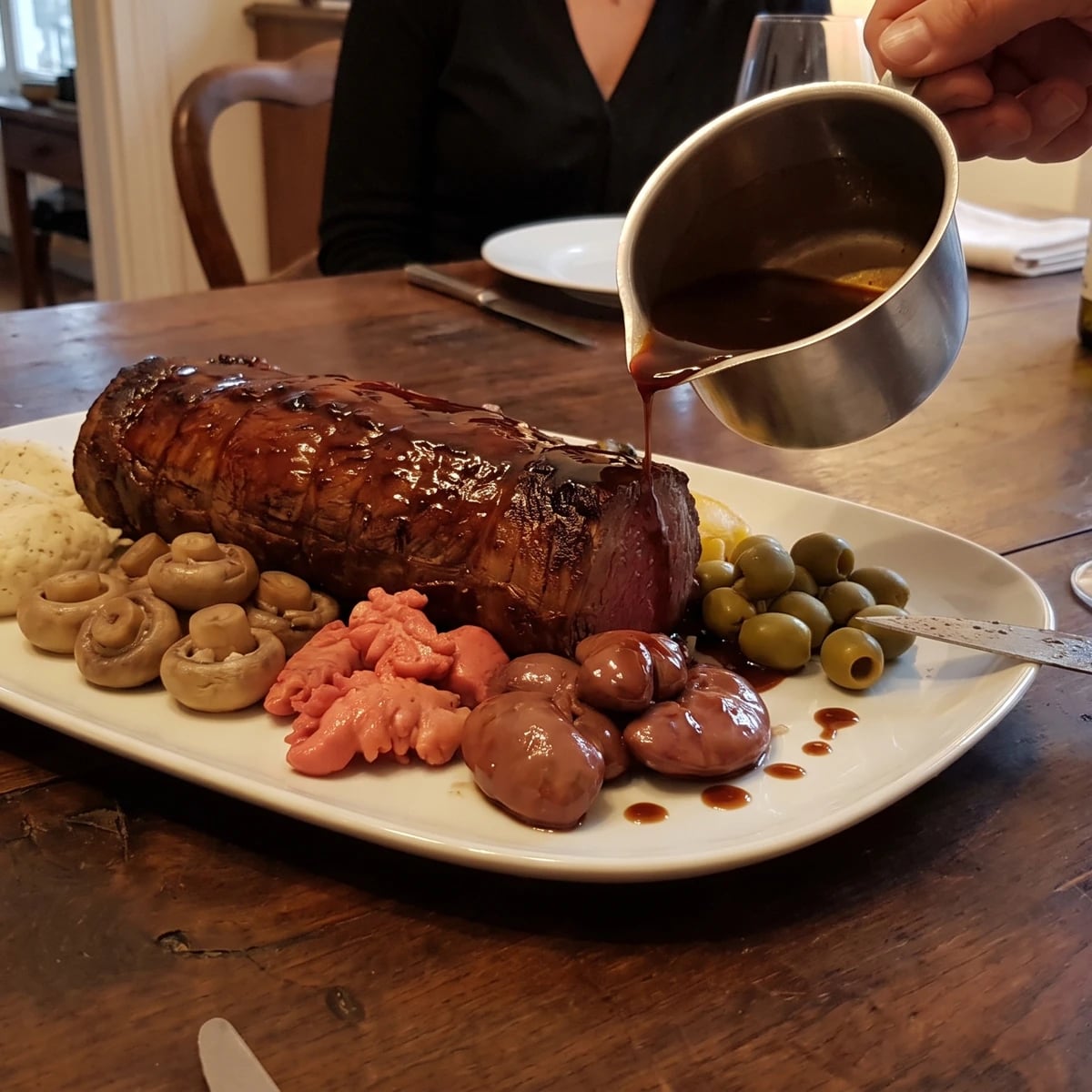
A whole rosy fillet, larded with cool fatback and poêlé beneath butter, then carved thick under glossy jus. The lesson is exact but simple: deep colour outside, red tenderness within.
A cooking platform built around craft, culture, and the stories behind what we eat.
Created by Chef Juliette
Based on No. 1052, Filet de Bœuf Financière, from Le Guide Culinaire (1907) by Auguste Escoffier
A larded fillet, gently poêled in butter, glazed, and ringed with quenelles, mushrooms, cocks' combs, kidneys, and olives in Madeira sauce: grandeur translated for one steady home cook.
Filet de Bœuf Financière (butter-poêled beef fillet with a Madeira-bound grand garnish) teaches orchestration. The fillet is almost the easy part. The cook's real work is bringing five small garnishes, one concentrated sauce, and the rested beef to the platter together, each hot, distinct, and properly itself. Know this before touching a pan: every garnish must be finished before the beef begins cooking.
The original assumed a larding needle, a saucier on staff, a stock never off the fire, several pans kept warm, and a salamander ready to set the final glaze. At home, a clean metal skewer makes the channels for chilled fatback, good unsalted stock gains body through reduction, one wide pan warms the garnishes in separate quarters, and a brushful of concentrated sauce supplies the gloss. The separate holding pans were brigade scaffolding, so they can go. The larding, butter cooking, distinct heaps, last-minute glaze, and sauceboat are the dish, so they stay. One cook, one stove, one evening.
Financière should look abundant without becoming muddled. The pale quenelles, grooved mushrooms, coral combs, tender rognons de coq, and green olives sit around the burnished fillet in deliberate groups, with enough sauce to bind them but never drown them. Prepare those groups first, then give the beef your full attention; timing the fillet is the one step that matters most.
Filet de Bœuf Financière belongs to the grand Parisian table, where a whole fillet was presented with the costly garniture financière in distinct groups rather than mixed like a stew. Stories connect the name with bankers, but the firmer truth is culinary: financière signaled abundance, especially quenelles, mushrooms, cocks' combs, rognons de coq, olives, and Madeira-bound sauce. The composition traveled from banquet service into bourgeois celebration cooking, where the long platter and separate sauceboat preserved its ceremony.
Quantity
1 fillet, 2 lb / 900 g
trimmed
Quantity
3 oz / 85 g
cut into 8 narrow batons
Quantity
1 tablespoon (15 ml / 18 g)
divided
Quantity
1 teaspoon (5 ml / 2 g)
divided
Quantity
1 home-scale application Poëlings (No. 250), scaled for one 2 lb / 900 g fillet and reserving its strained cooking liquor
Quantity
2½ oz / 70 g
finely diced
Quantity
2½ oz / 70 g
finely diced
Quantity
1 tablespoon (15 ml / 15 g)
Quantity
1½ tablespoons (22 ml / 22 g)
Quantity
1/16 teaspoon (0.3 ml / 0.1 g)
Quantity
6 cups (1.4 L / 1.4 kg)
for poaching the quenelles
Quantity
8, about 4 oz / 120 g
Quantity
8, about 3 oz / 85 g
Quantity
12, about 7 oz / 200 g
stems removed and caps grooved
Quantity
12, about 3 oz / 85 g
turned into neat ovals
Quantity
1 home-scale application Blanchings (No. 273), scaled for 8 cocks' combs and 12 turned olives
Quantity
3 cups (720 ml / 720 g)
divided
Quantity
¾ cup (180 ml / 180 g)
Quantity
1 teaspoon (5 ml / 3 g)
Quantity
4 tablespoons (60 ml / 56 g)
divided and kept cold
| Ingredient | Quantity |
|---|---|
| center-cut beef tenderloin fillettrimmed | 1 fillet, 2 lb / 900 g |
| chilled unsmoked fatbackcut into 8 narrow batons | 3 oz / 85 g |
| fine sea saltdivided | 1 tablespoon (15 ml / 18 g) |
| freshly ground black pepperdivided | 1 teaspoon (5 ml / 2 g) |
| Poëlings | 1 home-scale application Poëlings (No. 250), scaled for one 2 lb / 900 g fillet and reserving its strained cooking liquor |
| very cold lean vealfinely diced | 2½ oz / 70 g |
| very cold beef kidney suetfinely diced | 2½ oz / 70 g |
| beaten egg | 1 tablespoon (15 ml / 15 g) |
| ice water | 1½ tablespoons (22 ml / 22 g) |
| freshly grated nutmeg | 1/16 teaspoon (0.3 ml / 0.1 g) |
| waterfor poaching the quenelles | 6 cups (1.4 L / 1.4 kg) |
| cleaned cocks' combs | 8, about 4 oz / 120 g |
| cleaned rognons de coq | 8, about 3 oz / 85 g |
| large button-mushroom capsstems removed and caps grooved | 12, about 7 oz / 200 g |
| large pitted green olivesturned into neat ovals | 12, about 3 oz / 85 g |
| Blanchings | 1 home-scale application Blanchings (No. 273), scaled for 8 cocks' combs and 12 turned olives |
| unsalted brown veal or beef stockdivided | 3 cups (720 ml / 720 g) |
| dry Madeira | ¾ cup (180 ml / 180 g) |
| unflavored powdered gelatin (optional) | 1 teaspoon (5 ml / 3 g) |
| unsalted butterdivided and kept cold | 4 tablespoons (60 ml / 56 g) |
Chill the fatback batons until firm. Push a clean metal skewer lengthwise through the fillet eight times, spacing the channels evenly, then use a narrow chopstick or the skewer to guide one baton through each channel. Work while the fat is cold; soft fat smears instead of passing cleanly. Tie the fillet at 1½-inch intervals so it holds an even cylinder, then season it with 2 teaspoons of the salt and half the black pepper. Keep it cool while you prepare every garnish.
Chill the processor bowl and blade. Pulse the veal and suet with ½ teaspoon salt, the remaining pepper, and the nutmeg until finely minced, then add the beaten egg. Process while adding the ice water a teaspoon at a time, stopping when the ordinary forcemeat becomes smooth, pale, and tacky. It must remain cold enough that the fat stays invisible; if it turns shiny or greasy, stop and chill the bowl for 10 minutes before continuing.
Bring the water and 1 teaspoon salt to the barest tremble. Shape a small tester with two wet teaspoons and poach it for 3 minutes. If it holds cleanly, shape eight oval quenelles and poach them without boiling for 7 to 9 minutes, turning once, until firm and cooked through. If the tester feathers or splits, don't discard the forcemeat. Ça se rattrape: chill it until firm, process briefly until tacky again, and test once more. Lift the finished quenelles into a shallow dish with a spoonful of stock and cover.
Complete Blanchings (No. 273) for the cocks' combs and turned olives, keeping the two separate. Put the prepared combs in a small saucepan with 1½ cups of the stock and hold them at a bare simmer until tender enough to bend at the tip, about 25 to 35 minutes. Add the cleaned rognons de coq for their final 8 to 10 minutes, cooking until firm and opaque, then lift both out and keep them separate. Warm the olives in the same stock for 2 minutes, lift them out, and strain and reserve every drop of the cooking stock for the sauce.
Groove each mushroom cap with five shallow curved cuts, turning the cap as you work. Melt 1 tablespoon of the butter in a small pan, add the mushrooms and a pinch of salt, cover, and cook gently for 4 minutes. Uncover and turn them until tender and glossy but still pale, adding a spoonful of stock if the butter threatens to color. Set them beside the other garnishes, not mixed among them.
Let the seasoned fillet lose its deepest chill for 20 minutes, then follow Poëlings (No. 250) in a close-fitting covered vessel, using the preparation exactly as written for the larded beef. Begin checking the center early, because tenderloin has little connective tissue and gains nothing from overcooking. Remove it at 125°F / 52°C for medium-rare, or at your preferred temperature, then reserve the strained poëling cooking liquor and rest the fillet loosely covered for 15 to 20 minutes. If it reaches temperature before the garnishes are ready, take it out immediately. Resting can wait; overcooked fillet cannot.
Combine the strained poëling liquor, the reserved garnish stock, the remaining fresh stock, and the Madeira in a wide saucepan. If commercial stock stays watery when cold, first bloom the optional gelatin in 1 tablespoon of cold stock and add it now. Boil steadily until reduced to about 1¾ cups and the flavor is concentrated but not salty, then strain and skim carefully. This reduction is the foundation of the Sauce Financière, so judge it by the spoon: it should leave a light, glossy coat rather than run like broth.
Reserve ¼ cup of the reduced sauce in a small pan for glazing. Take the remaining sauce off the heat and whisk in 2 tablespoons of cold butter, a few pieces at a time, to give it a supple gloss. Taste before adding more salt. If butter gathers in oily beads, stop whisking it over heat. Ça se rattrape: whisk 1 tablespoon of cold stock in a clean pan, then add the separated sauce gradually off the heat until smooth again.
Set the quenelles, mushrooms, cocks' combs and rognons de coq, and olives in four separate quarters of one wide sauté pan. Add just enough Sauce Financière to moisten each group and warm them over the gentlest heat, nudging rather than stirring so the garnishes remain distinct. One pan replaces the brigade's row of holding pans, but the separation must remain; it is part of Financière's character.
Reduce the reserved ¼ cup sauce until syrupy enough to cling to a brush. Remove the twine, set the whole fillet lengthwise on a warmed long platter, and brush it at the last moment until burnished and glossy. This does the salamander's useful work without scorching the tenderloin. Arrange the quenelles, mushrooms, combs and rognons, and olives around it in separate heaps, cover only the garnishes with a little Sauce Financière, and send the remaining sauce in a warmed sauceboat. Carve at the table. À table!
1 serving (about 470g)
Culinary guides, cultural storytelling, and the editorial depth that makes cooking meaningful.
Discover Culinary Explorer
Chef Juliette
A whole rosy fillet, larded with cool fatback and poêlé beneath butter, then carved thick under glossy jus. The lesson is exact but simple: deep colour outside, red tenderness within.

Chef Juliette
A larded fillet glazed at the last moment, surrounded by rice-filled peppers, crisp aubergine cases, tomato concassée, and chipolatas: a grand garniture brought within reach of one attentive home cook.

Chef Juliette
One burnished fillet, six vegetables, and a clear gravy passed beside it: Bouquetière teaches the classical art of cooking each garnish correctly, then arranging colour with generosity rather than fuss.

Chef Juliette
Beef fillet hollowed and rebuilt around foie gras, cream, and truffle, then poêled until the center is just set and the roast gleams under Périgueux sauce and four garnished tartlets.