
Chef Juliette
John Dory (St. Pierre)
John Dory has the delicacy of sole and the firmness of turbot. A light flouring, a quick butter sauté, and nut-brown beurre noisette show exactly why looks never mattered.
A cooking platform built around craft, culture, and the stories behind what we eat.
Created by Chef Juliette
Based on No. 1037, Matelote au Vin Rouge, from Le Guide Culinaire (1907) by Auguste Escoffier
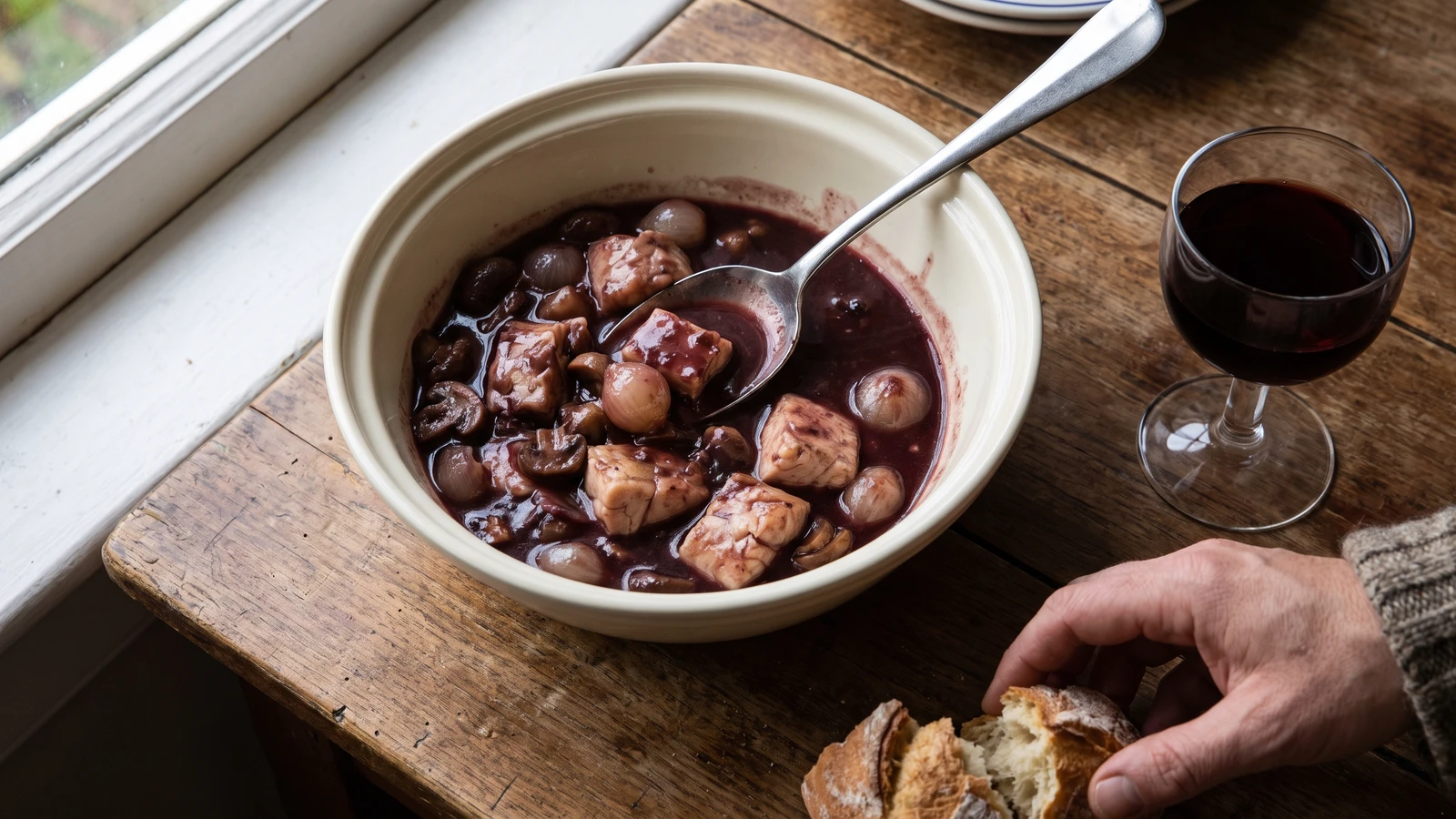
A riverman's matelote of freshwater fish and red wine, poached gently, reduced by one-third, and bound off the boil until the sauce gleams wine-dark and glossy.
Matelote au Vin Rouge (freshwater fish braised in red wine) teaches one decisive piece of sauce grammar: the fish and its cooking liquor finish at different moments. Cook the fish only until tender, lift it intact, then reduce the wine without it. Leave the fish in while the sauce finds its body and you will have a fine sauce surrounding dry fragments.
The entry assumes a saucier who can move the fish between pans and a hot timbale waiting at service. Its two pounds of fish already make four generous portions, so I have not altered the proportions. One wide sauté pan handles the poaching, reduction, and final warming, a covered warm dish replaces the holding saucepan, and a deep serving bowl does the timbale's work. That extra pan was brigade scaffolding. The one-third reduction and final liaison are the dish, and both stay. No stockpot or salamander belongs here. One cook, one stove, one evening.
Properly made, the sauce is wine-dark garnet, glossy with real butter, and just thick enough to cling without burying the fish. The final liaison, the binding, is beurre manié (kneaded butter), carried in the book as Manied Butter (No. 151). Whisk it in off the boil and keep the finished sauce below a simmer. That quiet final binding is the step that matters most.
Matelote au vin rouge belongs to the river inns of the Seine and Marne basin around Paris, where boatmen and fishers cooked the freshwater catch in wine. Grand kitchens adopted its poaching liquor, reduction, and final liaison, but the dish kept its river-table character. Eel became its emblem, yet carp, tench, bream, and perch are equally classical, and a matelote may contain one kind of fish or several.
Quantity
2 lb (907 g)
cut into uniform 2-inch (5 cm) sections
Quantity
1 medium (about 1 cup / 150 g)
minced
Quantity
1
4 parsley stems, 1 thyme sprig, and 1 bay leaf, tied
Quantity
2 cloves
lightly crushed
Quantity
1 imperial pint (2⅜ cups / 568 ml / about 560 g)
Quantity
1 pinch (about 1/16 teaspoon / 0.4 g)
Quantity
4
Quantity
3 tablespoons (45 ml / about 42 g)
Quantity
3½ tablespoons (52 ml / about 50 g) Manied Butter (No. 151)
freshly prepared, chilled, and cut into small pieces
| Ingredient | Quantity |
|---|---|
| cleaned firm freshwater fishcut into uniform 2-inch (5 cm) sections | 2 lb (907 g) |
| onionminced | 1 medium (about 1 cup / 150 g) |
| bouquet garni4 parsley stems, 1 thyme sprig, and 1 bay leaf, tied | 1 |
| garliclightly crushed | 2 cloves |
| dry red wine | 1 imperial pint (2⅜ cups / 568 ml / about 560 g) |
| fine salt | 1 pinch (about 1/16 teaspoon / 0.4 g) |
| whole black peppercorns | 4 |
| brandy | 3 tablespoons (45 ml / about 42 g) |
| Manied Butterfreshly prepared, chilled, and cut into small pieces | 3½ tablespoons (52 ml / about 50 g) Manied Butter (No. 151) |
Ask the fishmonger to clean and scale the fish, then cut larger fish crosswise into uniform 2-inch (5 cm) sections. Bone-in pieces lend the cooking liquor more body, but large fillet portions are easier at the table. Use one variety, or fish of similar firmness, if you want every piece ready together.
Arrange the fish in a single snug layer in a 12-inch (30 cm) wide sauté pan. Scatter over the minced onion, bouquet garni, garlic, salt, and peppercorns, then pour in the red wine. Bring the liquid just to its first boil over medium heat. Do not stir the fish; shake the pan gently if the aromatics need settling.
Warm the measured brandy in a small saucepan until hot but not boiling. Turn off every burner and the range hood, move the saucepan away from the stove, and ignite the brandy with a long match. Let the flame die completely, then pour the burnt brandy over the fish. Cover the sauté pan, lower the heat, and cook at the barest tremble for 8 to 18 minutes, depending on the fish, until each piece is opaque, yields in large flakes, and reaches 145°F (63°C) at its thickest point. Lift out pieces as they finish. If one begins to split, remove it immediately; the retained heat will complete the cooking without turning it to fragments.
Transfer the cooked fish carefully to a warm shallow dish and cover it loosely. Strain the cooking liquor through a fine sieve into a heatproof measuring jug without pressing the onion or herbs, which would cloud the sauce. Measure the liquor, wipe the sauté pan clean, and return the liquid to it. Boil uncovered until its volume has fallen by exactly one-third, leaving two-thirds of what you measured. The fish is safely out of the pan now, so the reduction can be brisk.
Take the pan completely off the heat. Add the cold Manied Butter (No. 151) one small piece at a time, whisking each piece smooth before adding the next. Return the pan to the lowest heat only as needed, whisking until the sauce coats the back of a spoon with a light, even gloss. Once the liaison has entered, do not let the sauce boil. If the first bubbles appear, lift the pan immediately and whisk in 1 tablespoon (15 ml) cold water to arrest the heat. Ça se rattrape. If small lumps remain, pass the sauce through the clean sieve and continue gently; a prolonged boil gives the sauce the raw-flour taste the source warns against.
Return the fish to the sauce and spoon the sauce over it rather than stirring. Warm everything over very low heat for 2 to 3 minutes, never allowing a simmer. If the sauce tightens too far around the fish, loosen it with a spoonful of hot water. Transfer the matelote to a warmed deep serving bowl, the home equivalent of the book's timbale, and bring it directly to the table. À table!
1 serving (about 300g)
Culinary guides, cultural storytelling, and the editorial depth that makes cooking meaningful.
Discover Culinary ExplorerChef Juliette
John Dory has the delicacy of sole and the firmness of turbot. A light flouring, a quick butter sauté, and nut-brown beurre noisette show exactly why looks never mattered.

Chef Juliette
Fresh haddock proves its delicacy in the meunière pan: a fine flour crust, moist pearly flakes, and beurre noisette sharpened with lemon and parsley, ready from one skillet in half an hour.

Chef Juliette
Éperlans à l’Anglaise turns small fish into a lesson in disciplined coating: boned smelts under a close, crisp crumb, pan-fried in clarified butter and finished with bright, half-melted maître d’hôtel butter.

Chef Juliette
Tiny smelts, shallot, mushrooms, white wine, gratin sauce, and fine bread raspings meet a fierce oven, where the fish must turn tender in the same breath the buttered crust bronzes.