
Chef Klaus
Aachener Printen
Aachen's Advent biscuit is dark, hard, and spiced, with beet syrup doing the deep work and a closed tin finishing what the oven only starts.
A cooking platform built around craft, culture, and the stories behind what we eat.
Created by
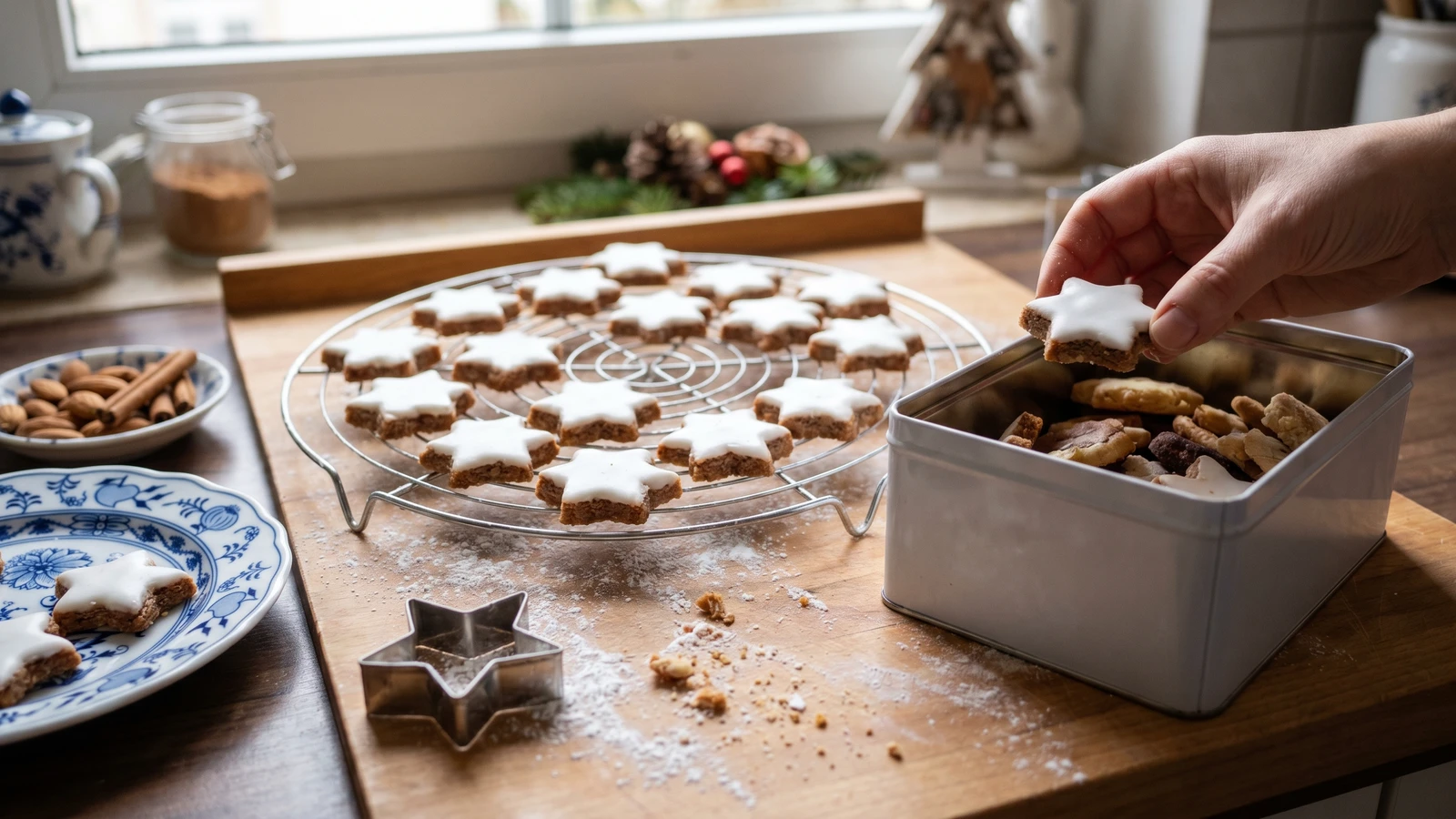
Flourless almond cinnamon stars for the Advent tin, with a white meringue lid that must set pale, never brown, or you've baked the tenderness out of them.
Zimtsterne are Advent Plätzchen, Christmas cookies, strongest in the south and southwest where almonds, cinnamon, and egg-white baking sit close to the older monastery and confectioners' table. You see them all over Germany now, but the arguments travel with them: some Swabian and Baden kitchens keep them almond-only, some Bavarian tins take hazelnut in the dough, and some northern bakers cut the spice harder. Im Norden anders, im Süden anders.
I make them flourless, because that is the point. Ground almonds carry the dough, egg white binds it, and cinnamon gives the dark warmth under the snow-white lid. There is no packet mix here. Nicht aus dem Glas, and not from a supermarket tin if you want the smell of Advent in your own kitchen.
The technique that decides the cookie is the heat. Runter mit der Temperatur. The meringue lid has to dry and set before it colours, because brown meringue means the almond dough underneath has gone dry. Low oven, short bake, and pull them while the centres still yield a little under your finger. They firm as they cool. Erst verstehen, dann kochen.
Zimtsterne belong to the German Christmas baking tradition that grew out of the medieval spice trade, when cinnamon, cloves, cardamom, and anise reached south German cities through Venetian and Alpine trade routes and were saved for feast days. Printed references to cinnamon stars appear in German-speaking baking by the 18th and 19th centuries, especially in the southern and Swiss border regions where nut-based sweets were common. Their flourless structure also marks an older luxury logic: wheat flour was everyday, while almonds, sugar, and imported cinnamon were kept for the Advent tin.
Quantity
3
at room temperature
Quantity
250g
sifted, plus more for rolling
Quantity
1 pinch
Quantity
2 teaspoons
Quantity
1 teaspoon
Quantity
400g
preferably skin-on
Quantity
50g
Quantity
1 teaspoon
| Ingredient | Quantity |
|---|---|
| large egg whitesat room temperature | 3 |
| icing sugarsifted, plus more for rolling | 250g |
| fine salt | 1 pinch |
| ground cinnamon | 2 teaspoons |
| lemon juice | 1 teaspoon |
| finely ground almondspreferably skin-on | 400g |
| ground hazelnuts or more ground almonds (optional) | 50g |
| Kirsch or dark rum (optional) | 1 teaspoon |
Beat the egg whites with the salt until foamy, then add the sifted icing sugar a spoon at a time and beat until thick, glossy, and able to hold a soft peak. Slow sugar gives a smooth lid; dump it in at once and the meringue stays grainy. Beat in the lemon juice at the end, because the acid steadies the egg white and keeps the icing white.
Fold the cinnamon and 400g ground almonds into the remaining meringue, adding Kirsch or rum if you use it. The dough should be sticky but able to hold together when pressed; if it slumps like paste, work in the extra ground hazelnuts or almonds a spoon at a time. Nut meal varies in oil and moisture, and the dough tells you when it has enough.
Wrap the dough and chill it for at least 1 hour, because cold nut dough cuts cleanly and warm dough smears into the star points. Roll it 8mm thick between sheets of baking paper dusted with icing sugar. Use sugar, not flour, because these are flourless cookies and flour dulls the chew.
Spread the reserved meringue over the rolled dough in a thin even layer, then cut stars with a cutter dipped in cold water and wiped between cuts. A wet cutter leaves sharp points and a clean white lid; a dry sticky cutter drags the meringue down the sides and makes ragged stars. Move them to lined baking sheets with a small offset spatula.
Bake at 140C, or 120C fan, for 10 to 12 minutes, one tray at a time, until the meringue is dry to the touch but still white and the cookie gives slightly in the centre. Do not chase golden colour. Brown is too far here. The almond dough finishes firming on the tray as it cools, and that is how it stays chewy.
Let the Zimtsterne cool fully on the tray, then pack them in a tin with baking paper between layers. They are good the next day and better after two, because the nut dough settles and the cinnamon rounds out. Das braucht seine Zeit.
1 serving (about 19g)
Culinary guides, cultural storytelling, and the editorial depth that makes cooking meaningful.
Discover Culinary ExplorerChef Klaus
Aachen's Advent biscuit is dark, hard, and spiced, with beet syrup doing the deep work and a closed tin finishing what the oven only starts.

Chef Klaus
The Baden-Wuerttemberg apple fritter that lives between weeknight dessert and Sunday coffee, built on tart rings, a light batter, and oil kept steady.

Chef Klaus
The Carnival doughnut lives by proofing and fat temperature: a light yeast round floats high, cooks through with one pale belt, then takes its jam without turning greasy.

Chef Klaus
A cold Mürbeteig ball, one clean hollow, and a spoon of tart jelly: Engelsaugen are Advent cookies that fail only when the dough gets warm.