
Chef Klaus
Bethmännchen
Frankfurt's Advent marzipan ball is small, pale gold, and exacting: real almond paste, rosewater, three almond halves pressed on firmly, then a short bake for gloss.
A cooking platform built around craft, culture, and the stories behind what we eat.
Created by
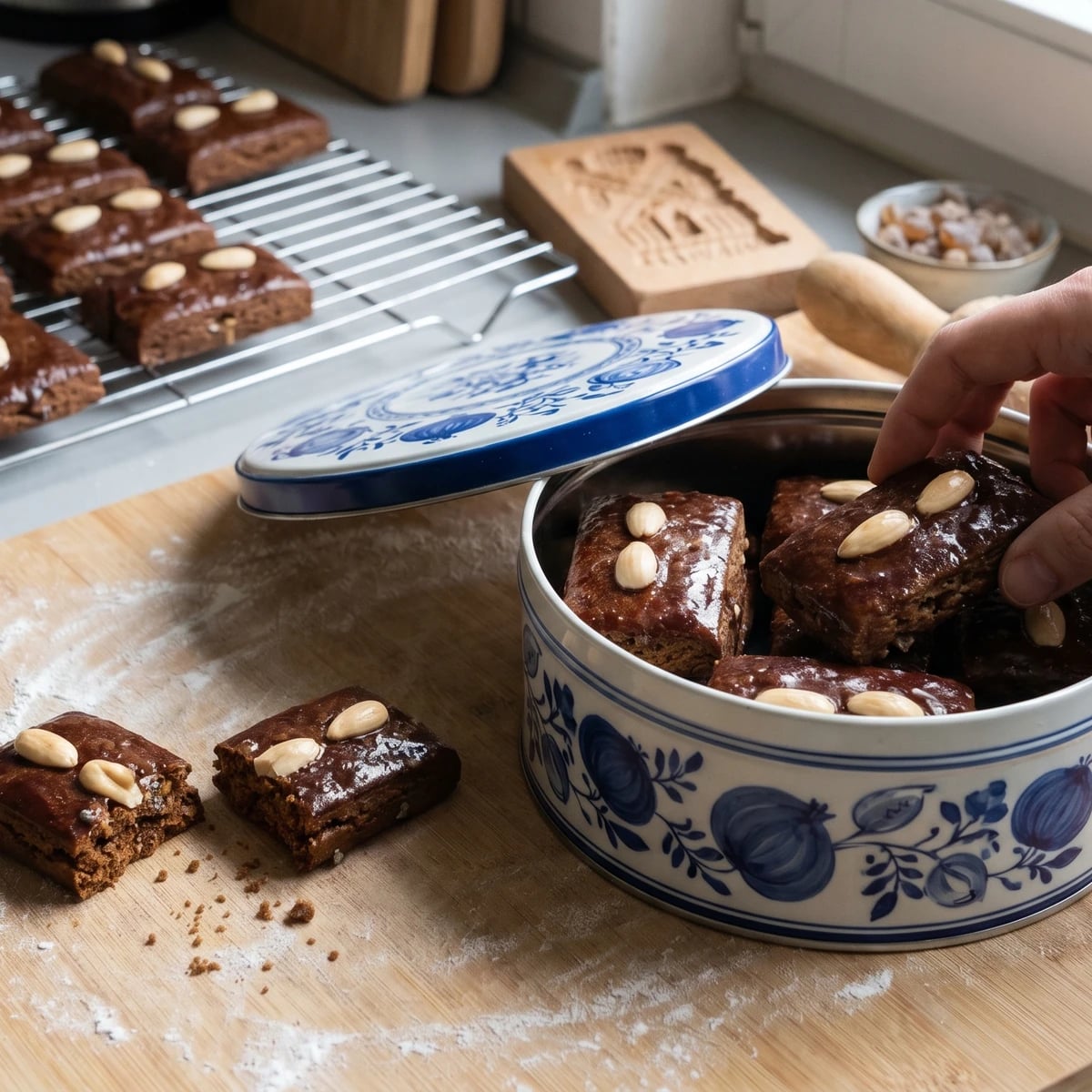
Aachen's Advent biscuit is dark, hard, and spiced, with beet syrup doing the deep work and a closed tin finishing what the oven only starts.
Aachener Printen belong to Advent in Aachen, the western edge of the Rhineland where the Christmas tin starts filling before the first candle is gone. They are Lebkuchen, yes, but not the soft Franconian kind from Nürnberg, fat with nuts and often set on Oblaten, baking wafers. Aachen's biscuit is darker, harder, rectangular, and sweetened with Rübenkraut, sugar beet syrup, with brown Kandis left to bite under your teeth. Im Norden anders, im Süden anders. The country can argue over spice cake without needing a beer tent.
I cook Printen as a larder sweet. The syrup carries moisture, the candied peel carries the winter store, and the spices, Zimt, Nelke, Kardamom, Anis, are not there for decoration. The single rule is this: don't judge them from the oven. Bake them firm, cool them dry, then close them in a tin for days. The beet syrup pulls moisture through the crumb and the spice loses its raw edge; eat one on day one and you'll think I've handed you a roof tile.
The dough is stiff on purpose. Warm the syrup only until it loosens, stir the Pottasche, potassium carbonate, in dissolved, and rest the dough overnight so the flour can drink and the leavening can spread evenly. If you roll fresh dough at once, it tears at the corners and bakes with hard bitter ridges. Das braucht seine Zeit.
Grind or buy fresh spices, chop the Orangeat and Zitronat fine, and keep the offcuts when you trim the rectangles. Weggeworfen wird nichts; press them together and roll again. The shape can be plain. Schön ist, was schmeckt.
Pressed spice cakes were baked around Aachen by the 18th century, with older models coming from the Low Countries and the Rhineland pilgrimage trade that carried pepper, cinnamon, cloves, cardamom, and anise north. After Napoleon's Continental System of 1806 disrupted overseas cane sugar, Rhineland bakers leaned hard on beet sugar and dark Rübenkraut, which helped fix the darker, harder Aachen style. Aachener Printen was registered as a protected geographical indication in the EU's 1996 first wave of protected food names, binding the name to Aachen and the nearby towns named in the specification.
Quantity
500g
plus a little for rolling
Quantity
250g
Quantity
100g
Quantity
80g
lightly crushed
Quantity
50g
Quantity
50ml
Quantity
60g
very finely chopped
Quantity
40g
very finely chopped
Quantity
2 teaspoons
Quantity
1 teaspoon
Quantity
1 teaspoon
Quantity
1/2 teaspoon
Quantity
1/4 teaspoon
Quantity
1/4 teaspoon
Quantity
1/2 teaspoon
Quantity
5g
dissolved in 2 tablespoons cold water
Quantity
70g
split lengthwise
Quantity
1 tablespoon Rübenkraut mixed with 1 tablespoon hot water
for brushing
| Ingredient | Quantity |
|---|---|
| plain wheat flour, Type 550 if availableplus a little for rolling | 500g |
| Rübenkraut (dark sugar beet syrup) | 250g |
| dark brown sugar | 100g |
| brown Kandis or rock sugarlightly crushed | 80g |
| unsalted butter | 50g |
| water | 50ml |
| Orangeat (candied orange peel)very finely chopped | 60g |
| Zitronat (candied lemon peel)very finely chopped | 40g |
| ground cinnamon | 2 teaspoons |
| ground anise or finely crushed aniseed | 1 teaspoon |
| ground coriander | 1 teaspoon |
| ground cardamom | 1/2 teaspoon |
| ground cloves | 1/4 teaspoon |
| ground allspice | 1/4 teaspoon |
| fine salt | 1/2 teaspoon |
| Pottasche (potassium carbonate)dissolved in 2 tablespoons cold water | 5g |
| blanched almondssplit lengthwise | 70g |
| Rübenkraut glazefor brushing | 1 tablespoon Rübenkraut mixed with 1 tablespoon hot water |
Put the Rübenkraut, brown sugar, butter, and 50ml water in a heavy saucepan and warm it gently until the butter melts and the sugar loosens. Do not boil it; boiling drives off water and leaves you with a dry, bitter dough. Take the pan off the heat, stir in the crushed Kandis briefly, and leave some crystals whole because that small bite is part of Aachen's Printen.
Mix the flour, Orangeat, Zitronat, spices, and salt in a large bowl. Dissolve the Pottasche fully in the cold water before it goes in; dry grains leave soapy pockets, and that is not a regional style, it is a mistake. Pour in the warm syrup mixture and work everything into a stiff dough with a spoon, dough hook, or your hands. It should feel too firm now, because the syrup will relax it while it rests.
Flatten the dough into a thick slab, wrap it well, and refrigerate it at least 24 hours, up to 3 days. The rest lets the flour take the syrup evenly, softens the candied peel into the dough, and gives the spices time to stop tasting raw. Fresh dough tears and bakes with hard edges. Das braucht seine Zeit.
Let the dough stand at room temperature for 30 to 45 minutes so it rolls without cracking. Roll it on a lightly floured board to 6mm thick, then cut rectangles about 3 by 8cm with a knife, ruler, or pastry wheel. Keep the thickness even because thin corners burn before the middle is baked. Press the split almonds into the tops, firmly enough that they stay put when the dough rises slightly.
Heat the oven to 180C, or 160C fan, and line two baking sheets with parchment. Bake the Printen for 10 to 12 minutes, until the tops are dry, the edges are set, and the undersides are deep chestnut. Pull them before they feel fully hard; they finish firming as they cool. If the edges darken too quickly, runter mit der Temperatur, because beet syrup burns before flour tastes baked.
Brush the warm Printen lightly with the thin Rübenkraut glaze, just enough to give the surface a dark shine. A heavy glaze stays sticky in the tin, and sticky is not the same as moist. Move them to a rack and let them cool completely, because closed warm biscuits wet their own surface and lose the clean bite.
Pack the cold Printen into a metal tin and leave them 4 to 7 days before serving. This is not storage after the recipe; this is part of the recipe. The beet syrup draws moisture through the crumb, the spice settles, and the biscuit changes from hard to properly firm. For a softer tin, add a slice of apple or a piece of rye bread for 12 hours, then remove it. Leave fruit in there longer and you've made a mold problem, not a Christmas biscuit.
1 serving (about 30g)
Culinary guides, cultural storytelling, and the editorial depth that makes cooking meaningful.
Discover Culinary Explorer
Chef Klaus
Frankfurt's Advent marzipan ball is small, pale gold, and exacting: real almond paste, rosewater, three almond halves pressed on firmly, then a short bake for gloss.

Chef Klaus
A cold Mürbeteig ball, one clean hollow, and a spoon of tart jelly: Engelsaugen are Advent cookies that fail only when the dough gets warm.

Chef Klaus
Florentiner are Advent tin work: almond lace held together by cream caramel, baked thin because thick turns chewy, then brushed with dark chocolate underneath.

Chef Klaus
Advent macaroons live or die by the egg white: beat it stiff, fold the hazelnuts gently, and bake low enough that the middle stays chewy.