
Chef Klaus
Aachener Printen
Aachen's Advent biscuit is dark, hard, and spiced, with beet syrup doing the deep work and a closed tin finishing what the oven only starts.
A cooking platform built around craft, culture, and the stories behind what we eat.
Created by
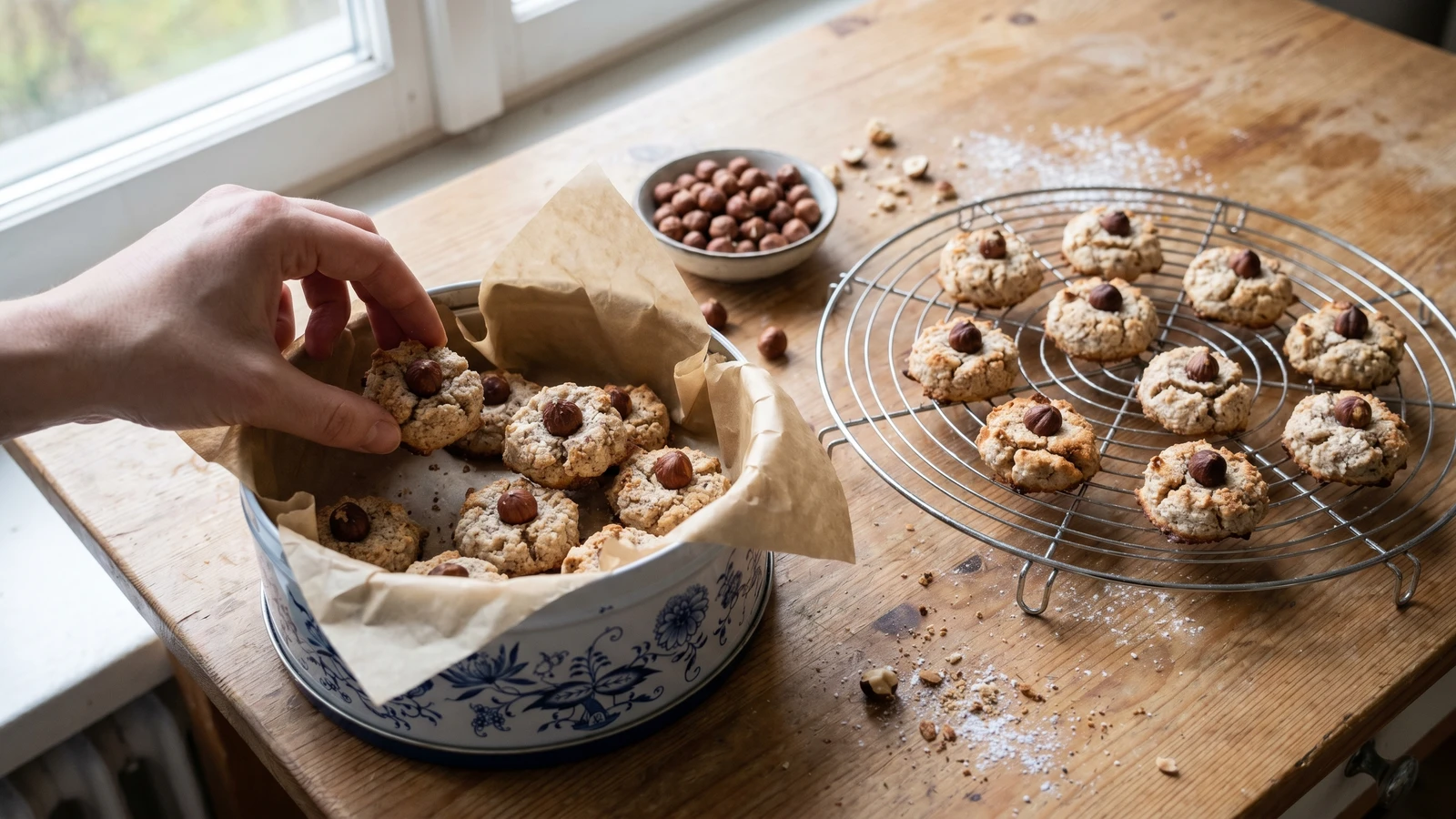
Advent macaroons live or die by the egg white: beat it stiff, fold the hazelnuts gently, and bake low enough that the middle stays chewy.
Haselnussmakronen belong to the Advent tin, the Plätzchen, Christmas cookies, that appear on the table before anyone has admitted they've eaten half of them. They sit strongest in the south and in the old nut-growing belts, where hazelnuts make more sense than almonds, but the whole country bakes some version once the first Advent candles are lit.
Im Norden anders, im Süden anders. Some houses make Kokosmakronen with coconut, some use almonds, some set every mound on Oblaten, baking wafers, and some argue the wafer is only for bakery neatness. I use it. The Oblate keeps the soft nut mass from sticking, gives the cookie a dry footing, and lets the middle stay chewy without tearing apart when you lift it.
The rule is the egg white. Beat it to stiff, glossy peaks with the sugar worked in, then fold the roasted, cooled hazelnuts through with a light hand. The foam is the structure because there is no flour here. Crush it and the nuts sink, the oil comes out, and you get sweet little stones. Bake them pale at the edges, not brown all over. Das braucht seine Zeit, but not much. Just attention.
Makronen descend from the European almond-and-egg-white sweet called macaroon, which entered German-speaking Christmas baking through court, monastery, and confectionery kitchens from the early modern period onward. Oblaten, thin baking wafers related to the wafer-making craft used for church hosts, became a practical base for sticky nut and honey doughs such as Lebkuchen and Makronen. Hazelnuts were the cheaper and local nut in many German regions, so the southern and central Christmas tins kept them where almond versions stayed more expensive.
Quantity
200g
Quantity
3
room temperature
Quantity
1 pinch
Quantity
180g
Quantity
1 teaspoon
Quantity
1/2 teaspoon
Quantity
1 teaspoon
finely grated
Quantity
36
50mm
Quantity
36
for topping
| Ingredient | Quantity |
|---|---|
| whole hazelnuts | 200g |
| large egg whitesroom temperature | 3 |
| fine salt | 1 pinch |
| caster sugar | 180g |
| vanilla sugar | 1 teaspoon |
| ground cinnamon | 1/2 teaspoon |
| lemon zestfinely grated | 1 teaspoon |
| Backoblaten (baking wafers)50mm | 36 |
| whole hazelnutsfor topping | 36 |
Roast the 200g hazelnuts at 160C for 10 to 12 minutes, until the skins darken and the nuts smell deep and sweet. Rub off the loose skins in a towel, then let the nuts cool completely before grinding. Warm nuts smear their oil into paste and collapse the egg white later, so don't rush this part.
Line two baking sheets with parchment and lay out the Oblaten, the baking wafers, with a little space between them. They are not decoration. They give the sticky flourless mass a base, so the cookies lift cleanly and stay tender underneath.
Beat the egg whites with the salt until foamy, then add the sugar a spoon at a time and keep beating until the meringue stands in stiff, glossy peaks. Add the sugar slowly so it dissolves into the foam instead of sitting gritty at the bottom. This foam is the whole building, because there is no flour beam hiding in the dough.
Fold in the ground hazelnuts, vanilla sugar, cinnamon, and lemon zest with a spatula, turning the bowl and lifting from underneath. Stop as soon as no dry nut pockets remain. Keep stirring and you'll knock the air out, then the nut oil has nowhere to go except out onto the tray. Nicht aus dem Glas, not from a packet mix. This is the work.
Spoon or pipe walnut-sized mounds onto the Oblaten and press one whole hazelnut lightly into each top. Press only enough to anchor it; push too hard and you squeeze the air out of the middle before the oven has set it.
Bake at 150C for 16 to 18 minutes, until the tops are dry to the touch, lightly cracked, and only faintly golden at the edges. Runter mit der Temperatur. High heat browns the outside before the centre sets, and then the cookie dries into a nut biscuit instead of staying chewy. Cool fully on the tray so the soft middle firms without breaking.
1 serving (about 14g)
Culinary guides, cultural storytelling, and the editorial depth that makes cooking meaningful.
Discover Culinary ExplorerChef Klaus
Aachen's Advent biscuit is dark, hard, and spiced, with beet syrup doing the deep work and a closed tin finishing what the oven only starts.

Chef Klaus
The Baden-Wuerttemberg apple fritter that lives between weeknight dessert and Sunday coffee, built on tart rings, a light batter, and oil kept steady.

Chef Klaus
The Carnival doughnut lives by proofing and fat temperature: a light yeast round floats high, cooks through with one pale belt, then takes its jam without turning greasy.

Chef Klaus
A cold Mürbeteig ball, one clean hollow, and a spoon of tart jelly: Engelsaugen are Advent cookies that fail only when the dough gets warm.