Culinary Explorer

A cooking platform built around craft, culture, and the stories behind what we eat.
Discover Culinary Explorer
Florentiner

Florentiner

Created by

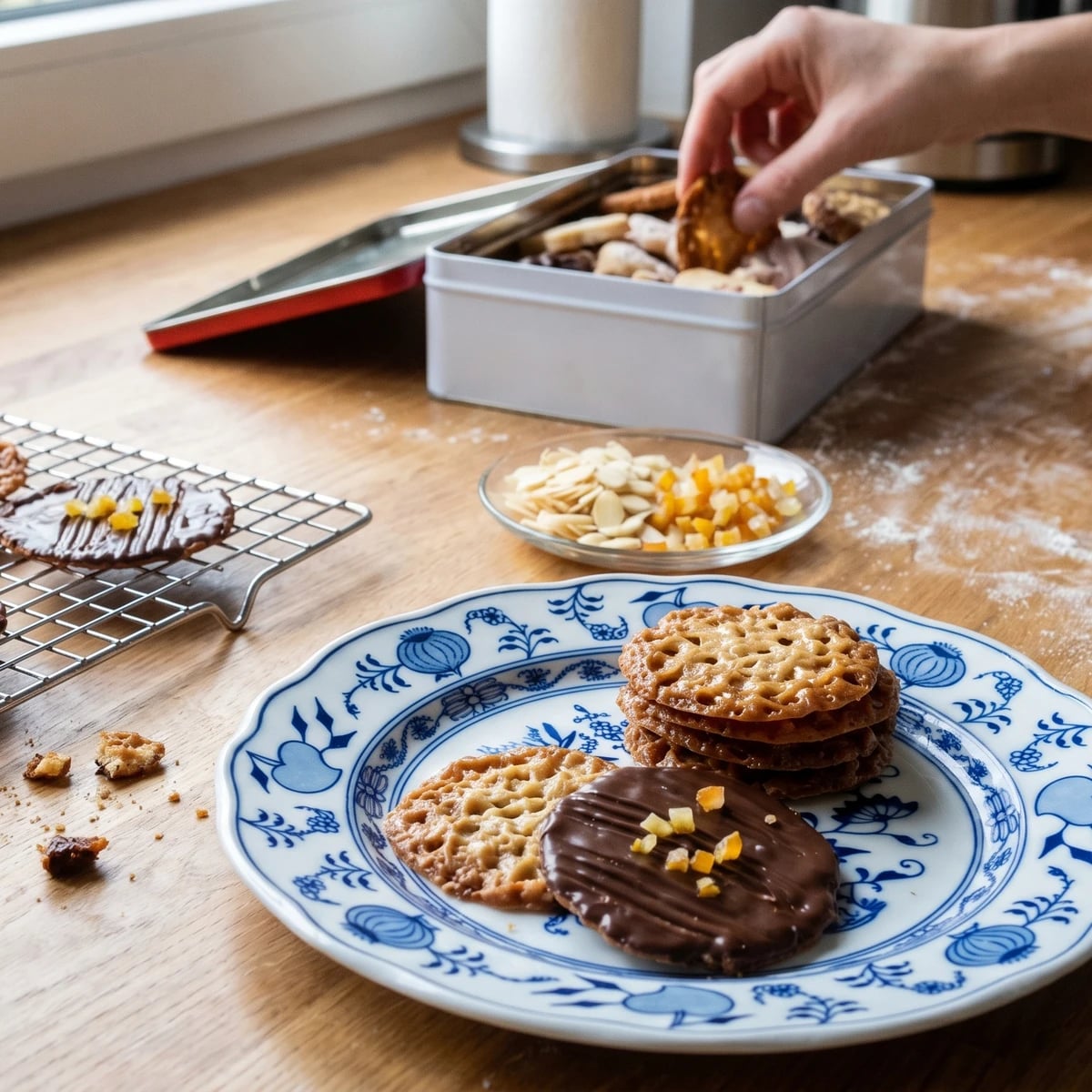
Florentiner are Advent tin work: almond lace held together by cream caramel, baked thin because thick turns chewy, then brushed with dark chocolate underneath.

Pastries & Cookies
German
Christmas
Holiday
Special Occasion
35 min
Active Time
12 min cook1 hr 45 min total
Yield24 cookies

Florentiner sit in the Advent tin with the serious Plätzchen, Christmas cookies, the ones you don't make by dumping dough on a sheet and hoping for manners. They belong to the Konditorei counter as much as the home kitchen, glossy with dark chocolate underneath, almond-gold on top, a little bitter from candied orange and lemon peel. The name points south, to Florence, but the cookie is at home in German Christmas baking because almonds, honey, citrus peel, and chocolate are feast-larder ingredients. You put them up, then you spend them properly.

The regions disagree mostly on thickness and bottom. Some bakers set the almond mass on Oblaten, thin baking wafers, especially when they want a neat base for a mixed Advent plate. Others bake it straight on lined trays so it spreads into lace and crisps at the edge. North, south, bakery, home kitchen, everyone has an opinion. I bake them lined, without wafers, because the caramel can spread thin and crisp. Das ist kein Bierzelt, and it is not a supermarket tin either.

One technique decides the cookie: cook the cream, butter, sugar, and honey until the sugar fully dissolves and the mixture thickens, then stop before it turns dark caramel. If you undercook it, the almonds float in syrup and the cookies run into a sheet. If you boil it too hard, the honey burns before the almonds toast and the Florentiner taste bitter in the wrong way. Runter mit der Temperatur once the almonds go in. Gentle heat coats every flake without breaking it.

Bake on paper with room between them. They spread. Let them firm on the tray before you touch them, because hot caramel tears like sugar glass and takes half the cookie with it. The chocolate goes on the flat underside when the cookies are cold, then you comb it with a fork. Schön ist, was schmeckt.

Florentiner are named for Florence, but the cookie entered German-speaking baking through the wider court and Konditorei tradition that prized imported almonds, candied citrus peel, honey, and chocolate from the early modern spice and sugar trade. By the 19th century, German confectioners had folded them into Weihnachtsgebäck, the Christmas baking repertoire, where expensive stored ingredients were spent during Advent. The German split is practical rather than political: some bakers use Oblaten for a tidy wafer base, while others bake the almond caramel directly on lined trays for a thinner lace edge.

The technique, the tradition, and the story behind every dish.

Discover Culinary Explorer

Ingredients

unsalted butter

Quantity

80g

sugar

Quantity

90g

honey

Quantity

40g

heavy cream

Quantity

100ml

fine salt

Quantity

1 pinch

flaked almonds

Quantity

180g

candied orange peel

Quantity

40g

finely chopped

candied lemon peel

Quantity

30g

finely chopped

plain flour

Quantity

1 teaspoon

dark chocolate, 60 to 70 percent cocoa

Quantity

150g

chopped

Equipment Needed

  • Two baking sheets
  • Baking paper or silicone baking mats
  • Small heavy saucepan
  • Pastry brush or small offset spatula
  • Wire rack

Instructions

  1. 1

    Line the trays

    Heat the oven to 180C and line two baking sheets with baking paper. Do not butter the tray directly, because Florentiner are caramel, not dough, and hot sugar welds itself to bare metal. Leave the paper flat and smooth so the cookies bake into even discs.

  2. 2

    Cook the cream caramel

    Put the butter, sugar, honey, cream, and salt in a small heavy pan and bring them to a steady simmer, stirring until the sugar has dissolved and the mixture looks glossy and slightly thickened, 3 to 4 minutes. Stop before it turns dark. This is a pale caramel glue for almonds, not brittle for a fairground stall.

    Use a heavy pan if you have one. Thin metal scorches honey at the edge before the centre has thickened, and burnt honey takes over the whole cookie.
  3. 3

    Coat the almonds

    Turn the heat low and fold in the flaked almonds, orange peel, lemon peel, and flour. Stir gently for 1 to 2 minutes, just until every almond is coated and the mixture holds together in a shiny mound. Rough stirring snaps the almond flakes, and broken almonds bake up heavy instead of lacy.

  4. 4

    Spoon with space

    Drop level teaspoons of the almond mixture onto the lined trays, leaving at least 6cm between them. Flatten each mound lightly with a wet spoon. They spread because the caramel loosens before it sets, so crowding them is how you make one large biscuit and pretend it was planned.

  5. 5

    Bake until amber

    Bake one tray at a time for 9 to 12 minutes, until the edges are amber and the centres are pale gold with almonds visibly toasted. Rotate the tray if one side browns faster. Pull them too early and they stay sticky; bake them too far and the honey goes bitter.

  6. 6

    Cool before moving

    Leave the Florentiner on the tray for 10 minutes, then slide the paper onto a rack and let them cool completely. Hot caramel is still soft and tears apart under a spatula; once cool, it sets firm enough to lift cleanly.

  7. 7

    Chocolate the bases

    Melt the dark chocolate gently over barely simmering water or in short microwave bursts, stirring often so it stays smooth. Brush or spoon it onto the flat underside of each cold cookie, then drag a fork through the chocolate in waves before it sets. The bitter chocolate balances the honey and peel; milk chocolate makes it sweet on sweet.

  8. 8

    Set and store

    Set the cookies chocolate-side up on clean paper until firm, then pack them between layers of paper in a tight tin. Keep them cool and dry. Moist air softens caramel, and a good Florentiner should bend a little at the centre but stay crisp at the almond edge.

Chef Tips

  • Buy flaked almonds, not chopped almonds. The thin flakes overlap into lace and toast quickly; chopped almonds make a rough lump and the caramel has nowhere graceful to go.
  • Use real candied orange and lemon peel, finely chopped. Nicht aus dem Glas if the jar is wet, syrupy peel with no bite; sticky peel throws extra sugar into the caramel and makes the cookies spread harder.
  • If you want the Oblaten version, spoon the almond mass onto 50mm baking wafers and bake the same way. The wafers keep the footprint neat, but you lose some of the lace at the edge.
  • Chocolate only cold cookies. Warm caramel melts the chocolate from underneath and gives you smears instead of a clean combed base.
  • Store them away from soft cookies. Florentiner give up their crisp edge when packed with moist Lebkuchen or jam-filled Spitzbuben.

Advance Preparation

  • Florentiner keep well for 10 to 14 days in a cool, dry tin, layered with baking paper so the chocolate bases stay clean.
  • The almond mixture should be baked as soon as it is made. If it cools in the pan, the caramel stiffens and the cookies spoon out unevenly.
  • You can chop the candied peel and chocolate a day ahead, then keep them covered separately until baking.

Frequently Asked Questions

Nutrition Information

1 serving (about 26g)

Calories
145 calories
Total Fat
10 g
Saturated Fat
4 g
Trans Fat
0 g
Unsaturated Fat
6 g
Cholesterol
12 mg
Sodium
10 mg
Total Carbohydrates
13 g
Dietary Fiber
2 g
Sugars
10 g
Protein
2 g

Note: Chef personas and recipes are created with AI assistance. Cook with care: follow safe food-handling practices, check doneness with a thermometer when needed, and adapt for allergies and your kitchen.

Where cooking meets culture.

Culinary guides, cultural storytelling, and the editorial depth that makes cooking meaningful.

Discover Culinary Explorer

More from Weihnachtsbäckerei & Plätzchen

Browse the full collection