
Chef Klaus
Aachener Printen
Aachen's Advent biscuit is dark, hard, and spiced, with beet syrup doing the deep work and a closed tin finishing what the oven only starts.
A cooking platform built around craft, culture, and the stories behind what we eat.
Created by
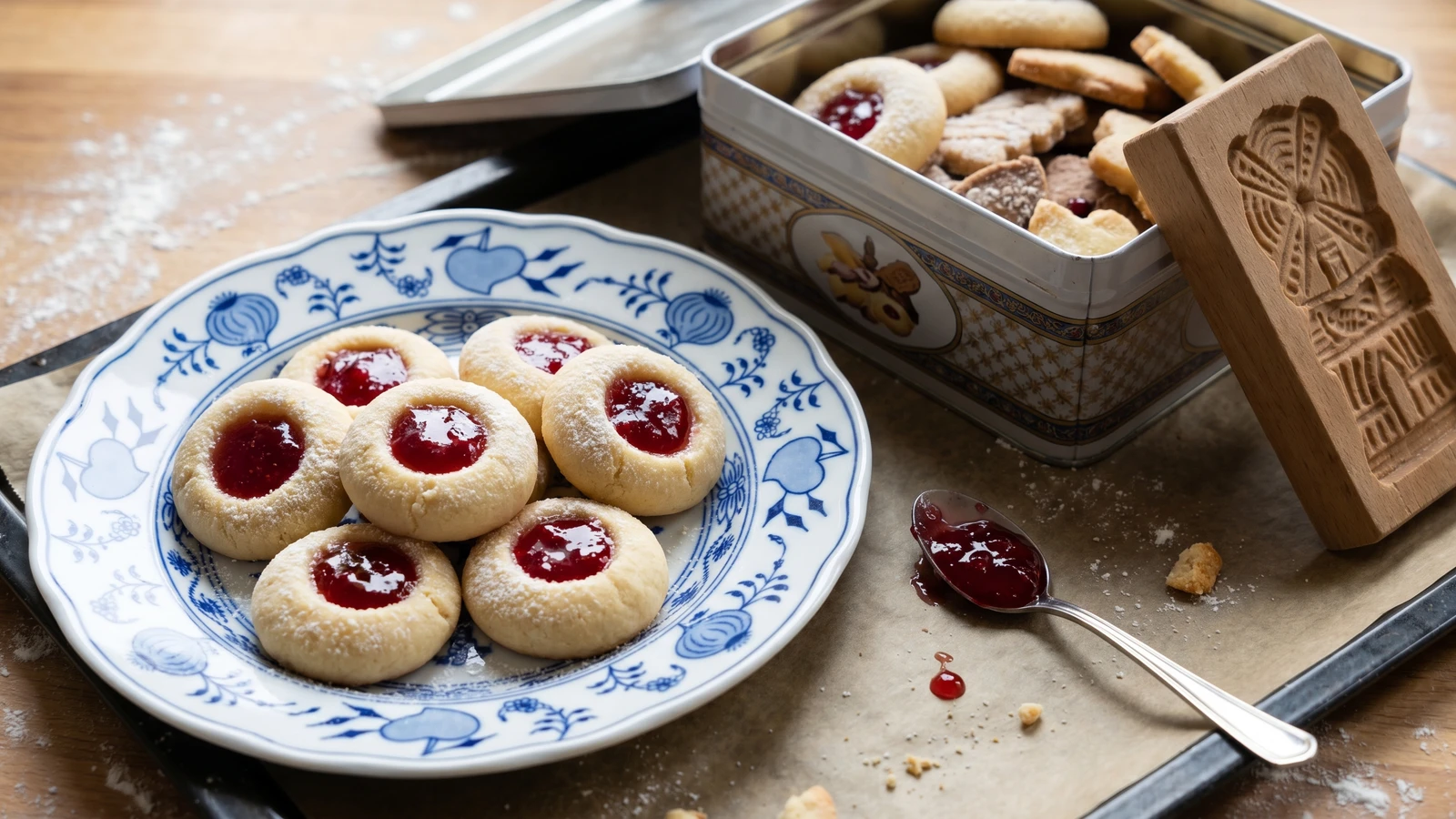
A cold Mürbeteig ball, one clean hollow, and a spoon of tart jelly: Engelsaugen are Advent cookies that fail only when the dough gets warm.
Engelsaugen belong in the Advent tin, where the pale butter cookies sit beside Vanillekipferl, Zimtsterne, and whatever the family insists must be baked first. In much of Germany they're Engelsaugen, angel eyes; in the south and in Austria you'll hear Husarenkrapfen, hussar cookies. Same table, different name. Im Norden anders, im Süden anders.
I make them from Mürbeteig, short pastry, with more butter than patience and just enough egg yolk to hold it. The hollow is the whole craft. Press too deep and the cookie cracks open; press too shallow and the jelly slides off like it was never invited. The dough must be cold because cold butter holds the wall of the hollow in the oven. Warm dough spreads, and then you've made a flat biscuit with a red puddle. Das braucht seine Zeit.
Red currant jelly is the cleanest filling because its acid cuts the butter and it sets glossy as it bakes. Raspberry is welcome. Apricot belongs more to the southern Husarenkrapfen side of the argument. Use a proper jelly or strain your jam. Nicht aus dem Glas is for sauce, not for common sense; here the point is no lumpy fruit pieces, because they tear the hollow and scorch before the pastry is done.
Bake them pale at the edge, not brown. These are Plätzchen, Christmas cookies, not rusks. Let them cool before they go into the tin, then leave them a day. The butter settles, the jelly firms, and the cookie eats cleaner than it did off the rack. Schön ist, was schmeckt.
Small Christmas Plätzchen spread through German middle-class home baking in the 19th century, helped by cheaper beet sugar after Franz Karl Achard opened the first successful beet-sugar factory in Silesia in 1801. Engelsaugen are closely related to the Austrian and southern German Husarenkrapfen, whose name points to the hussars of the Habsburg military world rather than to a church feast. The regional split is mostly name and filling: northern and central German tins often say Engelsaugen and use red currant or raspberry jelly, while Austrian and Bavarian versions often keep the Husarenkrapfen name and may lean toward apricot.
Quantity
250g
Quantity
75g
sifted
Quantity
1 packet or 1 teaspoon
Quantity
1 pinch
Quantity
150g
cold, cubed
Quantity
2
Quantity
1 teaspoon
finely grated
Quantity
120g
Quantity
1 tablespoon
for dusting
| Ingredient | Quantity |
|---|---|
| plain flour | 250g |
| icing sugarsifted | 75g |
| vanilla sugar or vanilla extract | 1 packet or 1 teaspoon |
| fine salt | 1 pinch |
| unsalted buttercold, cubed | 150g |
| egg yolks | 2 |
| lemon zestfinely grated | 1 teaspoon |
| red currant jelly | 120g |
| icing sugar (optional)for dusting | 1 tablespoon |
Mix the flour, icing sugar, vanilla sugar, and salt in a bowl, then rub in the cold butter until the mixture looks like fine crumbs. Work in the egg yolks and lemon zest just until the dough comes together. Stop there. Mürbeteig, short pastry, turns tough when you knead it like bread, because the flour develops strength where you want tenderness.
Flatten the dough into a thick disc, wrap it, and chill it for at least one hour. Cold dough is not decoration in this recipe. The butter must firm up again so the cookies keep their round shoulders and the hollow stays where you pressed it.
Heat the oven to 180C, or 160C fan, and line two baking sheets with parchment. Roll the cold dough into 36 balls, about 13g each, and set them a little apart. Keep the second tray in the refrigerator while the first one waits for the oven, because warm dough spreads before it sets.
Use the handle of a wooden spoon or your thumb to press a hollow into each ball, stopping before you reach the tray. If the edge cracks, pinch it back together while the dough is still cold. A sealed wall holds the jelly; a crack gives it a path out.
Warm the red currant jelly gently until it loosens, then stir it smooth and spoon a little into each hollow. Fill to just below the rim. Too much jelly bubbles over and burns on the tray before the pastry has finished baking. Weggeworfen wird nichts, any extra jelly goes back into the bowl for the next tray.
Bake for 10 to 12 minutes, until the cookies are set and only faintly golden at the bottom edge. Pull them before the tops brown. The pastry should taste of butter and vanilla, not toasted flour. Let them sit on the tray for five minutes so the jelly firms, then move them to a rack.
Cool the Engelsaugen completely, then dust only the pastry edges with icing sugar if you like, keeping the jelly clear. Store them in a tin with parchment between layers. They are good the same day and better the next, once the butter has settled and the jelly has tightened. Erst verstehen, dann kochen.
1 serving (about 16g)
Culinary guides, cultural storytelling, and the editorial depth that makes cooking meaningful.
Discover Culinary ExplorerChef Klaus
Aachen's Advent biscuit is dark, hard, and spiced, with beet syrup doing the deep work and a closed tin finishing what the oven only starts.

Chef Klaus
The Baden-Wuerttemberg apple fritter that lives between weeknight dessert and Sunday coffee, built on tart rings, a light batter, and oil kept steady.

Chef Klaus
The Carnival doughnut lives by proofing and fat temperature: a light yeast round floats high, cooks through with one pale belt, then takes its jam without turning greasy.

Chef Klaus
Florentiner are Advent tin work: almond lace held together by cream caramel, baked thin because thick turns chewy, then brushed with dark chocolate underneath.