
Chef Makoa
Baked ʻUlu Coconut Pudding (Hawaiian Ripe Breadfruit Custard)
Very ripe Hawaiian ʻulu, the canoe-crop breadfruit, mashed soft with coconut milk and sugar, then baked until the middle sets like a quiet custard.
A cooking platform built around craft, culture, and the stories behind what we eat.
Created by
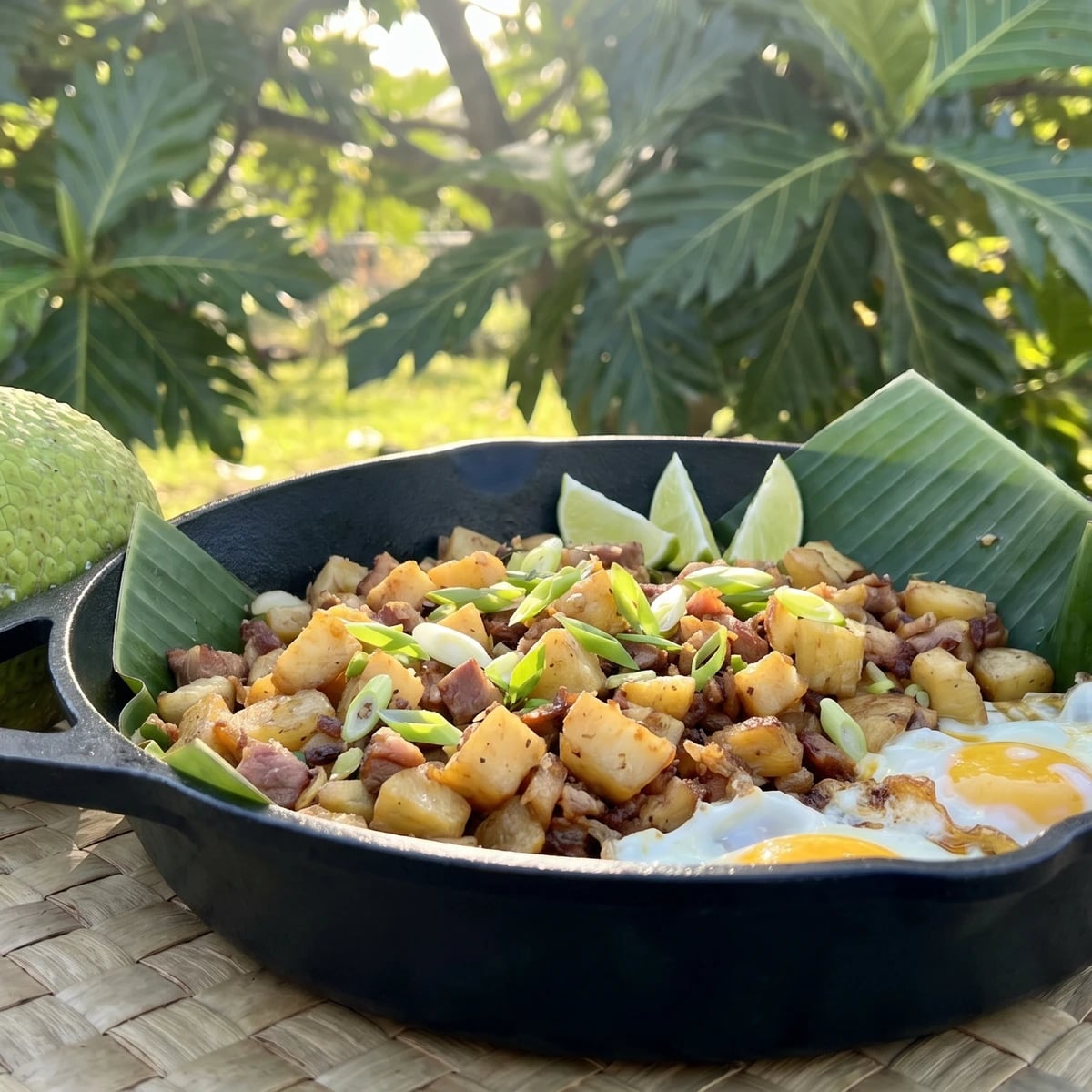
Hawaiʻi takes ʻulu, the breadfruit carried by canoe, and sears it with smoked meat until the edges crisp and the middle stays tender. Old food, breakfast pan, one more bowl for whoever walks in.
The canoe taught me this before any pan did. Waʻa means canoe in ʻōlelo Hawaiʻi, and in Hawaiʻi that word is not decoration. It remembers the hands that carried ʻulu, breadfruit, across the ocean with kalo, ʻuala, niu, and the other canoe plants, because a people who can feed themselves can keep standing on their own ʻāina.
This hash is Hawaiian, from the fresh-and-cooked table, not the fermented breadfruit keeping traditions of the atolls and the old pits. The cousins know the same tree by their own names: ʻulu in Sāmoa too, ʻuru in Tahiti, mei in Tonga and the Marquesas, kuru in the Cook Islands. One ocean, one canoe, one root stock, but each island cooks it with its own hand. Here we dice the cooked ʻulu, lay it in a hot pan, and let the cut sides go gold and crisp before the smoked meat joins in.
The smoked meat is everyday Hawaiʻi, backyard, plate lunch, market counter, somebody's uncle standing near the grill. No need make that precious. What matters is that the ʻulu is cooked tender first, then seared hard enough to hold its shape, with onion, garlic, and a little chile if your table likes heat. Eat what you have. Just don't treat the breadfruit like filler. It fed wayfinders, farmers, children, and chiefs long before it had to share the plate with rice.
When the hash is right, the ʻulu is creamy inside and browned at the corners, the meat is salty and smoky, and the whole pan smells like breakfast after work already started. That's good food. Deep food and everyday food sitting together, no fighting.
Breadfruit is one of the great Polynesian canoe crops, carried and planted across the tropical Triangle long before European ships arrived: ʻulu in Hawaiʻi and Sāmoa, ʻuru in Tahiti, mei in Tonga and the Marquesas, kuru in the Cook Islands. In Hawaiʻi, contemporary voyaging canoes such as Makaliʻi and Hōkūleʻa helped bring canoe-crop knowledge back into public life in the late twentieth century, tying navigation, farming, and food sovereignty back together. Hash like this is a modern Hawaiian kitchen form, but the foundation is older than the skillet: a crop planted so the people could eat from their own ground.
Quantity
1 medium (about 2 to 2 1/2 pounds)
cooked until tender, peeled, cored, and diced into 3/4-inch cubes
Quantity
10 ounces
diced into 1/2-inch pieces
Quantity
2 tablespoons
plus more as needed
Quantity
1 small
diced
Quantity
3 cloves
finely chopped
Quantity
1
diced
Quantity
1 small
thinly sliced
Quantity
1 teaspoon
or coarse sea salt, plus more to taste
Quantity
1/2 teaspoon
Quantity
3
sliced, white and green parts separated
Quantity
1 tablespoon
chopped
Quantity
4 to 6
Quantity
for serving
| Ingredient | Quantity |
|---|---|
| mature firm ʻulu (breadfruit)cooked until tender, peeled, cored, and diced into 3/4-inch cubes | 1 medium (about 2 to 2 1/2 pounds) |
| Hawaiian-style smoked meat or smoked porkdiced into 1/2-inch pieces | 10 ounces |
| neutral oilplus more as needed | 2 tablespoons |
| sweet oniondiced | 1 small |
| garlicfinely chopped | 3 cloves |
| red bell pepperdiced | 1 |
| fresh chile pepper (optional)thinly sliced | 1 small |
| paʻakai ʻalaea (Hawaiian red sea salt)or coarse sea salt, plus more to taste | 1 teaspoon |
| freshly ground black pepper | 1/2 teaspoon |
| green onionssliced, white and green parts separated | 3 |
| parsley or cilantro (optional)chopped | 1 tablespoon |
| fried eggs (optional) | 4 to 6 |
| lime wedges (optional) | for serving |
If your ʻulu is raw, cut it into quarters, remove the core, and steam or simmer it until a knife slides through with no fight, usually 25 to 35 minutes depending on the fruit. Let it cool enough to handle, peel it, and dice it into three-quarter-inch cubes. You want it tender but not falling apart, because the pan still has work to do.
Set a large cast-iron skillet over medium-high heat and add a teaspoon or two of oil if the smoked meat is lean. Cook the diced smoked meat until the edges darken and the fat glosses the pan, 5 to 7 minutes. Scoop the meat to a bowl and leave the good smoky fat behind.
Add the remaining oil to the skillet, then lay in the diced ʻulu in one layer. Let it sit. No stirring right away. Give the cut sides time to turn golden and crisp at the corners, 4 to 5 minutes, then turn and brown another side. If the pan looks dry, add a little more oil. No blame the ʻulu if you keep moving it and it never browns.
Add the onion, garlic, bell pepper, chile if using, the white parts of the green onion, paʻakai ʻalaea, and black pepper. Fold gently so the ʻulu stays in pieces, then cook until the onion softens and the pepper loses its raw edge, 5 to 6 minutes. The pan should smell smoky, sweet, and a little sharp from the garlic.
Fold the browned smoked meat back through the ʻulu and cook 3 to 4 minutes more, just until everything is hot and the meat juices shine over the cubes. Taste before you salt again. Smoked meat carries plenty on its own, and the breadfruit will tell you what it needs.
Scatter the green onion tops and parsley or cilantro over the pan. Serve straight from the skillet or heap it onto banana leaf with fried eggs if that's breakfast at your table. The best bite has crisp ʻulu edge, creamy middle, smoky meat, and a little green onion snap.
1 serving (about 335g)
Culinary guides, cultural storytelling, and the editorial depth that makes cooking meaningful.
Discover Culinary Explorer
Chef Makoa
Very ripe Hawaiian ʻulu, the canoe-crop breadfruit, mashed soft with coconut milk and sugar, then baked until the middle sets like a quiet custard.

Chef Makoa
Sweet ripe ʻulu from Hawaiʻi, mashed with mochiko and fried into chewy-crisp little rounds, the old canoe crop meeting island mochi at a Kalihi table.

Chef Makoa
Tender slices of Tahitian ʻuru, breadfruit, baked in coconut milk until the edges go gold, with just enough cheese from the French island pantry to brown the top.

Chef Makoa
Cook Islands kuru, breadfruit boiled tender, cooled, and tossed with crisp vegetables and a clean lime dressing. The canoe crop comes to the picnic table, unfussy and still full of mana.