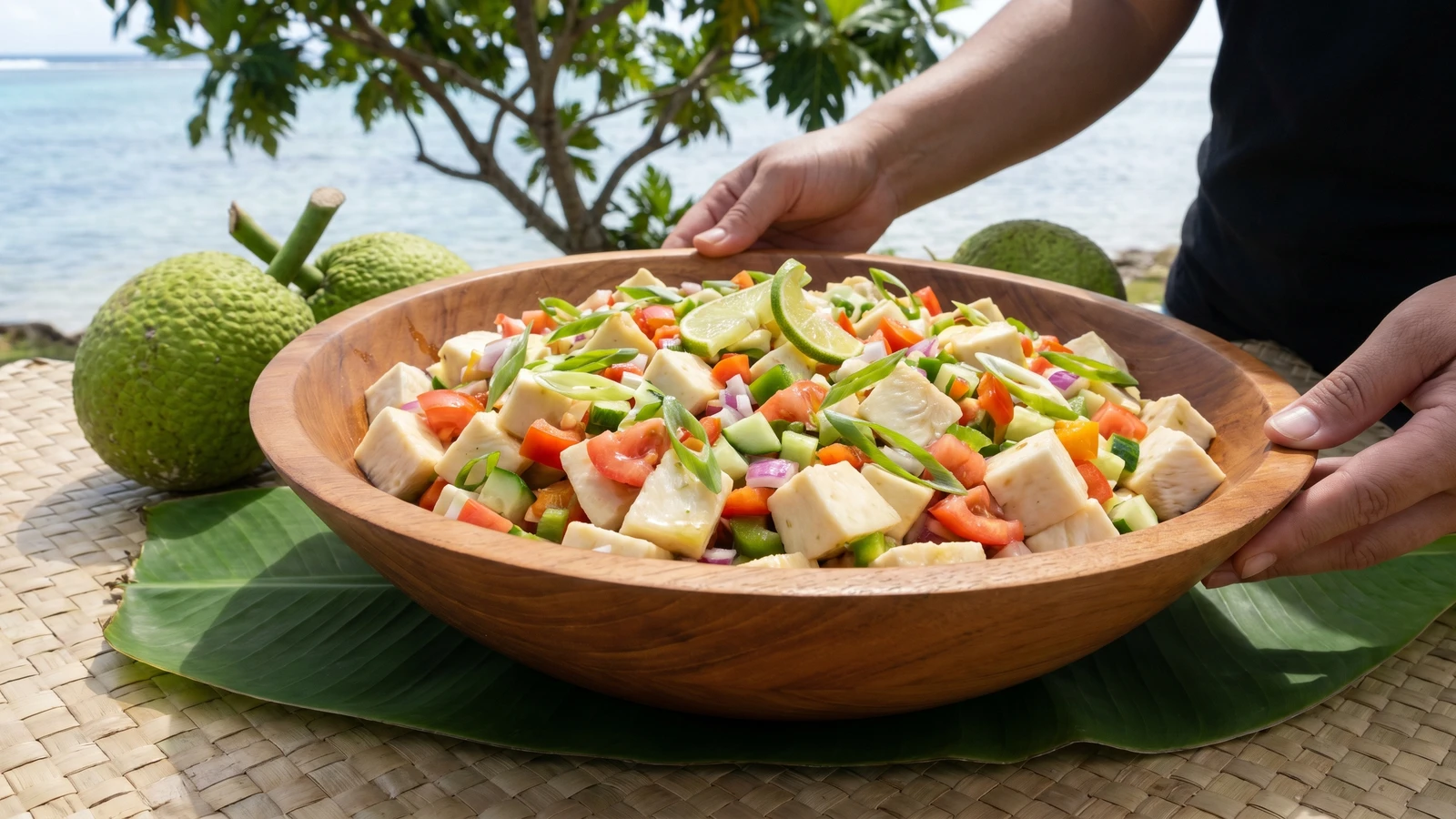
Cook Islands kuru, breadfruit boiled tender, cooled, and tossed with crisp vegetables and a clean lime dressing. The canoe crop comes to the picnic table, unfussy and still full of mana.
Salads
Polynesian, Cook Islands
Potluck
Outdoor Dining
Picnic
25 min
Active Time
35 min cook•1 hr total
Yield6 to 8 servings
The canoe carried this food before it carried any one of us by name. In the Cook Islands, kuru is breadfruit, that great canoe crop with green skin and a starchy heart, and when a family boils it, cools it, and tosses it into salad, the old food walks right into the modern potluck without making a speech.
I learned this one open-handed, sitting with Cook Islands cousins who treated kuru the way my own people treat ʻulu in Hawaiʻi, not as a fancy thing, but as food that knows how to feed a crowd. Tahiti calls its cousin ʻuru, the Marquesas know mei, Sāmoa and Tonga say ʻulu too. One ocean, one canoe, one root, and every island keeps its own hand.
The trick is simple, but no rush it. Boil the kuru until a knife slides through clean, then cool it enough that the cubes hold their shape. Toss it gently with cucumber, tomato, onion, and a bright dressing close to serving, so it stays fresh and not heavy. Eat what you have: beside grilled fish, next to chicken, with a plate lunch, under a tree, at the beach, anywhere the bowl can get passed from hand to hand.
Breadfruit was one of the major canoe crops carried through central and eastern Polynesia, planted from island to island for its reliable starch and its ability to feed many people from one tree. In the Cook Islands, fresh kuru belongs to the everyday table as much as to feast food, boiled, roasted, baked, or cooled into salads that sit naturally beside contemporary grilled meats and picnic spreads. Fermented breadfruit traditions such as popoi and masi are older keeping-foods across parts of Polynesia, but this salad belongs to the fresh-cooked table.
The technique, the tradition, and the story behind every dish.
Cut the breadfruit into quarters, trim away the stem, and cut out the pale center core. Peel off the green skin with a sturdy knife, then cut the flesh into big chunks. Work clean and steady; the sap can be sticky, so oil your knife lightly if it wants to grab.
2
Boil until tender
Put the chunks in a pot, cover with water, add the tablespoon of sea salt, and bring to a steady boil. Cook 25 to 35 minutes, until a knife slides through the kuru clean but the pieces are not falling apart. This is where you respect the crop: soft enough to eat, firm enough to hold the bowl.
3
Cool and cube
Drain the kuru well and spread it on a tray until it cools to room temperature. Cut it into bite-size cubes, about one inch. If you dress it while it is too hot, it drinks everything too fast and turns heavy. Let it breathe first.
4
Make the dressing
Whisk the lime juice, oil, honey or sugar if using, a good pinch of salt, and black pepper until glossy. For a richer bowl, whisk in the coconut cream too. Fresh coconut cream is beautiful here, but a good thick can does the job on a weeknight.
5
Fold the salad
Put the cooled kuru in a wide bowl with the cucumber, tomato, red onion, green onion, and bell pepper. Pour over the dressing and fold gently with your hands or a broad spoon, so the breadfruit stays in clean pieces and the vegetables stay crisp.
6
Rest and serve
Let the salad sit 10 to 15 minutes, just long enough for the lime and salt to settle into the kuru. Taste again before serving. It should be bright, lightly glossy, and clean, with the breadfruit still tasting like itself. Lay it out family-style beside grilled fish, chicken, or whatever the table has that day.
Chef Tips
•Choose firm-mature breadfruit, green to yellow-green outside and heavy for its size. If it is very soft and sweet-smelling, save that one for a sweeter preparation.
•No breadfruit where you live? Eat what you have. This is a Cook Islands kuru salad, so the true crop is kuru, but for a practical table you can use firm cooked ʻulu from a Pacific market freezer before you give up on the dish.
•Keep the dressing light. Kuru has its own clean starch and a gentle nutty taste; too much mayonnaise or too much oil can bury it.
•This bowl belongs beside the grill without turning the deep foods into a performance. Fish, chicken, sausages, plate lunch, whatever the family is actually eating, the kuru can sit there easy.
Advance Preparation
•Boil and cube the kuru up to 1 day ahead, then cover and refrigerate. Bring it back toward room temperature before dressing so the salad does not taste flat.
•Dice the vegetables a few hours ahead and keep them chilled, but fold them in close to serving so they stay crisp.
•Dress the salad 10 to 30 minutes before eating. After a few hours the breadfruit softens and the vegetables give off water.
Frequently Asked Questions
Nutrition Information
1 serving (about 250g)
Calories
345 calories
Total Fat
18 g
Saturated Fat
9 g
Trans Fat
0 g
Unsaturated Fat
8 g
Cholesterol
0 mg
Sodium
300 mg
Total Carbohydrates
47 g
Dietary Fiber
6 g
Sugars
15 g
Protein
3 g
Where cooking meets culture.
Culinary guides, cultural storytelling, and the editorial depth that makes cooking meaningful.