
Chef Juliette
Smelt (Éperlans)
Tiny éperlans, lightly floured and fried until their tails stand crisp, arrive in a generous heap on a napkin with fried parsley and grooved lemon, a weeknight lesson in heat and restraint.
A cooking platform built around craft, culture, and the stories behind what we eat.
Created by
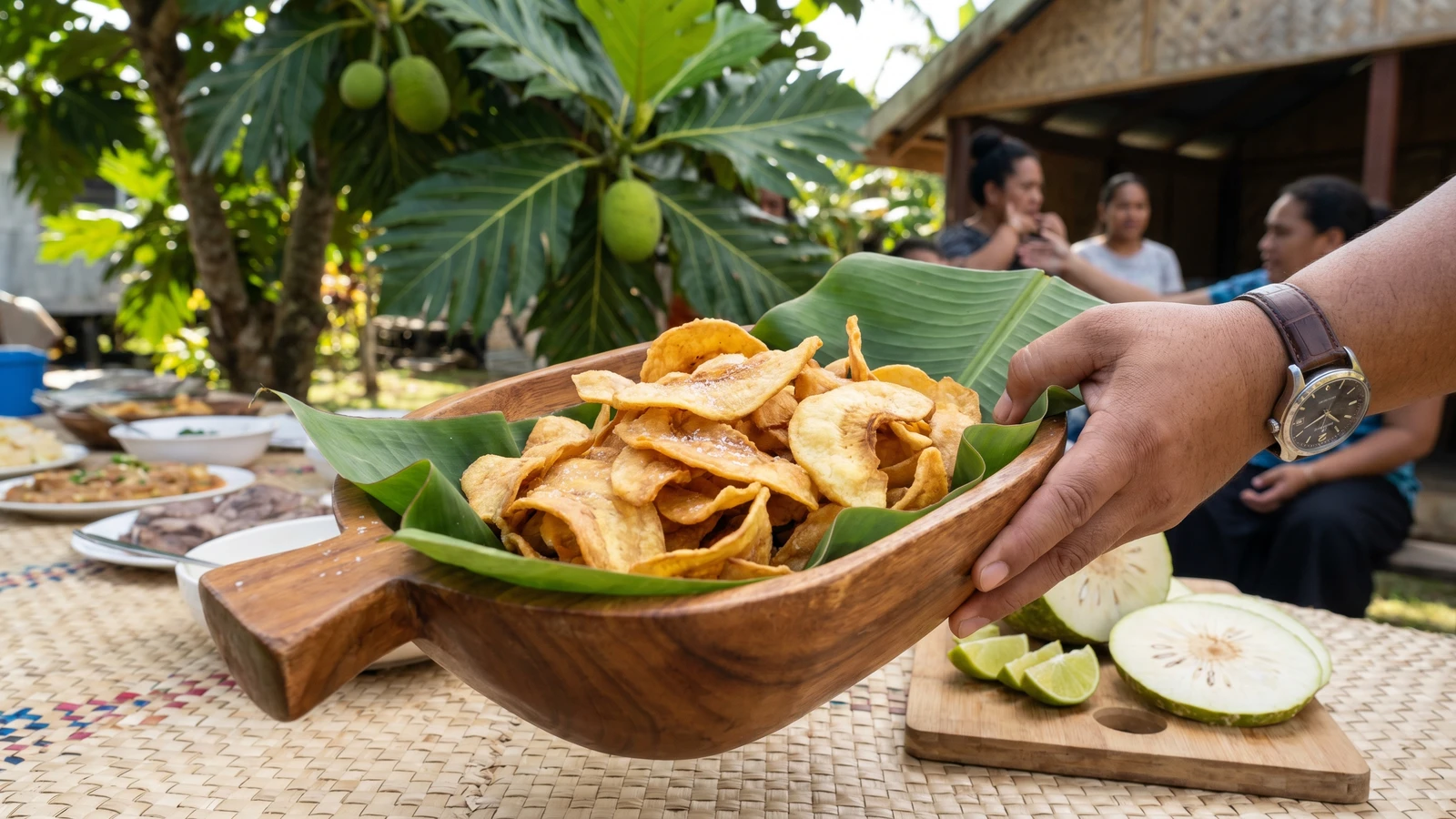
Tonga's mei, firm breadfruit from the canoe-crop family, sliced thin and fried crisp for the picnic table: golden chips, salted hot, easy to share, kin to Hawaiʻi's ʻulu.
The canoe carried more than food; it carried relatives. In Tonga, my cousins call breadfruit mei, a canoe crop rooted in the fonua, the land, with a green skin and a patient heart. Back home in Hawaiʻi we say ʻulu; Sāmoa keeps ʻulu too; Tahiti says ʻuru; the Cook Islands say kuru. One ocean, one canoe, one root, and still this plate belongs to Tonga by name and hand.
I remember standing near a Tongan auntie's frying pot after a church picnic, trying to look useful and mostly being useful only for eating the broken pieces. She sliced the mei thin, held it in water so it stayed clean and pale, dried it like she meant it, then let the oil do the fast work. Salt went on while the chips were still hot, because hot salt sticks, she said, and that's the kind of lesson you remember.
This is deep food brought into an everyday kitchen. The breadfruit tree is older than the fryer, older than the metal pot, older than the picnic cooler, but Tonga still gets to eat it crisp at game day and potluck without anyone scolding the table. Cook it with respect, name the island, and keep the chips abundant. If one more cousin walks in, good. Make room.
Mei, breadfruit, is one of the canoe plants Polynesian voyagers protected as they moved through western Polynesia and out across the Triangle; in Tonga it joined talo, ʻufi (yam), and niu (coconut) as food of household life and feast. When Cook's voyages reached Tonga in the 1770s, European observers were still learning to name a food system Tongan people already knew through season, kinship, and gift to the ʻeiki, the chiefs. Thin fried mei chips are a newer everyday form, made possible by metal pots and cooking oil, but the crop under the salt is older than the mission table: deep food carried forward into school lunches, church picnics, and the potluck tray.
Quantity
1 large, about 2 to 3 pounds
Quantity
enough to cover
for holding the sliced mei
Quantity
1 tablespoon
for the holding water
Quantity
2 to 3 quarts
such as rice bran, peanut, or canola
Quantity
1 1/2 teaspoons
plus more to taste
Quantity
1
cut into wedges
| Ingredient | Quantity |
|---|---|
| firm mature green breadfruit (mei) | 1 large, about 2 to 3 pounds |
| cold waterfor holding the sliced mei | enough to cover |
| sea saltfor the holding water | 1 tablespoon |
| high-heat frying oilsuch as rice bran, peanut, or canola | 2 to 3 quarts |
| fine sea saltplus more to taste | 1 1/2 teaspoons |
| lime (optional)cut into wedges | 1 |
Choose a firm mature green mei, the Tongan breadfruit, heavy for its size with no soft spots. If it smells sweet and gives under your thumb, save that one for another use. For chips you want starch, not softness, so the slices hold their shape and fry clean.
Trim off the stem and bottom end, quarter the mei, cut away the spongy center core, and peel off the green skin. Slice the flesh very thin, about 1/16 inch on a mandoline or a careful 1/8 inch with a knife. Drop the slices into cold salted water as you work so they stay pale and clean.
Drain the slices and lay them out between clean kitchen towels. Pat them until the surfaces feel dry, not wet and slippery. Water and hot oil fight each other, and that fight makes splatter. Dry slices fry crisper too.
Set a wire rack over a rimmed sheet pan. Pour the oil into a heavy pot, filling it no more than halfway, and heat to 350F. The oil should look lively but never smoky, and a test slice should bubble steadily as soon as it goes in.
Fry a loose handful at a time, stirring gently so the slices don't cling together. Keep the oil between 325F and 350F. In 2 to 4 minutes the chips should turn golden, curl at the edges, and sound lighter against the spoon as the bubbling slows. Pull them before they go dark.
Lift the chips to the rack and salt them right away, while the fine salt can catch on the ridges. Taste one after a minute. If it eats flat, add a little more salt. That's the whole thing, mei, oil, salt, and enough for everybody's hand to reach in.
Pile the chips into a banana-leaf-lined bowl or onto a woven mat with lime wedges if you like that bright edge. Serve them the same day, still crisp and lightly glossy. This is Tonga's everyday snack brought into your kitchen, not made precious, just named right and shared wide.
1 serving (about 95g)
Culinary guides, cultural storytelling, and the editorial depth that makes cooking meaningful.
Discover Culinary ExplorerChef Juliette
Tiny éperlans, lightly floured and fried until their tails stand crisp, arrive in a generous heap on a napkin with fried parsley and grooved lemon, a weeknight lesson in heat and restraint.

Chef Juliette
Brandade de Morue turns salt cod, warm olive oil, and milk into a pale, silky emulsion: keep everything warm and add the oil slowly, then crown the generous dome with butter-fried bread.

Chef Juliette
Salt cod worked warm with cream, one patient spoonful at a time, until the rough flakes become a glossy Nîmes paste, domed generously and ringed with butter-fried croutons for the table.

Chef Juliette
Wine-poached char packed in its earthenware crock beneath butter gold: a make-ahead first course that turns careful cooling, thorough boning, and one unbroken seal into quiet abundance.