
Chef Klaus
Aachener Printen
Aachen's Advent biscuit is dark, hard, and spiced, with beet syrup doing the deep work and a closed tin finishing what the oven only starts.
A cooking platform built around craft, culture, and the stories behind what we eat.
Created by
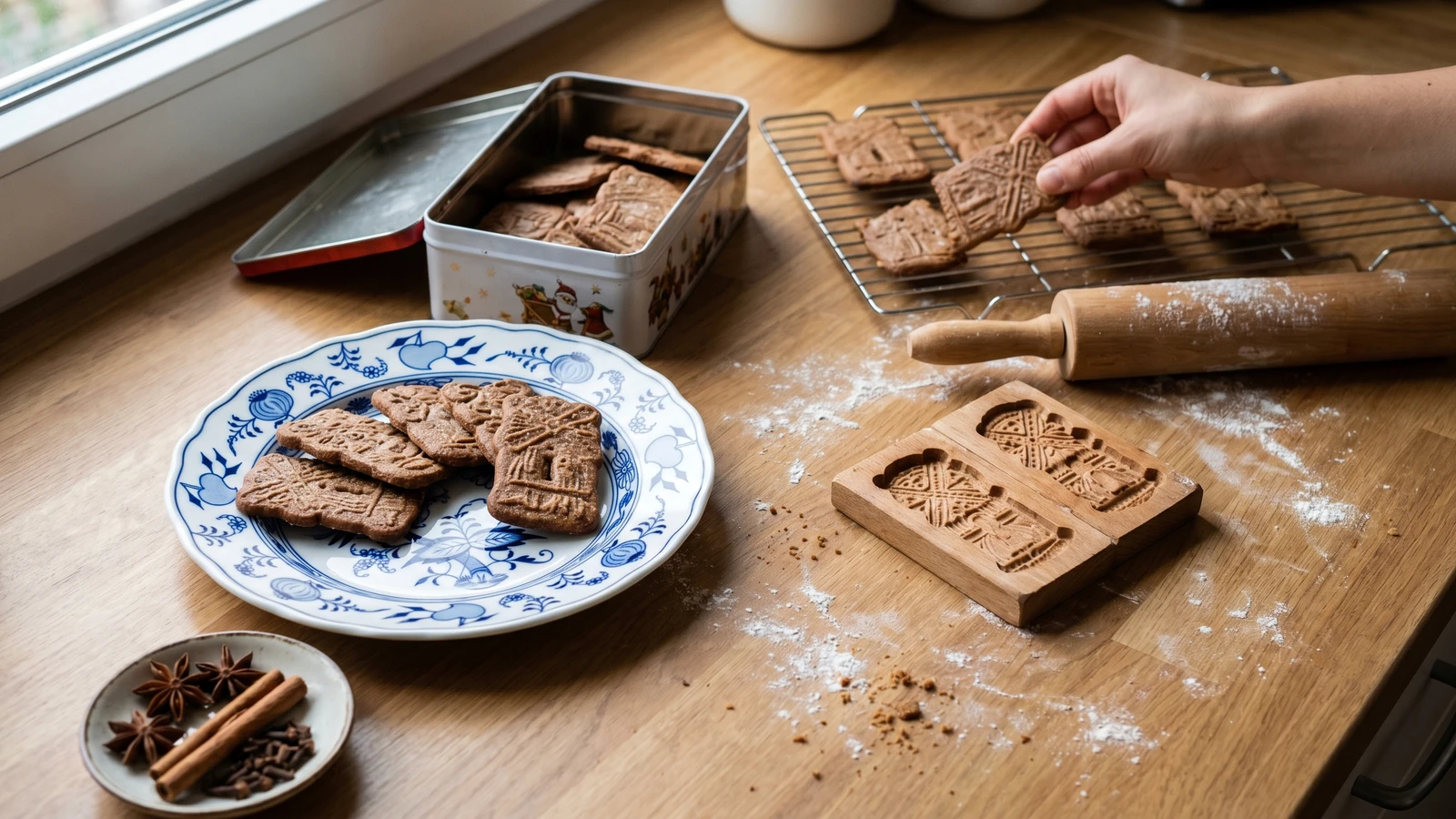
The St Nicholas biscuit of the Lower Rhine: thin, crisp, warmly spiced, and pressed into pictures that only work when the dough is cold and the mould is floured.
Spekulatius belongs to Advent, and on the Lower Rhine it still points straight at St Nicholas on 6 December. These are thin Plätzchen, Christmas cookies, pressed into carved wooden moulds so the pictures bake sharp: bishops, windmills, animals, whatever the old board gives you. The Rhineland and the Dutch borderlands like them spiced and crisp; butter Spekulatius is milder, almond Spekulatius wears sliced almonds on the back, and farther south it becomes one cookie among many on the Adventsteller, the Christmas plate. Im Norden anders, im Süden anders.
The dough is simple, but it isn't casual. The one technique that decides it is cold rest. Warm dough sticks in the mould, smears the picture, and spreads in the oven; cold dough holds the carved lines long enough for the heat to set them. Das braucht seine Zeit. You mix it, chill it, press it, chill it again if the kitchen is warm, then bake it fast enough to dry and brown without puffing.
Use the spices properly, not from a stale packet that smells of cupboard dust. Cinnamon, cardamom, clove, anise, nutmeg, and a little white pepper give the cookie its back. The brown sugar and a spoon of honey help the colour deepen and the snap come clean under the teeth. Nicht aus dem Glas, not from the jar, and not from a supermarket tin pretending it did the work for you.
Watch the edges, not the clock alone. They should go golden-brown with darker tips, while the middle stays firm and dry, not soft. Let them cool before judging the texture; Spekulatius hardens as it cools, and the tin finishes the job. Erst verstehen, dann kochen.
Spekulatius belongs to the St Nicholas customs of the Lower Rhine, Belgium, and the Netherlands, where carved moulds pressed mirrored pictures into spiced dough for the feast of 6 December. The name is argued from Latin speculum, mirror, because the mould reverses the image, and from speculator, a title linked to a watcher or bishop; the dispute suits a borderland biscuit. In the 19th century, cheaper beet sugar, wider spice trade, and roller presses helped move Spekulatius from a special feast biscuit into the broader German Christmas Plätzchen tin.
Quantity
250g
plus more for dusting the mould
Quantity
75g
Quantity
125g
cubed
Quantity
120g
Quantity
1 tablespoon
Quantity
1
Quantity
2 tablespoons
plus more only if needed
Quantity
1 teaspoon
Quantity
1/2 teaspoon
Quantity
1/4 teaspoon
Quantity
1/4 teaspoon
Quantity
1/4 teaspoon
Quantity
1 pinch
Quantity
1/2 teaspoon
Quantity
1/2 teaspoon
Quantity
40g
for almond Spekulatius
| Ingredient | Quantity |
|---|---|
| plain flourplus more for dusting the mould | 250g |
| ground almonds | 75g |
| cold unsalted buttercubed | 125g |
| dark brown sugar | 120g |
| honey | 1 tablespoon |
| egg yolk | 1 |
| cold milkplus more only if needed | 2 tablespoons |
| ground cinnamon | 1 teaspoon |
| ground cardamom | 1/2 teaspoon |
| ground cloves | 1/4 teaspoon |
| ground anise | 1/4 teaspoon |
| freshly grated nutmeg | 1/4 teaspoon |
| ground white pepper | 1 pinch |
| fine salt | 1/2 teaspoon |
| baking powder | 1/2 teaspoon |
| sliced almonds (optional)for almond Spekulatius | 40g |
Whisk the flour, ground almonds, spices, salt, and baking powder together until the colour is even. Do this before the butter goes in, because clove and cardamom clump in little hot pockets if you scatter them late, and one bitter bite will tell on you.
Rub the cold butter into the flour mixture with your fingertips until it looks like fine crumbs. Keep the butter cold, because small hard flakes coat the flour and give the baked cookie its clean snap; soft butter makes a greasy dough that spreads and blurs the picture.
Stir in the brown sugar, then add the honey, egg yolk, and two tablespoons of cold milk. Press the mixture together with your hand, adding only a few drops more milk if dry flour remains. The dough should hold like Mürbeteig, short pastry, not feel wet; a wet Spekulatius dough sticks in the mould and bakes dull.
Flatten the dough into a thick slab, wrap it, and chill it at least two hours. The flour hydrates, the butter firms, and the spices settle through the dough; skip the rest and the dough tears, sticks, and tastes raw at the edges. Das braucht seine Zeit.
Brush a carved Spekulatius mould clean and dust it lightly with flour, tapping out every loose patch. Flour is a release layer, not a coating; too much fills the carving and the bishop comes out looking like weather.
Roll a piece of cold dough about 4mm thick, press it firmly into the mould, then shave or cut away the excess so the back lies flat. Knock the mould once against the bench to release the cookie. If the dough sticks, stop and chill it again; fighting warm dough only ruins more dough.
For Mandelspekulatius, almond Spekulatius, scatter sliced almonds on the lined tray and lay the pressed cookies on top, pressing gently so the almonds grip the back. Put almonds underneath, not over the picture, because the carving is the face of the biscuit.
Bake at 180C in a fully heated oven for 10 to 12 minutes, until the edges are golden-brown and the centres look dry and set. Pull them before they darken hard in the middle; the sugar keeps cooking on the tray, and Spekulatius turns from spiced to bitter faster than a beginner expects.
Leave the cookies on the tray for five minutes, then move them to a wire rack until completely cold. They firm as they cool, so don't judge the snap while they are still flexible. Store them in a tin, where the spice rounds out over the next day and the cookie keeps its bite.
1 serving (about 12g)
Culinary guides, cultural storytelling, and the editorial depth that makes cooking meaningful.
Discover Culinary ExplorerChef Klaus
Aachen's Advent biscuit is dark, hard, and spiced, with beet syrup doing the deep work and a closed tin finishing what the oven only starts.

Chef Klaus
The Baden-Wuerttemberg apple fritter that lives between weeknight dessert and Sunday coffee, built on tart rings, a light batter, and oil kept steady.

Chef Klaus
The Carnival doughnut lives by proofing and fat temperature: a light yeast round floats high, cooks through with one pale belt, then takes its jam without turning greasy.

Chef Klaus
A cold Mürbeteig ball, one clean hollow, and a spoon of tart jelly: Engelsaugen are Advent cookies that fail only when the dough gets warm.