Chef Lupita
Acúmara Tatemada al Comal
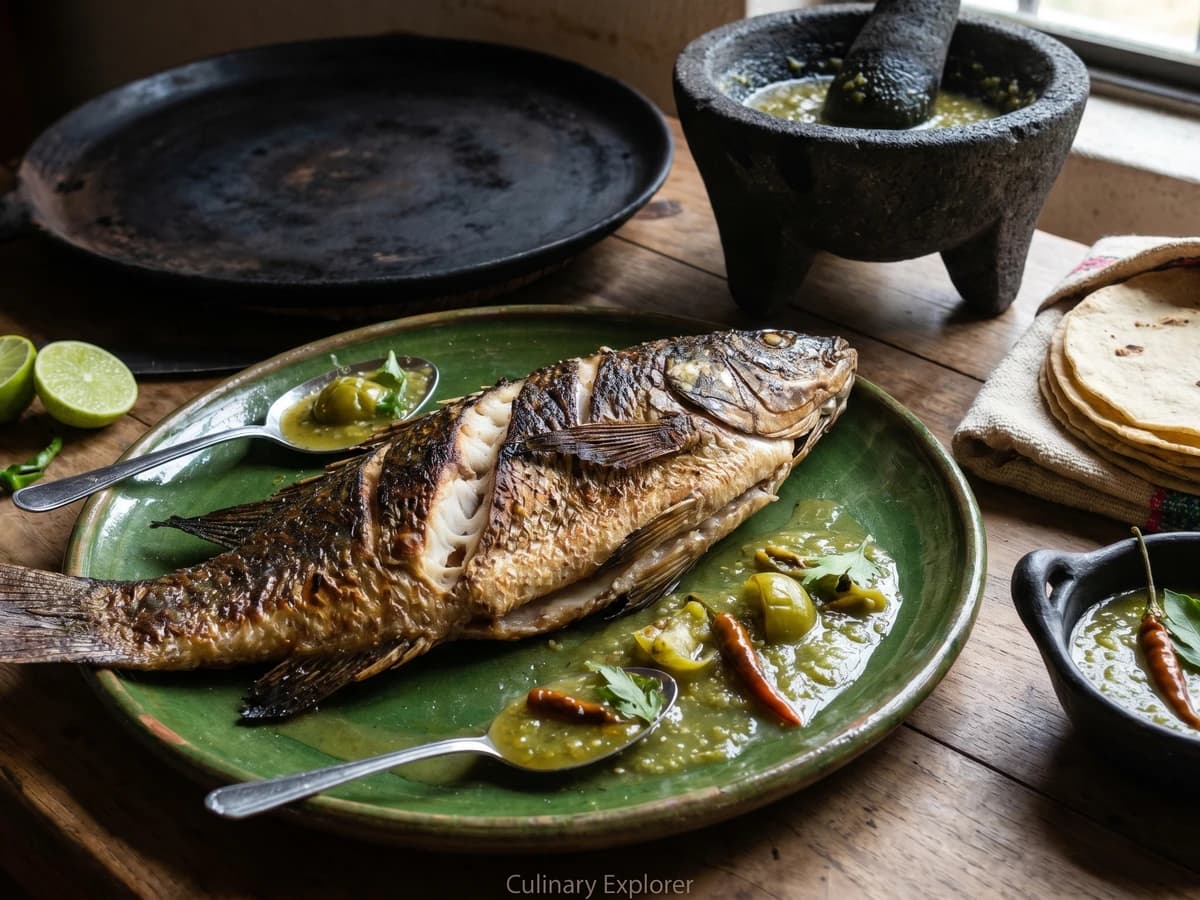
Michoacán's Lake Pátzcuaro acúmara, a whole kurucha from the lago tatemada on a comal de leña and served with chile perón atápakua, corn tortillas, and P'urhépecha discipline.
A cooking platform built around craft, culture, and the stories behind what we eat.

Created by
Oaxaca's Pacific coast signature: a whole snapper butterflied open, slathered in a smoky guajillo and costeño adobo, and grilled over wood until the chile paste blackens into a crust and the flesh pulls clean off the bone.
Pescado a la talla belongs to the Oaxacan coast. Specifically to the stretch of Pacific shoreline that runs from Puerto Escondido down through Mazunte, Zipolite, and into the Costa Chica, where the fishermen come in at dawn and the comedores along the beach build wood fires by mid-morning. By lunchtime there is fish on every grill.
The word talla comes from tallar, to rub or to score. The fish is butterflied open, rubbed hard with a chile adobo, and grilled flesh side down so the paste chars into the skin. This is not pescado zarandeado from Nayarit, which uses a clamshell grill and a different chile profile. This is the Oaxacan version, built on guajillo, ancho, and chile costeño, that small bright red chile that grows in the coastal lowlands and gives the paste its particular sharpness. If you can find a chile pasilla oaxaqueño from the Sierra Norte, smoke-dried over wood, add it. That smoke is what separates the Oaxacan version from every other grilled fish in Mexico.
The women who run the comedores in Zipolite taught me this dish. They do not measure. They build the paste by feel, taste it off a spoon, adjust the salt, slather it on a snapper that was swimming three hours ago, and slide it onto the grill over coconut wood. The fish comes off charred and red and smelling like the sea and the chile vendor's stall at the same time. My mother never made this dish, she was from Jalisco and her ocean was different, but I have a page in my notebook from a senora named Rosalba in Mazunte who showed me how to mix the adobo without writing anything down. I wrote it down for her. Saber cocinar es saber vivir.
Use a whole fish. A red snapper, a robalo, a huachinango. Skin on, head on, tail on. Filleted fish is for a different recipe. The skin holds the chile paste and the bones carry the flavor into the flesh. Cada estado, su propia cocina, and this one belongs to the Oaxacan coast.
Pescado a la talla evolved on the Costa Chica and Costa Grande of Oaxaca and Guerrero from indigenous coastal grilling traditions practiced by the Chatino and Afromexican fishing communities long before Spanish contact. The chile adobo that defines the modern dish is a colonial-era refinement, layering New World chiles with Old World vinegar, cloves, and cinnamon brought by the Manila galleon trade through the nearby port of Acapulco. Chile costeño, the small red chile native to Oaxaca's coastal lowlands, is essential to the regional version and is rarely cultivated outside the state, which is why pescado a la talla cooked elsewhere often tastes flatter than the version eaten in a Zipolite palapa with sand under the table.
Quantity
1 (3 to 4 pounds)
scaled, gutted, and butterflied open along the spine
Quantity
8
stemmed and seeded
Quantity
4
stemmed and seeded
Quantity
2
stemmed and seeded (or substitute 2 more guajillo)
Quantity
1
stemmed and seeded
Quantity
6
unpeeled
Quantity
1
halved
Quantity
2 medium
Quantity
1 teaspoon
preferably oregano de monte from Oaxaca
Quantity
1/2 teaspoon
Quantity
4
Quantity
1 small piece (1 inch)
Quantity
3 tablespoons
Quantity
3 tablespoons
Quantity
2 tablespoons
melted
Quantity
from 2 limes
Quantity
2 tablespoons, plus more for the fish
Quantity
as needed
lightly toasted over the flame, for lining the grill
Quantity
for serving
Quantity
for serving
warmed
Quantity
for serving
Quantity
for serving
| Ingredient | Quantity |
|---|---|
| whole red snapper or robaloscaled, gutted, and butterflied open along the spine | 1 (3 to 4 pounds) |
| dried chile guajillostemmed and seeded | 8 |
| dried chile anchostemmed and seeded | 4 |
| dried chile costeño rojostemmed and seeded (or substitute 2 more guajillo) | 2 |
| dried chile pasilla oaxaqueño (optional)stemmed and seeded | 1 |
| garlic clovesunpeeled | 6 |
| small white onionhalved | 1 |
| Roma tomatoes | 2 medium |
| dried Mexican oreganopreferably oregano de monte from Oaxaca | 1 teaspoon |
| ground cumin | 1/2 teaspoon |
| whole cloves | 4 |
| Mexican cinnamon (canela) | 1 small piece (1 inch) |
| apple cider vinegar | 3 tablespoons |
| olive oil | 3 tablespoons |
| manteca de cerdomelted | 2 tablespoons |
| lime juice | from 2 limes |
| kosher salt | 2 tablespoons, plus more for the fish |
| banana leaves (optional)lightly toasted over the flame, for lining the grill | as needed |
| lime halves (optional) | for serving |
| hand-pressed corn tortillas (optional)warmed | for serving |
| salsa de chile costeño (optional) | for serving |
| sliced white onion and fresh cilantro (optional) | for serving |
If your fishmonger has not done this for you, lay the cleaned whole fish on a cutting board and split it from head to tail along the spine, opening it like a book so it lies flat. Leave the head and tail on. Leave the skin on. The skin is what holds the fish together on the grill and what carries the chile paste. A fillet is not pescado a la talla. It is something else.
Heat a dry comal or heavy skillet over medium. Toast the guajillo, ancho, costeño, and pasilla oaxaqueño chiles separately, pressing each one flat for about 20 to 30 seconds per side. They should puff and turn fragrant, never blacken. The costeño is small and burns the fastest, watch it. The pasilla oaxaqueño carries a smoky note from the way it is dried over wood in the Sierra Norte. That smoke is the soul of this paste.
On the same comal, char the unpeeled garlic, halved onion, and whole tomatoes. Turn them every few minutes until the skins are blackened in patches and the flesh underneath has softened, about 8 to 10 minutes for the garlic and onion, 12 minutes for the tomatoes. Pull each one off when it is ready, do not wait for everything together. Slip the garlic out of its skins. Leave the char on the tomatoes and onion. That black is flavor.
Place the toasted chiles in a heatproof bowl and cover with hot tap water, not boiling. Press a small plate on top to keep them submerged. Soak for 20 minutes, until the flesh is pliable but the chiles still have body. Drain. Reserve a small cup of the soaking water in case the paste needs loosening.
In a blender, combine the soaked chiles, charred garlic, charred onion, charred tomatoes, oregano, cumin, cloves, cinnamon, vinegar, lime juice, and salt. Blend on high until completely smooth, adding a tablespoon or two of soaking water only if the blender struggles. The paste should be thick enough to coat the back of a spoon and stay there. Strain through a medium-mesh sieve, pressing on the solids, then stir in the olive oil and melted manteca. La manteca es el sabor and it carries the chile paste into the flesh of the fish.
Lay the butterflied fish flesh side up on a sheet pan. Slather the chile paste generously across the flesh, working it into every crease and along the bones. Flip and coat the skin side too, more lightly. Let the fish marinate for 30 minutes at room temperature. No longer. The acid in the paste starts to break down the flesh past that, and you want the fish to grill, not cure.
On the Costa Chica they grill over leña, hardwood that burns down to embers. If you have a charcoal grill, light a generous chimney of hardwood charcoal and let it burn until the coals are covered in gray ash. Add a few chunks of mesquite or oak if you have them. Spread the coals for medium-high heat. A gas grill will work, but the wood smoke is part of the dish. Asi se hace y punto.
If you have banana leaves, pass them quickly over the open flame until they turn glossy and pliable, then lay them on the grate to keep the fish from sticking. Place the fish flesh side down on the leaves or directly on a well-oiled grate. Grill for 6 to 8 minutes without moving it. The paste will darken and char in spots. That char is the talla.
Using two wide spatulas, gently flip the fish skin side down. Brush the flesh side with any remaining adobo. Grill for another 8 to 10 minutes, until the skin is charred and crisp and the flesh at the thickest part of the spine flakes easily when pressed with a fork. A 3-pound fish will be done in about 18 minutes total. A 4-pound fish needs closer to 22. The flesh should look opaque all the way through, with the chile paste set into a dark, glossy crust.
Slide the whole fish onto a long platter, banana leaf and all if you used one. Set the lime halves, warm tortillas, salsa de chile costeño, sliced onion, and cilantro alongside. Each person pulls flesh from the bone with a fork or a tortilla and builds their own taco at the table. This is a dish you eat with your hands, with cold beer, near the ocean if you can manage it. Recetas probadas y garantizadas.
1 serving (about 280g)
Culinary guides, cultural storytelling, and the editorial depth that makes cooking meaningful.
Discover Culinary ExplorerChef Lupita
Michoacán's Lake Pátzcuaro acúmara, a whole kurucha from the lago tatemada on a comal de leña and served with chile perón atápakua, corn tortillas, and P'urhépecha discipline.

Chef Lupita
Puebla's weekday adobo of pork shoulder braised in a thick guajillo and ancho sauce sharpened with vinegar, cumin, and clove. The deep red of a market spice stall, the dish a poblana cooks without thinking.

Chef Lupita
Loreto's pit-roasted clams, planted hinge-up in beach sand and tatemadas under a fast fire of dried romerillo brush, the resinous Baja desert shrub that gives this dish its smoke.

Chef Lupita
Oaxaca's eighth mole, the silky, almond-and-cinnamon almendrado, served over poached chicken. Mild, sweet, restrained, and a quiet rebuttal to anyone who thinks Mexican food has to be hot to be Mexican.