Culinary Explorer

A cooking platform built around craft, culture, and the stories behind what we eat.
Discover Culinary Explorer
Mole Amarillo Oaxaqueño con Pollo

Mole Amarillo Oaxaqueño con Pollo

Created by

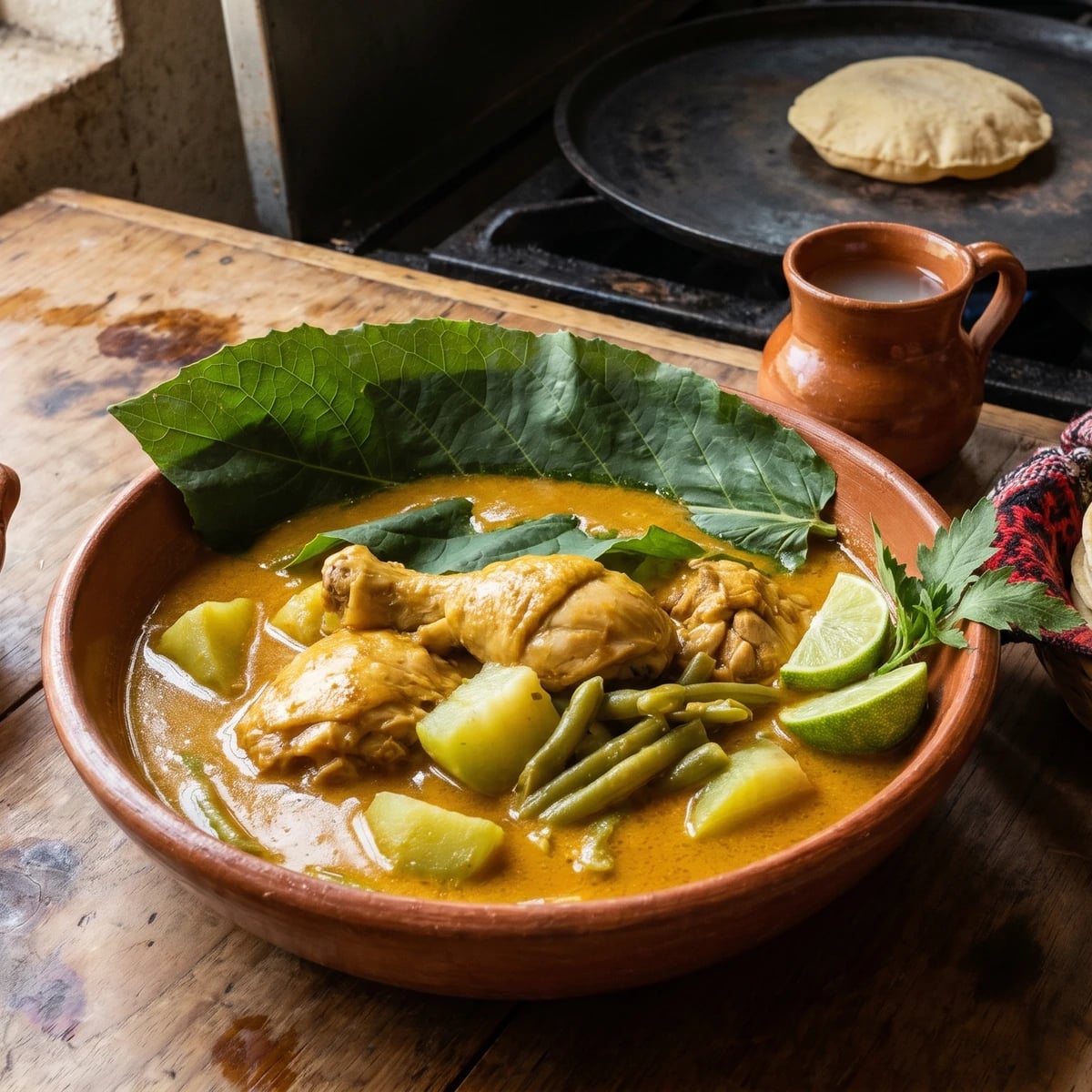
Oaxaca's lighter, brothy weeknight mole, built on chilhuacle amarillo, charred tomatillos, and hoja santa, thickened with masa to a clean finish over poached chicken and chayote.

Main Dishes
Mexican
Weeknight
Comfort Food
Quick Meal
30 min
Active Time
1 hr 15 min cook1 hr 45 min total
Yield6 servings

This is from Oaxaca. From the Valles Centrales and the sierra above them, where amarillo is the mole the cook reaches for on a Tuesday, when there is no time for the two-day commitment of a mole negro. Of the seven moles of Oaxaca, amarillo is the most misunderstood outside the state. People assume mole means thick, dark, sweet, and complicated. Amarillo is none of those things. It is brothy. It is herbaceous. It is built around a chile most cooks outside Oaxaca have never held in their hand.

The chile is chilhuacle amarillo. It grows in the Cañada region of Oaxaca and almost nowhere else, and it gives this mole its golden color and its quiet, fruity heat. The herb is hoja santa, the big heart-shaped leaf with a licorice and root-beer perfume that anchors the whole pot. Without hoja santa, you have a yellow chile sauce. With it, you have mole amarillo. The masa thickens the broth without weighing it down; this is not a paste, this is a sauce that drinks almost like a caldo.

I collected this version from a señora in Tlacolula who sold it from a clay pot at the Sunday market. She told me the rule that I now repeat to my students: the chilhuacle gives the color, the hoja santa gives the soul, the masa gives the body, and the chicken broth gives the life. Take any of them away and you are cooking something else. Cada estado, su propia cocina, and amarillo belongs to Oaxaca. Saber cocinar es saber vivir.

Mole amarillo is one of the seven moles of Oaxaca codified in the 20th century as a marker of regional culinary identity, alongside negro, rojo, coloradito, verde, chichilo, and manchamanteles. Its defining chile, the chilhuacle amarillo, is an heirloom variety cultivated in the Cañada region of Oaxaca for centuries and is at risk of disappearing because so few farmers continue to grow it; the Mexican Slow Food Presidium and several regional cooperatives have worked since the early 2000s to protect the seed line. The use of masa as a thickener, rather than nuts and seeds as in mole poblano or mole negro, marks amarillo as a closer descendant of pre-Columbian molli, the Nahuatl word for sauce, in which ground nixtamalized corn was the primary thickening agent long before the Spanish introduced bread and almonds.

The technique, the tradition, and the story behind every dish.

Discover Culinary Explorer

Ingredients

whole chicken

Quantity

1 (about 4 pounds)

cut into 8 pieces

white onion

Quantity

1 medium

halved

head of garlic

Quantity

1

halved crosswise

bay leaves

Quantity

2

kosher salt

Quantity

1 tablespoon, plus more to taste

dried chile chilhuacle amarillo

Quantity

6

stemmed and seeded

dried chile guajillo

Quantity

4

stemmed and seeded

dried chile costeño amarillo

Quantity

2

stemmed and seeded

tomatillos

Quantity

1 pound

husked and rinsed

small white onion

Quantity

1

quartered

whole garlic cloves

Quantity

4

unpeeled

whole cumin seed

Quantity

1 teaspoon

whole black peppercorns

Quantity

1/2 teaspoon

whole cloves

Quantity

2

Mexican cinnamon (canela)

Quantity

1 small piece, about 1 inch

manteca de cerdo (pork lard)

Quantity

2 tablespoons

masa harina

Quantity

1/3 cup

cold water

Quantity

1 cup

fresh hoja santa leaves

Quantity

3 large, plus more for serving

stems removed

fresh epazote

Quantity

1 sprig

chayote

Quantity

1 pound

peeled and cut into 1-inch chunks

green beans (ejotes)

Quantity

1/2 pound

trimmed and halved

hand-pressed corn tortillas (optional)

Quantity

for serving

warmed

lime wedges (optional)

Quantity

for serving

Equipment Needed

  • Wide 6-quart cazuela or heavy Dutch oven
  • Cast iron comal or heavy skillet for toasting chiles and charring vegetables
  • High-powered blender
  • Fine-mesh strainer
  • Wooden spoon for stirring the mole as it fries

Instructions

  1. 1

    Poach the chicken

    Place the chicken pieces in a wide pot. Cover with cold water by two inches. Add the halved onion, the halved head of garlic, the bay leaves, and the salt. Bring to a low simmer over medium heat. Skim the gray foam in the first ten minutes. Cook at the barest bubble for 35 to 40 minutes, until the chicken is just cooked through. Lift out the chicken and reserve. Strain the broth and keep it hot. You will need about six cups for the mole.

    Cold water start, low simmer, no rolling boil. Boiled chicken turns stringy and the broth turns cloudy. The broth is the body of this mole. Treat it with respect.
  2. 2

    Toast the chiles

    Heat a dry comal or heavy skillet over medium. Toast the chilhuacle amarillo, guajillo, and costeño amarillo separately, about 20 to 30 seconds per side. They should puff and turn fragrant, never blacken. The chilhuacle is the chile that names this mole. If you cannot find chilhuacle amarillo, double the costeño amarillo and add a chile guero seco. It is a compromise, not an upgrade. Place the toasted chiles in a heatproof bowl, cover with hot tap water, and let them soften for 20 minutes.

    Chilhuacle amarillo is grown in the Cañada region of Oaxaca and almost nowhere else. If you find it at a Mexican grocer or order from a reliable Oaxacan source, buy more than you need. It keeps for months in a sealed bag.
  3. 3

    Char the tomatillos and aromatics

    On the same comal, char the tomatillos, the quartered onion, and the unpeeled garlic cloves. The tomatillos will go from bright green to olive and start to release their juice in about eight minutes. The onion should show black edges. The garlic skins will blister; peel them once they are cool enough to handle. This direct-fire charring is what gives mole amarillo its smoky undertone. A pan-roasted vegetable is not the same thing.

  4. 4

    Toast the spices

    In a small dry skillet over low heat, toast the cumin, peppercorns, cloves, and the piece of canela for about 90 seconds, swirling the pan, until the kitchen smells like a spice market. Pull the pan off the heat the moment they turn fragrant. Burnt spice is bitter spice and there is no fixing it later.

  5. 5

    Blend the mole base

    Drain the soaked chiles. In a blender, combine the chiles, the charred tomatillos with their juices, the charred onion, the peeled charred garlic, and the toasted spices. Add one cup of the hot chicken broth. Blend on high for at least three minutes, until completely smooth. The amarillo should look like a clear, golden-orange suspension with no visible flecks of skin. Strain through a fine-mesh sieve into a bowl, pressing on the solids. Discard what stays behind.

  6. 6

    Fry the mole

    In a wide cazuela or heavy pot, melt the lard over medium heat. When it shimmers, pour in the strained mole base. It will sputter; stand back. Cook for eight to ten minutes, stirring constantly with a wooden spoon, until the mole darkens slightly and the fat begins to separate at the edges. La manteca es el sabor. This step is what turns a thin chile sauce into a mole. No me vengas con atajos.

    If the mole splatters too aggressively, pull the pan off the heat for thirty seconds and let it settle. Do not lower the heat too far or the fat will not separate.
  7. 7

    Build the broth and thicken with masa

    Pour in five cups of the hot chicken broth and stir well. Bring to a low simmer. In a small bowl, whisk the masa harina into the cold water until smooth, with no lumps. Pour the masa slurry into the simmering mole in a slow stream, whisking as you go. Cook for 10 minutes, stirring often. The mole will thicken into a brothy, velvety sauce that coats the back of a spoon but still flows. Mole amarillo is not pasted thick like mole negro or mole poblano. It is meant to drink almost like a caldo. Esto no es comida de un solo Mexico. Each mole has its own consistency.

  8. 8

    Add the hoja santa, vegetables, and chicken

    Tear the hoja santa leaves into pieces and stir them into the mole along with the epazote sprig. The hoja santa is the herb that names this version. It carries a soft licorice and root-beer note that no other leaf delivers. Add the chayote and green beans. Simmer for 10 minutes, until the chayote yields to a knife but still holds its shape. Slide the reserved chicken pieces back in, spooning the mole over them, and warm through for another five minutes. Taste for salt now. The masa absorbs flavor; the broth must be assertive.

  9. 9

    Serve in deep bowls

    Ladle the mole, a piece of chicken, and a generous portion of the vegetables into wide bowls. Drape a fresh hoja santa leaf across the top of each one if you have extra. Serve with warm hand-pressed corn tortillas and lime wedges. In Oaxaca, the tortillas are the spoon. Tear, dip, eat. Asi se hace y punto.

Chef Tips

  • Chilhuacle amarillo is the chile this mole is named for. If you cannot find it, the best compromise is doubling the chile costeño amarillo and adding one chile guero seco for color. A substitution is a compromise, not an upgrade, and you should know what you are missing.
  • Hoja santa is non-negotiable. Fresh leaves are sold at Mexican grocers and some farmers' markets, and the plant grows easily if you can find a cutting. Dried hoja santa is a pale ghost of the fresh leaf and I do not recommend it. If you cannot find fresh, wait until you can. The mole will keep.
  • The masa harina must be true nixtamalized masa harina, not cornmeal and not cornstarch. Maseca works. Bob's Red Mill cornmeal does not. The dish depends on the flavor of nixtamal.
  • Mole amarillo accepts whatever the mercado is selling: chayote, ejotes, calabacita, papa, even chochoyotes (small masa dumplings). Cook with what is in season, the way the señoras in Oaxaca have always cooked. Preguntale a las señoras del mercado.

Advance Preparation

  • The mole base, through the frying step, can be made up to two days ahead and refrigerated. The flavor only deepens. Thin with hot broth and add the masa, hoja santa, and vegetables on serving day.
  • The chicken can be poached one day ahead and kept in its strained broth, refrigerated.
  • The finished mole keeps refrigerated for three days. Add a fresh hoja santa leaf when reheating to wake the herb up; the original leaves give most of their flavor in the first hour.

Frequently Asked Questions

Nutrition Information

1 serving (about 600g)

Calories
735 calories
Total Fat
29 g
Saturated Fat
8 g
Trans Fat
0 g
Unsaturated Fat
19 g
Cholesterol
115 mg
Sodium
750 mg
Total Carbohydrates
73 g
Dietary Fiber
13 g
Sugars
7 g
Protein
48 g

Note: Chef personas and recipes are created with AI assistance. Cook with care: follow safe food-handling practices, check doneness with a thermometer when needed, and adapt for allergies and your kitchen.

Where cooking meets culture.

Culinary guides, cultural storytelling, and the editorial depth that makes cooking meaningful.

Discover Culinary Explorer

More from Oaxacan Main Dishes

Browse the full collection