Culinary Explorer

A cooking platform built around craft, culture, and the stories behind what we eat.
Discover Culinary Explorer
Luau Pisupo (Sāmoan Corned-Beef Taro-Leaf Parcel)

Luau Pisupo (Sāmoan Corned-Beef Taro-Leaf Parcel)

Created by

Sāmoa's taro-leaf parcel made generous with pisupo, coconut cream, and time: a toʻonaʻi kind of comfort, with Tonga's lū pulu and Hawaiʻi's laulau sitting close as cousins.

Main Dishes
Polynesian, Samoan
Special Occasion
Celebration
Comfort Food
35 min
Active Time
1 hr 30 min cook2 hr 5 min total
Yield6 to 8 servings

The taro leaf is kin before it's supper. In Sāmoa this dish is luau pisupo: luau, the taro leaves, wrapped around pisupo, the corned beef the islands took from the tin and made part of the living table. This is Sāmoa's hand, not Hawaiʻi's, and I cook it open-handed. For the deep parts of the toʻonaʻi, the Sunday meal, go sit with a Sāmoan auntie, uncle, or matai who carries that knowledge from inside the aiga, the family.

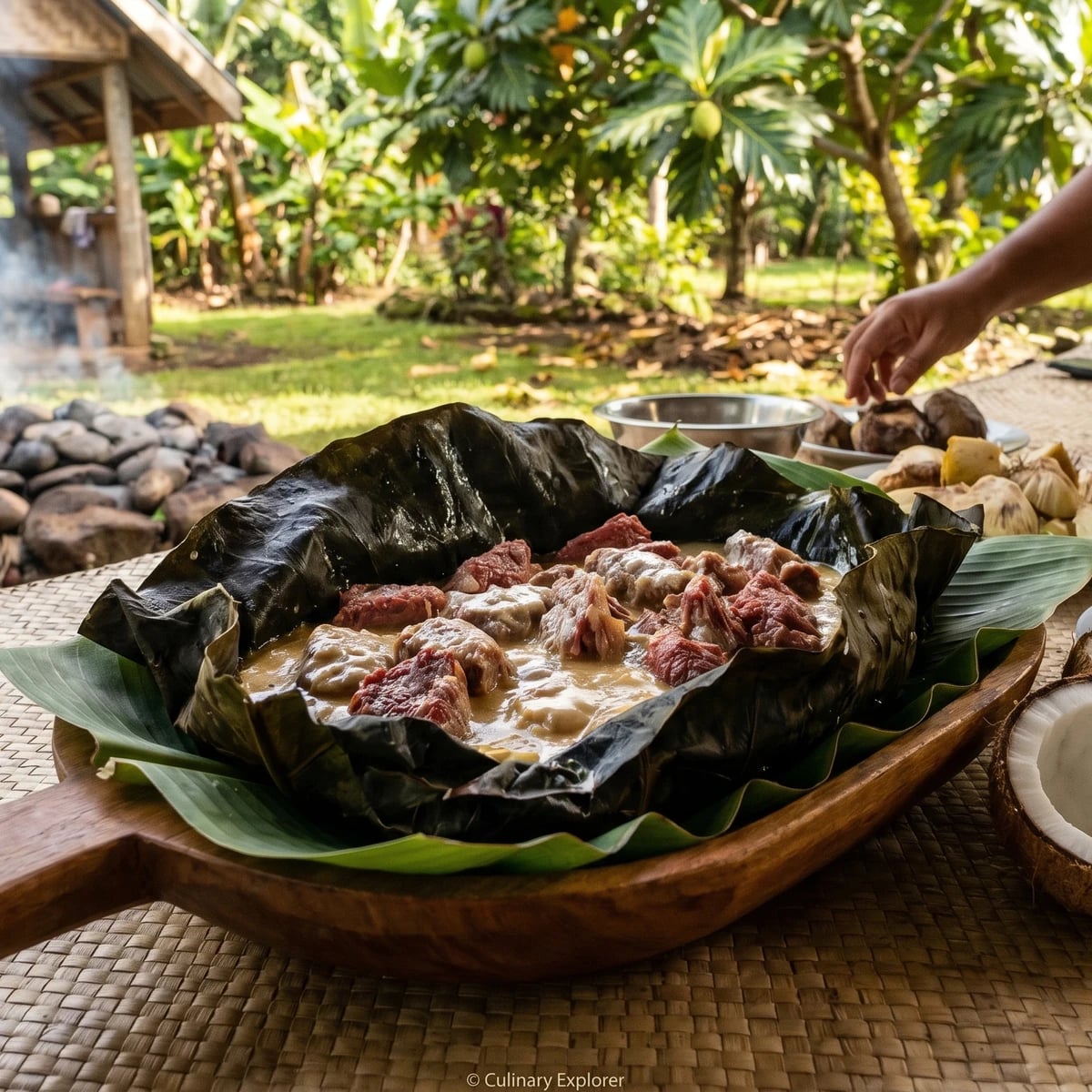
The old gesture is older than the tin. Leaf, coconut, fire. Palusami holds that same center, taro leaves folded around peʻepeʻe, fresh coconut cream, and set into the umu, the above-ground hot-stone oven. Tonga has lū pulu, rich with corned beef and coconut cream. The Cook Islands have rukau. Back home in Hawaiʻi we have laulau and lūʻau leaf. One ocean, one canoe, one root, but every island keeps its own hand.

Pisupo tells the truth of how people eat now. No shame in that can. The deep food and the everyday food sit together on the same mat, same as sapasui and rice sit beside the taro. Build the leaves four and five deep so the cream can't burn through, cook them long enough to lose every needle of oxalate, and don't keep opening the parcel to check. You're not steaming a vegetable. You're melting a tough leaf and a salty filling into each other until both forget they were tough.

Taro and coconut are canoe foods carried through the Polynesian Triangle, while canned corned beef entered Sāmoan tables through nineteenth- and twentieth-century trade, missions, military routes, and wage economies. Luau pisupo shows the old leaf-and-coconut parcel adapting without disappearing: palusami in Sāmoa, lū pulu in Tonga, rukau in the Cook Islands, and laulau in Hawaiʻi all speak the same cooking gesture in different island voices. That mix of canoe crop and tinned meat is not a fall from the old table, it is part of how Sāmoan families kept feeding the aiga through changing times.

The technique, the tradition, and the story behind every dish.

Discover Culinary Explorer

Ingredients

young taro leaves

Quantity

36

thick stems and ribs removed

pisupo (Sāmoan-style corned beef)

Quantity

1 can, 11 to 12 ounces

broken into rough pieces

fresh coconut cream (peʻepeʻe)

Quantity

2 cups

or 1 can thick coconut cream

onion

Quantity

1 small

finely diced

sea salt

Quantity

1/2 teaspoon

plus more to taste

freshly ground black pepper

Quantity

1/2 teaspoon

banana leaves

Quantity

4 to 6

softened over heat, or use parchment and foil

water

Quantity

1/2 cup

for the baking dish

Equipment Needed

  • Deep 9-by-13-inch baking dish or heavy 6-quart Dutch oven with lid
  • Foil and parchment, or softened banana leaves for wrapping
  • Wide bowl for shaping leaf parcels

Instructions

  1. 1

    Ready the leaves

    Rinse the taro leaves well and cut away the thick stems and ribs so the leaves can fold without tearing. Keep the tender leaf whole where you can. Raw taro leaf can bite the throat, so remember this now: the full cook is not optional. No blame the taro if you rush it.

  2. 2

    Season the filling

    Break the pisupo into rough pieces and mix it with the onion, black pepper, and a small pinch of salt. Go easy with the salt at first because corned beef already carries plenty. You want savory and rich, not harsh.

  3. 3

    Cup the leaf

    Lay four or five taro leaves in a stack, largest on the outside, cupped like pages in your hands or in a bowl. This depth matters. It protects the cream, gives the parcel strength, and lets the leaf cook down to that dark silk instead of drying out.

  4. 4

    Fill and fold

    Spoon a portion of pisupo into the center, then pour in enough coconut cream to moisten it deeply without flooding the parcel. Fold the inner leaves over the filling, then bring the outer leaves around everything into a tight bundle. Wrap each bundle in softened banana leaf, or parchment and foil if that's what your kitchen has.

    Fresh coconut cream is the soul of this kind of western-island food. A good thick can works on a weeknight, but if you can squeeze it fresh from grated mature coconut, do that.
  5. 5

    Bake it covered

    Set the parcels seam-side down in a deep baking dish or Dutch oven and pour the water around them, not over them. Cover tight and bake at 350F for 1 hour 15 minutes to 1 hour 30 minutes, until the parcels feel soft when pressed and the leaf has gone deep green-black and silky. Don't keep opening it. Trust the leaf and the time.

  6. 6

    Rest and share

    Let the parcels rest 10 minutes before opening. Spoon any coconut-rich juices from the bottom back over the split leaves. The finished luau pisupo should be glossy, tender, and rich, with the cream pooling white-gold against the dark leaf. Serve with taro, breadfruit, green banana, or rice, enough for one more.

Chef Tips

  • Use young taro leaves when you can. Older leaves can work, but they need the ribs trimmed hard and the full long cook so the oxalate bite disappears.
  • Frozen taro leaves from a Pacific or Asian market are a good shortcut. Thaw, drain, and handle them gently because they tear easier than fresh leaves.
  • Pisupo is salty, rich, and real island food. Balance it with unsweetened coconut cream and plain starch on the side, taro, ʻulu, green banana, or rice.
  • For a gentler version, use half a can of pisupo and add diced cooked taro or breadfruit inside the parcel. Eat what you have, just don't short the leaf on time.

Advance Preparation

  • Trim and wash the taro leaves up to 1 day ahead, then wrap them in a damp towel and refrigerate.
  • Assemble the parcels up to 6 hours ahead and keep them cold, covered tightly, then bake them before serving.
  • Leftovers keep 3 days refrigerated. Reheat gently, covered, with a spoonful of coconut cream or water so the leaf stays soft.

Frequently Asked Questions

Nutrition Information

1 serving (about 190g)

Calories
395 calories
Total Fat
32 g
Saturated Fat
24 g
Trans Fat
0 g
Unsaturated Fat
8 g
Cholesterol
40 mg
Sodium
640 mg
Total Carbohydrates
11 g
Dietary Fiber
5 g
Sugars
4 g
Protein
15 g

Note: Chef personas and recipes are created with AI assistance. Cook with care: follow safe food-handling practices, check doneness with a thermometer when needed, and adapt for allergies and your kitchen.

Where cooking meets culture.

Culinary guides, cultural storytelling, and the editorial depth that makes cooking meaningful.

Discover Culinary Explorer

More from The Leaf-and-Coconut-Cream Parcel

Browse the full collection