
Chef Klaus
Aachener Printen
Aachen's Advent biscuit is dark, hard, and spiced, with beet syrup doing the deep work and a closed tin finishing what the oven only starts.
A cooking platform built around craft, culture, and the stories behind what we eat.
Created by
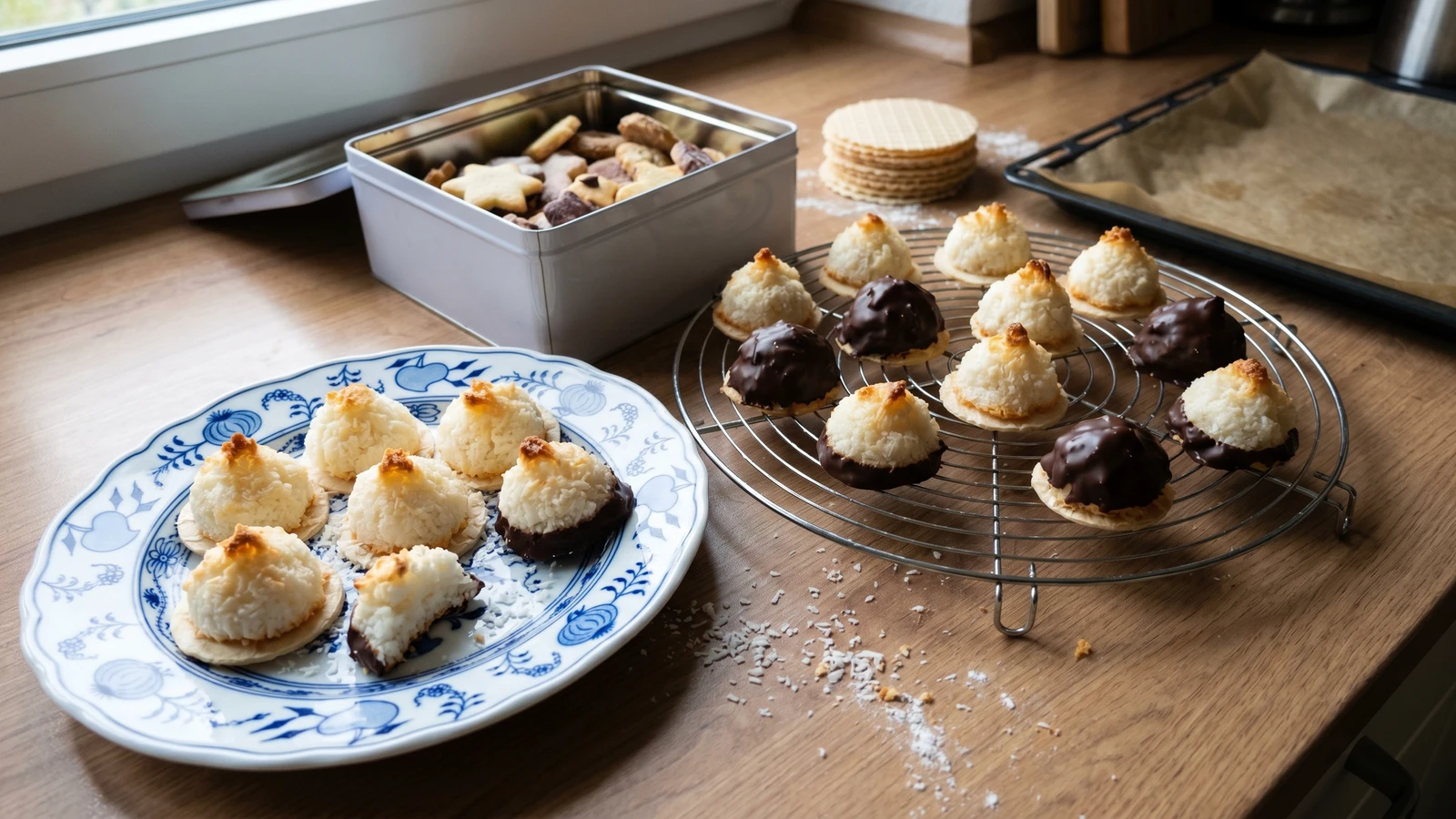
The Advent macaroon that works only when the egg-white mixture is warmed gently first, so the coconut hydrates, the peaks hold, and the middle stays soft.
Kokosmakronen belong to the Advent tin, the Blechdose that starts filling when the first candles are lit and disappears faster than the baker admits. They sit with the Plätzchen, Christmas cookies, but they are not Mürbeteig, short pastry, and they do not need flour. Coconut, egg white, sugar, Oblaten, baking wafers. That is the work.
The north and south disagree in the usual useful way. Some households bake them plain and snow-white, some brown the tips, some dip the bottoms in dark chocolate, and in the south you see them more often on Oblaten because the wafer keeps the soft macaroon from sticking and gives it a clean base. Im Norden anders, im Süden anders. This is not a crisis. It is December.
The technique is gentle warming. I heat the egg whites, sugar, salt, and coconut together over low heat until the mixture is glossy and warm, not scrambled, because the sugar begins to dissolve and the dry coconut drinks in moisture before the oven tries to set it. Skip that and you get dry little haystacks. Warm it properly, rest it briefly, then bake only until the edges and tips colour. Runter mit der Temperatur if they brown too fast.
Weggeworfen wird nichts: extra egg whites from Stollen, Vanillekipferl, or butter cookies go here. That is why these belong in the Christmas kitchen. The rich doughs spend the yolks, the Makronen take the whites, and the tin gets filled without a packet. Nicht aus dem Glas.
Makronen in German baking descend from the older European almond macaroon tradition, but coconut versions became common only after dried coconut entered central European trade more widely in the nineteenth century. Oblaten, the thin baking wafers also used under Lebkuchen, tie the cookie to medieval wafer baking and to the flour-light Christmas larder, where sticky honey, nut, and egg-white doughs needed a base that released cleanly. By the twentieth century Kokosmakronen had become a standard Advent Plätzchen across Germany, especially useful because they spend the egg whites left from yolk-rich holiday baking.
Quantity
4
Quantity
200g
Quantity
1 pinch
Quantity
250g
Quantity
1 teaspoon
Quantity
1 teaspoon
finely grated
Quantity
36
50mm diameter
Quantity
100g
melted
| Ingredient | Quantity |
|---|---|
| large egg whites | 4 |
| caster sugar | 200g |
| fine salt | 1 pinch |
| desiccated coconut, unsweetened | 250g |
| vanilla sugar or vanilla extract | 1 teaspoon |
| lemon zestfinely grated | 1 teaspoon |
| Oblaten, baking wafers50mm diameter | 36 |
| dark chocolate (optional)melted | 100g |
Heat the oven to 160C conventional, or 140C fan, and line two baking sheets with parchment. Set the Oblaten on the sheets with space between them. The wafers give the sticky mixture a dry base, so the bottoms release cleanly instead of tearing when the sugar sets.
Put the egg whites, sugar, salt, coconut, vanilla, and lemon zest in a heatproof bowl over a pan of barely simmering water. Stir constantly for 6 to 8 minutes, until the mixture is glossy, warm, and holds together in a heavy mound. Do not let the bowl get hot enough to cook the egg white into curds; gentle heat dissolves sugar and hydrates the coconut, hard heat makes sweet scrambled egg.
Take the bowl off the heat and let the mixture stand for 20 minutes. The rest matters because coconut is dry and slow to drink; give it time and the Makronen bake moist inside instead of dusty. Das braucht seine Zeit, even here.
Spoon or pipe walnut-sized mounds onto the Oblaten, building them into rough peaks with damp fingers. Damp fingers keep the sugar from sticking to you, and the peak gives the cookie its pale sides and lightly toasted tip. Press only enough to anchor the mound to the wafer.
Bake for 15 to 18 minutes, rotating the trays once, until the tips and edges are pale gold and the centres still feel soft when touched gently. Do not chase a deep brown colour. The oven keeps working after the tray comes out, and a dark Kokosmakrone is usually a dry one.
Let the Makronen cool on the tray for 10 minutes, then move them to a rack so the bases stay dry. Dip the cooled bottoms or tips in melted dark chocolate if you like; the chocolate belongs after cooling because warm macaroons melt and smear instead of taking a clean coat. Store in a tin once fully cool.
1 serving (about 18g)
Culinary guides, cultural storytelling, and the editorial depth that makes cooking meaningful.
Discover Culinary ExplorerChef Klaus
Aachen's Advent biscuit is dark, hard, and spiced, with beet syrup doing the deep work and a closed tin finishing what the oven only starts.

Chef Klaus
The Baden-Wuerttemberg apple fritter that lives between weeknight dessert and Sunday coffee, built on tart rings, a light batter, and oil kept steady.

Chef Klaus
The Carnival doughnut lives by proofing and fat temperature: a light yeast round floats high, cooks through with one pale belt, then takes its jam without turning greasy.

Chef Klaus
A cold Mürbeteig ball, one clean hollow, and a spoon of tart jelly: Engelsaugen are Advent cookies that fail only when the dough gets warm.