
Chef Klaus
Aachener Printen
Aachen's Advent biscuit is dark, hard, and spiced, with beet syrup doing the deep work and a closed tin finishing what the oven only starts.
A cooking platform built around craft, culture, and the stories behind what we eat.
Created by
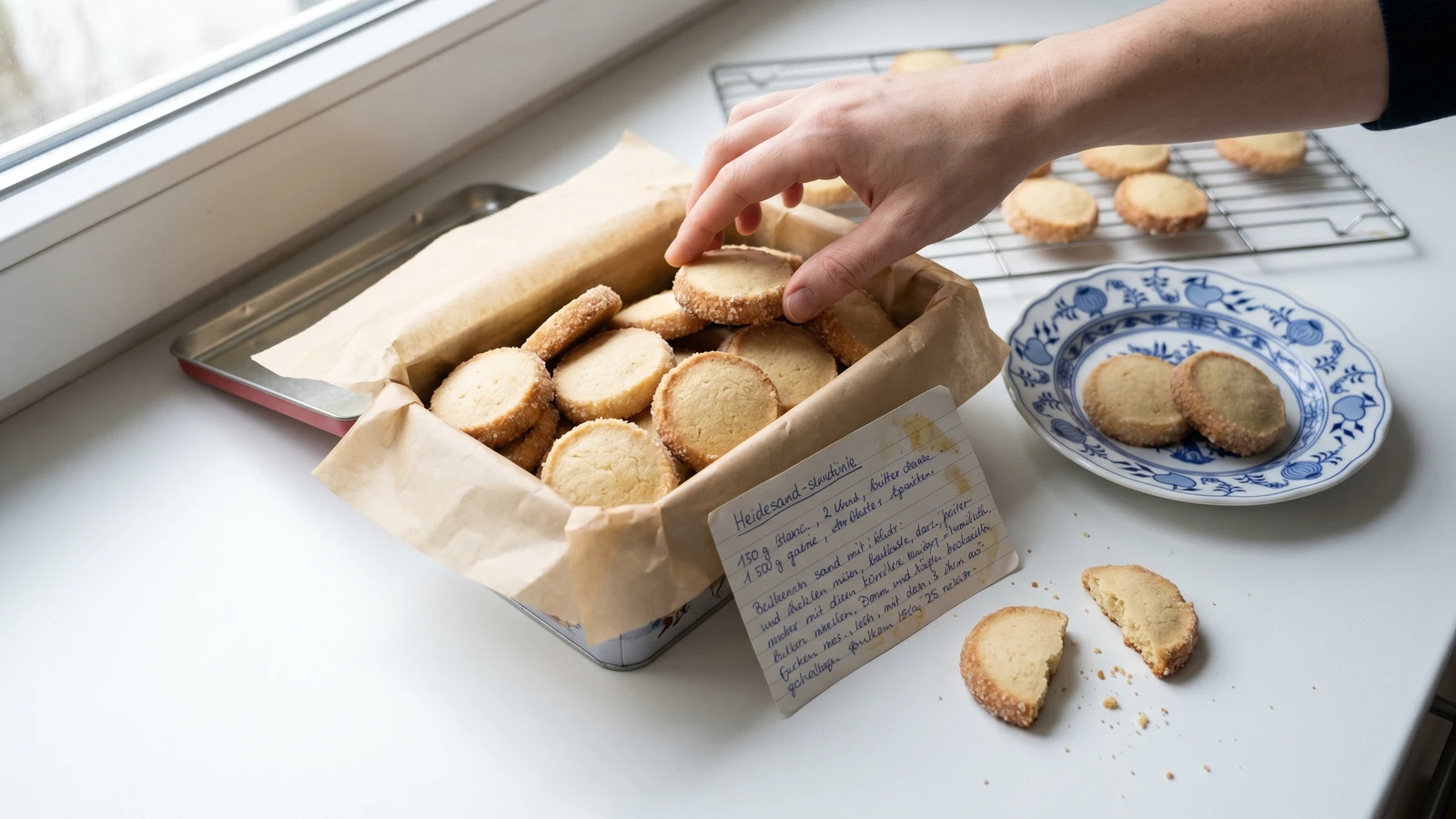
The North German Advent cookie that gets nearly all its flavour before the flour goes in: butter cooked nut-brown, cooled firm, then sliced into pale sandy rounds.
Heidesand belongs to the north, especially Lower Saxony and the Lüneburg Heath, and it sits in the Advent tin with the plain cookies that teach you whether a baker knows restraint. No icing, no window of jelly, no spice cabinet tipped over the bowl. Brown the butter properly and the biscuit tastes of hazelnut and caramel without either one being added.
Im Norden anders, im Süden anders. The south fills its Christmas plates with Vanillekipferl, Springerle, and cut-out Butterplätzchen; the north keeps a place for this sandy slice-and-bake cookie. Some cooks leave Heidesand pale and butter-forward, some roll the log in coarse sugar, and a few add lemon zest. I keep it plain. The browned butter is the point.
The deciding step is the butter. Cook it until the milk solids turn nut-brown, then cool it until firm but still workable. If it goes into the dough warm, the sugar melts and the flour drinks too much fat, so the cookie spreads flat instead of cutting clean and crumbling short under the teeth. Das braucht seine Zeit.
Shape the dough tight, chill it hard, slice it cold. That is the whole discipline. A Christmas cookie does not need to shout across the table. It needs to hold together in the tin and disappear with coffee.
Heidesand is tied by name and habit to the Lüneburg Heath in Lower Saxony, where the pale, crumbly texture suggested the sandy heath soil rather than a decorated feast pastry. By the late nineteenth and early twentieth centuries, slice-and-bake butter cookies like Heidesand had become part of the North German Advent Plätzchen tin, alongside spiced trade-route cookies from the Hanseatic cities. Its regional argument is quiet but real: northern versions prize browned butter and restraint, while farther south the Christmas table leans more heavily toward shaped, spiced, or nut-based biscuits.
Quantity
250g
Quantity
180g
Quantity
1 packet or 2 teaspoons
Quantity
1/2 teaspoon
Quantity
1 tablespoon
Quantity
350g
Quantity
1/2 teaspoon
Quantity
3 tablespoons
for rolling
| Ingredient | Quantity |
|---|---|
| unsalted butter | 250g |
| fine sugar | 180g |
| vanilla sugar | 1 packet or 2 teaspoons |
| fine salt | 1/2 teaspoon |
| whole milk | 1 tablespoon |
| plain flour | 350g |
| baking powder | 1/2 teaspoon |
| coarse sugar (optional)for rolling | 3 tablespoons |
Melt the butter in a light-coloured pan over medium heat, then keep cooking it until the foam quiets and the milk solids on the bottom turn nut-brown. Watch the pan, not the clock. Pale butter gives you a plain biscuit, black butter gives you bitterness, and Heidesand lives in the brown place between them.
Pour the browned butter, including the brown specks, into a mixing bowl and let it cool until firm but still soft enough to beat, about 45 to 60 minutes in a cool kitchen. Do not mix the dough while the butter is liquid. Warm fat coats the flour too quickly and melts the sugar, so the cookie spreads instead of staying short and sandy.
Beat the cooled browned butter with the fine sugar, vanilla sugar, and salt until creamy and a shade lighter, then beat in the milk. The milk replaces a little of the water cooked out of the butter, so the dough comes together without making the cookie tough.
Whisk the flour with the baking powder, then mix it into the butter just until no dry patches remain. Stop there. Heidesand wants a short crumb, and overworking the flour builds strength where you want sand.
Divide the dough in two and roll each piece into a tight log about 4cm wide. Roll the logs in coarse sugar if you want the northern tin-shop edge, then wrap them and chill at least 1 hour, until firm. Cold dough slices clean; soft dough squashes under the knife and bakes into ovals. Schön ist, was schmeckt, but round is still round.
Heat the oven to 175C and line two baking sheets with parchment. Slice the cold logs into 7mm rounds and set them a little apart. Bake 12 to 15 minutes, until the edges are barely golden and the centres are set but still pale. Let them cool on the sheet for 5 minutes before moving them, because the crumb firms as the butter sets again.
Cool the cookies completely, then pack them in a tin with parchment between layers. They keep for 2 to 3 weeks, and the browned-butter flavour settles after a day. Weggeworfen wird nichts: broken ones go over stewed apples or ice cream, which is not a tragedy.
1 serving (about 18g)
Culinary guides, cultural storytelling, and the editorial depth that makes cooking meaningful.
Discover Culinary ExplorerChef Klaus
Aachen's Advent biscuit is dark, hard, and spiced, with beet syrup doing the deep work and a closed tin finishing what the oven only starts.

Chef Klaus
The Baden-Wuerttemberg apple fritter that lives between weeknight dessert and Sunday coffee, built on tart rings, a light batter, and oil kept steady.

Chef Klaus
The Carnival doughnut lives by proofing and fat temperature: a light yeast round floats high, cooks through with one pale belt, then takes its jam without turning greasy.

Chef Klaus
A cold Mürbeteig ball, one clean hollow, and a spoon of tart jelly: Engelsaugen are Advent cookies that fail only when the dough gets warm.