
Chef Margarida
Caracóis à Portuguesa
Há caracóis! The signs appear in May and all of Lisbon knows summer has arrived. Tiny snails in spiced broth, sucked from shells at plastic tables, washed down with imperial after imperial.
A cooking platform built around craft, culture, and the stories behind what we eat.

Created by
Buttery puff pastry wrapped around smoky chouriço, baked until the layers shatter and the fat renders into every fold. Pastelaria perfection that belongs with your afternoon coffee.
Every pastelaria in Portugal has these in the display case. Right there next to the natas and the rissóis, sitting under the glass, waiting for someone to point and say "um folhado, faz favor." One folhado, please. Usually followed by "e uma bica." And an espresso.
This is the snack that sustained generations of Portuguese workers. Factory workers, fishermen, office clerks. A mid-morning bite between breakfast and lunch, something to hold you over, something with enough fat and smoke and salt to remind you that life has pleasures even on a Tuesday.
The genius is in the simplicity. Good chouriço does all the work. You're just wrapping it in pastry and applying heat. The fat from the sausage renders as it bakes, soaking into all those buttery layers, making the pastry around it richer than any pastry has a right to be. The outside shatters. The inside is smoky and soft.
At Mesa da Avó, we serve these at the start of the evening, while people are still arriving, still finding their seats. Something to eat standing up, napkin in hand, catching the flakes before they hit the floor. That's how folhados are meant to be eaten. Not sitting properly at a table. Standing in a pastelaria. Or leaning against a counter in a Portuguese kitchen, sneaking one before anyone else notices they're ready.
Folhados emerged from Portugal's rich pastelaria culture, where every neighborhood bakery developed its own savory pastries alongside the sweets. The pairing of puff pastry and chouriço likely dates to the 19th century, when French pastry techniques merged with Portuguese cured meats. The chouriço itself is far older, a preservation tradition from Trás-os-Montes where families slaughtered pigs each winter and cured the meat to last until spring.
Quantity
2 sheets (about 500g total)
thawed if frozen
Quantity
2 sausages (about 200g total)
Quantity
1 large
beaten with 1 tablespoon water
Quantity
for dusting
| Ingredient | Quantity |
|---|---|
| puff pastry sheetsthawed if frozen | 2 sheets (about 500g total) |
| chouriço | 2 sausages (about 200g total) |
| eggbeaten with 1 tablespoon water | 1 large |
| all-purpose flour | for dusting |
Remove the casing from the chouriço if it has one. Some traditional chouriço comes in natural casings that you leave on; the thin ones will crisp up beautifully in the oven. Thicker casings should come off. Cut each sausage in half lengthwise, then cut each half into three pieces. You want 12 pieces total, each about the length of your thumb.
On a lightly floured surface, roll each puff pastry sheet slightly thinner, to about 3mm thickness. Cut each sheet into 6 rectangles, roughly 8cm by 12cm. You should have 12 pieces total. Work quickly if your kitchen is warm. Puff pastry needs to stay cold to puff properly.
Place one piece of chouriço along the shorter edge of each pastry rectangle. Roll it up snugly, leaving the seam on the bottom. The pastry should wrap around at least one and a half times. Press the edges gently to seal. Some people tuck the ends in; others leave them open so the chouriço peeks out. Both are correct. Avó Leonor left them open. She said it lets more fat render into the pastry.
Place the rolled folhados on a parchment-lined baking sheet, seam side down. Refrigerate for at least 15 minutes, or up to overnight. This firms up the butter in the pastry and helps it puff dramatically in the hot oven. Skip this step and you'll have flat, greasy pastries instead of golden, layered ones.
Preheat your oven to 200°C (400°F). Brush each folhado with the egg wash, making sure to cover the top and sides. Bake for 20 to 25 minutes, until deeply golden and puffed. The fat from the chouriço will have started to render into the pastry, making it impossibly rich. You'll see some of it bubbling at the edges. That's good. That's the whole point.
Let the folhados cool for 5 minutes on the baking sheet. They need this time. Bite into one straight from the oven and you'll burn your mouth on molten chouriço fat. Not pleasant. After 5 minutes, they're still warm, still crispy, but no longer dangerous. Serve with a bica and nothing else. These don't need accompaniment.
1 serving (about 55g)
Culinary guides, cultural storytelling, and the editorial depth that makes cooking meaningful.
Discover Culinary ExplorerChef Margarida
Há caracóis! The signs appear in May and all of Lisbon knows summer has arrived. Tiny snails in spiced broth, sucked from shells at plastic tables, washed down with imperial after imperial.

Chef Margarida
Crispy triangles of spiced meat wrapped in golden pastry, carrying the flavors of Goa across the ocean to every Portuguese tasca and family gathering. Colonial history you can eat.
Chef Margarida
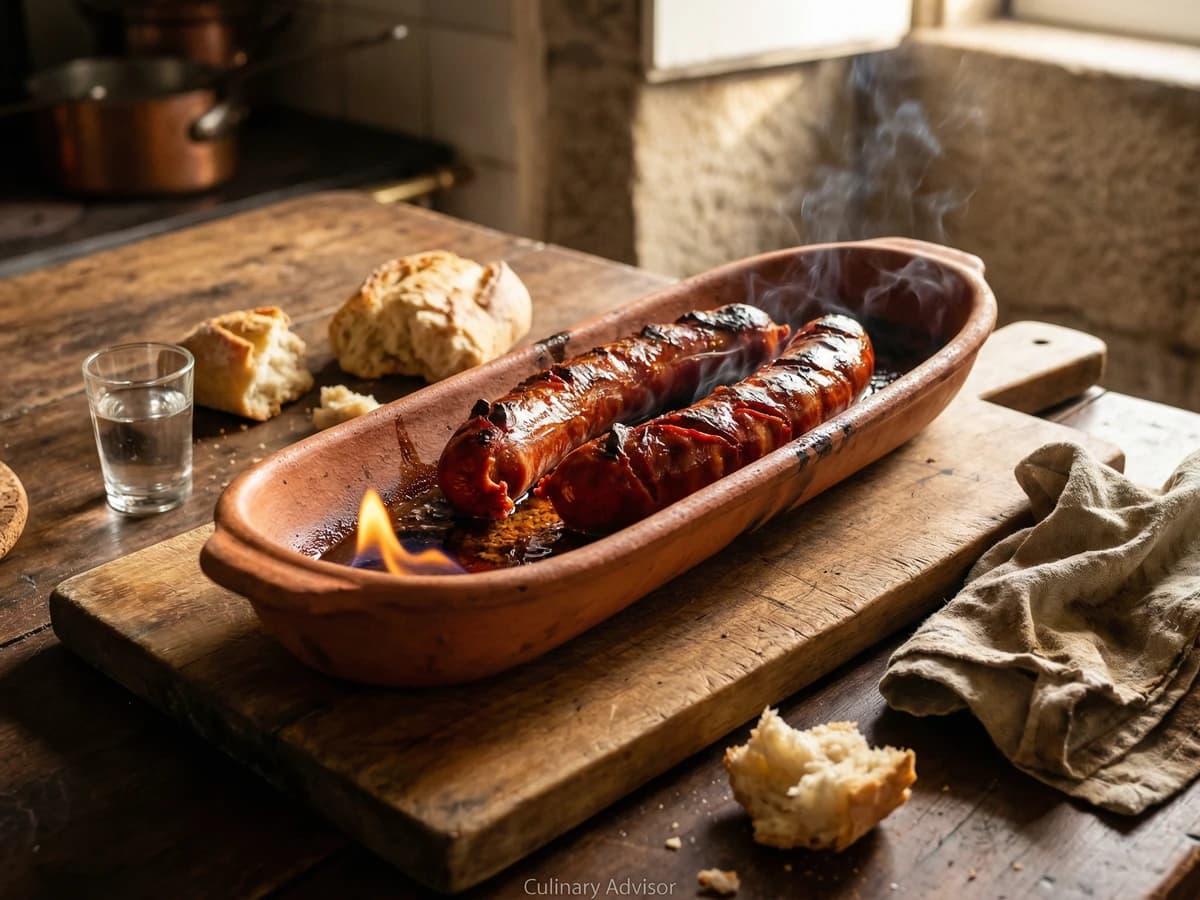
The theater of the tasca: chouriço set ablaze in its clay vessel, aguardente flames dancing blue and orange until the casing splits and the smoky fat runs. This is how we gather.

Chef Margarida
Mushrooms stuffed with chouriço and baked until the cheese bubbles and browns, the kind of petisco that disappears from the table before you've finished pouring the wine. Tasca food for your home.