
Chef Joost
Aardappelschotel met Gehakt
A plain name for a quietly clever dish: fresh mince, sweet fried onion, nutmeg, and mashed potato baked until the top goes golden and the table goes silent.
A cooking platform built around craft, culture, and the stories behind what we eat.
Created by
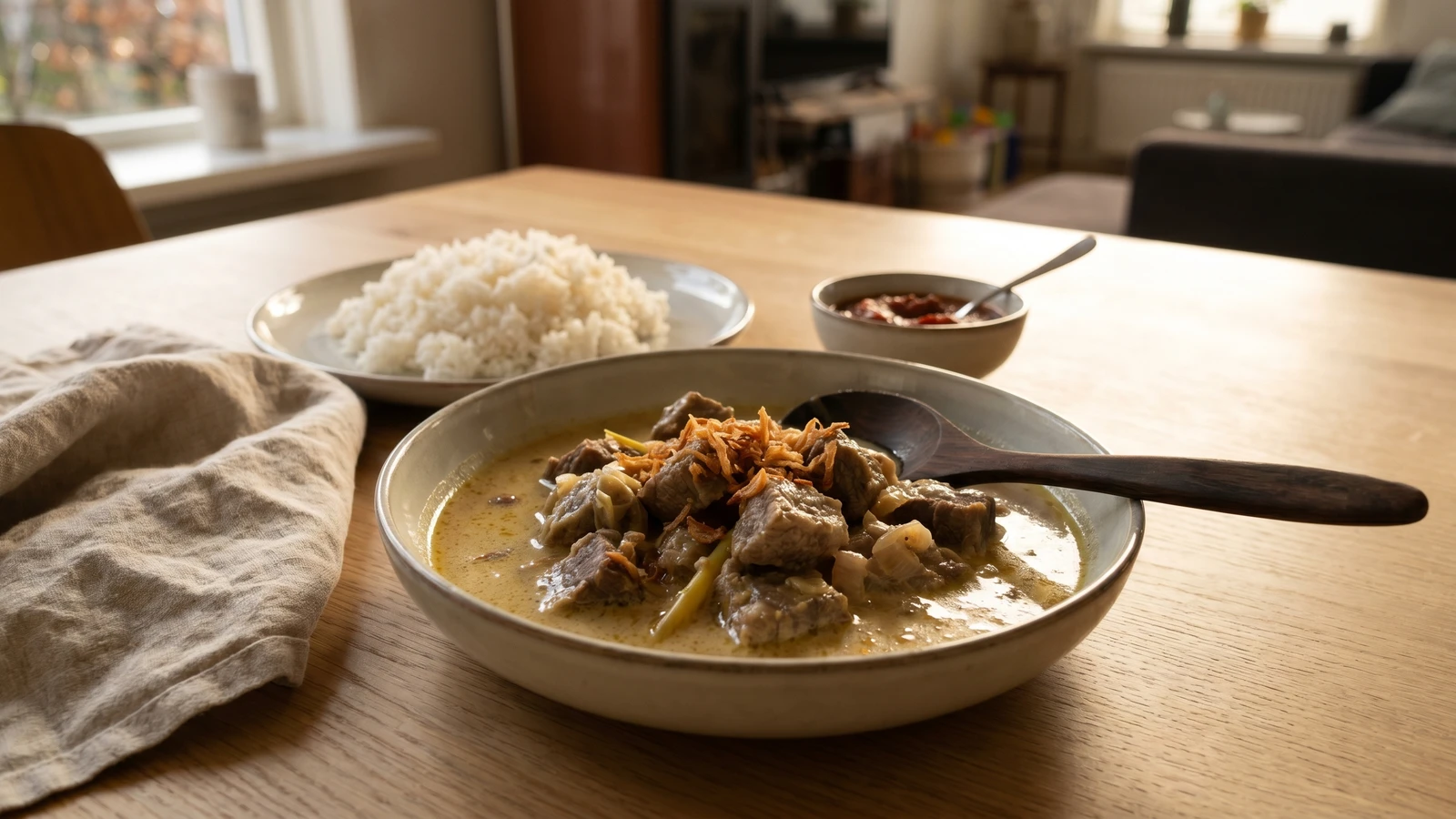
Daging opor is the pale, fragrant beef stew of the Indo-Dutch table, where coconut milk, candlenut, and lemongrass soften the louder dishes around it.
The Dutch table has more than one history, and some of it smells of coconut milk catching the fat of beef in a quiet yellow light. Daging opor did not begin in Zeeland, or Limburg, or Friesland. It came to Dutch kitchens through Java, through colonial households, through repatriated Indo families, through the rijsttafel, rice table, where many small dishes tell one large, complicated story.
The name already tells you enough, without pretending to tell everything. Daging means meat in Indonesian, and opor is the pale coconut stew most famously made with chicken for festive Javanese tables, especially around Lebaran, the end of Ramadan. With beef, it becomes slower, deeper, less festive in appearance perhaps, but generous at the table. But let me tell you a secret: on a rijsttafel, this gentle dish is not the shy one. It is the diplomat. Beside sambal, ketjap-dark braises, pickles, and fried things, opor gives the mouth somewhere soft to stand.
The method is old kitchen common sense. Candlenuts thicken the sauce, coconut milk must not be bullied, and lemongrass gives perfume only if you bruise it first. Hou het altijd simpel, always keep it simple: brown the beef lightly, cook the spice paste until it smells rounded and no longer raw, then let time do the work. History and cookery, they cannot be separated, but supper still has to arrive.
Opor is a Javanese coconut-milk stew closely associated with festive meals, especially opor ayam served for Lebaran with ketupat, compressed rice cakes. Beef versions entered Dutch domestic cooking through the Indo-Dutch table, particularly after Indonesian independence and the migration of Indo families to the Netherlands in the 1940s and 1950s, when dishes once cooked in colonial households became part of Dutch home repertoire. In rijsttafel service, daging opor often functions as a pale, mild counterpoint to darker ketjap braises and sharper sambals.
Quantity
1kg
cut into 4cm pieces
Quantity
2 tablespoons
Quantity
6
roughly chopped
Quantity
4
roughly chopped
Quantity
5
or 8 macadamia nuts if unavailable
Quantity
3cm
peeled and chopped
Quantity
3cm
sliced
Quantity
2 teaspoons
Quantity
1/2 teaspoon
Quantity
1/2 teaspoon
Quantity
1/2 teaspoon
Quantity
2
bruised
Quantity
3
or 2 bay leaves if unavailable
Quantity
2
Quantity
400ml
Quantity
500ml
Quantity
1 tablespoon
Quantity
1 1/2 teaspoons
plus more to taste
Quantity
1 tablespoon
to finish
Quantity
to serve
Quantity
to serve
| Ingredient | Quantity |
|---|---|
| beef chuck or stewing beefcut into 4cm pieces | 1kg |
| neutral oil | 2 tablespoons |
| shallotsroughly chopped | 6 |
| garlic clovesroughly chopped | 4 |
| candlenutsor 8 macadamia nuts if unavailable | 5 |
| fresh gingerpeeled and chopped | 3cm |
| fresh galangalsliced | 3cm |
| ground coriander | 2 teaspoons |
| ground cumin | 1/2 teaspoon |
| ground white pepper | 1/2 teaspoon |
| ground turmeric | 1/2 teaspoon |
| lemongrass stalksbruised | 2 |
| Indonesian salam leavesor 2 bay leaves if unavailable | 3 |
| kaffir lime leaves (optional) | 2 |
| full-fat coconut milk | 400ml |
| beef stock or water | 500ml |
| palm sugar or light brown sugar | 1 tablespoon |
| saltplus more to taste | 1 1/2 teaspoons |
| lime juiceto finish | 1 tablespoon |
| fried shallots (optional) | to serve |
| cooked white rice | to serve |
Grind the shallots, garlic, candlenuts, ginger, galangal, coriander, cumin, white pepper, turmeric, and a spoonful of the oil to a thick paste. A mortar gives the best texture, a small processor gives you supper before midnight. Both are respectable. Candlenuts must be cooked through, so do not taste the raw paste.
Pat the beef dry and season it lightly with salt. Heat the remaining oil in a heavy braadpan, Dutch oven, over medium-high heat, then brown the meat in batches until the edges take colour. You are not trying to make a dark stew here; just give the beef enough browned surface to hold its own in the coconut sauce.
Lower the heat to medium and add the spice paste to the same pan. Cook it for 6 to 8 minutes, stirring often, until it thickens, loses its raw onion sharpness, and the oil begins to show at the edges. This is the step that buys you depth. Skip it and the sauce will taste like a cupboard, not a kitchen.
Return the beef and any juices to the pan. Add the bruised lemongrass, salam leaves, lime leaves if using, stock or water, palm sugar, and salt. Bring it to a gentle simmer, scrape the bottom clean, then cover with the lid slightly ajar and cook for 1 hour and 30 minutes, until the beef is beginning to yield but is not yet fully tender.
Stir in the coconut milk and keep the heat low. Let the opor murmur uncovered for 35 to 45 minutes, stirring now and then, until the beef is tender and the sauce has thickened to a pale, glossy coat. Coconut milk is patient but proud; boil it hard and it splits to teach you manners.
Taste for salt, then stir in the lime juice. Remove the lemongrass and leaves if you like, or leave them in as the old warning that not everything in a stew is meant to be eaten. Rest the opor for 15 minutes before serving with white rice and fried shallots.
1 serving (about 465g)
Culinary guides, cultural storytelling, and the editorial depth that makes cooking meaningful.
Discover Culinary ExplorerChef Joost
A plain name for a quietly clever dish: fresh mince, sweet fried onion, nutmeg, and mashed potato baked until the top goes golden and the table goes silent.

Chef Joost
Ajam Besengek is the golden chicken stew of the Indo-Dutch table: coconut milk, turmeric, and candlenut cooked down until the sauce clings to the meat like memory.

Chef Joost
The old Dutch spelling says ajam, the city says Batavia, and the pot says exactly what the rijsttafel always was: memory, trade, and dinner in one dish.

Chef Joost
The name means simply fried chicken, but the Dutch spelling carries a whole Indies kitchen: turmeric, coriander, garlic, and a golden crust that remembers the boemboe.