
Chef Joost
Aardappelschotel met Gehakt
A plain name for a quietly clever dish: fresh mince, sweet fried onion, nutmeg, and mashed potato baked until the top goes golden and the table goes silent.
A cooking platform built around craft, culture, and the stories behind what we eat.
Created by
The old Dutch spelling says ajam, the city says Batavia, and the pot says exactly what the rijsttafel always was: memory, trade, and dinner in one dish.
In the Indo-Dutch kitchen, a name can carry more luggage than a sailor. Ajam Betawi looks simple enough on the page: chicken, coconut milk, spice paste, a patient simmer. But the name already tells you the table is bigger than the pan. Ajam is the old Dutch spelling for ayam, chicken in Indonesian, and Betawi points to Batavia, the city the Dutch made from Jayakarta and the city Indonesia now knows as Jakarta. History and cookery, they cannot be separated, however inconvenient this becomes for dinner guests who only asked what smells so good.
During my manuscript year in Fez, I learned to distrust any cook who treats spices as decoration. In old Batavia, as in the Arab kitchens whose books I had been reading, spice was architecture: coriander for warmth, turmeric for colour and earth, galangal for its clean sharpness, candlenut to thicken, lemongrass and salam leaf to pull the whole sauce upright. But let me tell you a secret. The Dutch did not bring this dish home as a museum piece. They brought it home as family food, adjusted in apartments above tram lines, at birthday tables, in the long shadow of empire where affection and history sit uneasily but truthfully together.
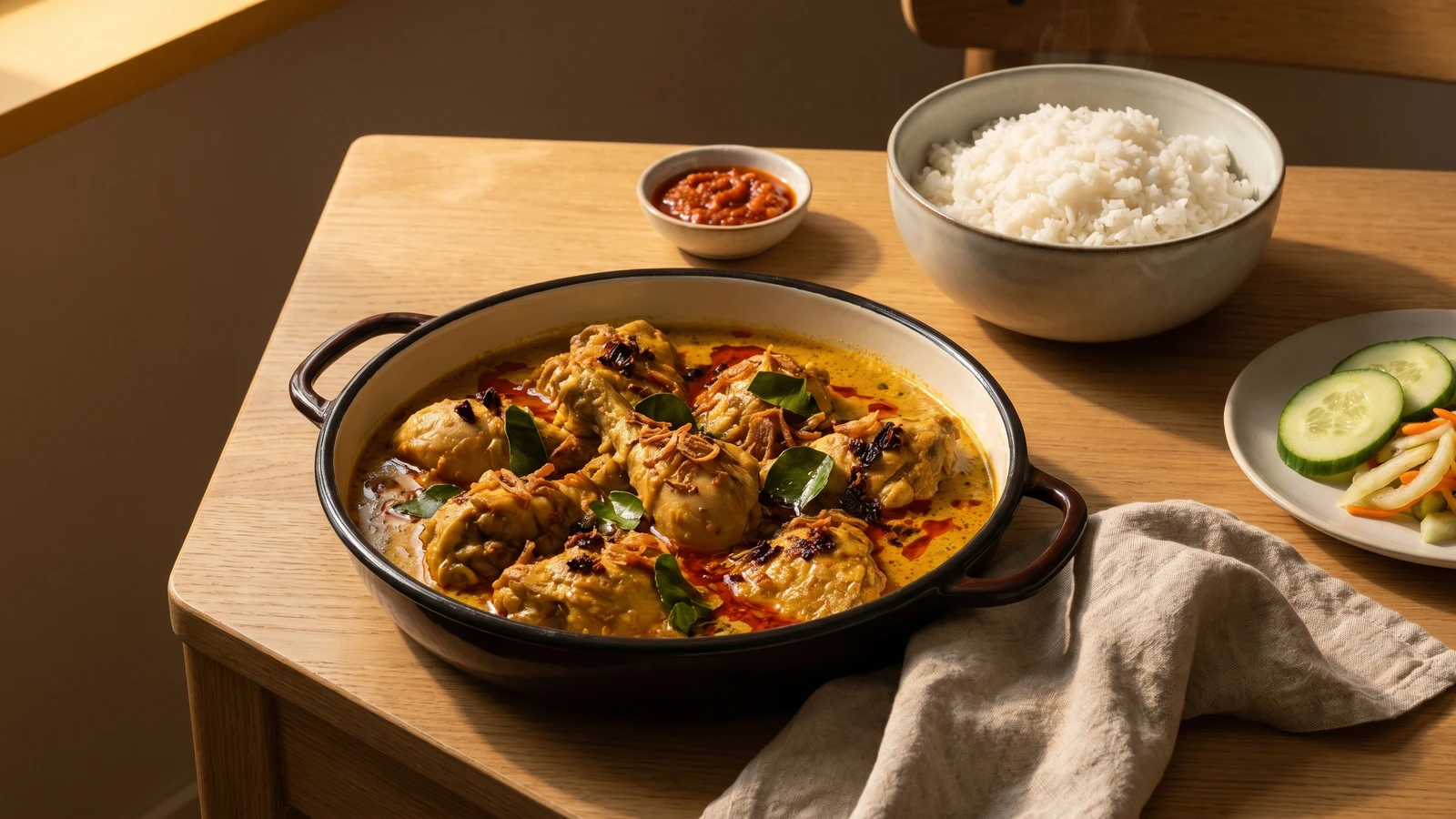
The method asks for no theatrics. Pound or blend the bumbu, the spice paste, until it is no longer a collection of ingredients but one idea. Fry it patiently until the raw onion smell disappears, because this is where the sauce earns its depth. Then the chicken braises gently in coconut milk until the meat is tender and the sauce clings. Hou het altijd simpel, always keep it simple: rice, sambal, cucumber, maybe a little acar, pickled vegetables, and the braadpan straight on the table. A dish without its story is half a meal. This one arrives with a city inside it.
Ajam Betawi belongs to the Indo-Dutch rijsttafel tradition that developed in the colonial Netherlands East Indies, especially around Batavia, the VOC headquarters from 1619 and later the administrative centre of Dutch rule. The term Betawi refers both to the city and to the mixed urban culture of Batavia, where Malay, Javanese, Sundanese, Chinese, Arab, Portuguese, and Dutch foodways met in daily cooking. In the Netherlands, the old spelling ajam survived in twentieth-century Indo-Dutch cookbooks and toko counters long after Indonesian spelling settled on ayam, making the name itself a small archive of colonial language.
Quantity
1.2kg
skin removed if preferred
Quantity
1 teaspoon, plus more to taste
Quantity
2 tablespoons
Quantity
6
roughly chopped
Quantity
4
roughly chopped
Quantity
3
seeded for less heat
Quantity
4 candlenuts or 40g macadamia nuts
Quantity
2 teaspoons
Quantity
1 teaspoon
Quantity
1/2 teaspoon
Quantity
1/2 teaspoon
freshly ground
Quantity
3cm
sliced
Quantity
4cm
sliced
Quantity
2
bruised
Quantity
4 salam leaves or 2 bay leaves
Quantity
3
torn
Quantity
1 tablespoon
Quantity
1 tablespoon
mixed with 3 tablespoons warm water
Quantity
400ml
Quantity
250ml
Quantity
1 tablespoon
Quantity
1 tablespoon, or to taste
Quantity
a small handful
Quantity
to serve
| Ingredient | Quantity |
|---|---|
| bone-in chicken thighs and drumsticksskin removed if preferred | 1.2kg |
| fine salt | 1 teaspoon, plus more to taste |
| neutral oil | 2 tablespoons |
| shallotsroughly chopped | 6 |
| garlic clovesroughly chopped | 4 |
| red chilliesseeded for less heat | 3 |
| candlenuts or macadamia nuts | 4 candlenuts or 40g macadamia nuts |
| ground coriander | 2 teaspoons |
| ground turmeric | 1 teaspoon |
| ground cumin | 1/2 teaspoon |
| white pepperfreshly ground | 1/2 teaspoon |
| fresh gingersliced | 3cm |
| fresh galangalsliced | 4cm |
| lemongrass stalksbruised | 2 |
| salam leaves or bay leaves | 4 salam leaves or 2 bay leaves |
| makrut lime leavestorn | 3 |
| palm sugar or dark brown sugar | 1 tablespoon |
| tamarind pastemixed with 3 tablespoons warm water | 1 tablespoon |
| coconut milk | 400ml |
| chicken stock or water | 250ml |
| kecap manis | 1 tablespoon |
| lime juice | 1 tablespoon, or to taste |
| fried shallots (optional) | a small handful |
| steamed white rice, cucumber slices, sambal, and acar | to serve |
Rub the chicken pieces with the teaspoon of salt and set them aside while you make the bumbu, the spice paste. This short rest seasons the meat before the sauce begins, and bone-in chicken will reward you with better flavour than neat little cubes ever could.
Pound or blend the shallots, garlic, chillies, candlenuts, coriander, turmeric, cumin, white pepper, ginger, and galangal into a thick paste. If using a blender, add a spoonful of the coconut milk only if the blades refuse to move. The paste should be heavy and fragrant, not watery.
Warm the oil in a wide heavy pan over medium heat. Add the bumbu, lemongrass, salam leaves, and lime leaves, and fry for 8 to 10 minutes, stirring often, until the paste darkens slightly, the oil begins to separate at the edges, and the raw onion smell has gone. Do not hurry this. A sauce built on half-cooked paste tastes loud in all the wrong places.
Add the chicken pieces to the pan and turn them through the fried paste until every surface is stained yellow and red. Let them sit against the heat for a few minutes, turning once, so the spice clings to the meat before the liquid goes in.
Stir in the palm sugar, tamarind water, coconut milk, and stock. Bring the pan just to a gentle bubble, then lower the heat and cook uncovered for 45 to 55 minutes, turning the chicken now and then. The sauce should reduce from thin and pale to glossy and spoon-coating, with little beads of oil on the surface. If it thickens before the chicken is tender, add a splash of water.
Stir in the kecap manis and lime juice. Taste carefully: you want salt, sweetness, sourness, and heat in conversation, not in competition. Add a pinch of salt, a little more lime, or a thread of palm sugar as needed. Remove the lemongrass and whole leaves if they bother you at the table, though in many homes they simply stay where they are.
Spoon the chicken and its thick sauce over steamed white rice and scatter fried shallots on top. Serve cucumber, sambal, and acar alongside. I prefer to keep it a bit more relaxed, in the Dutch way: the pan on the table, the rice in a bowl, and everyone building the plate they came for.
1 serving (about 620g)
Culinary guides, cultural storytelling, and the editorial depth that makes cooking meaningful.
Discover Culinary ExplorerChef Joost
A plain name for a quietly clever dish: fresh mince, sweet fried onion, nutmeg, and mashed potato baked until the top goes golden and the table goes silent.

Chef Joost
Ajam Besengek is the golden chicken stew of the Indo-Dutch table: coconut milk, turmeric, and candlenut cooked down until the sauce clings to the meat like memory.

Chef Joost
The name means simply fried chicken, but the Dutch spelling carries a whole Indies kitchen: turmeric, coriander, garlic, and a golden crust that remembers the boemboe.

Chef Joost
Ajam is the old Dutch spelling of ayam, chicken, and opor is the pale coconut braise that lets a rijsttafel breathe between its darker, hotter dishes.