Culinary Explorer

A cooking platform built around craft, culture, and the stories behind what we eat.
Discover Culinary Explorer
Chiles en Vinagre Conventuales

Chiles en Vinagre Conventuales

Created by

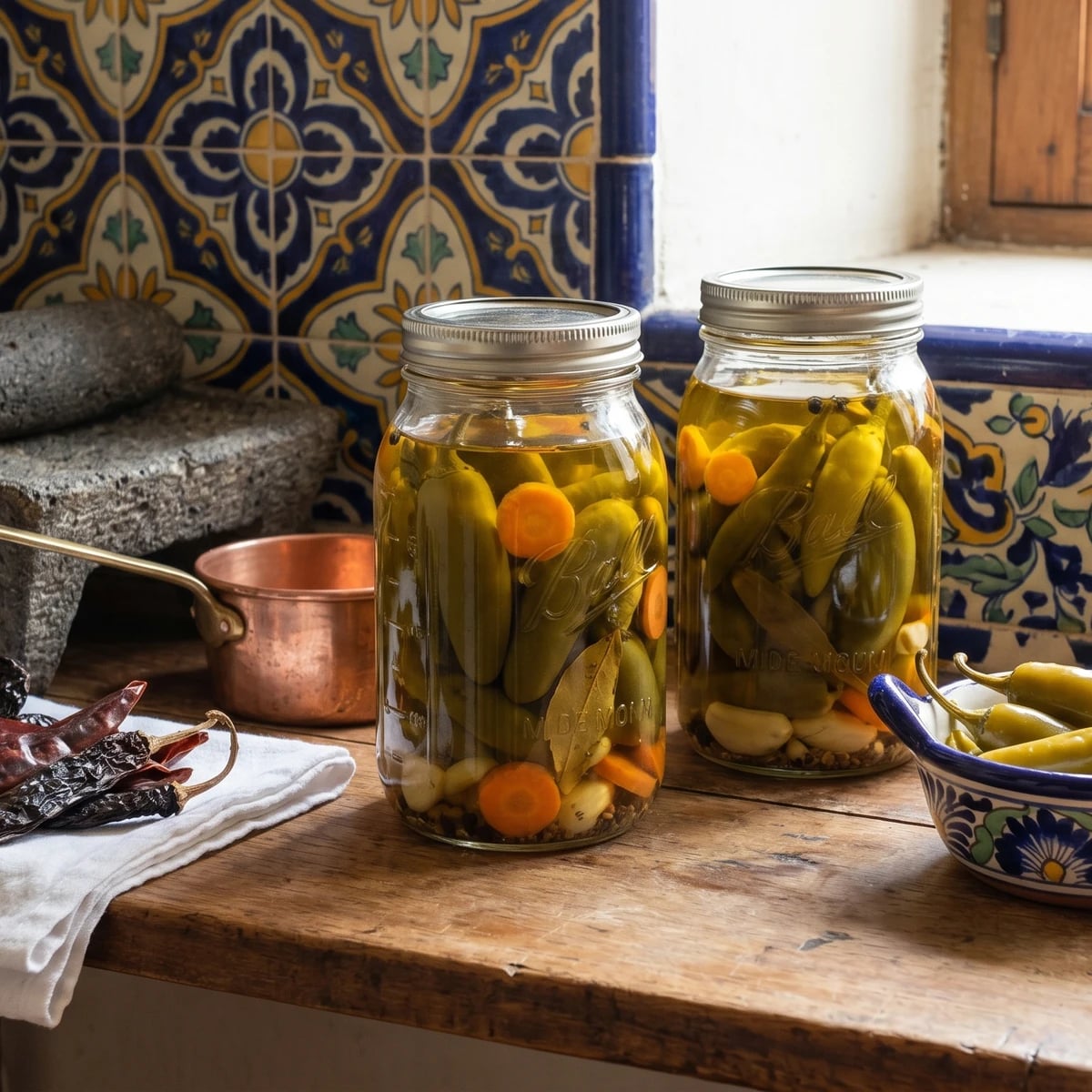
Puebla's convent escabeche of whole chiles, sealed in glass jars with vinegar, olive oil, garlic, laurel, comino, and the patience of women who preserved food before refrigeration.

Sauces & Condiments
Mexican
Make Ahead
Easter
Holiday
30 min
Active Time
18 min cook48 hr 48 min total
Yield2 quart jars

Puebla, in the old convent belt around the city center, is where these chiles en vinagre belong. Not as a plate. As a jar on the table. The kind that sits beside vigilia dishes in Lent, beside bacalao, tortitas de camarón, romeritos, rice, beans, and feast plates that need acidity to wake them up.

The chiles are whole: jalapeño, cuaresmeño, güero, and serrano when the market is generous. The technique is conventual because it is preservation with discipline: dry the chiles, blister them lightly on a comal, fry the garlic and spices in olive oil, then cover everything with vinegar and salt until the jar has enough bite to last. The Old World is in the olive oil, laurel, cloves, black pepper, and cumin. The Mexican hand is in the chile, the comal, and the restraint.

I learned this style from Puebla cooks who still speak about the convent kitchens as working kitchens, not museum rooms. Santa Rosa with its Talavera walls, Santa Clara with its sweets and preserves, Santa Mónica with its guarded recipes. Nobody needs to decorate this jar. It is useful, sharp, and exact. La cocina no es decoración, es trabajo.

Use clean jars. Use firm chiles. Use vinegar strong enough to preserve, not the weak sweet vinegar sitting forgotten in the back of a pantry. If the chiles are soft at the market, do not buy them. Pregúntale a las señoras del mercado. They know which vendor has chiles that will stay crisp under vinegar.

Chiles en vinagre belong to the preserving practices of Puebla's colonial convent kitchens, especially the Dominican houses of Santa Rosa and Santa Catalina, the Clarisas of Santa Clara, and the Augustinian Recollect convent of Santa Mónica, where vinegar, sugar, spices, and olive oil entered Mexican kitchens through Spanish and conventual trade networks. The famous tiled kitchen of Santa Rosa in Puebla, lined with blue-and-yellow Talavera, remains the visual reference for this register of cooking, though the archive records preservation methods more often than individual authors. These escabeches became useful during vigilia and feast calendars because they could be made ahead, stored in jars, and served with meatless and celebratory dishes without needing a fresh sauce every day.

The technique, the tradition, and the story behind every dish.

Discover Culinary Explorer

Ingredients

fresh jalapeño or cuaresmeño chiles

Quantity

1 pound

firm, whole, stems trimmed but caps left intact

fresh chile güero

Quantity

8

firm and whole

fresh serrano chiles

Quantity

8

firm and whole

carrots

Quantity

3 medium

peeled and sliced into 1/4-inch rounds

white onion

Quantity

1 medium

sliced into thick half-moons

garlic cloves

Quantity

10

peeled and lightly crushed

extra-virgin olive oil

Quantity

1/2 cup

white vinegar, 5 percent acidity

Quantity

2 cups

apple cider vinegar

Quantity

1 cup

water

Quantity

1 cup

kosher salt

Quantity

1 tablespoon

piloncillo or dark brown sugar

Quantity

1 teaspoon

bay leaves

Quantity

4

whole black peppercorns

Quantity

1 teaspoon

cumin seeds

Quantity

1 teaspoon

whole cloves

Quantity

6

Mexican cinnamon stick

Quantity

1 small

dried Mexican oregano

Quantity

1 teaspoon

mustard seed (optional)

Quantity

1/2 teaspoon

Equipment Needed

  • Two sterilized 1-quart glass jars with tight lids
  • Dry comal or heavy cast iron skillet
  • Wide clay cazuela or heavy saucepan
  • Clean tongs
  • Ladle

Instructions

  1. 1

    Prepare the jars

    Wash two quart glass jars and their lids with hot soapy water. Rinse well. Submerge the jars in boiling water for 10 minutes, then let them dry upside down on a clean towel. This is vinegar preservation, not decoration. Dirty jars ruin good chiles.

  2. 2

    Dry the chiles

    Wipe every chile dry with a clean towel. Trim long stems, but leave the caps intact so the chiles hold their shape. Pierce each chile once near the shoulder with the tip of a knife. That small cut lets the vinegar enter without turning the chile limp.

  3. 3

    Blister on comal

    Heat a dry comal over medium. Blister the jalapeño, cuaresmeño, güero, and serrano chiles in batches, turning them until the skins show small dark freckles and the flesh just begins to soften. Do not roast them black. You are waking the chile, not making rajas. Así se hace y punto.

    If a chile collapses on the comal, it was too old for this recipe. Use it for salsa and buy firmer chiles for the jar.
  4. 4

    Fry the aromatics

    Warm the olive oil in a wide clay cazuela or heavy saucepan over medium-low heat. Add the garlic and cook until pale gold, about 2 minutes. Add the onion and carrots and cook 4 to 5 minutes, stirring so the edges gloss over but do not brown hard. The oil carries the garlic and spice into the vinegar. This is why convent food tastes built, not dumped together.

  5. 5

    Toast the spices

    Add the bay leaves, black peppercorns, cumin seeds, cloves, cinnamon, oregano, and mustard seed if using. Stir for 30 seconds, just until the cumin smells warm and the laurel opens. Do not burn the clove. Burned clove takes over the jar like a bad sermon.

  6. 6

    Build the vinegar

    Pour in the white vinegar, apple cider vinegar, water, salt, and piloncillo. Stir and bring to a steady simmer. Taste the liquid carefully. It should be sharp, salty, and lightly sweet at the end, not sugary. The vinegar is the preserving wall around the chile.

  7. 7

    Simmer the chiles

    Add the blistered chiles to the simmering escabeche. Cook 3 to 4 minutes for serranos and güeros, 5 to 6 minutes for larger jalapeños or cuaresmeños. They should turn olive-green and glossy but still hold their shape. No me vengas con atajos. Overcooked chiles become tired before they ever reach the table.

  8. 8

    Pack the jars

    Using clean tongs, divide the chiles, carrots, onion, garlic, bay leaves, and spices between the warm jars. Pour the hot vinegar mixture over them, leaving 1/2 inch of space at the top. Tap the jars gently to release trapped air. The chiles must be fully submerged.

  9. 9

    Rest before serving

    Close the jars and let them cool to room temperature. Refrigerate at least 48 hours before serving. The first day tastes like vinegar and impatience. By the second day the chile, garlic, laurel, and cumin begin to speak together. Recetas probadas y garantizadas.

Chef Tips

  • Use chiles that feel heavy for their size, with tight skin and no soft shoulders. At a Puebla market, the vendor will separate chiles for rellenar, for salsa, and for vinagre. Ask. Si no conoces el mercado, no conoces la cocina.
  • Cuaresmeño is the older market name for the jalapeño used heavily during Lent. In many places the names overlap now. For this jar, choose thick-fleshed green chiles that can take vinegar without collapsing.
  • The vinegar must be 5 percent acidity. Anything weaker is for dressing a salad, not preserving chiles. Keep the finished jars refrigerated unless you process them with tested canning methods.
  • Olive oil is not a modern flourish here. It is part of the conventual register, along with laurel, clove, cinnamon, pepper, and cumin. Use enough to give the surface a golden gloss.
  • These chiles dress other dishes. They are not the plate. Put them beside bacalao, tortitas de camarón, beans, rice, roasted meats, or a plain quesadilla when the table needs acid and bite.

Advance Preparation

  • Make the chiles at least 48 hours before serving. They are better after 4 or 5 days, once the vinegar has settled into the flesh.
  • Refrigerated and kept fully submerged, the chiles hold for 1 month. Use clean utensils every time you take from the jar.
  • For holiday service, prepare the jars up to 1 week ahead and bring them to the table in small Talavera bowls with some of the carrots, garlic, and onion.

Frequently Asked Questions

Nutrition Information

1 serving (about 60g)

Calories
40 calories
Total Fat
3 g
Saturated Fat
0 g
Trans Fat
0 g
Unsaturated Fat
3 g
Cholesterol
0 mg
Sodium
180 mg
Total Carbohydrates
3 g
Dietary Fiber
1 g
Sugars
2 g
Protein
1 g

Note: Chef personas and recipes are created with AI assistance. Cook with care: follow safe food-handling practices, check doneness with a thermometer when needed, and adapt for allergies and your kitchen.

Where cooking meets culture.

Culinary guides, cultural storytelling, and the editorial depth that makes cooking meaningful.

Discover Culinary Explorer

More from Moles, Pipianes & Escabeches Conventuales

Browse the full collection