
Chef Juliette
Homard à l’Américaine
Lobster shells blaze red over fierce heat, brandy catches, and tomato-wine liquor reduces to a shining sauce bound with coral and cold butter. The lesson is simple: after the finish, never let it boil.
A cooking platform built around craft, culture, and the stories behind what we eat.
Created by Chef Juliette
Based on No. 975, Aspic de Queues d’Écrevisses à la Moderne, from Le Guide Culinaire (1907) by Auguste Escoffier
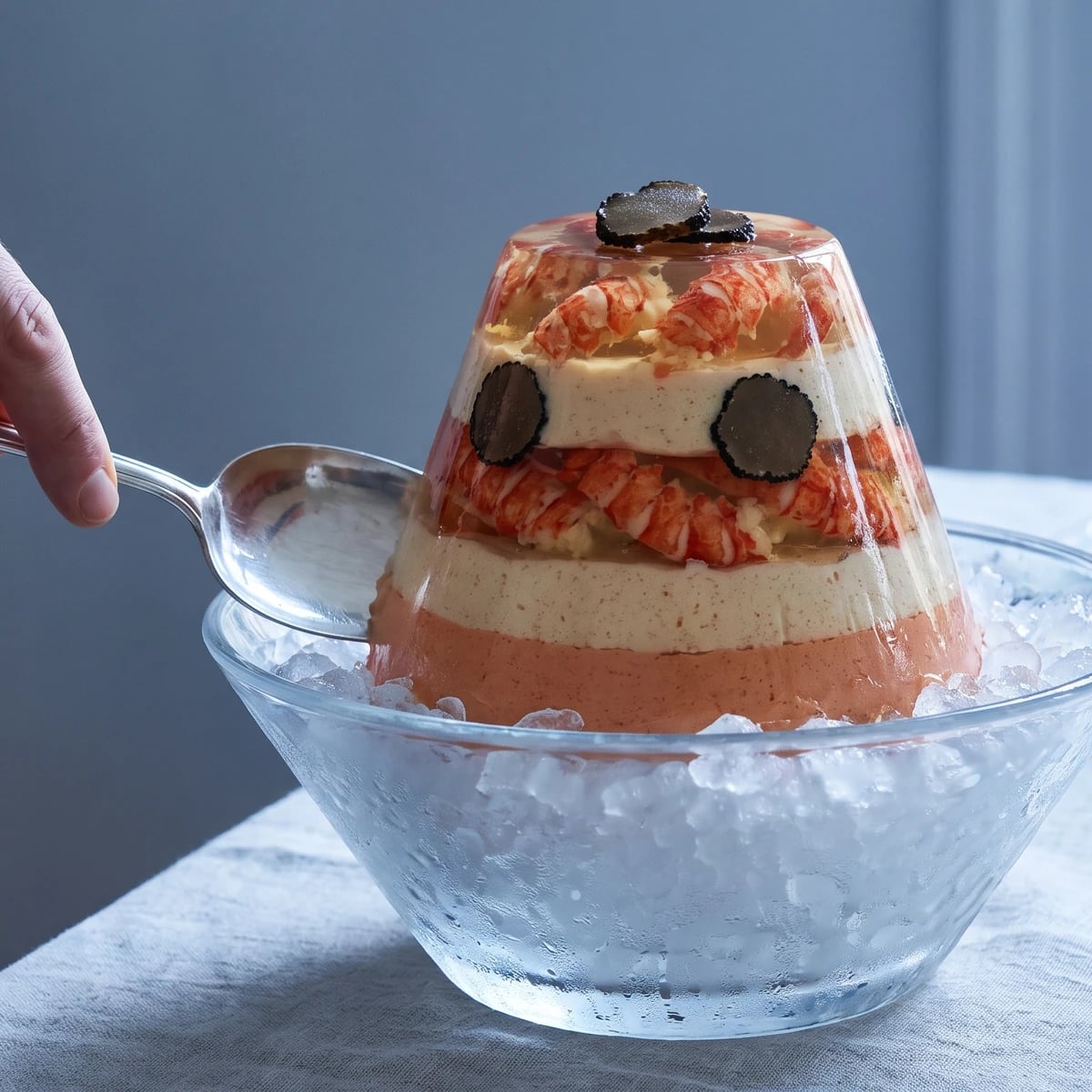
A cold classical showpiece made practical at home: coral crayfish mousse built high in a crystal bowl, circled with glazed tails and carapaces, then lacquered in clear fish aspic until every ring holds.
Aspic de Queues d’Écrevisses à la Moderne (crayfish-tail aspic in the modern manner) teaches the cold side of the classical grammar: gelatin is seasoning, structure, and glue in one. The one true thing to know before touching a pan is temperature. Aspic that is warm runs away, while aspic that is too cold clumps before you can spread it.
The original assumed a saucier with clear fish aspic always ready, a mortar, a tamis (drum sieve), several cold-larder hands, and a block of ice cut for service. Your honest equivalents are clear fish stock strengthened with measured gelatin, a food processor followed by the tamis, a refrigerator, and a basin of crushed ice. The processor removes brigade labor, but the fine sieving and repeated glazing stay because they are the dish. Twelve crayfish already make four generous portions, so no grand buffet quantity is needed. One cook, one stove, one evening.
When it is right, coral tails climb a pale crayfish mousse in overlapping rings, black truffle punctuates the crown, and clear jelly makes the whole construction gleam inside its chilled bowl. Before you build, bring the aspic to the half-melted stage, cool and syrupy enough to cling without setting in lumps; that one temperature decides the whole dish.
This aspic belongs to the Parisian grand-kitchen repertoire of cold entrées and formal buffet pieces, where clear fish jelly served as seasoning, protection, and architecture. Crayfish also carry powerful associations with Lyon and nearby Nantua, but this cone of mousse, glazed tails, truffle, and decorated carapaces is not a regional bouchon dish; its home is the formal French cold table. The title à la Moderne describes its arrangement rather than a region, a composition carried from brigade service to celebration tables through careful moulding and repeated glazing.
Quantity
1 preparation of Écrevisses à la Bordelaise (No. 966), made with 12 fine live crayfish (about 2 lb / 900 g)
Quantity
A generous 1/2 cup (140 ml / 140 g)
used in place of the white wine in the referenced crayfish preparation
Quantity
1 tablespoon (15 ml / 18 g) Mirepoix (No. 228)
Quantity
2 cups (480 ml / 480 g)
well chilled
Quantity
1 tablespoon plus 1 teaspoon (20 ml / 12 g), plus up to 1 teaspoon (5 ml / 3 g) if needed
Quantity
3 tablespoons (45 ml / 45 g)
very cold
Quantity
1, about 1 oz / 28 g
chilled
Quantity
as needed
Quantity
6 cups (1.4 L / 1.2 kg)
divided between assembly and service
| Ingredient | Quantity |
|---|---|
| Écrevisses à la Bordelaise, with cooking mixture reserved | 1 preparation of Écrevisses à la Bordelaise (No. 966), made with 12 fine live crayfish (about 2 lb / 900 g) |
| brut Champagneused in place of the white wine in the referenced crayfish preparation | A generous 1/2 cup (140 ml / 140 g) |
| fully cooked Mirepoix | 1 tablespoon (15 ml / 18 g) Mirepoix (No. 228) |
| clear fish stockwell chilled | 2 cups (480 ml / 480 g) |
| unflavored powdered gelatin | 1 tablespoon plus 1 teaspoon (20 ml / 12 g), plus up to 1 teaspoon (5 ml / 3 g) if needed |
| heavy creamvery cold | 3 tablespoons (45 ml / 45 g) |
| small whole black trufflechilled | 1, about 1 oz / 28 g |
| fine sea salt | as needed |
| crushed icedivided between assembly and service | 6 cups (1.4 L / 1.2 kg) |
Pour 1/2 cup (120 ml / 120 g) of the cold fish stock into a bowl and sprinkle the gelatin evenly over it. Leave it for 10 minutes to bloom. Warm the remaining stock only until hot, then remove it from the heat and whisk in the bloomed gelatin until completely dissolved. Never boil gelatin after adding it, because hard boiling weakens the set. Season the liquid so it tastes slightly more pronounced than a warm broth, then strain it through damp muslin into a clean bowl.
Spoon a teaspoon of aspic onto a chilled saucer and refrigerate it for 5 minutes. It should set clearly and hold when the saucer is tilted, yet yield cleanly beneath a spoon. If it runs, gently rewarm the batch, bloom the optional extra gelatin in a tablespoon of cold stock, and dissolve it into the aspic. Cool the aspic over ice until cold but still liquid, then measure a generous 1/2 cup (140 ml / 140 g) for the mousse and reserve the rest for assembly and glazing.
Reach for the Écrevisses à la Bordelaise (No. 966), prepared with Champagne replacing its white wine and with the fully cooked Mirepoix (No. 228) called for by the formula. Lift the crayfish from their cooking mixture and let them cool just enough to handle. Strain and reserve the Mirepoix (No. 228), leaving behind excess liquid.
Twist away the tails and remove their meat without breaking the carapaces. Trim the tail meat evenly, saving every offcut, then split each tail lengthwise to make 24 neat halves. Crack the claws and collect their meat. From the carapaces, reserve only the clean creamy or coral-colored edible matter; discard the gills, stomach sacs, grit, and any grey-green residue. Trim the carapaces so they sit neatly on their backs, then keep the shells and tail halves covered in the cold.
Put the tail trimmings, claw meat, reserved creamy parts, and the drained Mirepoix (No. 228) into the small bowl of a food processor. Process until very fine, stopping to scrape down the bowl, then force the purée through the tamis with a flexible scraper. The processor replaces the mortar, but the tamis stays. Without it, shell fibers and coarse meat interrupt the silkiness that defines cold Mousses.
Beat the cold cream only until it thickens slightly, with no firm peaks. Stir the measured 1/2 cup plus 1 tablespoon (140 ml / 140 g) of cold liquid aspic into the crayfish purée, then fold in the cream without whipping air into it. Chill for 15 to 25 minutes, stirring once, until the mousse holds a soft mound. If it turns grainy because the aspic began setting before it was fully mixed, place the bowl over barely warm water and fold gently until smooth, then return it to the cold. Ça se rattrape.
Cut 12 small roundels from the black truffle, reserving its roundest end for the cone. Spoon a little mousse into each trimmed carapace, no more than about 1 teaspoon, and smooth it level. Place a truffle roundel in the center of each filling and chill the carapaces for 10 minutes so their surfaces hold.
Set the chilled crystal bowl in a basin of crushed ice. Mound the remaining mousse in the center and use a small offset spatula to form a tall cone, narrow where it meets the bowl and rising as high as the mousse will support. Work in two or three additions, chilling briefly between them if necessary. If the cone slumps, it is too warm; chill it for 10 minutes and reshape it rather than adding more gelatin.
Arrange the filled carapaces on their backs around the cone. Cool the reserved aspic until half-melted, with the loose consistency of egg white. Dip each tail half in it and apply the tails to the cone in overlapping, superposed rings, working from the bottom upward. Set the reserved round piece of truffle at the tip. If a tail slides, do not press harder; chill the cone and let the aspic thicken for another few minutes before continuing.
With the bowl still over crushed ice, spoon half-melted aspic over the entire arrangement in thin coats. Let each layer turn tacky before adding the next, repeating five to seven times until the mousse, tails, carapaces, and truffle sit beneath a clear continuous glaze. If the jelly runs straight off, it is too warm; if it catches in lumps, warm it only until smooth. Chill the finished aspic for at least 4 hours. Bring it to the table nested in fresh crushed ice, then divide the cone among four plates and give each diner three filled carapaces. À table!
1 serving (about 200g)
Culinary guides, cultural storytelling, and the editorial depth that makes cooking meaningful.
Discover Culinary Explorer
Chef Juliette
Lobster shells blaze red over fierce heat, brandy catches, and tomato-wine liquor reduces to a shining sauce bound with coral and cold butter. The lesson is simple: after the finish, never let it boil.

Chef Juliette
Lobster blushed red in clarified butter, then wrapped in a Bordeaux-built sauce of white wine, brandy, fumet, Espagnole, and tomato, finished with cold butter for a generous table.

Chef Juliette
A whole lobster boiled in vinegar court-bouillon, opened on its linen-lined platter, and sent to table with floury potatoes and melted butter. Timing is the luxury, and twenty minutes decides it.

Chef Juliette
One lobster, one fierce oven, and a Champagne-butter baste: Homard à la Broche teaches the discipline of keeping shellfish glossy, succulent, and generous enough for a celebration table.