
Chef Juliette
John Dory (St. Pierre)
John Dory has the delicacy of sole and the firmness of turbot. A light flouring, a quick butter sauté, and nut-brown beurre noisette show exactly why looks never mattered.
A cooking platform built around craft, culture, and the stories behind what we eat.
Created by Chef Juliette
Based on No. 964, Langouste à la Parisienne, from Le Guide Culinaire (1907) by Auguste Escoffier
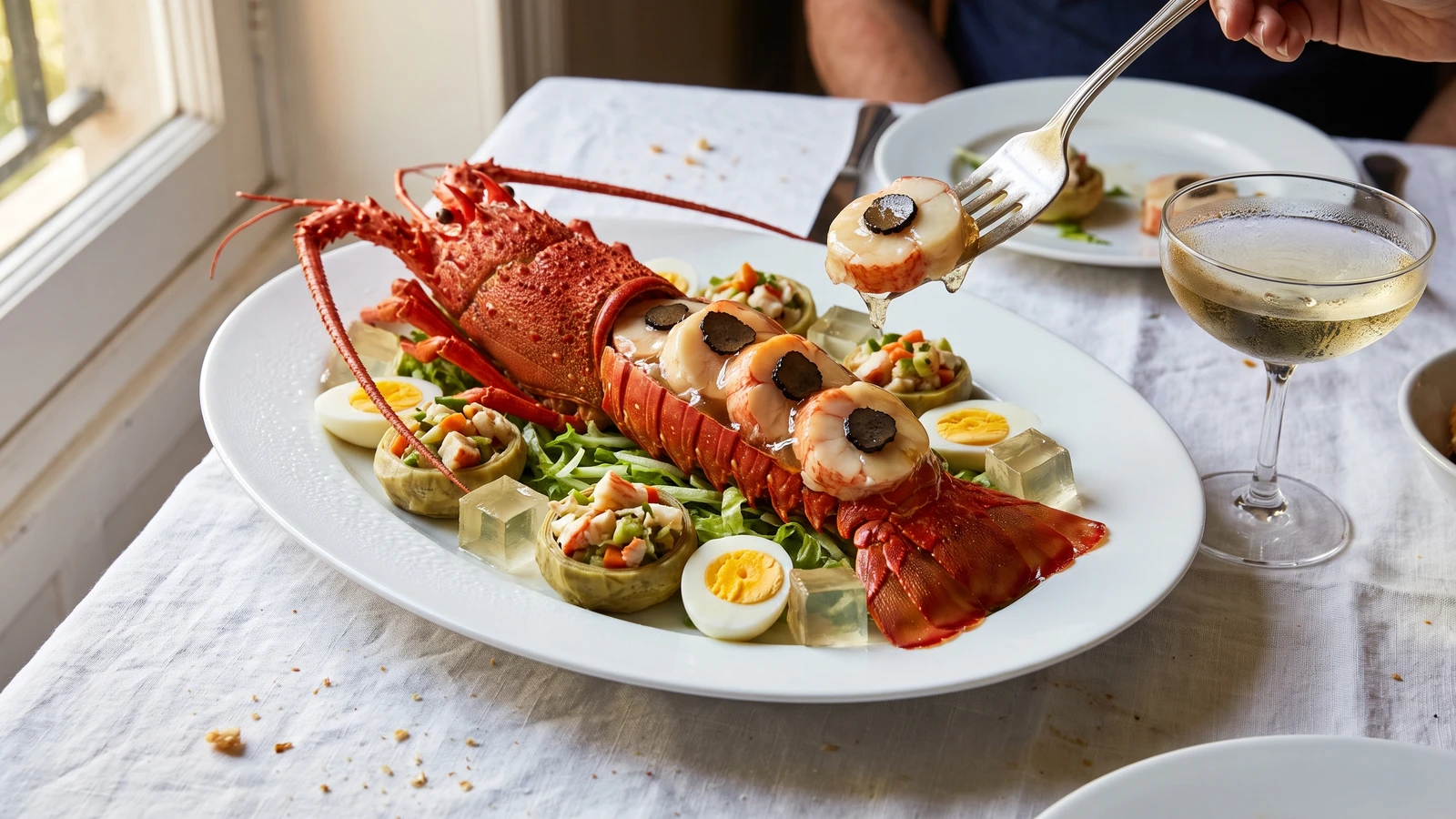
Firm langouste tail, sliced into truffle-crowned collops and glazed with clear aspic, returns to its shell beside artichoke bottoms, vegetable salad, and eggs: Parisian cold-buffet grandeur made workable at home.
Langouste à la Parisienne (Parisian-style spiny lobster) teaches the discipline of cuisine froide, cold-kitchen work: everything must be fully cold, dry, and orderly before the first spoonful of gelée, clear savory jelly, touches it. Warm lobster melts the coating, wet vegetables loosen the mayonnaise, and a rushed platter slumps. Control the temperature and this formidable showpiece becomes a sequence of small, calm jobs.
The original assumed a saucier with clear fish jelly ready, stock never off the fire, an extra pair of hands to glaze each collop repeatedly, and a carved rice or buttered-bread wedge holding the shell at a proud angle. Your equivalent is good clear fish stock strengthened with gelatin, a chilled tray, and a broad oval platter with a low bed of lettuce. The carved plinth is brigade scaffolding and goes. The intact shell, truffle-crowned collops, mayonnaise-bound vegetable salad, artichoke bottoms, eggs, and gleaming gelée are the dish, so they stay.
One whole langouste feeds four generously once the cold garnishes surround it. Because spiny lobster has no claws, its diced garnish comes from the leg and body meat plus the less even ends of the tail, the honest anatomical change from the referenced homard. One cook, one stove, one evening. The step that decides everything is glazing fully chilled, carefully blotted collops with several thin coats rather than drowning them in one thick layer.
Langouste à la Parisienne belongs to Parisian cuisine froide, the cold-buffet repertoire that arranged shellfish, mayonnaise, truffle, artichokes, eggs, salad, and clear gelée as edible architecture. Its method travels directly through Homard à la Parisienne, but langouste is the clawless spiny lobster, not homard, so body meat and tail trimmings replace the claw meat used in the salad. The elaborate support beneath the shell displayed a grand kitchen's labor, while the glazed collops and ordered cold garnishes carried the actual flavor and remain the heart of the preparation.
Quantity
1 complete application (No. 960), using spiny lobster and the home-scale quantities below
Quantity
1, weighing 3 to 3½ pounds (1.4 to 1.6 kg)
Quantity
3 quarts (2.8 L / 2.8 kg)
Quantity
2 cups (475 ml / 470 g)
Quantity
¼ cup (60 ml / 60 g)
Quantity
1 medium, about 1 cup (240 ml / 150 g)
sliced
Quantity
1 medium, about ¾ cup (180 ml / 100 g)
sliced
Quantity
1 stalk, about ½ cup (120 ml / 60 g)
sliced
Quantity
2 tablespoons (30 ml / 36 g)
Quantity
1 teaspoon (5 ml / 3 g)
Quantity
1
Quantity
6
Quantity
2 sprigs
Quantity
3 cups (710 ml / 710 g)
Quantity
2 tablespoons plus 1 teaspoon (35 ml / 21 g)
Quantity
1 tablespoon (15 ml / 15 g)
Quantity
½ teaspoon (2.5 ml / 3 g)
Quantity
1 small, about 1 ounce (30 g)
thinly sliced
Quantity
2 small heads, about 9 ounces (250 g)
washed and thoroughly dried
Quantity
½ cup (120 ml / 75 g)
cut into ¼-inch dice
Quantity
½ cup (120 ml / 60 g)
cut into ¼-inch pieces
Quantity
½ cup (120 ml / 75 g)
Quantity
2 large
Quantity
1 teaspoon (5 ml / 5 g)
Quantity
1 tablespoon (15 ml / 15 g)
Quantity
¾ cup (180 ml / 165 g)
Quantity
½ teaspoon (2.5 ml / 3 g)
Quantity
¼ teaspoon (1.25 ml / 0.5 g)
Quantity
Up to 2 tablespoons (30 ml / 30 g)
passed through a fine sieve
Quantity
8, about 14 ounces (400 g) drained
rinsed and thoroughly dried
Quantity
4
| Ingredient | Quantity |
|---|---|
| Homard à la Parisienne method | 1 complete application (No. 960), using spiny lobster and the home-scale quantities below |
| whole live or just-dispatched spiny lobster | 1, weighing 3 to 3½ pounds (1.4 to 1.6 kg) |
| cold water | 3 quarts (2.8 L / 2.8 kg) |
| dry white wine | 2 cups (475 ml / 470 g) |
| white wine vinegar for the court-bouillon | ¼ cup (60 ml / 60 g) |
| yellow onionsliced | 1 medium, about 1 cup (240 ml / 150 g) |
| carrot for the court-bouillonsliced | 1 medium, about ¾ cup (180 ml / 100 g) |
| celerysliced | 1 stalk, about ½ cup (120 ml / 60 g) |
| fine sea salt for the court-bouillon | 2 tablespoons (30 ml / 36 g) |
| black peppercorns | 1 teaspoon (5 ml / 3 g) |
| bay leaf | 1 |
| parsley stems | 6 |
| thyme | 2 sprigs |
| clear unsalted fish stock | 3 cups (710 ml / 710 g) |
| unflavored powdered gelatin | 2 tablespoons plus 1 teaspoon (35 ml / 21 g) |
| fresh lemon juice | 1 tablespoon (15 ml / 15 g) |
| fine sea salt for the gelée | ½ teaspoon (2.5 ml / 3 g) |
| black truffle, fresh or preservedthinly sliced | 1 small, about 1 ounce (30 g) |
| butter lettucewashed and thoroughly dried | 2 small heads, about 9 ounces (250 g) |
| carrot for the macédoinecut into ¼-inch dice | ½ cup (120 ml / 75 g) |
| green beanscut into ¼-inch pieces | ½ cup (120 ml / 60 g) |
| shelled peas | ½ cup (120 ml / 75 g) |
| egg yolks | 2 large |
| Dijon mustard | 1 teaspoon (5 ml / 5 g) |
| white wine vinegar for the mayonnaise | 1 tablespoon (15 ml / 15 g) |
| neutral oil | ¾ cup (180 ml / 165 g) |
| fine sea salt for the mayonnaise | ½ teaspoon (2.5 ml / 3 g) |
| ground white pepper | ¼ teaspoon (1.25 ml / 0.5 g) |
| cooked orange lobster coral (optional)passed through a fine sieve | Up to 2 tablespoons (30 ml / 30 g) |
| small artichoke bottomsrinsed and thoroughly dried | 8, about 14 ounces (400 g) drained |
| large eggs | 4 |
Put 1 cup of the cold fish stock in a bowl, sprinkle the gelatin evenly over it, and leave it for 10 minutes to bloom. Heat the remaining 2 cups of stock only until it begins to tremble, then whisk it into the bloomed gelatin with the lemon juice and salt. Strain through a damp coffee filter or a very fine cloth without pressing. Pour 2 cups into a shallow metal tray for the border cubes and the remaining cup into a bowl for glazing and the mayonnaise. Chill until firmly set, about 45 minutes. If the gelée turns cloudy, don't clarify it with a brigade's egg-white raft; let it set, trim away any sediment, and use the clearest upper portion. Ça se rattrape.
Combine the water, wine, vinegar, sliced onion, sliced carrot, celery, salt, peppercorns, bay, parsley stems, and thyme in a stockpot. Simmer the court-bouillon, an aromatic poaching liquor, for 20 minutes. Have the fishmonger dispatch the langouste immediately before cooking. Lay two long metal skewers along the underside of its tail and secure them with kitchen twine so the tail remains straight, the home equivalent of tying the shellfish to a board. Lower it into the simmering liquor, bring the liquid back to the barest simmer, and begin checking after 16 minutes. Remove it from the heat when the thickest tail meat reaches 145°F (63°C), usually within 18 to 22 minutes.
Leave the langouste in the court-bouillon for 10 minutes so the aromatic liquor settles around the meat. Set the pot in a deep sink or basin of ice water and stir the liquor gently until it falls below 70°F (21°C), about 30 minutes. Lift out the langouste, drain it well, and refrigerate it on a tray until the shell and tail are cold throughout, about 1 hour. The old kitchen had a cold larder and hands to move great vessels; rapid cooling in an ice bath gives one home cook the same result safely.
Bring a saucepan of salted water to a boil. Cook the diced carrot until just tender, about 3 minutes, add the green beans for 2 minutes, then add the peas for the final minute. Drain the macédoine, neat vegetable dice, into ice water, drain again, and spread it on a towel until completely dry. Cover and chill. In the same saucepan, cook the four whole eggs for 9 minutes, cool them in ice water, peel them, and halve them lengthwise.
Use Homard à la Parisienne (No. 960) as the governing preparation for the shell and cold garnish construction. Remove the skewers, then use sturdy kitchen shears to cut a strip about 1½ inches wide along the upper shell from behind the head through the length of the tail. Lift the strip away intact and ease out the tail meat without breaking it. Remove the intestinal vein, then pick the clean white meat from the leg joints and body. Reserve any cooked orange coral, but discard the green tomalley. Langouste has no claws, so dice the body and leg meat with the less even tail ends for the salad; this is the required change from the homard formula.
Blot the tail meat thoroughly dry and cut it crosswise into 10 to 12 even collops, medallions about ¼ inch thick, reserving uneven end pieces for the salad. Cut small roundels from the truffle slices and set one on each collop. Warm the bowl of set gelée over barely warm water until fluid, then cool it over ice until it has the body of light syrup. Dip each truffle roundel in the gelée to anchor it, then spoon or brush three or four very thin coats over the collops on a chilled tray, refrigerating briefly between coats. If the gelée runs off, the meat or jelly is too warm; chill both for 10 minutes. If it seizes in the bowl, warm it gently. Ça se rattrape.
Whisk the egg yolks with the Dijon mustard, vinegar, salt, and white pepper. Add the oil first drop by drop and then in a thin stream, whisking until the mayonnaise is thick and glossy. If it splits, stop. Put 1 teaspoon of cold water in a clean bowl and whisk in the broken mayonnaise a spoonful at a time until it returns. Melt ¼ cup of the gelée and cool it until barely fluid, then whisk it into the mayonnaise with the sieved coral, if present. Fold in the dry macédoine and diced langouste meat. Chill the mayonnaise collée, lightly set mayonnaise, for 10 minutes, just until it holds a mound.
Arrange the dried artichoke bottoms on a chilled tray. Divide the langouste salad among them, shaping each portion into a compact pyramid with two teaspoons. Crown each with a small piece of truffle and brush the salad with a thin coat of fluid gelée. Keep them cold. If the salad slumps, the gelée in the mayonnaise has not begun to set; return the bowl and the filled artichokes to the refrigerator for 10 minutes, then reshape them.
Shred the firm inner lettuce leaves into a fine julienne, keeping several whole leaves for the shell. Fill the empty tail cavity loosely with whole leaves and return the removed shell strip upside down to form a stable channel. Spread the julienned lettuce in a low bed on a broad chilled oval platter and settle the shell on it, raising the head only slightly with extra lettuce. The carved rice or buttered-bread wedge was display scaffolding for a brigade; the lettuce supports the langouste without putting an inedible monument beneath dinner.
Lay the glazed collops along the upturned shell strip, beginning with the smallest near the head and overlapping them toward the tail in increasing size. Alternate the filled artichoke bottoms with the egg halves around the shell, yolks facing outward. Cut the firm tray of gelée into large clear cubes and arrange them around the platter's rim. Chill the finished Langouste à la Parisienne for 20 to 30 minutes, then serve it directly from the cold, giving each person collops, artichoke salad, egg, lettuce, and gelée. À table!
1 serving (about 630g)
Culinary guides, cultural storytelling, and the editorial depth that makes cooking meaningful.
Discover Culinary ExplorerChef Juliette
John Dory has the delicacy of sole and the firmness of turbot. A light flouring, a quick butter sauté, and nut-brown beurre noisette show exactly why looks never mattered.

Chef Juliette
Fresh haddock proves its delicacy in the meunière pan: a fine flour crust, moist pearly flakes, and beurre noisette sharpened with lemon and parsley, ready from one skillet in half an hour.

Chef Juliette
Éperlans à l’Anglaise turns small fish into a lesson in disciplined coating: boned smelts under a close, crisp crumb, pan-fried in clarified butter and finished with bright, half-melted maître d’hôtel butter.

Chef Juliette
Tiny smelts, shallot, mushrooms, white wine, gratin sauce, and fine bread raspings meet a fierce oven, where the fish must turn tender in the same breath the buttered crust bronzes.