
Chef Juliette
John Dory (St. Pierre)
John Dory has the delicacy of sole and the firmness of turbot. A light flouring, a quick butter sauté, and nut-brown beurre noisette show exactly why looks never mattered.
A cooking platform built around craft, culture, and the stories behind what we eat.
Created by Chef Juliette
Based on No. 931, Turbotin Fermière, from Le Guide Culinaire (1907) by Auguste Escoffier
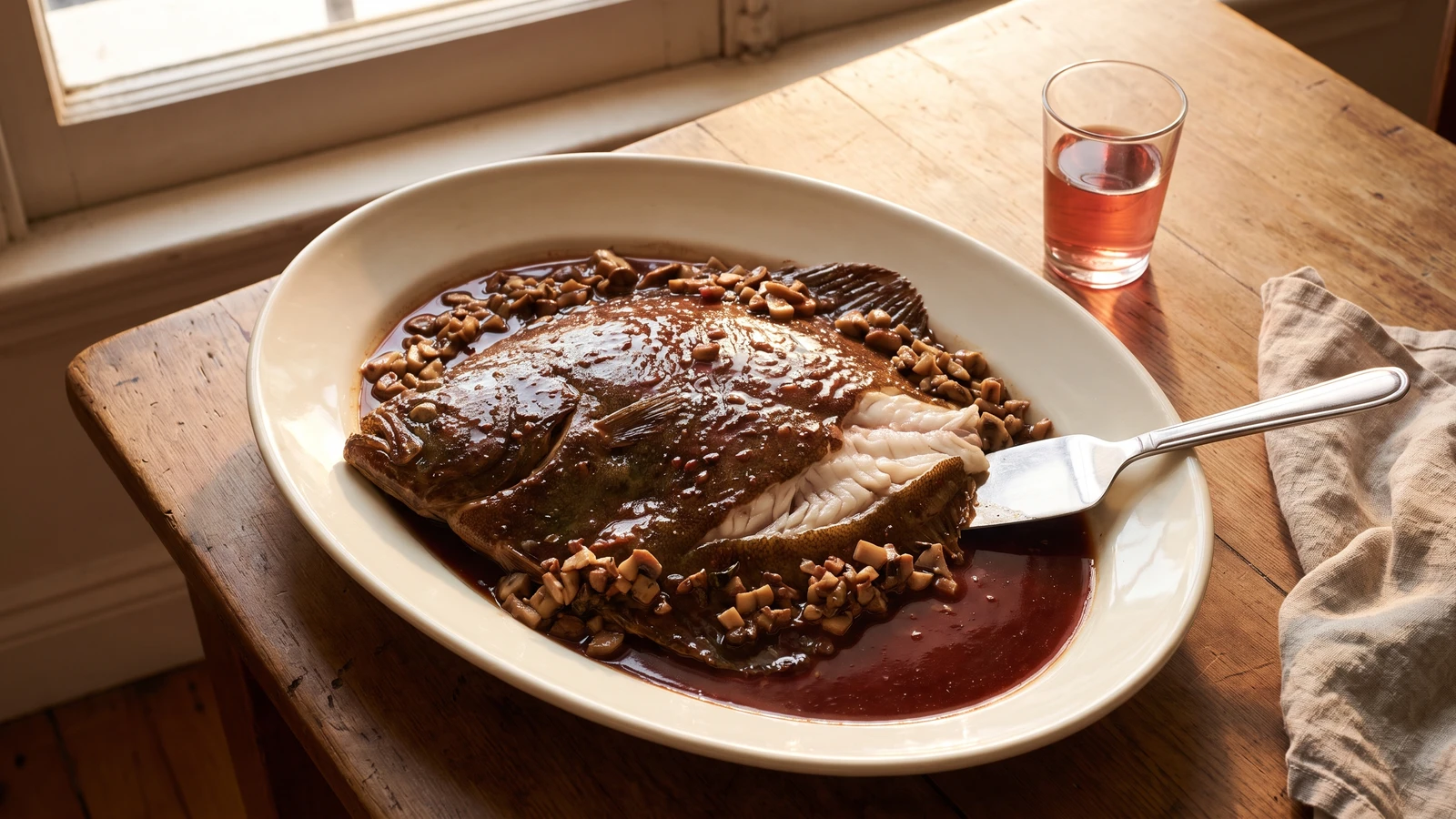
A whole young turbot poached at a tremble in red wine, laid over farmhouse aromatics, ringed with buttery mushrooms, and glazed until its sauce catches the light.
Turbotin Fermière (young turbot poached in red wine with farmhouse aromatics) teaches one of the canon's quiet laws: a fish poach is governed by temperature, not force. The wine may tremble around the fish, but it must never boil. Keep that discipline and the turbot stays pearly while its liquor becomes a sauce with the depth and gloss of polished garnet.
The original recipe stood inside a brigade: a saucier could reduce the liquor while another cook guarded the fish, stock sat never far from the fire even though this formula calls for none, and a salamander glazed the finished platter in seconds. At home, a shallow roasting pan, one saucepan, and a fiercely heated broiler do the same work. The book's two-pound chicken-turbot is already right for four, so the scale stays; what changes is the choreography, with the fish resting on a warmed ovenproof platter while you finish the sauce. One cook, one stove, one evening.
A separate hot-holding station was brigade scaffolding and can go. The aromatic bed, frequent basting, reduction by half, Manied Butter (No. 151), generous butter finish, and quick glaze are the dish and remain. The moment that decides it comes after the reduction: once the thickening butter enters, no boil.
Turbotin Fermière belongs to the Parisian grand-kitchen table, where a small whole turbot could be poached to order, sauced, and passed beneath the salamander before service. Fermière here is a classical garnish-name, not a claim of origin in one farming region: shallot, carrot, onion, herbs, and mushrooms give the costly fish the plain larder of a household pot. The dish moved naturally into the bourgeois dining room because its architecture is domestic at heart, one fish, one wine, and one pan, with the brigade's separate saucier compressed into a careful final reduction.
Quantity
1 small fish, about 2 pounds (900 g)
gutted, fins trimmed, and patted dry
Quantity
1 tablespoon (15 ml / 14 g)
softened
Quantity
2 small shallots (⅓ cup / 80 ml / 50 g)
minced
Quantity
½ small carrot (¼ cup / 60 ml / 30 g)
sliced into thin rounds
Quantity
¼ medium onion (⅓ cup / 80 ml / 40 g)
sliced into thin rounds
Quantity
6
Quantity
2 sprigs
Quantity
1
Quantity
¾ teaspoon (3.75 ml / 4.5 g)
divided
Quantity
¼ teaspoon (1.25 ml / 0.6 g)
Quantity
1½ cups plus 1 tablespoon plus 2 teaspoons (380 ml / 380 g)
Quantity
1 tablespoon (15 ml / 14 g)
chilled and diced
Quantity
1¼ cups (300 ml / 85 g)
finely minced
Quantity
6 tablespoons (90 ml / 85 g)
Quantity
1 rounded tablespoon (20 ml / 18 g) Manied Butter (No. 151)
freshly made
Quantity
6 tablespoons (90 ml / 85 g)
chilled and cut into small cubes
Quantity
1 tablespoon (15 ml / 15 g)
| Ingredient | Quantity |
|---|---|
| whole turbot (chicken-turbot)gutted, fins trimmed, and patted dry | 1 small fish, about 2 pounds (900 g) |
| unsalted butter for the roasting pansoftened | 1 tablespoon (15 ml / 14 g) |
| shallotsminced | 2 small shallots (⅓ cup / 80 ml / 50 g) |
| carrotsliced into thin rounds | ½ small carrot (¼ cup / 60 ml / 30 g) |
| yellow onionsliced into thin rounds | ¼ medium onion (⅓ cup / 80 ml / 40 g) |
| parsley stalks | 6 |
| fresh thyme | 2 sprigs |
| bay leaf | 1 |
| fine sea saltdivided | ¾ teaspoon (3.75 ml / 4.5 g) |
| ground white pepper | ¼ teaspoon (1.25 ml / 0.6 g) |
| dry, low-tannin red wine | 1½ cups plus 1 tablespoon plus 2 teaspoons (380 ml / 380 g) |
| unsalted butter for poachingchilled and diced | 1 tablespoon (15 ml / 14 g) |
| button mushroomsfinely minced | 1¼ cups (300 ml / 85 g) |
| unsalted butter for the mushrooms | 6 tablespoons (90 ml / 85 g) |
| Manied Butter (No. 151)freshly made | 1 rounded tablespoon (20 ml / 18 g) Manied Butter (No. 151) |
| unsalted butter for finishingchilled and cut into small cubes | 6 tablespoons (90 ml / 85 g) |
| cold water (optional) | 1 tablespoon (15 ml / 15 g) |
Heat the oven to 325°F (165°C) with a rack in the center. Coat a shallow nonreactive roasting pan with the softened butter, then scatter the shallots, carrot, onion, parsley stalks, thyme, and bay evenly across its bottom. Season the turbot on both sides and inside the cavity with most of the salt and all the white pepper. Lay it dark side up over the aromatics and dot its surface with the diced poaching butter.
Warm the red wine in a saucepan until small bubbles gather at its edge, then pour it around the fish. Reserve the saucepan. Transfer the pan to the oven and poach for 20 to 25 minutes, basting the exposed surface every 5 minutes. The liquor should barely tremble, never boil. If it bubbles hard, lift the pan out for a minute, lower the oven by 25°F (15°C), and return it only when the agitation subsides. Ça se rattrape before the flesh tightens. Begin checking at 20 minutes: the flesh beside the backbone should be opaque and lift cleanly, and an instant-read thermometer in the thickest part should register about 140°F (60°C). The rest and final glaze will carry it toward 145°F (63°C).
While the fish poaches, melt the mushroom butter in a wide skillet over medium-high heat. Add the minced mushrooms and a pinch of the reserved salt, then toss for 5 to 7 minutes until they release their water, that moisture evaporates, and the butter turns clear around them again. Keep them supple, with only a faint bronze at the edges. Do not drain away their butter; it belongs to the garnish.
Warm a broiler-safe oval platter with hot water, empty it, and dry it thoroughly. When the turbot is ready, lift it carefully with two broad spatulas and set it on the platter without breaking its fins or skin. Arrange the mushrooms and their butter around the fish, then cover loosely with foil. Strain the cooking liquor through a fine sieve into a measuring jug without pressing the aromatics, which would cloud the sauce. Note its volume and return it to the reserved saucepan.
Set the strained liquor over medium-high heat and reduce it at a brisk simmer to exactly half its measured volume, usually ¾ to 1 cup (180 to 240 ml), depending on the juices released by the fish. A lively simmer is permitted now because the thickening butter has not entered. Skim any coarse foam, but leave the fine butter sheen alone. The reduction is ready when the wine's raw edge has softened and the liquor tastes concentrated without turning bitter. Heat the broiler to high and place its rack 4 to 6 inches (10 to 15 cm) below the element.
Lower the heat until the reduced liquor only quivers. Whisk in the Manied Butter (No. 151) a small piece at a time, allowing each piece to disappear before adding the next, until the sauce lightly coats the back of a spoon. Once the Manied Butter enters, never let the sauce boil; a rolling boil leaves its flour raw-tasting and can force out the butter. Monter au beurre (finish by whisking in cold butter): remove the pan from the heat and add the chilled butter cubes gradually, whisking until the sauce is smooth, glossy, and softly thickened. Taste and add the remaining salt only if needed. If oily beads appear, put the cold water in a clean saucepan and whisk the broken sauce into it one spoonful at a time. Ça se rattrape.
Spoon the sauce over the turbot and mushrooms, coating them generously without burying the fish's shape. Pass the platter beneath the fully heated broiler for 20 to 45 seconds, watching without interruption, just until the glaze catches the light and barely quivers at the rim. This is the home salamander: quick gloss, not a browned crust. Carry the platter straight to the table and serve the fish with plenty of its mushrooms and sauce. À table!
1 serving (about 210g)
Culinary guides, cultural storytelling, and the editorial depth that makes cooking meaningful.
Discover Culinary ExplorerChef Juliette
John Dory has the delicacy of sole and the firmness of turbot. A light flouring, a quick butter sauté, and nut-brown beurre noisette show exactly why looks never mattered.

Chef Juliette
Fresh haddock proves its delicacy in the meunière pan: a fine flour crust, moist pearly flakes, and beurre noisette sharpened with lemon and parsley, ready from one skillet in half an hour.

Chef Juliette
Éperlans à l’Anglaise turns small fish into a lesson in disciplined coating: boned smelts under a close, crisp crumb, pan-fried in clarified butter and finished with bright, half-melted maître d’hôtel butter.

Chef Juliette
Tiny smelts, shallot, mushrooms, white wine, gratin sauce, and fine bread raspings meet a fierce oven, where the fish must turn tender in the same breath the buttered crust bronzes.