
Chef Juliette
Filets de Soles Américaine
Folded sole, barely poached in fumet, circles lobster beneath a gleaming brandy-and-tomato shellfish sauce. The sauce is the whole dish, and gentle heat is the lesson.
A cooking platform built around craft, culture, and the stories behind what we eat.
Created by Chef Juliette
Based on No. 915, Aspic de Filets de Soles, from Le Guide Culinaire (1907) by Auguste Escoffier
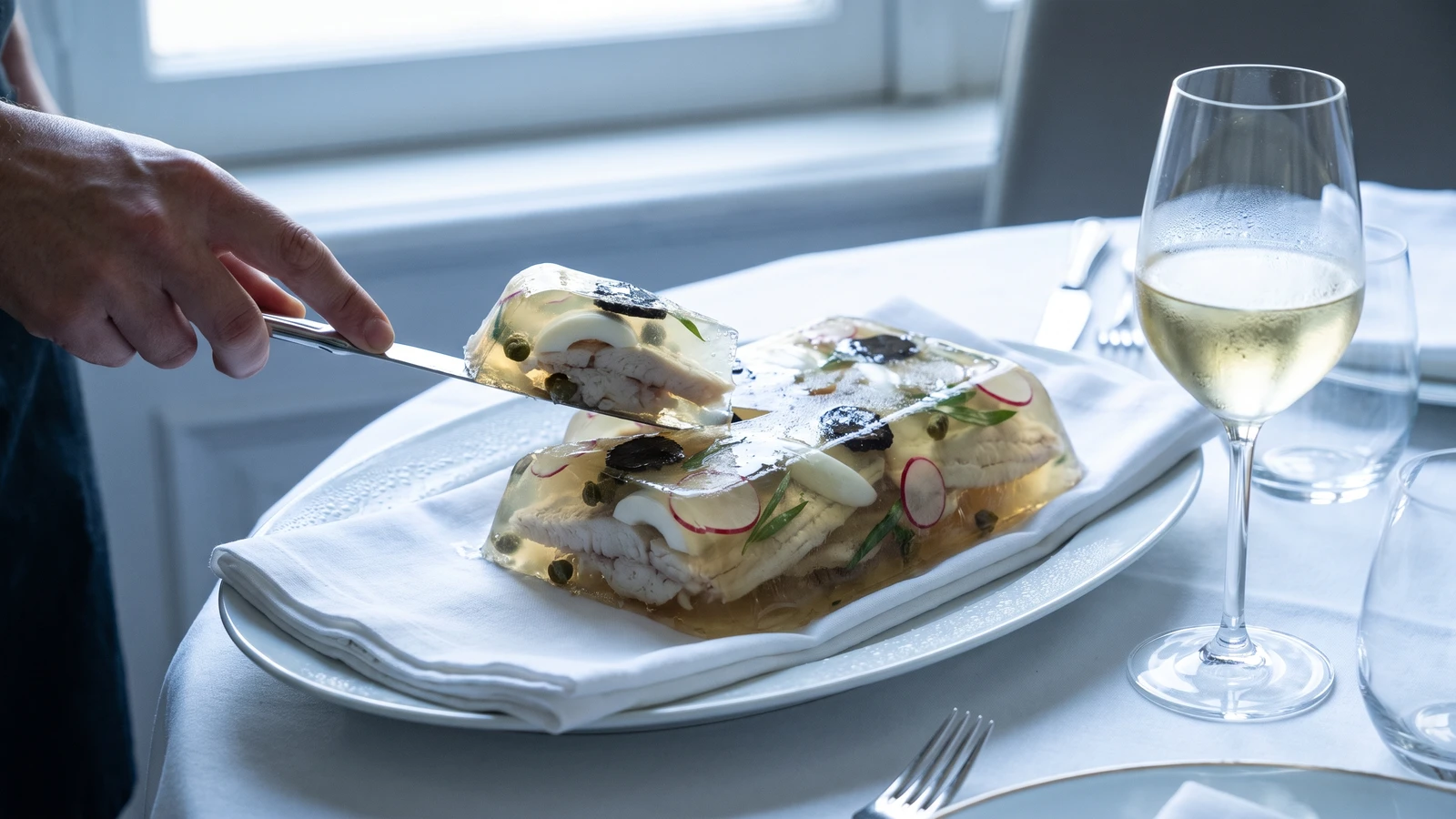
Aspic de Filets de Soles makes clarity visible: folded white sole, black truffle, egg white, capers, tarragon, and radish suspended in limpid fish jelly firm enough to unmould and tender enough to melt.
Aspic de Filets de Soles (sole fillets in clear fish jelly) teaches one severe, useful lesson: clarity must be built before beauty can be arranged. If the jelly is cloudy when it enters the mould, black truffle and white fish will only make the fault more visible. Clarify first, decorate second.
The book's kitchen assumed a saucier with a stockpot never off the fire, a garde-manger working beside broken ice, and a border mould waiting on the shelf. A salamander, indispensable to many grand dishes, has no job in this cold one. Your honest equivalents are concentrated fish stock clarified with egg white, powdered gelatin measured for a tender unmoulding set, a fine sieve lined with damp cheesecloth, a one-quart metal mould, and the refrigerator. The ornate cutter work and constant ice service are brigade scaffolding; the limpid jelly, white poaching, light pressing, and staged layers are the dish and must stay.
Scaled to twelve small fillets, this feeds four from one mould. One cook, one stove, one evening. The jelly should look like pale glass and taste distinctly of fish; the sole inside stays ivory, buttery, and bright with lemon. The step that matters most is the clarification: let the egg-white raft do its work, then strain without pressing a single cloudy particle back through.
Aspic de Filets de Soles belongs to the Parisian cold buffet of grande cuisine, where limpid fish jelly protected delicate fillets while giving the garde-manger, the cold-kitchen station, a surface for precise decoration. The border mould traveled into cuisine bourgeoise, where a cold fish centerpiece could be completed before guests arrived and unmoulded at the table. Its jelly was never meant to be rubbery or flavorless: it should carry concentrated fish stock, cut cleanly, and soften at once in the mouth.
Quantity
12 fillets (about 14 oz / 400 g)
trimmed evenly
Quantity
3 cups (720 ml / 720 g)
well flavored, unsalted or lightly salted, and fully cold
Quantity
¼ cup (60 ml / 60 g)
Quantity
1 tablespoon plus 1½ teaspoons (22 ml / 14 g)
Quantity
2
Quantity
1
Quantity
1
Quantity
2 tablespoons (30 ml / 28 g)
softened and divided
Quantity
2 tablespoons (30 ml / 30 g)
Quantity
1¼ teaspoons (6 ml / 7 g)
divided
Quantity
1 small truffle (about ¾ oz / 20 g)
drained and cut into lozenges and crescents
Quantity
1 tablespoon (15 ml / 9 g)
rinsed and dried
Quantity
12 small leaves
dried thoroughly
Quantity
2 (about 1 oz / 30 g)
cut into paper-thin roundels
Quantity
About 8 cups (1.9 L / 1.8 kg)
for chilling
| Ingredient | Quantity |
|---|---|
| small skinless sole filletstrimmed evenly | 12 fillets (about 14 oz / 400 g) |
| clear fish stockwell flavored, unsalted or lightly salted, and fully cold | 3 cups (720 ml / 720 g) |
| cold water | ¼ cup (60 ml / 60 g) |
| unflavored powdered gelatin | 1 tablespoon plus 1½ teaspoons (22 ml / 14 g) |
| large egg whites for clarification | 2 |
| additional large egg white for reclarifying (optional) | 1 |
| large egg white for decoration | 1 |
| unsalted buttersoftened and divided | 2 tablespoons (30 ml / 28 g) |
| fresh lemon juice | 2 tablespoons (30 ml / 30 g) |
| fine sea saltdivided | 1¼ teaspoons (6 ml / 7 g) |
| preserved black truffledrained and cut into lozenges and crescents | 1 small truffle (about ¾ oz / 20 g) |
| small capersrinsed and dried | 1 tablespoon (15 ml / 9 g) |
| fresh tarragon leavesdried thoroughly | 12 small leaves |
| small radishescut into paper-thin roundels | 2 (about 1 oz / 30 g) |
| icefor chilling | About 8 cups (1.9 L / 1.8 kg) |
Clear a level refrigerator shelf and set the one-quart mould inside a larger bowl or roasting pan. Pack ice around the outside, then add enough cold water to make a stable ice bath without letting water enter the mould. Chill the mould while you work. Lay two layers of cheesecloth in a fine-mesh sieve, wet them thoroughly with cold water, and squeeze them almost dry.
Sprinkle the gelatin evenly over the cold water and leave it untouched for 10 minutes. Whisk two egg whites just enough to loosen them, then combine them with the fully cold fish stock in a clean saucepan. Heat slowly, stirring and scraping the bottom, until the proteins begin gathering into a pale raft at the surface. Stop stirring, open a small hole in the raft with a spoon, and hold the stock at the barest tremble for 10 minutes. Ladle it gently through the damp cheesecloth without disturbing or pressing the raft. Pressing is the betrayal here; it forces the captured particles straight back into the jelly. If the liquid remains cloudy, ça se rattrape: cool it rapidly over ice, whisk in the additional fresh egg white, and repeat the clarification. Once the stock is limpid and still warm, stir in the bloomed gelatin and up to ½ teaspoon of the salt, using slow strokes that do not raise bubbles. Keep the jelly fluid over barely warm water.
Brush a small heatproof ramekin with the faintest film of butter and slip in the egg white reserved for decoration. Set the ramekin in a covered saucepan with gently trembling water reaching halfway up its side. Poach for 6 to 8 minutes, until the white is firm but carries no color. Cool it in cold water, turn it out, pat it completely dry, and cut small crescents or lozenges to echo the truffle.
Heat the oven to 275°F (135°C). Brush a shallow baking dish with half the remaining butter. Season the sole lightly with the remaining salt, then fold each fillet into a compact parcel, tucking the narrow tail inward so every piece has nearly the same thickness. Arrange them in one layer, spoon over the lemon juice, and dot with the remaining butter. Cover closely with buttered parchment and then foil. Poach for 8 to 12 minutes, just until the folds are opaque, supple, and 145°F (63°C) at their thickest point. Do not let them brown. White fish against clear jelly is the whole visual argument.
Lift the fillets from their cooking liquid with a small offset spatula and arrange them neatly on a flat tray. Cover with parchment, set a second tray or small board on top, and add a light weight of about 1 pound (450 g). Chill for 30 minutes. The pressure should persuade the folds to hold together, not crush them. If a fillet begins to separate, press it gently back into shape while it is still warm; the chilling and jelly will finish the repair.
Cool the fluid fish jelly over ice until it flows like light syrup but has not begun to set. Spoon a thin layer, about 3 tablespoons (45 ml), into the chilled mould. When it becomes tacky, arrange the black truffle and poached egg-white shapes against the bottom, adding a few capers, tarragon leaves, and radish roundels with restraint. Drip a teaspoon or two of jelly over each piece to fix it. If something shifts, move it back with a skewer before the fixing drops set. Ça se rattrape.
Pour more jelly slowly down the side of the mould, or over the back of a spoon, until the decorated foundation measures about 1 inch (2.5 cm) deep. Chill until fully set. Arrange six sole fillets on this layer with their tail ends overlapping. Spoon the jelly over them in successive thin coats, chilling each coat until tacky, until the fish is covered by about ½ inch (1.25 cm) of jelly. Thin coats keep the fillets in place; one impatient flood makes them float.
Arrange the remaining six fillets in the reverse direction so the finished slice has an even pattern. Fill the mould with cool, fluid jelly, again pouring down the side rather than directly onto the fish. Slip a fine skewer between the fillets to release any trapped air bubbles, then top up to the rim. You may not need every spoonful of jelly. If the jelly sets in its bowl before you finish, warm it gently until fluid again; never boil it.
Transfer the mould from the ice bath to the refrigerator without tilting it. Chill for at least 4 hours, preferably overnight, until the center is completely firm. Cover only after the surface has set, otherwise condensation can fall onto the jelly and mark it.
Lay a clean folded white napkin on a chilled serving dish. Dip the mould almost to its rim in hot water for 5 seconds, wipe the outside dry, and invert it decisively onto the napkin. If it does not release, return it to the water for 2 seconds and try again; a long soak melts the decoration before it frees the center. Chill the unmoulded aspic for 10 minutes if its surface softens. Cut with a thin knife dipped in warm water and wiped dry between slices. Serve very cold. À table!
1 serving (about 285g)
Culinary guides, cultural storytelling, and the editorial depth that makes cooking meaningful.
Discover Culinary ExplorerChef Juliette
Folded sole, barely poached in fumet, circles lobster beneath a gleaming brandy-and-tomato shellfish sauce. The sauce is the whole dish, and gentle heat is the lesson.

Chef Juliette
A fine à l'anglaise crust, set the instant it touches hot clarified butter, protects tender sole before maître-d'hôtel butter melts across the ridges. The lesson is heat first, gentle frying second.

Chef Juliette
Pepper-filled sole paupiettes rise over butter-stewed tomatoes, capsicum risotto, and crisp aubergine, all glossed with lightly browned butter. The lesson is control: keep every element distinct and never let the poach boil.

Chef Juliette
Filets de Soles Caprice turns restraint into surprise: fine-crumbed sole grilled light gold, buttered banana laid over each fillet, and mustard-bright Sauce Robert sent separately so every bite balances sweet, savory, and sharp.