
Chef Juliette
John Dory (St. Pierre)
John Dory has the delicacy of sole and the firmness of turbot. A light flouring, a quick butter sauté, and nut-brown beurre noisette show exactly why looks never mattered.
A cooking platform built around craft, culture, and the stories behind what we eat.
Created by Chef Juliette
Based on No. 911, Timbale de Filets de Soles Grimaldi, from Le Guide Culinaire (1907) by Auguste Escoffier
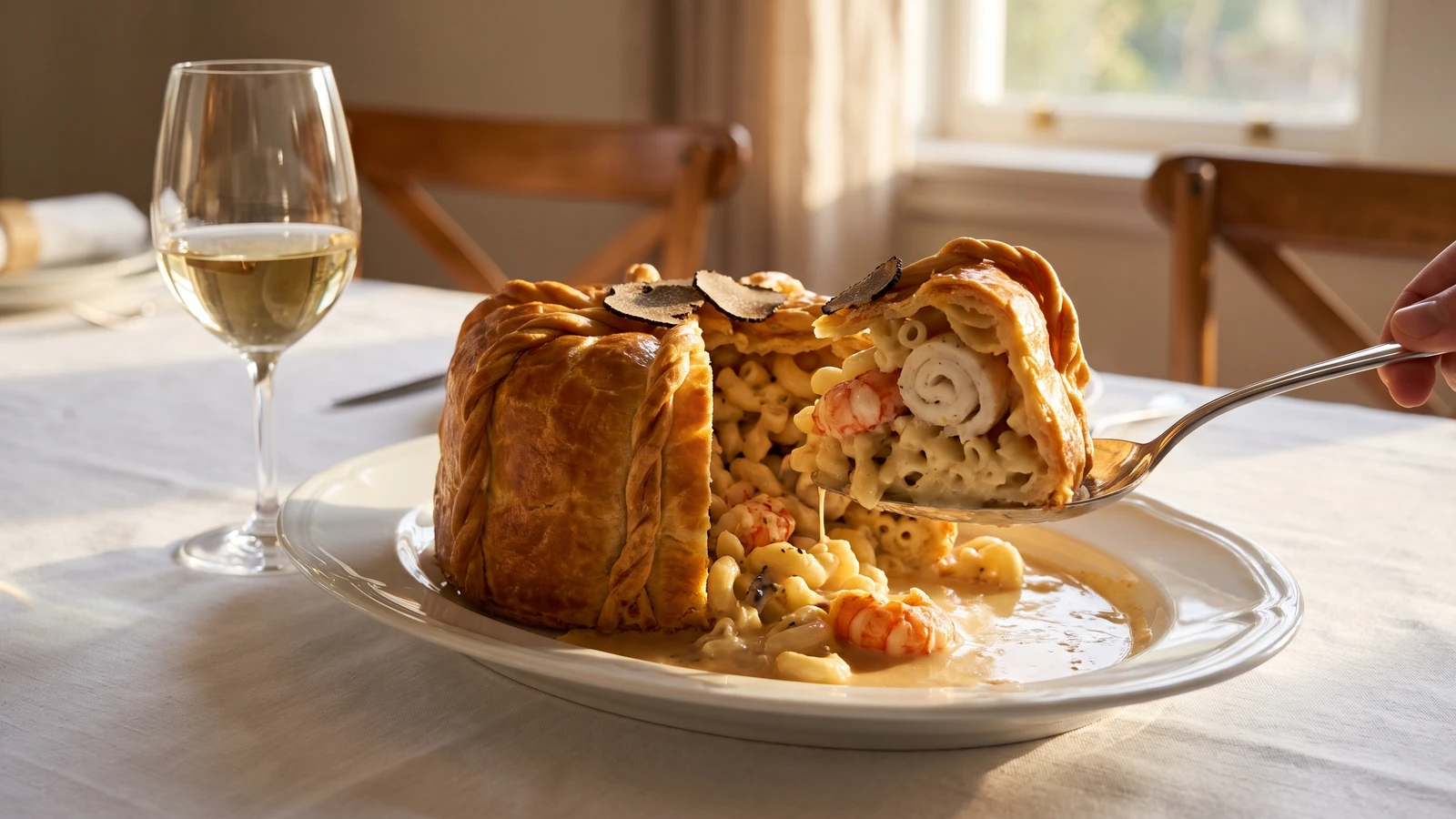
A burnished pastry timbale holding truffled macaroni, scrolls of sole, and buttered langoustine tails in a shellfish cullis: an ambitious assembly made workable for one careful cook.
Timbale de Filets de Soles Grimaldi (Grimaldi sole-fillet pastry timbale) teaches synchronization. The one true thing to know before touching a pan is that this dish is won by order, not speed: the crust must be warm and crisp, the macaroni creamy, the cullis glossy, and the sole poached only when everything else is waiting.
The original assumed a pastry cook, a saucier on staff, a fish cook for the final poach, and fumet never off the fire. Here, the book's sixteen fillets and twenty-four langoustines become eight and twelve for four; one small Béchamel serves both garnishes, a processor and two passes through a fine sieve replace the mortar and tammy, and a saucepan of hot water becomes the bain-marie. The folded napkin is service scaffolding and can go. The decorated crust, truffled forcemeat, shell-built cullis, precise layers, real cream, and butter stay because they are the dish. One cook, one stove, one evening.
Cut into the timbale and you should find pale scrolls of sole between creamy macaroni flecked black with truffle, with coral langoustine tails and an ivory-rose cullis gleaming between the layers. The step that decides everything is the last-minute poach: begin it only when the warm shell and both garnishes are ready to receive the fish.
Timbale de Filets de Soles Grimaldi belongs to the French grand-kitchen repertoire associated with Monaco's courtly table and cosmopolitan Monte Carlo, rather than to the regional cooking of neighboring Provence. The Grimaldi title signals ceremonial abundance through sole, langoustines, truffle, and an architectural pastry case, ingredients organized as a named garnish rather than a local household formula. Contrary to what its imposing shape suggests, the fish is not baked inside the crust; the timbale is filled just before service so the sole stays tender and the pastry remains distinct.
Quantity
2 cups (475 ml / 250 g)
Quantity
½ teaspoon (2.5 ml / 3 g)
Quantity
½ cup (120 ml / 113 g)
cubed
Quantity
1
Quantity
2 to 3 tablespoons (30 to 45 ml / 30 to 45 g)
Quantity
1 teaspoon (5 ml / 5 g)
Quantity
½ cup (120 ml / 65 g)
Quantity
1
Quantity
1 tablespoon (15 ml / 15 g)
Quantity
1
beaten
Quantity
1 tablespoon (15 ml / 14 g)
Quantity
1 tablespoon plus 2 teaspoons (25 ml / 13 g)
Quantity
⅔ cup (160 ml / 165 g)
warmed
Quantity
4 ounces (115 g)
kept very cold
Quantity
1
Quantity
¼ cup (60 ml / 60 g)
kept very cold
Quantity
2 teaspoons (10 ml / 8 g)
finely chopped
Quantity
8 (about 1 pound 5 ounces / 600 g total)
Quantity
12 (about 1 pound 2 ounces / 500 g total)
Quantity
3 tablespoons (45 ml / 42 g)
divided
Quantity
1 (about 1 ounce / 30 g)
finely chopped
Quantity
½ (about 1 ounce / 30 g)
finely chopped
Quantity
1 tablespoon (15 ml / 16 g)
Quantity
2 tablespoons (30 ml / 28 g)
Quantity
⅓ cup (80 ml / 80 g)
Quantity
1
Quantity
1
Quantity
3 cups (710 ml / 710 g)
homemade, or good unsalted fish stock reduced by one-quarter
Quantity
1½ tablespoons (22 ml / 22 g)
Quantity
½ cup (120 ml / 57 g), prepared by Blanchings (No. 273) and left somewhat stiff
Quantity
3 tablespoons plus 1 teaspoon (50 ml / 50 g)
Quantity
⅓ cup (80 ml / 43 g)
thinly sliced
Quantity
1½ tablespoons (22 ml / 21 g)
cut into small lumps
Quantity
1¼ teaspoons (6 ml / 7 g)
divided
Quantity
½ teaspoon (2.5 ml / 1 g)
divided
| Ingredient | Quantity |
|---|---|
| all-purpose flour for the timbale crust | 2 cups (475 ml / 250 g) |
| fine salt for the timbale crust | ½ teaspoon (2.5 ml / 3 g) |
| cold unsalted buttercubed | ½ cup (120 ml / 113 g) |
| large egg | 1 |
| ice water | 2 to 3 tablespoons (30 to 45 ml / 30 to 45 g) |
| softened unsalted butter for the mould | 1 teaspoon (5 ml / 5 g) |
| all-purpose flour for the noodle paste | ½ cup (120 ml / 65 g) |
| large egg yolk | 1 |
| cold water for the noodle paste (optional) | 1 tablespoon (15 ml / 15 g) |
| small egg for sealing and glazingbeaten | 1 |
| unsalted butter for the Béchamel | 1 tablespoon (15 ml / 14 g) |
| all-purpose flour for the Béchamel | 1 tablespoon plus 2 teaspoons (25 ml / 13 g) |
| whole milkwarmed | ⅔ cup (160 ml / 165 g) |
| skinless sole or firm white-fish trimmingskept very cold | 4 ounces (115 g) |
| large egg white | 1 |
| heavy cream for the forcemeatkept very cold | ¼ cup (60 ml / 60 g) |
| black truffle for the forcemeatfinely chopped | 2 teaspoons (10 ml / 8 g) |
| small skinless sole fillets | 8 (about 1 pound 5 ounces / 600 g total) |
| small whole langoustines | 12 (about 1 pound 2 ounces / 500 g total) |
| unsalted butter for the langoustinesdivided | 3 tablespoons (45 ml / 42 g) |
| small shallotfinely chopped | 1 (about 1 ounce / 30 g) |
| small carrotfinely chopped | ½ (about 1 ounce / 30 g) |
| tomato paste | 1 tablespoon (15 ml / 16 g) |
| Cognac | 2 tablespoons (30 ml / 28 g) |
| dry white wine | ⅓ cup (80 ml / 80 g) |
| thyme sprig | 1 |
| bay leaf | 1 |
| unsalted fish fumethomemade, or good unsalted fish stock reduced by one-quarter | 3 cups (710 ml / 710 g) |
| heavy cream for the cullis | 1½ tablespoons (22 ml / 22 g) |
| dried short macaroni | ½ cup (120 ml / 57 g), prepared by Blanchings (No. 273) and left somewhat stiff |
| heavy cream for the macaroni | 3 tablespoons plus 1 teaspoon (50 ml / 50 g) |
| black truffle for the macaronithinly sliced | ⅓ cup (80 ml / 43 g) |
| unsalted butter for the macaronicut into small lumps | 1½ tablespoons (22 ml / 21 g) |
| fine sea saltdivided | 1¼ teaspoons (6 ml / 7 g) |
| ground white pepperdivided | ½ teaspoon (2.5 ml / 1 g) |
Mix the crust flour and its salt, then rub in the cold butter until the mixture resembles coarse crumbs with a few pea-sized pieces remaining. Add the whole egg and just enough ice water to make a firm pâte à foncer, the sturdy lining pastry needed to support the garnishes. Knead only until smooth, flatten into a disc, cover, and chill for 30 minutes. A soft dough will slide down the deep mould, so give it the full rest.
Heat the oven to 375°F (190°C). Butter an 18 cm by 10 cm deep charlotte mould. Mix the noodle-paste flour with the yolk and enough cold water to form a stiff paste, roll it thin, and cut simple leaves, bands, or diamonds. Arrange these against the buttered interior, brush their exposed sides with beaten egg, then line the mould with the chilled pastry rolled about ⅛ inch (3 mm) thick. Press gently so the decoration adheres, trim the rim, line with parchment, and fill to the top with baking weights. Bake for 25 minutes, remove the weights, brush the interior lightly with beaten egg, and bake for 10 to 15 minutes more, until dry and evenly golden. If a small crack appears, press on a thin scrap of raw pastry with egg and return the shell to the oven for several minutes. Ça se rattrape. Cool for 10 minutes, then unmould carefully.
Melt the Béchamel butter over gentle heat, stir in its flour, and cook the white roux for 2 minutes without allowing it to colour. Whisk in the warm milk gradually, then simmer gently for 7 to 8 minutes, stirring until the sauce is smooth and coats a spoon. Season lightly with salt and white pepper. You need about 5 fluid ounces (145 ml) after cooking: reserve 3 fluid ounces (95 ml) for the langoustine cullis and 1⅔ fluid ounces (50 ml) for the macaroni. Press parchment directly onto the surface and keep warm. If the sauce forms lumps, whisk it hard off the heat and pass it through the fine sieve. Nothing is lost.
Chill the processor bowl and blade, then process the cold fish trimmings with ¼ teaspoon of the sea salt until smooth and tacky. Add the egg white and process again. With the machine pulsing, add the cold cream a spoonful at a time, stopping as soon as the mixture becomes smooth, light, and cohesive. Fold in the chopped truffle and refrigerate. Warm forcemeat turns grainy; if it begins to separate, stop, chill it for 10 minutes, then work in a teaspoon of cold cream. Ça se rattrape.
Melt 1 tablespoon of the langoustine butter in a wide saucepan. Soften the shallot and carrot without browning, add the whole langoustines, and toss until their shells turn coral. Stir in the tomato paste, then add the Cognac, wine, thyme, bay leaf, and 1 cup (240 ml) of the fumet. Cover and cook at a gentle simmer for 4 minutes. Lift out the langoustines, twist off the tails, peel them, remove the dark intestinal thread, and split each tail lengthwise. Coat the tail halves with the remaining 2 tablespoons of butter and cover. Return every head and shell to the cooking liquid, crush them firmly with a wooden spoon, and simmer uncovered for 10 minutes.
Let the shell mixture cool for 5 minutes, remove the thyme and bay, then process it with the reserved 3 fluid ounces (95 ml) of Béchamel. Work in batches and vent the processor lid. Pass the mixture through a fine sieve twice, pressing firmly with a ladle; the second pass is the home equivalent of the old tammy and gives the cullis its smooth body. Warm it without boiling, sharpen the salt and white pepper, and add the cream little by little. Fold in the buttered tail halves and hold the cullis in a bain-marie, a hot-water bath, with the water below a simmer. If the cream sauce separates, take it off the heat and whisk in a teaspoon of cold cream before returning the tails. Keep it warm, never boiling.
Reduce ½ cup (120 ml) of the fumet in a small saucepan until 2 tablespoons remain, then whisk this into the reserved 1⅔ fluid ounces (50 ml) of Béchamel. Put the macaroni prepared by Blanchings (No. 273) into a clean saucepan with its cream and the sliced truffle. Warm gently until the macaroni has absorbed the cream, then fold in the fumet-finished Béchamel. Remove from the heat and add the butter lumps one at a time. The macaroni should hold together without becoming stiff; if it tightens, loosen it with a spoonful of fumet. Cover and keep warm.
Lay the sole fillets skinned side upward and season them lightly with salt and white pepper. Spread each with a thin, even layer of the cold truffled forcemeat, leaving a narrow border around the edges. Roll each fillet from its narrow end into a compact scroll and set it seam side down. Keep the rolls cold while the fumet is readied; cold forcemeat holds the scrolls together and sets more delicately.
Warm the pastry shell for 5 minutes in a 300°F (150°C) oven and place it on a stable serving platter. Bring the remaining fumet to the barest tremble in a wide sauté pan, set in the sole rolls seam side down, and cover with a lid or buttered parchment. Poach for 6 to 8 minutes, until the fish is opaque and the centre of the forcemeat reaches 145°F (63°C). Do not boil. If a roll starts to open, draw the pan off the heat, settle it seam side down again, and finish gently under the cover. Drain the rolls well so they do not soften the pastry.
Spread half the truffled macaroni across the bottom of the warm timbale. Arrange four sole scrolls over it, then spoon over half the langoustine tails and enough cullis to gloss them without flooding the crust. Repeat with the remaining macaroni, sole, and cullis, finishing with the handsomest langoustine tail halves visible on top. Carry it directly to the table while the crust is crisp and the sauce still gleams. À table!
1 serving (about 525g)
Culinary guides, cultural storytelling, and the editorial depth that makes cooking meaningful.
Discover Culinary ExplorerChef Juliette
John Dory has the delicacy of sole and the firmness of turbot. A light flouring, a quick butter sauté, and nut-brown beurre noisette show exactly why looks never mattered.

Chef Juliette
Fresh haddock proves its delicacy in the meunière pan: a fine flour crust, moist pearly flakes, and beurre noisette sharpened with lemon and parsley, ready from one skillet in half an hour.

Chef Juliette
Éperlans à l’Anglaise turns small fish into a lesson in disciplined coating: boned smelts under a close, crisp crumb, pan-fried in clarified butter and finished with bright, half-melted maître d’hôtel butter.

Chef Juliette
Tiny smelts, shallot, mushrooms, white wine, gratin sauce, and fine bread raspings meet a fierce oven, where the fish must turn tender in the same breath the buttered crust bronzes.