
Chef Juliette
John Dory (St. Pierre)
John Dory has the delicacy of sole and the firmness of turbot. A light flouring, a quick butter sauté, and nut-brown beurre noisette show exactly why looks never mattered.
A cooking platform built around craft, culture, and the stories behind what we eat.
Created by Chef Juliette
Based on No. 909, Timbale de Filets de Soles Cardinal, from Le Guide Culinaire (1907) by Auguste Escoffier
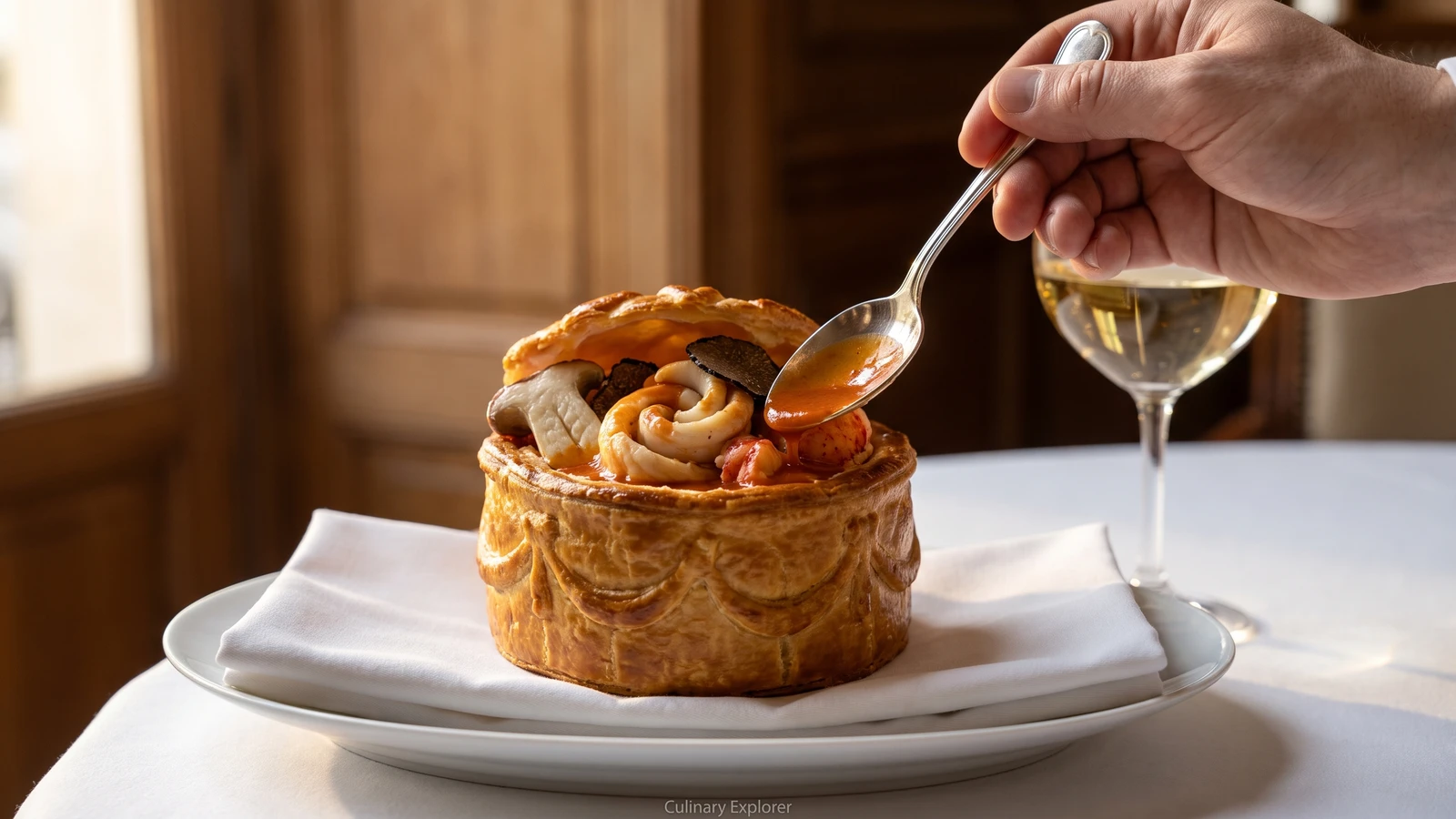
A crisp, ornamented pastry case holding scrolls of sole, lobster, white mushrooms, truffle, and Cardinal sauce: a celebration dish whose success depends on poaching the rolled fillets only when everything else is ready.
Timbale de Filets de Soles Cardinal (a pastry timbale of rolled sole with lobster-red Cardinal sauce) teaches orchestration. The paupiettes, rolled fillets, are poached only at the last minute, when the pastry is warm, the garnishes are ready, and the sauce needs nothing but its final butter. Poach them early and delicate sole waits itself into dryness while its liquid softens the crust. That is the one true thing to know before touching a pan.
The original kitchen assumed a pastry cook, a saucier on staff, fish stock never off the fire, several hands preparing ten portions, and a drying box for the crust. At home, the finished Timbale Crust (No. 2394) is made separately, a food processor replaces the mortar and fine sieve, one saucepan handles the lobster butter and sauce in sequence, and a low oven refreshes the shell. There is no salamander work because this timbale is filled, not gratinéed. Ten portions become five sole rolls for four. The extra hands and holding pans were scaffolding; the ornamented pastry, crayfish-scented farce, lobster, mushrooms, truffle, and butter-finished Cardinal sauce are the dish, so all of them stay.
When it is right, the pastry stands burnished around ivory spirals of sole, coral lobster, white mushrooms, and black truffle, with the sauce gleaming between them. It is grand food, certainly, but cooking well is not cooking fancy. One cook, one stove, one evening. Have every component ready, then poach the paupiettes and carry the timbale straight to the table.
Pastry timbales belong to the Parisian grand-kitchen repertoire, where free-standing crusts served as edible vessels for carefully sauced fish, poultry, and game before passing onto bourgeois celebration tables. Cardinal names the vivid red register given by lobster or crayfish butter, not a regional preparation, and its richness was traditionally paired with pale fish, mushrooms, and truffle for contrast. Beneath the ornament, the governing practice is practical: prepare the crust and garnishes ahead, then poach the delicate fish only when service begins.
Quantity
1 Timbale Crust (No. 2394), 7 inches (18 cm) wide and no more than 4 inches (10 cm) high
Quantity
5 fillets, 14 oz (400 g) total
trimmed to similar sizes
Quantity
3 1/2 oz (100 g)
chilled, pin-boned, and cubed
Quantity
1
Quantity
2/3 cup (160 ml / 160 g)
very cold and divided
Quantity
1 tbsp (15 ml / 14 g)
chilled
Quantity
1 medium tail, about 6 oz (170 g)
Quantity
1/2 cup (120 ml / 113 g)
divided
Quantity
2 1/2 cups (600 ml / 600 g)
divided
Quantity
1/2 cup (120 ml / 120 g)
divided
Quantity
1 small shallot, about 1 oz (30 g)
thinly sliced
Quantity
4 small button mushrooms and 1 large mushroom, about 5 oz (140 g) total
Quantity
1 tbsp (15 ml / 15 g)
Quantity
2 tbsp (30 ml / 16 g)
Quantity
1 small truffle, about 1/2 oz (15 g)
cut into at least 6 thin slices
Quantity
1 1/2 tsp (7.5 ml / 9 g)
divided
Quantity
1/2 tsp (2.5 ml / 1 g)
divided
Quantity
1/16 tsp (0.3 ml / 0.1 g)
| Ingredient | Quantity |
|---|---|
| baked and dried Timbale Crust | 1 Timbale Crust (No. 2394), 7 inches (18 cm) wide and no more than 4 inches (10 cm) high |
| skinless sole filletstrimmed to similar sizes | 5 fillets, 14 oz (400 g) total |
| whiting filletchilled, pin-boned, and cubed | 3 1/2 oz (100 g) |
| large egg white | 1 |
| heavy creamvery cold and divided | 2/3 cup (160 ml / 160 g) |
| prepared crayfish butterchilled | 1 tbsp (15 ml / 14 g) |
| shell-on lobster tail | 1 medium tail, about 6 oz (170 g) |
| unsalted butterdivided | 1/2 cup (120 ml / 113 g) |
| unsalted fish stockdivided | 2 1/2 cups (600 ml / 600 g) |
| dry white winedivided | 1/2 cup (120 ml / 120 g) |
| shallotthinly sliced | 1 small shallot, about 1 oz (30 g) |
| white mushrooms | 4 small button mushrooms and 1 large mushroom, about 5 oz (140 g) total |
| fresh lemon juice | 1 tbsp (15 ml / 15 g) |
| all-purpose flour | 2 tbsp (30 ml / 16 g) |
| black trufflecut into at least 6 thin slices | 1 small truffle, about 1/2 oz (15 g) |
| fine sea saltdivided | 1 1/2 tsp (7.5 ml / 9 g) |
| ground white pepperdivided | 1/2 tsp (2.5 ml / 1 g) |
| cayenne pepper | 1/16 tsp (0.3 ml / 0.1 g) |
Bring 1 1/2 cups (360 ml) of the fish stock, 1/4 cup (60 ml) of the wine, and the shallot to the barest simmer in a small saucepan. Add the lobster tail, cover partly, and poach gently for 5 to 7 minutes, turning once, until the shell is bright and the thickest part reaches 145°F (63°C). Lift it out immediately and strain the poaching liquor into a jug. Once the tail can be handled, remove the meat in one piece and cut it crosswise into 4 small medallions. Cover and keep cool.
Break the lobster shell into small pieces. Melt 6 tbsp (85 g) of the unsalted butter over medium-low heat, add the shell, and cook for about 8 minutes, pressing and turning the pieces until the butter becomes orange-red and smells deeply of lobster without browning. Add 2 tbsp (30 ml) of the reserved poaching liquor, cover, and take the pan off the heat for 10 minutes. Strain firmly through a fine sieve, chill until the fat sets, and lift the colored lobster butter from any liquid beneath it. Reserve 2 tbsp (28 g) for finishing the Cardinal sauce.
Chill the food-processor bowl and blade. Process the whiting with 1/2 tsp (3 g) salt and 1/4 tsp (0.5 g) white pepper until completely smooth. Add the egg white and pulse only until absorbed, then drizzle in 1/4 cup (60 ml) of the cold cream while pulsing. Add the crayfish butter and process briefly to a pale, smooth paste. This farce de merlan, whiting forcemeat, must remain cold enough to hold its emulsion. If it turns loose or greasy, stop. Ça se rattrape: chill the bowl for 10 minutes, then pulse in 1 tbsp of the measured cold cream. Poach a teaspoon in the lobster liquor, taste, and correct the seasoning.
Lay the sole fillets skinned side up between sheets of parchment and flatten them lightly with the smooth side of a mallet or a small pan until evenly thin, about 1/8 inch (3 mm). Spread each with an even layer of farce, leaving a narrow border. Roll each fillet into a compact scroll from the narrow end and set it seam-side down. If a fillet tears, overlap the edges and use a little farce as the binder. Cover the 5 paupiettes and refrigerate while the sauce and garnishes are completed.
Trim the mushrooms and use the point of a paring knife to cut shallow curved grooves from the centre of each cap to its edge. Melt 1 tbsp (14 g) of the plain butter in a small pan, add the mushrooms, lemon juice, 1/4 cup (60 ml) fish stock, and a pinch of salt. Cover with parchment and cook gently for 5 to 7 minutes, turning once, until tender but still white. Drain them well, adding their cooking liquor to the reserved lobster liquor. Keep the large mushroom separate for the central garnish.
Boil the combined lobster and mushroom liquors until reduced to 3/4 cup (180 ml). If the measure falls short, add enough of the remaining fish stock to reach it. In the cleaned saucepan, melt the final 1 tbsp (14 g) plain butter, stir in the flour, and cook for 2 minutes without letting the roux color. Whisk in the reduced liquor gradually, scraping into every corner, then add the remaining cream. Simmer gently for 8 to 10 minutes, whisking often, until the sauce has reduced to about 2/3 cup (160 ml) and coats a spoon in a smooth, ivory layer. Strain it and hold it warm, but do not add the lobster butter yet.
Heat the oven to 300°F (150°C). Set the Timbale Crust (No. 2394) on a baking sheet and warm it for 8 minutes, just long enough to refresh its crispness. If the base still feels soft, give it another 5 minutes and shield the decorated rim with foil if it is already deeply browned. Place the warm crust on a folded clean linen napkin set over its serving platter. Meanwhile, warm the lobster medallions and mushrooms gently in 2 tbsp (30 ml) of the remaining fish stock, then drain them well.
Only now combine the remaining fish stock and wine in a wide sauté pan and bring them to a bare simmer. Set in the paupiettes seam-side down, cover with a parchment lid, and poach for 5 to 7 minutes. The liquid must only tremble; if it begins bubbling hard, pull the pan off the heat for 30 seconds, lower the burner, and continue. The rolls are ready when the sole is opaque, the farce feels just firm, and the centre reaches 145°F (63°C). Lift them onto a clean towel and drain them thoroughly. Water left on the fish would dilute the Cardinal sauce and soften the pastry.
Return the sauce base to gentle heat. Take it off the burner and whisk in the 2 tbsp (28 g) lobster butter a little at a time, then add the cayenne and adjust the salt and white pepper. The sauce should be coral-red, glossy, and fluid enough to settle around the fish. Never boil it after mounting the butter. If it separates, ça se rattrape: place 1 tsp hot sole-poaching liquid in a clean warm bowl and whisk in the broken sauce a spoonful at a time until smooth. Arrange the well-drained paupiettes in a circle around the bottom of the timbale, place the lobster medallions and 4 small mushrooms in the centre, and cover them with the Cardinal sauce. Set the large grooved mushroom over the centre and encircle it with 6 truffle slices. Carry it to the table immediately. À table!
1 serving (about 390g)
Culinary guides, cultural storytelling, and the editorial depth that makes cooking meaningful.
Discover Culinary ExplorerChef Juliette
John Dory has the delicacy of sole and the firmness of turbot. A light flouring, a quick butter sauté, and nut-brown beurre noisette show exactly why looks never mattered.

Chef Juliette
Fresh haddock proves its delicacy in the meunière pan: a fine flour crust, moist pearly flakes, and beurre noisette sharpened with lemon and parsley, ready from one skillet in half an hour.

Chef Juliette
Éperlans à l’Anglaise turns small fish into a lesson in disciplined coating: boned smelts under a close, crisp crumb, pan-fried in clarified butter and finished with bright, half-melted maître d’hôtel butter.

Chef Juliette
Tiny smelts, shallot, mushrooms, white wine, gratin sauce, and fine bread raspings meet a fierce oven, where the fish must turn tender in the same breath the buttered crust bronzes.