Culinary Explorer

A cooking platform built around craft, culture, and the stories behind what we eat.
Discover Culinary Explorer
Filets de Soles Wilhelmine

Filets de Soles Wilhelmine

Created by Chef Juliette

Based on No. 905, Filets de Soles Wilhelmine, from Le Guide Culinaire (1907) by Auguste Escoffier

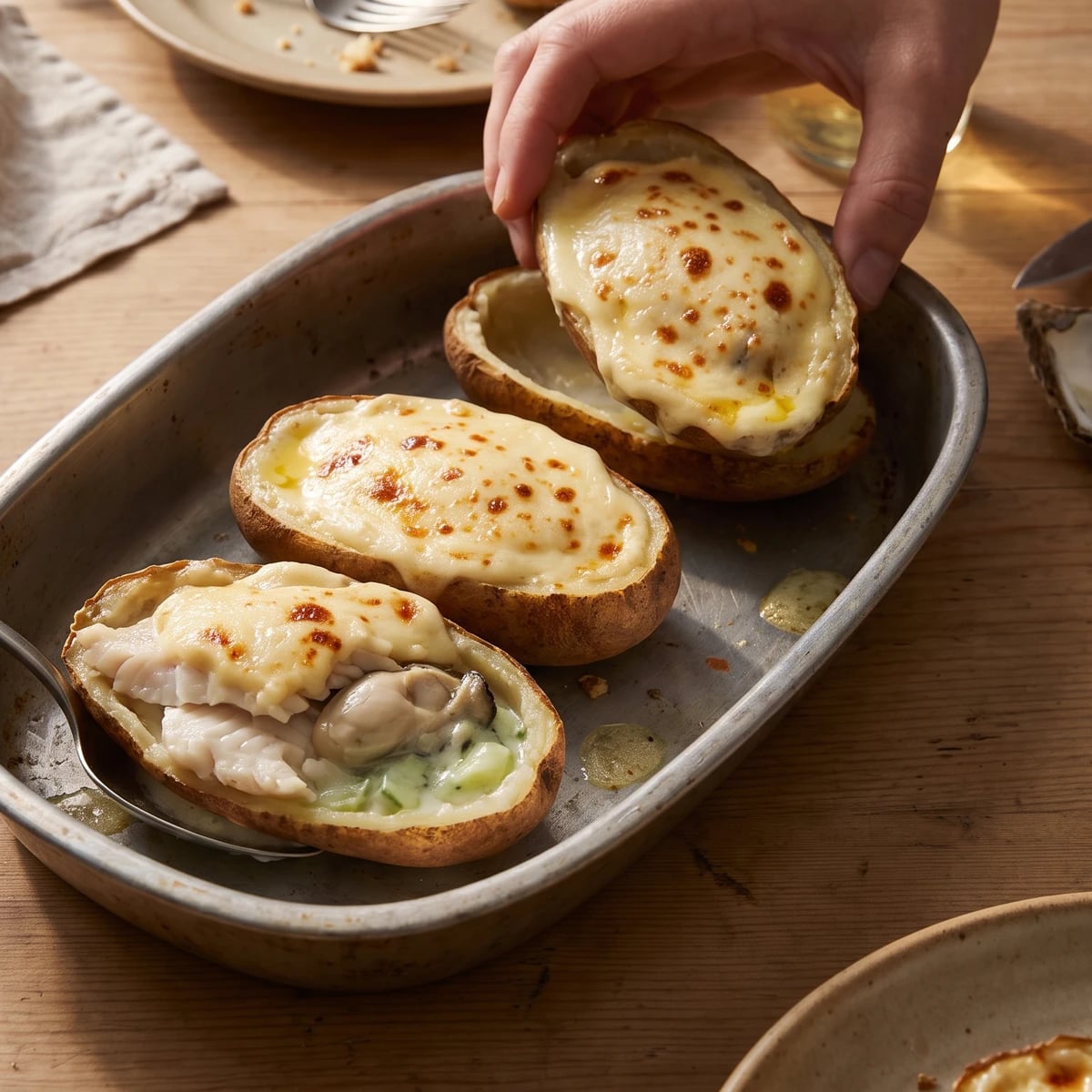
Filets de Soles Wilhelmine turns one potato shell into the whole composition: creamed cucumber below, tender sole and a briny oyster above, then ivory Mornay glazed fast to a bronzed, bubbling crown.

Main Dishes
French
Dinner Party
Special Occasion
35 min
Active Time
1 hr cook1 hr 35 min total
Yield4 servings

Filets de Soles Wilhelmine (sole fillets glazed in potato shells) teaches the discipline of assemblage: every component must arrive hot, dry, and ready before the final glaze. The one true thing to know before touching a pan is that the broiler does not cook this dish; it only bronzes a dish already cooked. Miss that, and either the sole waits itself dry or the sauce burns while the centre stays tepid.

The formula assumed potato shells arriving from one station, a saucier on staff, excellent fish fumet never off the fire, and a salamander fierce enough to glaze the top in moments. Your home equivalent is a small saucepan of Mornay, the cheese-enriched béchamel, a snug skillet for poaching, and a thoroughly heated broiler. The quantities are reduced to four generous shells, and the work is arranged in one compact sequence. One cook, one stove, one evening.

Station-by-station service and the napkin used to steady the shells were brigade scaffolding, so they go; shallow gratin dishes or little foil collars do the same job safely. The crisp potato vessel, creamed cucumber, poached sole, Zeeland oyster, Mornay, and fierce final glaze all stay, because that order is the dish. Have the sauce nappé, the sole barely poached, and the broiler fully hot before filling the shells. That quick glaze is the step that matters most.

Filets de Soles Wilhelmine belongs to the named sole garnishes of the Parisian grand-kitchen canon, while its Wilhelmine title and Zeeland oyster give the composition a deliberate Dutch salute. It is not a regional Zeeland fish dish: the hollow potato vessel, Mornay, and salamander glaze speak French classical service, a composed formula that traveled from formal dining rooms into the home repertoire.

The technique, the tradition, and the story behind every dish.

Discover Culinary Explorer

Ingredients

long baked potato shells

Quantity

4 shells from Filets de Soles Olga, otherwise “Otero” (No. 894)

prepared and kept warm

Dover sole fillets

Quantity

4 (about 4 oz / 115 g each)

skinned and trimmed

excellent fish fumet

Quantity

¾ cup (180 ml / 180 g)

unsalted butter

Quantity

1 teaspoon (5 ml / 5 g)

for the poaching pan

live Zeeland oysters

Quantity

4 medium

scrubbed and shucked just before assembly

small cucumber

Quantity

1 (about 4 oz / 110 g)

peeled, halved, seeded, and finely diced

fine sea salt

Quantity

¾ teaspoon (3.75 ml / 4.5 g)

divided

unsalted butter

Quantity

1 tablespoon (15 ml / 14 g)

for the cucumber

heavy cream

Quantity

2 tablespoons (30 ml / 30 g)

for the cucumber

unsalted butter

Quantity

2 tablespoons (30 ml / 28 g)

for the Mornay

all-purpose flour

Quantity

¼ cup (60 ml / 30 g)

whole milk

Quantity

1 cup (240 ml / 245 g)

heavy cream

Quantity

¼ cup (60 ml / 60 g)

for the Mornay

Gruyère

Quantity

½ cup (120 ml / 50 g)

finely grated

Parmesan

Quantity

2 tablespoons (30 ml / 12 g)

finely grated

ground white pepper

Quantity

⅛ teaspoon (0.6 ml / 0.3 g)

nutmeg

Quantity

1 small grating

Equipment Needed

  • Four small oval broiler-safe gratin dishes or folded foil rings
  • 10-inch (25 cm) lidded skillet
  • 1½-quart (1.4 L) saucepan and whisk
  • Rimmed baking sheet
  • Oyster knife and protective glove
  • Fine-mesh sieve

Instructions

  1. 1

    Ready the potato shells

    Have the four long baked potato shells from Filets de Soles Olga, otherwise “Otero” (No. 894) prepared and warm. If they have cooled, re-crisp them for 8 minutes in a 375°F (190°C) oven. Cradle each shell in a shallow oval gratin dish or a small ring of folded foil so it cannot roll during assembly.

  2. 2

    Cream the cucumber

    Toss the diced cucumber with ¼ teaspoon of the salt and leave it for 10 minutes, then blot it thoroughly. Melt 1 tablespoon butter over medium heat, add the cucumber, and cook for 3 minutes without browning. Add the 2 tablespoons cream and simmer gently until it clings to the dice and no loose liquid remains, about 2 minutes. You need four generous tablespoonfuls. If the cucumber is tender before the cream has thickened, lift it out, reduce the cream alone, then fold it back in.

  3. 3

    Build the Mornay

    Warm the milk with 3 tablespoons of the Mornay cream, keeping the final tablespoon cold. Melt 2 tablespoons butter in a small saucepan, stir in the flour, and cook this roux for 2 minutes without letting it colour. Whisk in the warm milk mixture gradually, then simmer for 4 to 5 minutes, whisking, until the sauce is nappé, thick enough to coat the back of a spoon. Remove it from the heat before stirring in the Gruyère, Parmesan, white pepper, nutmeg, and up to ¼ teaspoon salt. Never boil Mornay after the cheese enters. If it turns grainy or releases fat, take it off the heat and whisk in the reserved cold cream. Ça se rattrape. Pass it through a fine sieve only if a few rough curds remain, then keep it warm over barely hot water.

    The finished Mornay must flow slowly from a spoon. If it becomes too tight while waiting, loosen it with a spoonful of warm milk, not water.
  4. 4

    Poach the sole

    Butter a snug lidded skillet with the teaspoon of butter. Season the sole with the remaining salt, fold each fillet once with its skinned side inward, and arrange them in one layer. Pour in the fish fumet, cover, and bring it only to the barest tremble. Poach for 3 to 5 minutes, depending on thickness, until the flesh is opaque and reaches 145°F (63°C) at its thickest point. Lift the fillets out immediately and drain them well; wet fish would thin both the cucumber and the Mornay. Turn the broiler to high and set a rack about 6 inches (15 cm) below it.

  5. 5

    Assemble in sequence

    Spoon 1 tablespoon of creamed cucumber into the bottom of each hot potato shell. Set a drained sole fillet over it. Shuck the oysters now, checking each for a clean sea smell, and place one oyster on every fillet without adding its liquor. Spoon hot Mornay over each assembly until the shell is filled and the fish and oyster are completely covered. Work promptly, but don't crush the layers.

  6. 6

    Glaze under broiler

    Set the supported shells on a rimmed baking sheet and slide them under the fully heated broiler. Glaze for 1 to 3 minutes, watching without leaving the oven, until the Mornay bubbles at the rim and takes small bronze freckles across the top. This is glazing, not a second cooking. If one shell colours before the others, remove it individually rather than sacrificing the sole to symmetry.

  7. 7

    Serve at once

    Transfer each shell, still supported in its shallow dish, to a warm plate. Serve immediately while the potato remains crisp, the sole tender, and the Mornay fluid beneath its bronzed crown. Never make a glazed sole wait for the table. À table!

Chef Tips

  • Dover sole has the fine texture and broad fillet this preparation expects. If it is unavailable, use thick lemon sole or flounder fillets of equal size; the species changes, but the careful poach and composed shell remain honest.
  • Buy live Zeeland oysters from a reputable fishmonger and keep them deeply chilled until the last moment. The classical quick glaze leaves them delicately cooked. For diners at increased risk from undercooked shellfish, simmer the shucked oysters in fumet for 3 minutes before assembly; they will be firmer, but properly cooked.
  • Use a broiler-safe support for every potato shell. Small oval gratin dishes are ideal, while tightly folded foil rings work perfectly well and disappear beneath the shell.
  • Pour a mineral dry white wine with enough acidity for the oyster and Mornay. Chablis or a restrained Champagne will carry the dish without bullying the sole.

Advance Preparation

  • The potato shells from Filets de Soles Olga, otherwise “Otero” (No. 894) can be prepared up to 6 hours ahead. Cool them uncovered so they stay dry, then re-crisp them before assembly.
  • The creamed cucumber can be prepared up to 4 hours ahead and rewarmed gently. The Mornay can wait for 1 hour with buttered parchment pressed against its surface; reheat it over barely hot water and loosen it with warm milk if necessary.
  • Do not poach the sole, shuck the oysters, or fill the shells ahead. Once assembled, the dish must go directly beneath the broiler and then directly to the table.

Frequently Asked Questions

Nutrition Information

1 serving (about 320g)

Calories
455 calories
Total Fat
26 g
Saturated Fat
16 g
Trans Fat
1 g
Unsaturated Fat
10 g
Cholesterol
135 mg
Sodium
800 mg
Total Carbohydrates
22 g
Dietary Fiber
1 g
Sugars
5 g
Protein
33 g

Note: Chef personas and recipes are created with AI assistance. Cook with care: follow safe food-handling practices, check doneness with a thermometer when needed, and adapt for allergies and your kitchen.

Where cooking meets culture.

Culinary guides, cultural storytelling, and the editorial depth that makes cooking meaningful.

Discover Culinary Explorer

More from Fish - Fillets of Sole

Browse the full collection