
Chef Juliette
Filets de Soles Américaine
Folded sole, barely poached in fumet, circles lobster beneath a gleaming brandy-and-tomato shellfish sauce. The sauce is the whole dish, and gentle heat is the lesson.
A cooking platform built around craft, culture, and the stories behind what we eat.
Created by Chef Juliette
Based on No. 894, Filets de Soles Olga, otherwise “Otero”, from Le Guide Culinaire (1907) by Auguste Escoffier
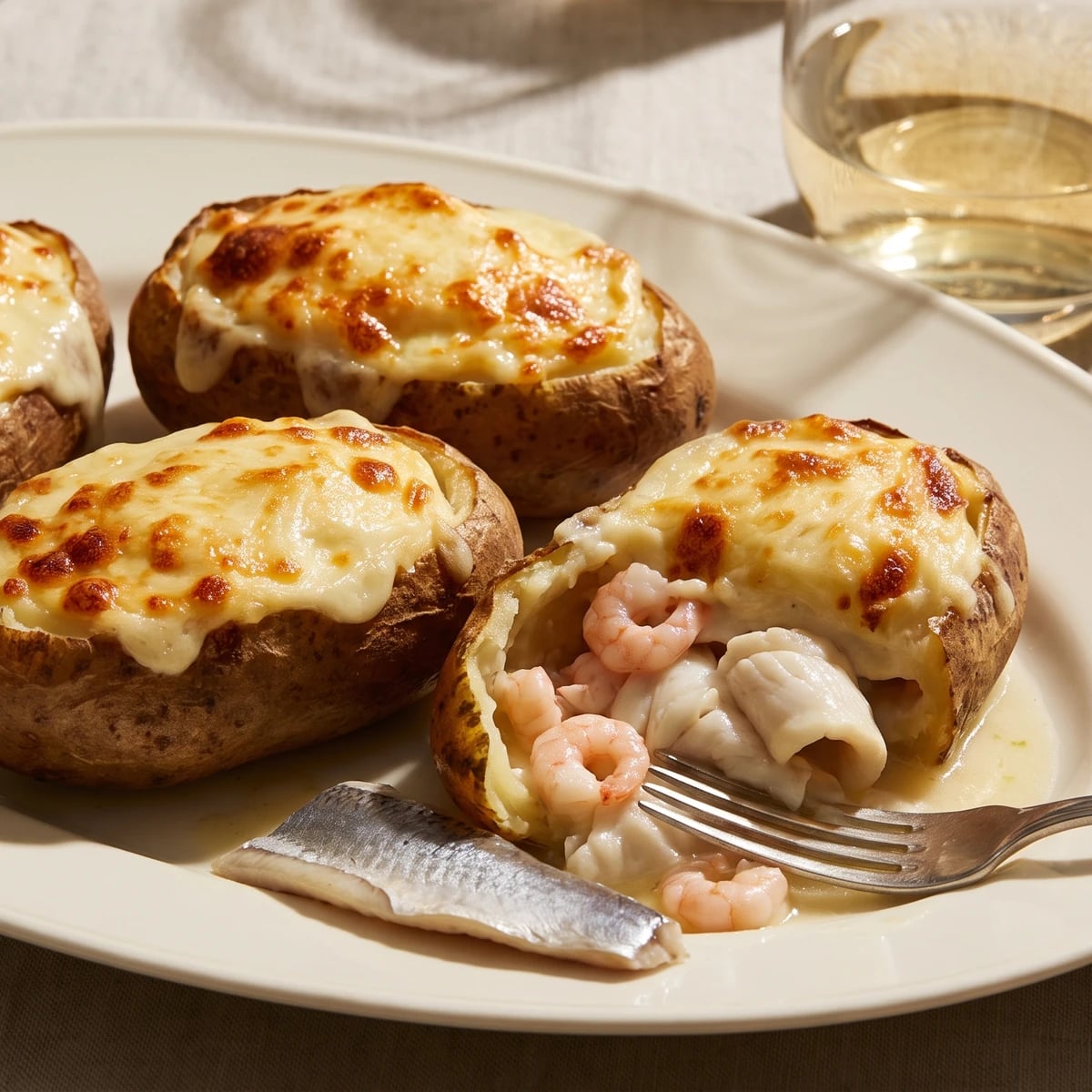
Parched baked potato shells cradle shrimp bound in white-wine sauce, folded sole, and Mornay, then meet the broiler just long enough for a bronzed, bubbling crown.
Filets de Soles Olga, otherwise Otero (sole fillets glazed in parched potato shells), teaches the architecture of a composed fish dish: a dry edible case, a moist shrimp garnish, gently poached fish, Mornay, and a quick glaze. The one true thing to know before touching a pan is this: the potato shell must remain dry and sound. If it softens or tears, all those beautiful layers lose their shape.
The original recipe assumed a saucier with white-wine sauce and Mornay already warm, excellent fumet never far from the fire, and a salamander waiting to glaze each order. At home, one small Mornay serves all four portions, the strained poaching fumet becomes the foundation of the white-wine sauce, and the broiler supplies the fierce top heat. The cloth napkin under the finished potatoes was service scaffolding, so it gives way to a warm platter. The parched shell, tablespoon of shrimp, folded fillet, complete covering of sauce, and rapid glaze stay exactly where they belong. Those steps are the dish.
When it lands correctly, each brown potato shell carries an ivory sauce with a bronzed, bubbling crown, and the first forkful finds tender sole over pink shrimp underneath. One cook, one stove, one evening. Hollow the potatoes while they're hot, leave an even wall, and dry the shells before filling them. That is the step that decides everything.
Filets de Soles Olga, also catalogued as Otero, belongs to Parisian grand cuisine, where poached sole fillets were matched with named garnitures and composed for formal service rather than tied to a regional larder. Its surprise is the vessel: an emptied baked potato, not pastry or porcelain, carries shrimp, white-wine sauce, sole, and Mornay beneath a quick glaze. The title shifted between Olga and Otero as the dish traveled from grand dining rooms into household manuals, but its layered construction remained its reliable identity.
Quantity
4 (about 2 pounds 4 ounces / 1 kg total)
scrubbed well
Quantity
4 (about 3½ ounces / 100 g each)
Quantity
¼ cup (60 ml / 55 g)
well drained
Quantity
3 tablespoons (45 ml / 43 g)
divided
Quantity
2 tablespoons plus 2 teaspoons (40 ml / 21 g)
divided
Quantity
¾ cup (180 ml / 184 g)
Quantity
½ cup (120 ml / 119 g)
divided
Quantity
1 cup (240 ml / 240 g)
Quantity
⅓ cup (80 ml / 80 g)
Quantity
¾ cup (180 ml / 75 g)
finely grated and divided
Quantity
2 tablespoons (30 ml / 10 g)
finely grated
Quantity
1 teaspoon (5 ml / 6 g)
divided
Quantity
¼ teaspoon (1.25 ml / 0.5 g)
| Ingredient | Quantity |
|---|---|
| medium-long russet potatoesscrubbed well | 4 (about 2 pounds 4 ounces / 1 kg total) |
| skinless sole fillets | 4 (about 3½ ounces / 100 g each) |
| cooked tiny peeled shrimp tailswell drained | ¼ cup (60 ml / 55 g) |
| unsalted butterdivided | 3 tablespoons (45 ml / 43 g) |
| all-purpose flourdivided | 2 tablespoons plus 2 teaspoons (40 ml / 21 g) |
| whole milk | ¾ cup (180 ml / 184 g) |
| heavy creamdivided | ½ cup (120 ml / 119 g) |
| excellent fish fumet | 1 cup (240 ml / 240 g) |
| dry white wine | ⅓ cup (80 ml / 80 g) |
| Gruyèrefinely grated and divided | ¾ cup (180 ml / 75 g) |
| Parmesanfinely grated | 2 tablespoons (30 ml / 10 g) |
| fine sea saltdivided | 1 teaspoon (5 ml / 6 g) |
| ground white pepper | ¼ teaspoon (1.25 ml / 0.5 g) |
Heat the oven to 425°F (220°C). Prick the potatoes in several places and bake them directly on a rimmed sheet for 50 to 60 minutes, until a skewer enters without resistance but the skins remain firm. Cut a long strip, about 1 inch (2.5 cm) wide, from the top of each potato. While they're still hot, scoop out the pulp carefully, leaving an even ¼-inch (6 mm) wall and an intact shell. Season the interiors lightly, then return them cut-side up to the oven for 6 to 8 minutes, until the inner surface looks dry and faintly chalky. Save the pulp for another meal; it does not return to this dish.
While the potatoes bake, melt 2 tablespoons (30 ml / 28 g) of the butter in a small heavy saucepan. Stir in 2 tablespoons (30 ml / 16 g) of the flour and cook this pale roux for 2 minutes without letting it color. Whisk in the milk gradually, followed by ¼ cup (60 ml / 60 g) of the cream. Simmer gently for 5 to 7 minutes, whisking, until the sauce is smooth and coats the back of a spoon. Remove it from the heat and stir in ½ cup (120 ml / 50 g) of the Gruyère and all the Parmesan. Season lightly with salt and white pepper, then cover the surface directly and keep warm. If the Mornay turns oily after the cheese goes in, take it off the heat and whisk in 1 tablespoon (15 ml / 15 g) of the reserved cold cream. Ça se rattrape.
Lower the oven to 350°F (180°C). Use 1 teaspoon (5 ml / 5 g) of the remaining butter to coat a shallow baking dish. Fold each sole fillet into a compact packet by bringing the thin tail inward and folding the thicker end over it, then arrange the packets in one layer. Season with salt and white pepper. Pour ¾ cup (180 ml / 180 g) of the fumet around the fish, reserving the rest, and cover closely with parchment or foil. Poach in the oven for 7 to 10 minutes, until the edges are opaque but the centers remain faintly pearly, about 135°F (57°C). The sole will finish beneath the glaze. Lift the fillets carefully to a warm plate and strain the poaching liquid into a clean saucepan.
Add the white wine to the strained poaching liquid and boil briskly until reduced to about ⅓ cup (80 ml). Make a beurre manié, flour kneaded with butter, from the remaining 2 teaspoons (10 ml / 10 g) butter and 2 teaspoons (10 ml / 5 g) flour. Whisk the beurre manié into the reduction a little at a time, then simmer for 2 minutes to cook out the flour. Add the remaining cream and simmer gently until the white-wine sauce lightly naps the spoon. If it's too thick, loosen it with reserved fumet; if it's thin, reduce it before adding the shrimp. Fold in the shrimp just long enough to warm them. They should be cohered by sauce, not swimming in it.
Set the dried potato shells on a broiler-safe rimmed sheet. Divide the shrimp evenly among them, placing one tablespoonful in the bottom of each shell with just enough white-wine sauce to bind it. Set one folded sole fillet over each shrimp layer. If the Mornay has tightened while standing, whisk in a spoonful of warm fumet or milk, then cover every fillet completely and fill each shell neatly to its rim. Sprinkle with the remaining ¼ cup (60 ml / 25 g) Gruyère.
Heat the broiler to high and place the sheet about 6 inches (15 cm) below it. Glaze the filled shells for 2 to 4 minutes, watching without distraction, until the Mornay bubbles at the edges and the cheese takes an even bronze. Everything underneath is already cooked, so color is the only purpose. If the top darkens before the sauce bubbles, lower the sheet by one rack and let the gentler heat finish the center. Confirm that the sole reaches 145°F (63°C), then transfer the shells to a warm platter and serve immediately. A cloth napkin beneath them belongs to brigade service; the warm platter keeps dinner simpler and the shells crisper. À table!
1 serving (about 425g)
Culinary guides, cultural storytelling, and the editorial depth that makes cooking meaningful.
Discover Culinary Explorer
Chef Juliette
Folded sole, barely poached in fumet, circles lobster beneath a gleaming brandy-and-tomato shellfish sauce. The sauce is the whole dish, and gentle heat is the lesson.

Chef Juliette
A fine à l'anglaise crust, set the instant it touches hot clarified butter, protects tender sole before maître-d'hôtel butter melts across the ridges. The lesson is heat first, gentle frying second.

Chef Juliette
Pepper-filled sole paupiettes rise over butter-stewed tomatoes, capsicum risotto, and crisp aubergine, all glossed with lightly browned butter. The lesson is control: keep every element distinct and never let the poach boil.

Chef Juliette
Filets de Soles Caprice turns restraint into surprise: fine-crumbed sole grilled light gold, buttered banana laid over each fillet, and mustard-bright Sauce Robert sent separately so every bite balances sweet, savory, and sharp.